
The Order of the Resurrections
1. Introduction: Why the Order of the Resurrections Matters
Biblical eschatology teaches not one “general resurrection,” but a series of resurrections unfolding in an ordered, prophetic timetable. Understanding the order of the resurrections—Christ’s own resurrection, the “first resurrection” of the righteous, and the final resurrection of the wicked at the Great White Throne—clarifies the sequence of end-time events and the eternal destinies of believers and unbelievers.
Scripture summarizes this ordered program in two key passages:
“But each in his own order: Christ the firstfruits, then at his coming those who belong to Christ. Then comes the end, when he delivers the kingdom to God the Father…”
— 1 Corinthians 15:23–24
“They came to life and reigned with Christ for a thousand years. The rest of the dead did not come to life until the thousand years were ended. This is the first resurrection.”
— Revelation 20:4–5
From these texts, we can trace a three-stage structure:
- Christ’s resurrection (the “firstfruits”)
- The first resurrection (all the righteous in stages, beginning with the rapture)
- The second resurrection (all the wicked at the Great White Throne)
The following sections focus exclusively on this sequence and timing.
2. Christ’s Resurrection: The Firstfruits and Pattern
2.1 Christ as “Firstfruits” and “Firstborn”
The resurrection program begins with Christ Himself.
“But in fact Christ has been raised from the dead, the firstfruits of those who have fallen asleep.”
— 1 Corinthians 15:20
In the Old Testament, firstfruits were the first portion of the harvest offered to God (Lev 23:9–14). They were:
- First in time (the earliest part of the harvest)
- A pledge and pattern of the full harvest yet to come
Applied to Jesus:
- He is the first person ever raised with a glorified, deathless body (cf. Rom 6:9).
- His resurrection is the guarantee that all who are in Him will likewise be raised.
Scripture also calls Him “the firstborn from the dead” (Colossians 1:18; Revelation 1:5), stressing:
- Priority in rank and authority over death
- His role as the head of the resurrection order
2.2 A Token Resurrection with Him
At Christ’s resurrection, Matthew records a token resurrection of some Old Testament saints:
“The tombs also were opened. And many bodies of the saints who had fallen asleep were raised, and coming out of the tombs after his resurrection they went into the holy city and appeared to many.”
— Matthew 27:52–53
These saints:
- Confirm that resurrection is not purely spiritual but bodily
- Function as an early “sheaf” of the resurrection harvest connected with Christ the Firstfruits
Yet Christ’s own resurrection remains the foundational, defining beginning of the entire resurrection order.
3. The First Resurrection: Resurrection of Life
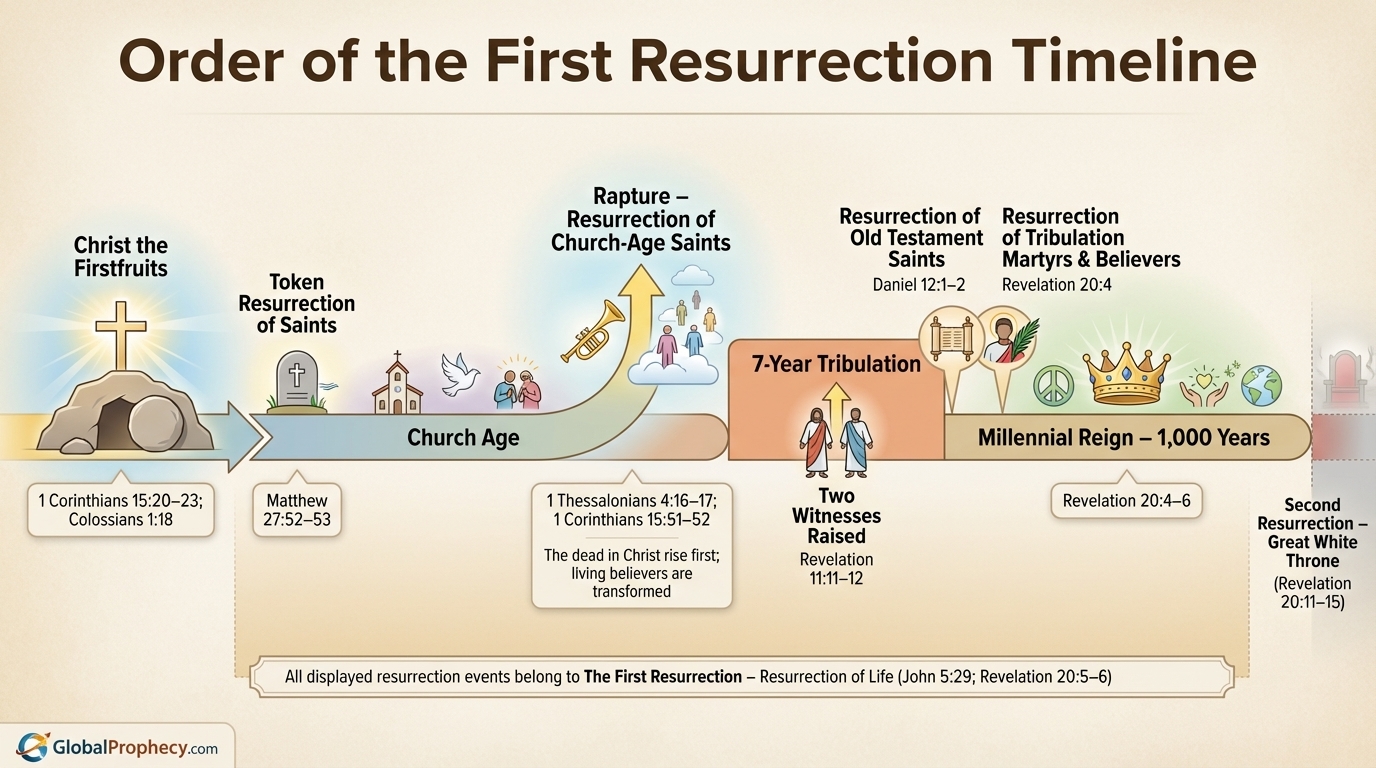
Jesus spoke of two distinct outcomes:
“…those who have done good to the resurrection of life, and those who have done evil to the resurrection of judgment.”
— John 5:29
Revelation 20 calls the resurrection of the righteous “the first resurrection” (Rev 20:5–6). This is not one momentary event, but a category of resurrections that unfolds in stages. All within this “first resurrection” are saved; none face condemnation.
From 1 Corinthians 15:23 and Revelation 20:4–6, the first resurrection embraces all believers of all ages, but not all at once. The key phrase is:
“But each in his own order (tagma). Christ the firstfruits, then at his coming those who belong to Christ. Then comes the end…”
— 1 Corinthians 15:23–24
The term order denotes a rank or division, like units in a military parade, marching in sequence. The New Testament reveals several identifiable phases.
3.1 Phase 1: Church-Age Saints at the Rapture
The first major phase of the first resurrection after Christ is the resurrection of church-age believers at the rapture.
“For the Lord himself will descend from heaven with a cry of command… And the dead in Christ will rise first. Then we who are alive, who are left, will be caught up together with them… to meet the Lord in the air…”
— 1 Thessalonians 4:16–17
“We shall not all sleep, but we shall all be changed, in a moment, in the twinkling of an eye… For the trumpet will sound, and the dead will be raised imperishable, and we shall be changed.”
— 1 Corinthians 15:51–52
Key points:
- The “dead in Christ” (church-age believers who have died) are raised first.
- Living believers are instantly transformed (translated), not resurrected from death.
- Both groups receive glorified, imperishable bodies.
- This event occurs before the outpouring of wrath known as the Tribulation (in a pretribulational framework).
This rapture-resurrection event begins the “those who are Christ’s at his coming” segment (1 Cor 15:23).
3.2 Further Phases: Old Testament and Tribulation Saints
The first resurrection also includes believers from other ages, raised in connection with Christ’s second coming to earth and the establishment of His millennial kingdom:
-
Old Testament saints
- Anticipated in Daniel 12:2:
“Many of those who sleep in the dust of the earth shall awake, some to everlasting life…”
- Linked to Israel’s deliverance after a “time of trouble” (Dan 12:1), corresponding to the end of the Tribulation.
- These saints are raised to share everlasting life in the Messianic kingdom.
- Anticipated in Daniel 12:2:
-
Tribulation martyrs and other Tribulation believers
- Described in Revelation 20:4:
“…the souls of those who had been beheaded for the testimony of Jesus and for the word of God… They came to life and reigned with Christ for a thousand years.”
- Their resurrection occurs after Christ’s return (cf. Rev 19:11–21), but before the millennium.
- They are explicitly said to reign with Christ for a thousand years, which requires a bodily resurrection prior to the millennium.
- Described in Revelation 20:4:
-
Two witnesses (a special case within the same righteous category)
- In the middle of the Tribulation, two prophetic witnesses are killed and then raised:
“But after the three and a half days a breath of life from God entered them, and they stood up on their feet… And they went up to heaven in a cloud…”
— Revelation 11:11–12 - Their resurrection is a sign-miracle within the first resurrection category.
- In the middle of the Tribulation, two prophetic witnesses are killed and then raised:
Putting this together, the “first resurrection” includes:
- Christ (the Firstfruits)
- Church saints at the rapture
- Old Testament saints resurrected after Israel’s “time of trouble”
- Tribulation martyrs (and all saints of that period)
- Special sign-resurrections (two witnesses, token saints in Matt 27:52–53)
John’s summary:
“This is the first resurrection. Blessed and holy is the one who shares in the first resurrection! Over such the second death has no power…”
— Revelation 20:5–6
All who participate in this first resurrection share:
- Eternal life
- Security from the second death
- A place in Christ’s millennial reign and the eternal kingdom
4. The Second Resurrection: The Great White Throne
In contrast to the first resurrection, Scripture presents a distinct, final resurrection of the unsaved dead—the second resurrection, associated with the Great White Throne judgment.
4.1 Separated by a Thousand Years
Revelation 20 draws a sharp chronological and qualitative line:
“They came to life and reigned with Christ for a thousand years.
The rest of the dead did not come to life until the thousand years were ended.”
— Revelation 20:4–5
- “They came to life” – the resurrected righteous (first resurrection) share Christ’s millennial reign.
- “The rest of the dead” – a different group, left in their graves until after the thousand years.
This group consists of all the unredeemed of all ages.
Thus, there is at least a 1,000-year gap between:
- The resurrection of the righteous (completed before and at the start of the millennium)
- The resurrection of the wicked (after the millennium)
4.2 The Scene of the Great White Throne
After the millennial kingdom and the final rebellion, John writes:
“Then I saw a great white throne and him who was seated on it… And I saw the dead, great and small, standing before the throne, and books were opened. Then another book was opened, which is the book of life… And the sea gave up the dead who were in it, Death and Hades gave up the dead who were in them, and they were judged… Then Death and Hades were thrown into the lake of fire. This is the second death… And if anyone’s name was not found written in the book of life, he was thrown into the lake of fire.”
— Revelation 20:11–15
Key features of the second resurrection:
- Subjects: “the dead, great and small” – all unbelievers of all eras.
- Time: after the thousand years are ended (Rev 20:7, 11–15).
- Nature:
- They are resurrected bodily (“the sea gave up the dead,” “Death and Hades gave up the dead”).
- They stand before Christ as Judge.
- Basis of judgment:
- Their names are not in the Book of Life.
- They are judged “by what they had done” according to the books.
- Outcome:
- All are cast into the lake of fire.
- This is called “the second death” (Rev 20:14), the eternal, conscious punishment of the lost.
This second resurrection is what Jesus called:
“…those who have done evil to the resurrection of judgment.”
— John 5:29
It completes the resurrection program and ushers in the eternal state (new heaven and new earth; Revelation 21–22).
5. Comparing the First and Second Resurrections
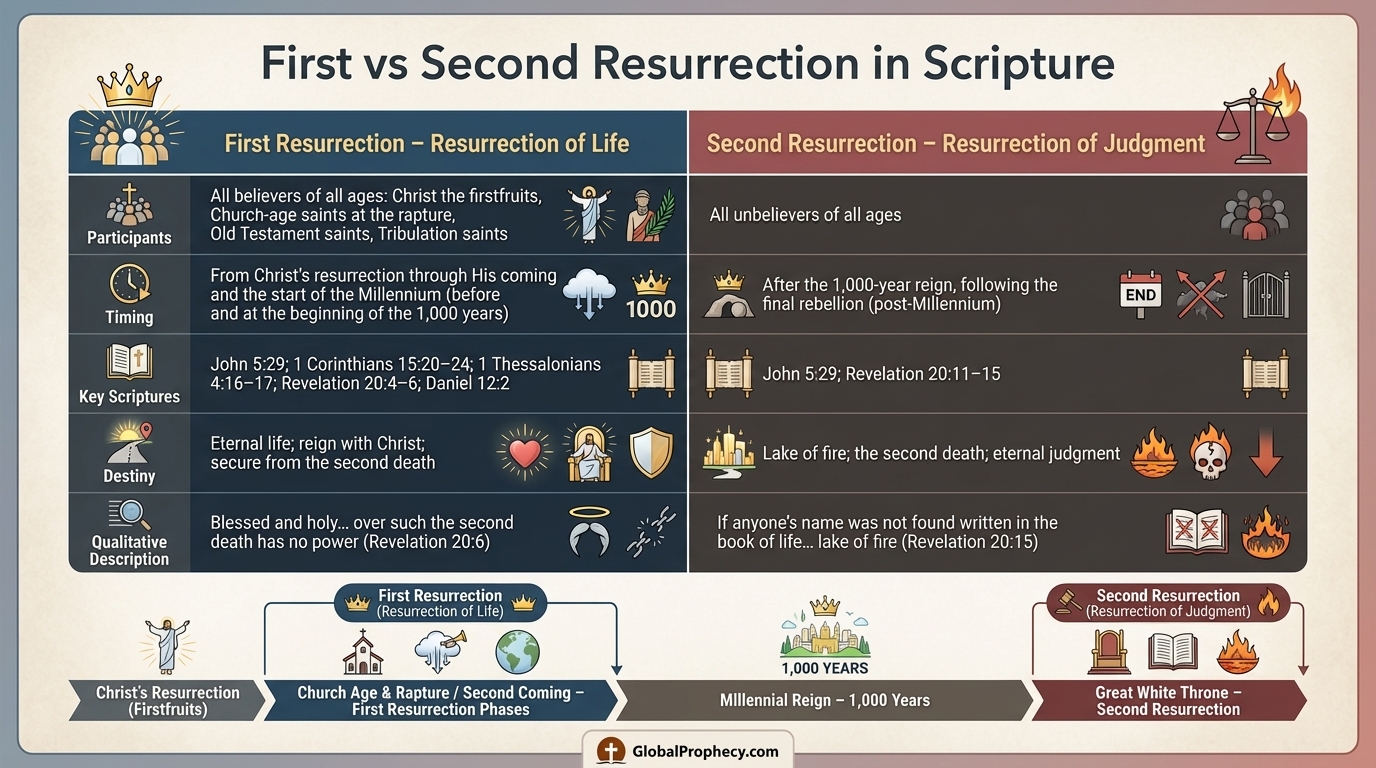
For clarity, the basic contrasts can be summarized:
| Aspect | First Resurrection | Second Resurrection |
|---|---|---|
| Primary label | Resurrection of life (John 5:29) | Resurrection of judgment (John 5:29) |
| Participants | All believers (various ages & phases) | All unbelievers of all ages |
| Core passages | 1 Cor 15:20–24; 1 Thess 4:16–17; Rev 20:4–6; Dan 12:2 | Rev 20:11–15; John 5:29 |
| Timing | From Christ’s resurrection through Second Coming and start of Millennium | After the 1,000-year reign (post-Millennium) |
| Destiny | Eternal life; reign with Christ; no second death | Lake of fire; the second death |
| Qualitative description | “Blessed and holy… Over such the second death has no power” (Rev 20:6) | “If anyone’s name was not found… he was thrown into the lake of fire” (Rev 20:15) |
6. Conclusion: The Order of the Resurrections and Personal Destiny
Scripture presents a structured, sequential resurrection program:
- Christ’s resurrection – the firstfruits, both the guarantee and the pattern of all future resurrections.
- The first resurrection – the resurrection of life, encompassing:
- Church saints at the rapture
- Old Testament and Tribulation saints at and around the Second Coming
- Special sign-resurrections within that same righteous category
- The second resurrection – the resurrection of judgment at the Great White Throne, when all remaining unbelievers are raised, judged, and cast into the lake of fire.
This ordered sequence shows that every person will be raised, but not all to the same destiny. The decisive issue is whether one belongs to Christ:
“For as in Adam all die, so also in Christ shall all be made alive. But each in his own order…”
— 1 Corinthians 15:22–23
To share in the first resurrection—the resurrection of life—is to be forever safe from the second death and to reign with Christ. To remain outside of Christ is to face the second resurrection and the Great White Throne.
The doctrine of the resurrections is not abstract speculation; it is a personal, urgent reality. Our present response to the risen Christ determines our place in God’s ordered resurrection program and our eternal future.
FAQ
Q: What is meant by “the first resurrection” in Revelation 20?
“The first resurrection” in Revelation 20:5–6 is a qualitative term describing the resurrection of the righteous. It includes all believers of all ages in several stages—Christ the firstfruits, church saints at the rapture, Old Testament saints, and Tribulation saints—raised before the millennium and never subject to the second death.
Q: Does the Bible teach a single general resurrection for everyone at the same time?
No. Passages like 1 Corinthians 15:23–24 and Revelation 20:4–6, 11–15 show distinct phases: Christ’s resurrection, then those who are Christ’s at His coming, then “the rest of the dead” after the thousand years. There is a resurrection of life for believers and, separated by time, a resurrection of judgment for unbelievers.
Q: When does the resurrection at the rapture occur in the order of resurrections?
The resurrection at the rapture is the first major phase of the first resurrection after Christ’s own rising. At that moment, “the dead in Christ will rise first,” and living believers will be instantly transformed (1 Thessalonians 4:16–17; 1 Corinthians 15:51–52), before the Tribulation and long before the final resurrection of the wicked.
Q: Who is raised at the Great White Throne?
At the Great White Throne (Revelation 20:11–15), all unbelievers of all ages are resurrected. This is the second resurrection, where the dead are judged according to their works, shown not to be in the Book of Life, and cast into the lake of fire, which is the second death.
Q: How does Christ’s resurrection relate to our own future resurrection?
Christ’s resurrection is both the firstfruits and the pattern of ours (1 Corinthians 15:20–23). Because He rose with a glorified, immortal body, all who are “in Christ” will likewise be raised in due order with bodies conformed to His glorious body (Philippians 3:21; 1 John 3:2).
Frequently Asked Questions
What is meant by “the first resurrection” in Revelation 20?
Does the Bible teach a single general resurrection for everyone at the same time?
When does the resurrection at the rapture occur in the order of resurrections?
Who is raised at the Great White Throne?
How does Christ’s resurrection relate to our own future resurrection?
L. A. C.
Theologian specializing in eschatology, committed to helping believers understand God's prophetic Word.
Related Articles
Amillennialism Examined: Is the Church the Millennial Kingdom?
Amillennialism examined: is the church the millennial kingdom? Explore its claims, symbols, and a biblical critique of this end-times view.
The Nature of the Believer's Resurrection Body
Resurrection body of believers explained: explore 1 Corinthians 15 on the glorified, imperishable, Christlike nature of the believer’s future body.
Jewish Wedding Customs and Biblical Prophecy
Jewish wedding customs and biblical prophecy reveal how the betrothal, bridal chamber, and wedding feast picture the rapture and marriage of the Lamb.
What are the Marriage of the Lamb?
Marriage of the Lamb reveals Christ’s union with His church in Revelation 19. Explore its meaning, timing, and eternal significance in God’s plan.