
The Partial Rapture View Examined
1. Introduction
Within evangelical eschatology the partial rapture view holds that only some Christians will be caught up at Christ’s coming—specifically, those who are faithful, spiritually prepared, and “watching.” Carnal or unprepared believers, it is argued, will be left behind to endure some or all of the Tribulation as a severe discipline, and may be raptured only later.
This teaching raises serious questions about salvation, assurance, and the nature of Christ’s church. Does Scripture teach that the Rapture is a reward for the worthy, or a facet of God’s saving grace given to all who are “in Christ”? This article fairly summarizes the partial rapture view and then examines it biblically, arguing that all believers will be raptured, not just a select spiritual elite.
2. What the Partial Rapture View Teaches
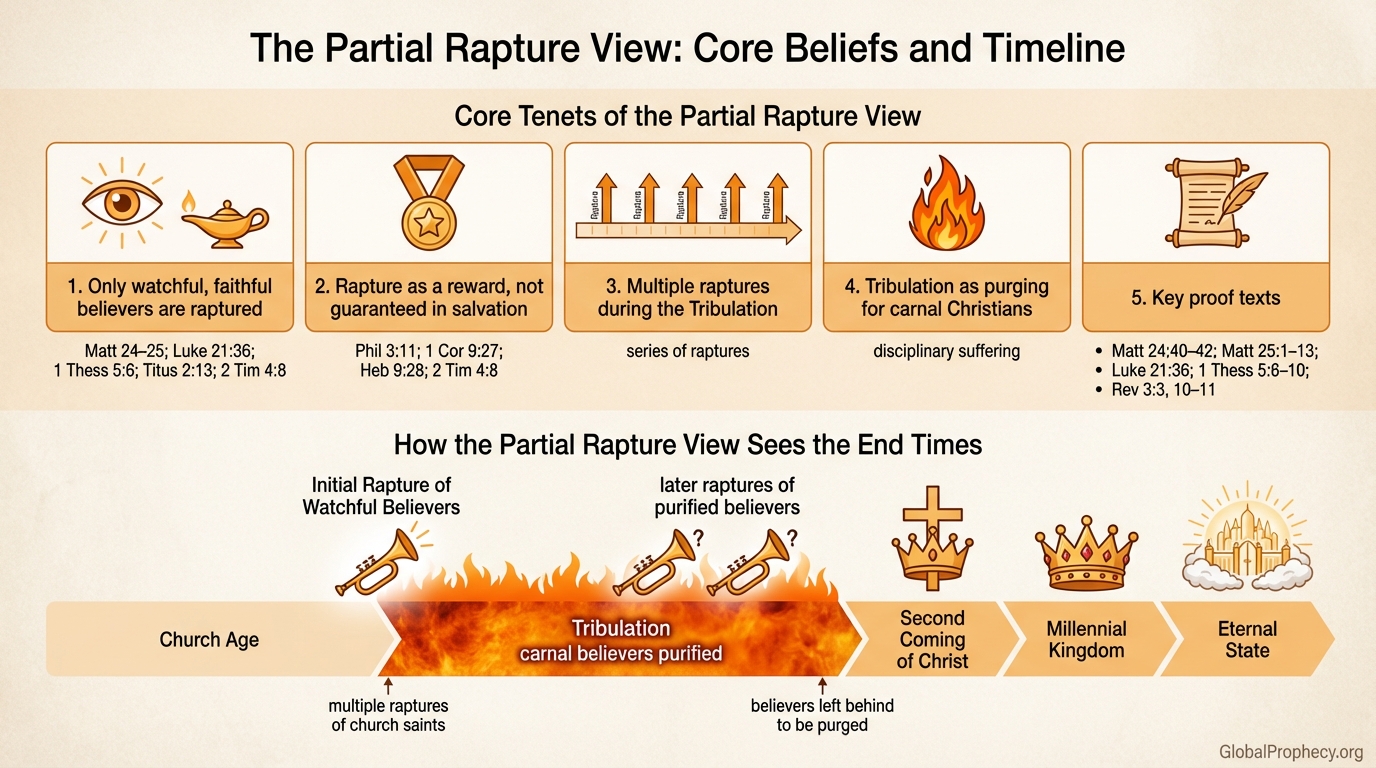
Though there are variations, the core tenets of the partial rapture view are:
-
Only watchful, faithful believers are raptured.
Passages that exhort believers to watch and be ready are taken as conditions for participation in the Rapture (e.g., Matt 24–25; Luke 21:36; 1 Thess 5:6; Titus 2:13; 2 Tim 4:8). -
The Rapture is a reward, not a guaranteed part of salvation.
The Rapture is seen as a prize reserved for “overcomers” who love Christ’s appearing and live in holiness (e.g., Phil 3:11; 1 Cor 9:27; Heb 9:28; 2 Tim 4:8). -
Multiple raptures during the Tribulation.
The church is divided: the prepared are taken first; other believers are raptured later as they become ready, or at the end of the Tribulation. Some formulations effectively posit a series of raptures. -
Tribulation as purging for carnal Christians.
Those left behind are true believers, but they must “go through the fire” of the Tribulation to be purified of worldliness and sin. -
Key proof texts.
Commonly cited passages include:- Matthew 24:40–42 (“one will be taken and one left”)
- Matthew 25:1–13 (the parable of the ten virgins)
- Luke 21:36 (“pray that you may have strength to escape all these things”)
- 1 Corinthians 9:27; Philippians 3:11; Hebrews 9:28
- 1 Thessalonians 5:6–10; Titus 2:13; 2 Timothy 4:8
- Revelation 3:3, 10–11
The view is often motivated by a sincere desire to promote holiness and watchfulness. But good intentions cannot compensate for weak exegesis or theological inconsistency. We must ask: Do these texts actually teach what the partial rapture view claims?
3. Examining the Key Proof Texts
3.1 Matthew 24:40–42 — “One will be taken and one left”
Partial rapturists commonly equate Matthew 24:40–41 with the Rapture:
“Then two men will be in the field; one will be taken and one left. Two women will be grinding at the mill; one will be taken and one left.”
— Matthew 24:40–41
They argue that the “taken” are watchful believers raptured; the “left” are unprepared Christians or unbelievers. But the immediate context points to judgment, not deliverance:
-
Jesus compares His coming to the days of Noah (Matt 24:37–39). In Noah’s day, the ones “taken” were those swept away in judgment; the ones “left” were Noah and his family, who entered a new world.
-
Luke 17:34–37, a parallel passage, makes this explicit. When the disciples ask, “Where, Lord?” concerning those “taken,” He replies:
“Where the corpse is, there the vultures will gather.”
— Luke 17:37Those “taken” are taken to judgment, not to heaven.
Thus Matthew 24:40–41 describes a separation at Jesus’ post-tribulational return: unbelievers “taken” in judgment, believing survivors “left” to enter the kingdom. It does not distinguish spiritual and carnal Christians at a pretribulational Rapture.
3.2 Matthew 25:1–13 — The Ten Virgins
The parable of the ten virgins is central to the partial rapture view. The five wise virgins (with oil) are said to represent spiritual Christians raptured to the wedding; the five foolish virgins (without oil) are unspiritual believers left behind.
However:
-
In the Gospels, oil commonly symbolizes the Holy Spirit. To have no oil is to lack the Spirit entirely, which is true of unbelievers, not backslidden Christians (Rom 8:9).
-
The foolish virgins are shut out permanently:
“Afterward the other virgins came also, saying, ‘Lord, lord, open to us.’ But he answered, ‘Truly, I say to you, I do not know you.’”
— Matthew 25:11–12Jesus never says to His own, “I do not know you” (cf. John 10:27–30).
-
Matthew 24–25 (the Olivet Discourse) is set in a Jewish, tribulational context, dealing with Israel and Christ’s return after the Tribulation, not the church’s pretribulational Rapture.
The wise and foolish virgins depict saved and unsaved (within professing Israel), not faithful and unfaithful members of the body of Christ. The parable warns that mere profession is not enough; one must truly belong to Christ before He returns.
3.3 Luke 21:36 — “Pray that you may have strength to escape”
“But stay awake at all times, praying that you may have strength to escape all these things that are going to take place, and to stand before the Son of Man.”
— Luke 21:36
Partial rapturists argue that only those who watch and pray will “escape”—i.e., be raptured. But:
- The passage addresses those who will be living in the Tribulation, predicting events just prior to Jerusalem’s fall and the end-time distress.
- “Escape” is not defined as the Rapture, but as persevering faith in the midst of severe testing.
- Commands to “watch” and “pray” appear throughout the New Testament as general exhortations to readiness and holiness, not as conditions for maintaining justification or securing a place in the Rapture.
Luke 21:36 calls believers to spiritual vigilance, not to earn eligibility for a partial rapture.
3.4 1 Thessalonians 5:6–10 — Awake and Asleep
“So then let us not sleep, as others do, but let us keep awake and be sober. … For God has not destined us for wrath, but to obtain salvation through our Lord Jesus Christ, who died for us so that whether we are awake or asleep we might live with him.”
— 1 Thessalonians 5:6, 9–10
Partial rapturists latch onto the call to stay awake (v. 6) and argue that only the watchful escape “wrath.” But note Paul’s conclusion in verse 10:
- The verbs “awake” and “asleep” in this context describe spiritual alertness vs. spiritual lethargy, not physical life vs. death (here Paul uses katheudō, not koimaō which he used of physical death in 4:13–15).
- Yet he states that whether we are awake or asleep, we “will live with him.” All true believers—vigilant or not—share the same eschatological destiny.
The text exhorts believers to live consistently with their identity (“children of light”), but explicitly affirms that destiny is grounded in Christ’s death for us, not in our level of watchfulness.
4. Biblical Reasons All Believers Will Be Raptured
4.1 The Plain “All” of 1 Corinthians 15:51–52
“Behold! I tell you a mystery. We shall not all sleep, but we shall all be changed, in a moment, in the twinkling of an eye, at the last trumpet.”
— 1 Corinthians 15:51–52
Paul reveals the “mystery” of the Rapture: a generation of believers who will not die but be transformed. Crucially, he insists that “we shall all be changed”:
- The “we” includes all church saints, both spiritual and carnal, as in the rest of the letter (cf. 1 Cor 1:2; 3:1–4).
- Paul nowhere introduces a spiritual qualifier; the transformation is a universal blessing of union with Christ.
If only some believers were to be raptured, this verse would be fatally misleading.
4.2 1 Thessalonians 4:16–17 — All Who Are “In Christ”
“The dead in Christ will rise first. Then we who are alive, who are left, will be caught up together with them in the clouds to meet the Lord in the air, and so we will always be with the Lord.”
— 1 Thessalonians 4:16–17
Key observations:
- The only condition stated is being “in Christ.” This is Paul’s standard term for all who are truly saved (1 Cor 1:2; Rom 8:1).
- The raptured group includes all “we who are alive” at that time—not a spiritually elite subset.
- Paul’s pastoral concern is to comfort grieving believers (4:18), assuring them that deceased Christians will not miss out, not warning carnal Christians that they may be left behind.
If Paul had believed in a partial rapture, this would have been the place to warn the unruly. Instead, he gives unqualified assurance to all who are “in Christ.”
4.3 The Unity of the Body of Christ
Scripture presents the church as a single, unified body:
“For in one Spirit we were all baptized into one body—Jews or Greeks, slaves or free—and all were made to drink of one Spirit.”
— 1 Corinthians 12:13
To remove only part of Christ’s body at the Rapture while leaving other genuine members on earth would:
- Fracture the unity of the body that Spirit baptism has created.
- Imply that some members are less truly united to Christ than others.
- Undermine the imagery of the bride of Christ, which is one corporate entity (Eph 5:25–27; Rev 19:7–8). Christ does not marry His bride in pieces.
Partial rapture theology divides what God has joined together.
4.4 Salvation by Grace, Not by Worthiness
The New Testament uniformly teaches that all aspects of our salvation—including glorification—are of grace:
“Those whom he justified he also glorified.”
— Romans 8:30
“By grace you have been saved through faith.… not a result of works.”
— Ephesians 2:8–9
The Rapture (our transformation and catching up to meet Christ) is the climactic outworking of that salvation. To make participation contingent on a believer’s level of devotion or watchfulness:
- Mixes grace with works, turning the Rapture into a reward for performance rather than a gift of redemption.
- Threatens assurance; believers can never know if they have watched or suffered enough to qualify.
Rewards for faithfulness are indeed taught (1 Cor 3:10–15; 2 Cor 5:10), but these concern degrees of reward and responsibility in the kingdom, not basic inclusion in the Rapture or the resurrection.
5. Theological Problems with the Partial Rapture View
5.1 It Requires a Partial Resurrection
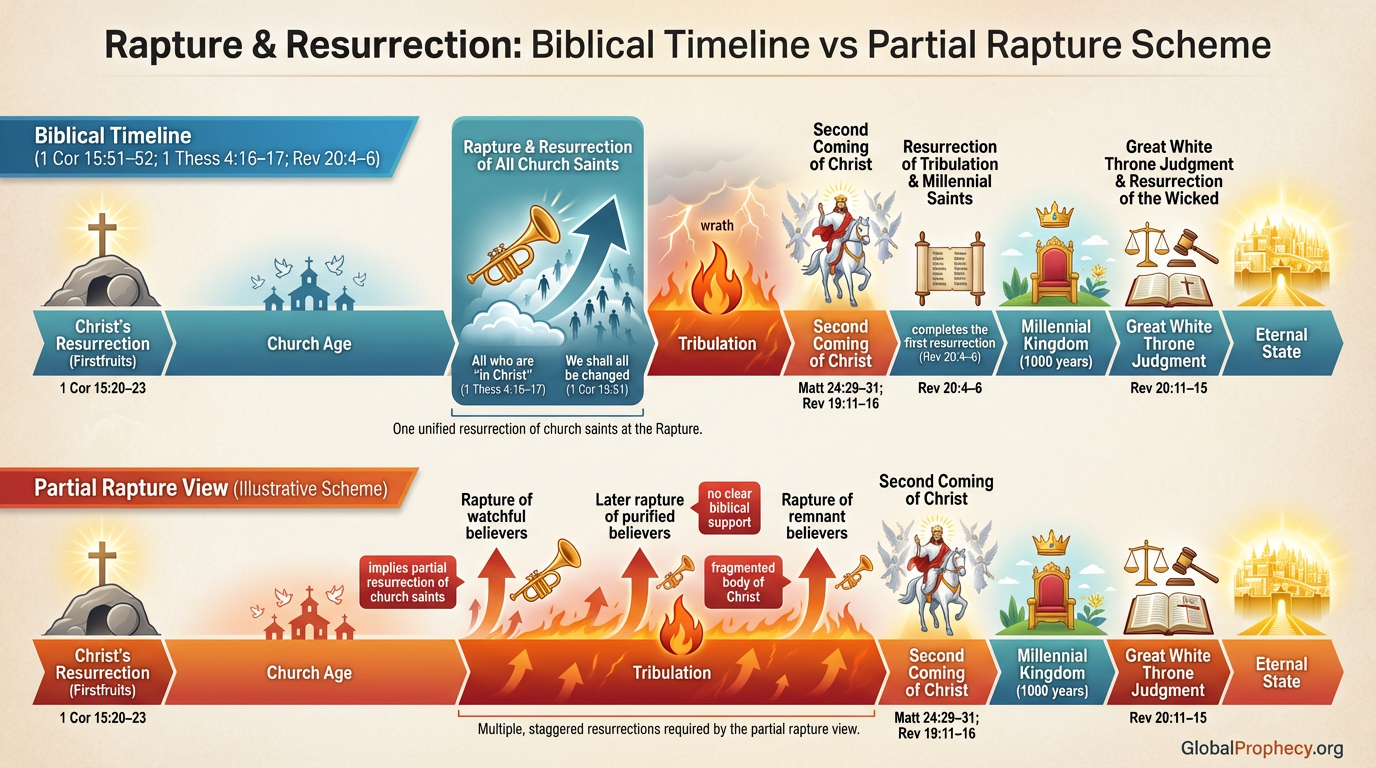
If only “worthy” believers are raptured at the initial coming of Christ, then only part of the dead in Christ would be raised at that point, with other believers resurrected later. Yet Scripture knows of only:
- A “first resurrection” of the righteous in multiple stages (Christ the firstfruits, then those who are Christ’s at His coming, then Tribulation/millennial saints), and
- A final resurrection of the wicked (Rev 20:4–6, 11–15),
not a staggered resurrection of spiritual vs. carnal believers within the same group. There is no biblical support for a partial resurrection of church saints.
5.2 It Empties the Judgment Seat of Christ of Meaning
If unfaithful believers are punished by being left on earth to suffer the Tribulation, then:
- Much of the function of the judgment seat of Christ (2 Cor 5:10; 1 Cor 3:10–15), where works are evaluated and rewards assigned, is effectively relocated into history.
- The Bema becomes largely redundant; the real disciplinary judgment has already occurred by exclusion from the Rapture.
Scripture, however, places the evaluation of believers’ works after the Rapture, in heaven, not during the Tribulation on earth.
5.3 It Turns the Tribulation into a Purgatory for Believers
By teaching that carnal Christians must endure the Tribulation to be purged of sin and made fit for Christ’s presence, the partial rapture view:
- Implies that Christ’s atoning death was not fully sufficient to deal with the guilt and penalty of believers’ sin.
- Introduces an earthly purgatory—a period of severe suffering to cleanse believers.
Yet the New Testament declares that Christ’s sacrifice has perfected for all time those who are being sanctified (Heb 10:14). God may discipline His children in this life (Heb 12:5–11), but no further atoning or purging suffering is required to qualify them for glorification.
5.4 It Confuses Israel and the Church in Prophetic Texts
Many of the “watch” passages used to support the partial rapture view are drawn from the Olivet Discourse (Matt 24–25; Mark 13; Luke 21), which:
- Was spoken before the church was formed at Pentecost.
- Concerns Israel, Jerusalem, and events in the Tribulation leading up to Christ’s visible return.
- Speaks of the elect in a broad sense, not specifically of church-age believers.
Reading partial-rapture conditions for the church into these passages ignores their original audience and context, and blurs the biblical distinction between Israel and the church.
5.5 It Misreads “Watchfulness” Passages
New Testament calls to watch, be ready, and love Christ’s appearing (e.g., 2 Tim 4:8; Titus 2:13) are:
- Ethical exhortations flowing from salvation, not entrance requirements for eschatological blessings.
- Appeals to live in light of our sure hope, not warnings that we may forfeit the Rapture.
The partial rapture view effectively weaponizes pastoral exhortations into threats, undermining gospel assurance and shifting the focus from Christ’s faithfulness to our fluctuating performance.
6. Conclusion
The partial rapture view, though often motivated by a zeal for holiness, rests on misinterpreted texts and flawed theology. It:
- Misreads judgment texts as rapture texts.
- Divides the unified body and bride of Christ.
- Merges grace with merit by making the Rapture a prize for the worthy.
- Requires unscriptural partial resurrections and turns the Tribulation into a purgatory for believers.
By contrast, the consistent testimony of Scripture is that all who are “in Christ” will be caught up and changed when He comes for His church. Watchfulness, readiness, and love for His appearing are the proper responses to this gracious hope, not the conditions that determine whether we share in it.
Believers should therefore live in reverent expectation, knowing that:
“We shall not all sleep, but we shall all be changed.”
— 1 Corinthians 15:51
“And so we will always be with the Lord. Therefore encourage one another with these words.”
— 1 Thessalonians 4:17–18
Frequently Asked Questions
What is the partial rapture view?
Does the Bible say that only worthy believers will be raptured?
How do partial rapture teachers use Matthew 25 and the ten virgins?
Does the call to be watchful mean I might miss the rapture if I'm not?
Why is the partial rapture view considered problematic theologically?
L. A. C.
Theologian specializing in eschatology, committed to helping believers understand God's prophetic Word.
Related Articles
Mid-Tribulationalism Examined
Mid-tribulationalism examined in depth: understand its last trumpet argument, compare rapture texts, and see biblical reasons the church misses all tribulation.
Post-Tribulationalism Examined
Post-tribulationalism examined with a fair summary of the posttrib rapture view plus biblical critiques on imminence, the tribulation, and the millennium.
Pre-Tribulationalism Examined
Pretribulationalism examined: a detailed defense of the pre-trib rapture, Israel–Church distinction, exemption from wrath, and the doctrine of imminence.
The Pre-Wrath Rapture View Examined
Pre-wrath rapture view examined: timing in the second half of the tribulation, its Satan vs. God's wrath distinction, and why wrath begins at the seals.