
Post-Tribulationalism Examined
1. Introduction
Post-tribulationalism is one of the major evangelical views on the timing of the rapture of the church. It teaches that the church will pass through the entire future tribulation, and that the rapture occurs at the end of that period, essentially simultaneous with the visible, glorious Second Coming of Christ.
This article will (1) define and fairly summarize post-tribulational rapture teaching, and then (2) examine its biblical and theological difficulties—especially the questions of who populates the millennial kingdom and how Christ’s coming can be imminent if prophesied signs must occur first.
Throughout, we will distinguish between the rapture (the catching up and transformation of the saints) and the Second Coming (Christ’s descent to earth in judgment and to establish His kingdom), even though post-tribulationalism typically merges them into one event.
2. The Post‑Tribulational Rapture View Defined
2.1 Core Thesis
Post‑tribulationism (often called “historic premillennialism” in its modern form) maintains:
- The church will endure the entire future tribulation (Daniel’s seventieth week).
- The rapture and the Second Coming are one complex event at the close of that tribulation.
- All saints of all ages are raised and translated at that time (often appealing to Revelation 20:4–6).
- The “elect” in tribulational passages (e.g., Matthew 24:31) are the church.
In this view, the sequence is:
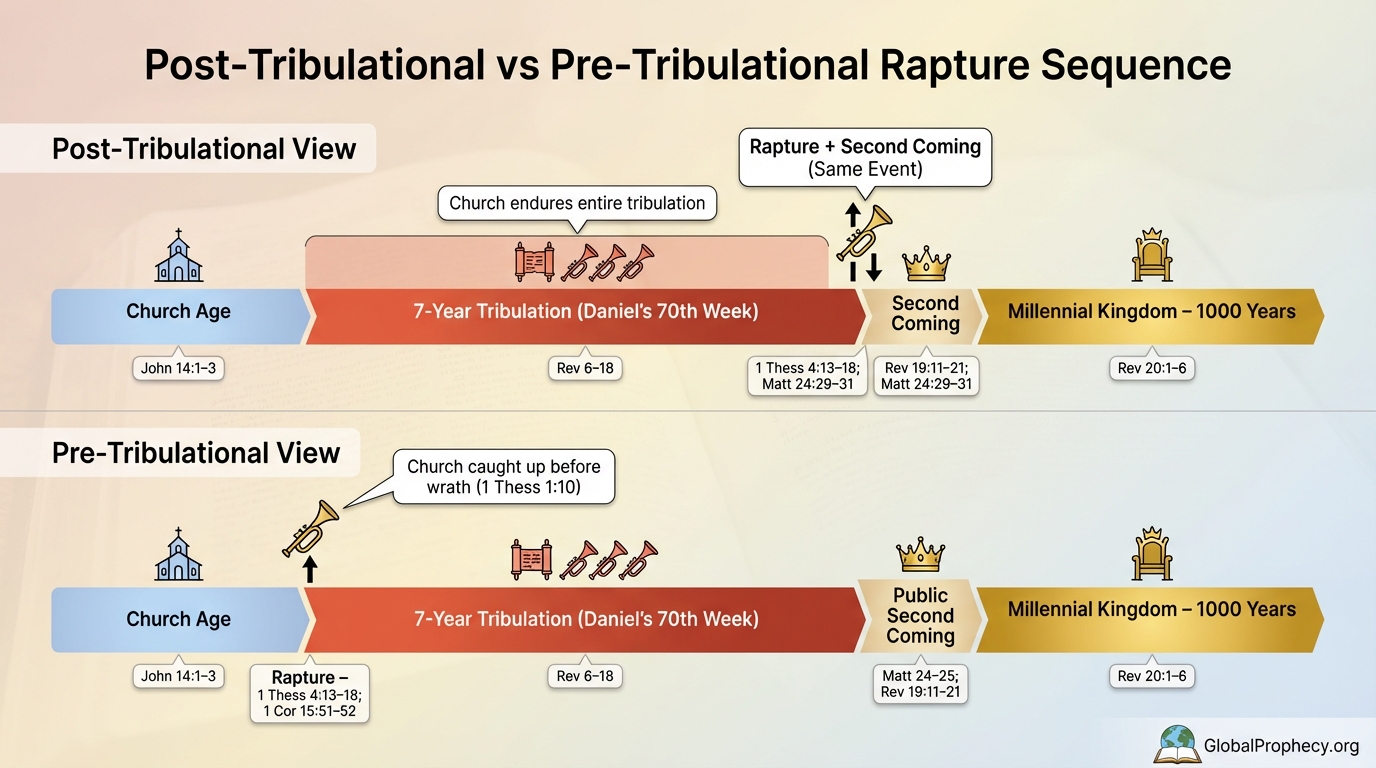
- The church goes through the tribulation.
- Christ appears in glory at the end.
- The dead in Christ rise and the living believers are caught up (rapture).
- Immediately, Christ descends to the earth with His people and establishes the millennial kingdom.
2.2 Main Arguments Offered
Post‑tribulationists typically appeal to several lines of reasoning:
-
Unity of the people of God.
They argue there is one overarching people of God—“the elect”—so that the elect in the tribulation (e.g., Matthew 24:22, 31) must be the church. -
2 Thessalonians 2 and signs before the “coming.”
Paul speaks of the apostasy and the revealing of the “man of sin” before the Day of the Lord (2 Thessalonians 2:1–4), implying to post‑tribulationists that the church will see Antichrist and therefore must be in the tribulation. -
“Meeting” the Lord in the air (1 Thessalonians 4:17).
The Greek term apantēsis (“to meet”) is sometimes argued to imply going out to greet a dignitary and then escorting him back to the city—thus, the saints meet Christ in the air and immediately return to earth with Him. -
The “last trumpet.”
The trumpet of 1 Corinthians 15:52 and 1 Thessalonians 4:16 is sometimes linked with the post‑tribulational trumpet of Matthew 24:31 or the seventh trumpet of Revelation 11:15, suggesting a single, end‑of‑tribulation event. -
Historical argument.
Some claim the majority of early Christian writers did not teach a pre‑tribulational rapture, and therefore the “historic” view must be post‑tribulational.
Post‑tribulationism rightly insists that believers should expect suffering and tribulation in this present age (John 16:33; Acts 14:22). But the crucial question is whether the church is appointed to the specific eschatological “wrath” and judgments of the future Day of the Lord, and whether Scripture actually merges the rapture and the Second Coming into a single, undifferentiated event.
3. Biblical Distinctions Between the Rapture and the Second Coming
A key issue in evaluating post‑tribulationalism is whether the New Testament distinguishes the rapture from the Second Coming.
3.1 Contrasting Features
When we compare classic rapture passages (John 14:1–3; 1 Thessalonians 4:13–18; 1 Corinthians 15:51–52) with classic Second Coming passages (Matthew 24–25; Zechariah 14; Revelation 19:11–21), notable contrasts emerge:
| Aspect | Rapture Passages | Second Coming Passages |
|---|---|---|
| Direction | Christ comes in the air, believers go up (1 Thess 4:17). | Christ comes to the earth, feet stand on the Mount of Olives (Zech 14:4). |
| Purpose | To receive His bride, take her to the Father’s house (John 14:3). | To judge nations and establish His earthly kingdom (Matt 25:31–32; Rev 19:15). |
| Participants | Involves church saints only (“the dead in Christ… we who are alive,” 1 Thess 4:16–17). | Involves all nations, both saved and unsaved (Matt 25:31–46). |
| Judgment vs. Comfort | Emphasis on comfort and hope (1 Thess 4:18). | Emphasis on wrath, destruction, and separation (2 Thess 1:7–10; Rev 19:15). |
| Translation | Believers are transformed and caught up (1 Cor 15:51–52; 1 Thess 4:17). | No translation; living believers inherit the kingdom in natural bodies (Matt 25:34; Isa 65:20–23). |
| Signlessness | Presented as imminent, with no intervening prophesied events (1 Thess 1:10; Titus 2:13). | Preceded by clear, prophesied signs (Matt 24:15–30; 2 Thess 2:3–4). |
Similarity in vocabulary (e.g., parousia, “coming”) does not prove identity of events; these words can characterize different phases of Christ’s overall return.
3.2 Exegetical Implications
If the rapture and the Second Coming are identical and occur at the end of the tribulation—as post‑tribulationism claims—several difficulties follow:
- The removal and transformation of believers of 1 Thessalonians 4 must be squeezed into the same moment as Christ’s descent to earth in Revelation 19, where resurrection and rapture are not even mentioned.
- The promised trip to the Father’s house (John 14:2–3) is effectively bypassed: believers would meet Christ in the air only to make an immediate U‑turn to earth, never experiencing what He described as going to be “where I am.”
- The rapture loses its distinct character as a blessed hope and comfort, because it is inevitably preceded by the unparalleled horrors of the Day of the Lord.
By contrast, understanding the rapture as a prior, catching‑up of the church, followed later by Christ’s public descent to earth in judgment, allows the New Testament data to be harmonized without flattening distinct stages of His return.
4. Who Populates the Millennium in a Post‑Tribulational Scheme?
One of the most serious theological challenges for post‑tribulationism is the matter of who enters and populates the millennial kingdom.
4.1 Millennial Population in Scripture
Old Testament and New Testament prophecies indicate that:
- The millennium begins with mortals on earth in natural, non‑glorified bodies who:
- Build houses and plant vineyards (Isaiah 65:21–22).
- Bear children and raise families (Isaiah 65:20–23).
- Can still sin, and some rebel at the end of the thousand years (Revelation 20:7–9).
Additionally:
- At the Second Coming, Christ conducts judgments that separate believers from unbelievers among both Israel and the Gentile nations:
- The judgment of Israel in the wilderness (Ezekiel 20:33–38).
- The sheep and goats judgment of the nations (Matthew 25:31–46).
In both cases, unbelievers are removed in judgment, while believers—still in natural bodies—enter the kingdom.
4.2 Post‑Tribulational Dilemma
If, as post‑tribulationism affirms:
- At the end of the tribulation all church believers, living and dead, are glorified and raptured, and
- All unbelievers are judged and removed before the millennium begins,
then a critical question arises:
Who remains in mortal bodies to enter and populate the millennium?
Under a strict post‑tribulational rapture, you are left with:
- No unglorified believers (all have been changed, 1 Cor 15:51–52).
- No unbelievers (all have been removed in judgment: Matt 25:41–46; Ezek 20:38).
Yet the millennial prophecies demand exactly such a group: believing survivors in natural bodies who can marry, have children, and among whose descendants a final rebellion arises at the close of the thousand years.
Various post‑tribulationist proposals—such as suggesting that the 144,000 Jewish sealed ones or some spared Gentiles enter the millennium as unbelievers and then are converted—collide with the plain teaching that all unredeemed are purged before the kingdom (e.g., “I will purge out the rebels,” Ezek 20:38; “These will go away into eternal punishment,” Matt 25:46).
A pre‑tribulational rapture, in contrast, fits this data seamlessly:
- The church is removed and glorified before the tribulation.
- During the tribulation, multitudes—both Jews and Gentiles—come to faith and survive physically.
- These tribulation saints, still in natural bodies, are those who pass through the end‑time judgments and enter the millennium to form the initial population of Christ’s earthly kingdom.
5. Imminence and the Necessity of Signs in Post‑Tribulationalism
Scripture repeatedly presents the Lord’s coming for His own as something believers are to expect at any moment:
- “We wait for His Son from heaven” (1 Thess 1:10).
- “Awaiting eagerly the revelation of our Lord Jesus Christ” (1 Cor 1:7).
- “The Lord is near” (Phil 4:5).
- “Looking for the blessed hope and the appearing of the glory of our great God and Savior Jesus Christ” (Titus 2:13).
- “The Judge is standing right at the door” (James 5:9).
- “Yes, I am coming quickly” (Rev 22:20).
This doctrine of imminence does not mean Christ must come “soon” in terms of human reckoning, but that no prophesied events must intervene before He can come for His church.
5.1 Post‑Tribulational Loss of Imminence
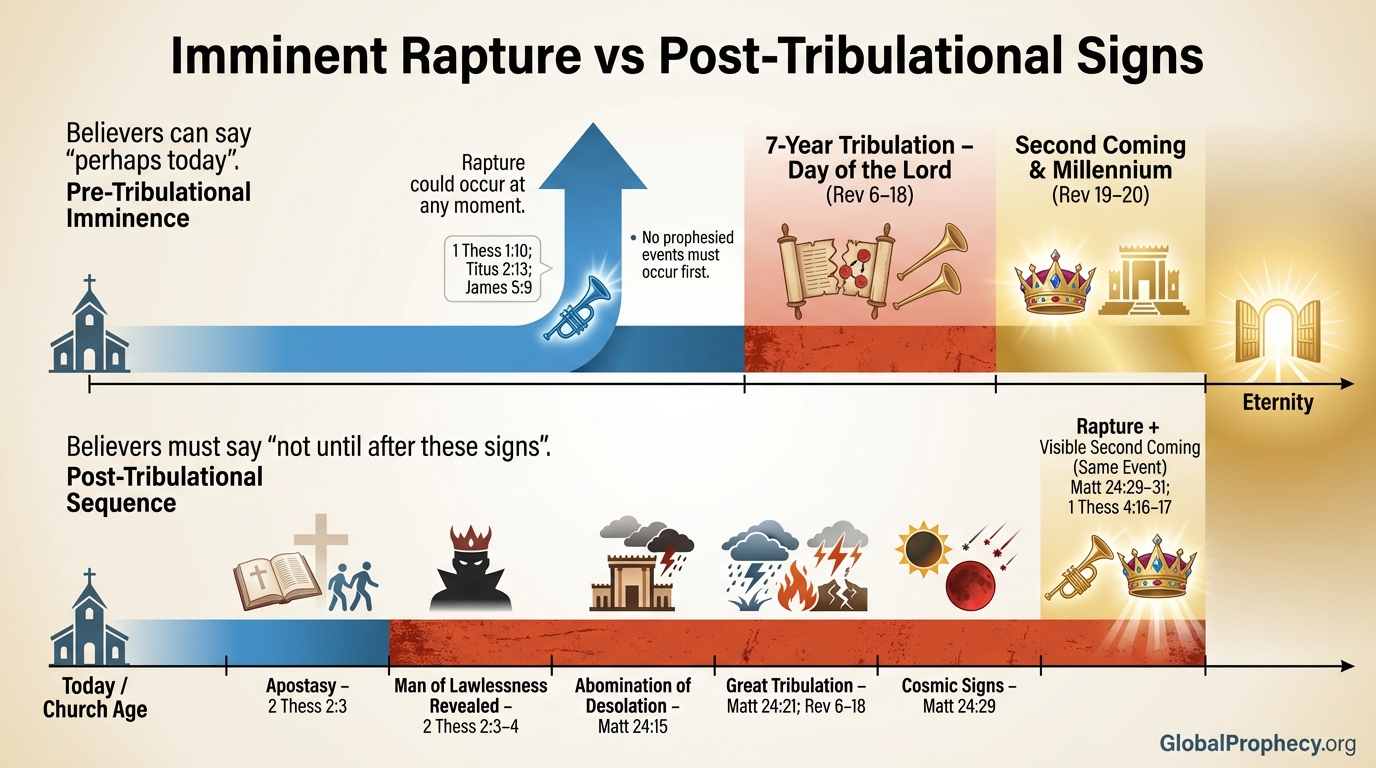
By definition, post‑tribulationism denies imminence:
- Before Christ can rapture His church, according to this view, the following must occur:
- The apostasy and revelation of the man of lawlessness (2 Thess 2:3–4).
- The abomination of desolation in the temple (Matt 24:15).
- The great tribulation with its unprecedented judgments (Matt 24:21; Rev 6–18).
- The visible cosmic signs that immediately precede His appearing (Matt 24:29–30).
Under post‑tribulationism, believers cannot truthfully say “perhaps today,” but must say “not until after the tribulation.”
The New Testament’s repeated commands to watch, wait, and be ready for Christ’s coming at any time are severely blunted if that coming cannot occur until after the most dramatic prophetic events in history have already unfolded.
5.2 Re‑Reading “Imminence” as General Expectancy
Some post‑tribulationists attempt to recast imminence as a general attitude of expectancy—believers are to look for Christ “in any generation,” but not necessarily “at any moment.” However, the language of the relevant passages (“you do not know on which day your Lord is coming,” Matt 24:42; “at an hour when you do not think He will,” Matt 24:44) fits much more naturally with a signless, always‑possible coming, not one fixed at the end of a clearly delineated seven‑year period marked by globally recognized signs.
Again, distinguishing a prior rapture of the church from the later, sign‑laden Second Coming preserves both the imminent hope of believers and the integrity of the prophetic timetable.
6. Additional Exegetical Considerations
6.1 2 Thessalonians 2 Revisited
Post‑tribulationists often contend that 2 Thessalonians 2:1–4 teaches that the rapture cannot happen until after the apostasy and the revelation of the man of sin. However, a careful reading shows that Paul’s purpose is not to provide a checklist of events that must precede the rapture, but rather to reassure the Thessalonians that they had not missed the Day of the Lord.
- Some had been troubled by the false teaching that “the day of the Lord has come” (2 Thess 2:2).
- Paul responds by explaining that the Day of the Lord will be characterized by highly visible developments—the apostasy and the man of sin—that had not yet occurred.
- Therefore, they were not in the Day of the Lord, and since they were still on earth, they had not been raptured prior to it.
In other words, the absence of these phenomena proved that the Day of the Lord had not arrived, not that the rapture must await them.
6.2 The “Meeting” (Apantēsis) in 1 Thessalonians 4:17
Post‑tribulationists claim that apantēsis implies believers meet Christ in the air only to turn and escort Him immediately back to earth. Yet:
- The term apantēsis in Greek does not inherently demand an immediate return to the point of origin; it simply denotes a meeting (cf. Acts 28:15; John 4:51).
- In John 14:3, Christ promises to “receive you to Myself, that where I am, there you may be also,” with clear reference to the Father’s house in heaven.
- The text of 1 Thessalonians 4 itself highlights the purpose of being “with the Lord”—not the executive details of an immediate descent.
Insisting that the word apantēsis compresses the entire event into one up‑and‑down motion ignores both lexical flexibility and broader contextual teaching.
7. Conclusion
Post‑tribulationalism’s desire to take seriously the reality of tribulation and persecution for believers is commendable; Scripture does not promise the church exemption from suffering in this present age. However, when post‑tribulationalism is tested against the full range of biblical data concerning the rapture, the Day of the Lord, and the Second Coming, significant difficulties emerge:
- It struggles to explain who populates the millennial kingdom in natural bodies if all believers are glorified and all unbelievers are removed at the end of the tribulation.
- It necessarily abandons the imminence of Christ’s coming for His church, replacing a truly any‑moment hope with a far‑off, post‑sign expectation.
- It tends to flatten clear biblical distinctions between the rapture and the Second Coming, forcing divergent passages into a single mold.
- It often blurs the theological distinction between Israel and the church, making all “elect” language refer to the same corporate entity and thereby placing the church into prophecies whose primary focus is Israel’s end‑time purification and restoration.
A careful, literal reading of Scripture supports a different picture: Christ will first catch away His church to meet Him in the air and take her to the Father’s house, thus delivering her from the coming eschatological wrath. After the tribulation judgments and the conversion of Israel and many Gentiles, He will then return in visible glory to earth with His saints to judge the nations and establish His millennial kingdom.
From this perspective, the rapture remains a truly blessed hope (Titus 2:13)—a purifying, imminent prospect that can rightly shape the church’s expectation, worship, and endurance in the present age.
Frequently Asked Questions
What is post-tribulationalism?
Who populates the millennium if all believers are raptured at the end?
Does post-tribulationalism deny the imminence of Christ's return?
Is the rapture the same event as the Second Coming?
L. A. C.
Theologian specializing in eschatology, committed to helping believers understand God's prophetic Word.
Related Articles
Mid-Tribulationalism Examined
Mid-tribulationalism examined in depth: understand its last trumpet argument, compare rapture texts, and see biblical reasons the church misses all tribulation.
Pre-Tribulationalism Examined
Pretribulationalism examined: a detailed defense of the pre-trib rapture, Israel–Church distinction, exemption from wrath, and the doctrine of imminence.
The Pre-Wrath Rapture View Examined
Pre-wrath rapture view examined: timing in the second half of the tribulation, its Satan vs. God's wrath distinction, and why wrath begins at the seals.
Comparing the Rapture Views
Rapture views compared side by side: pretrib, midtrib, posttrib, partial rapture, and pre-wrath. See which timing best fits Scripture and why clearly shown.