
Pre-Tribulationalism Examined
1. Introduction
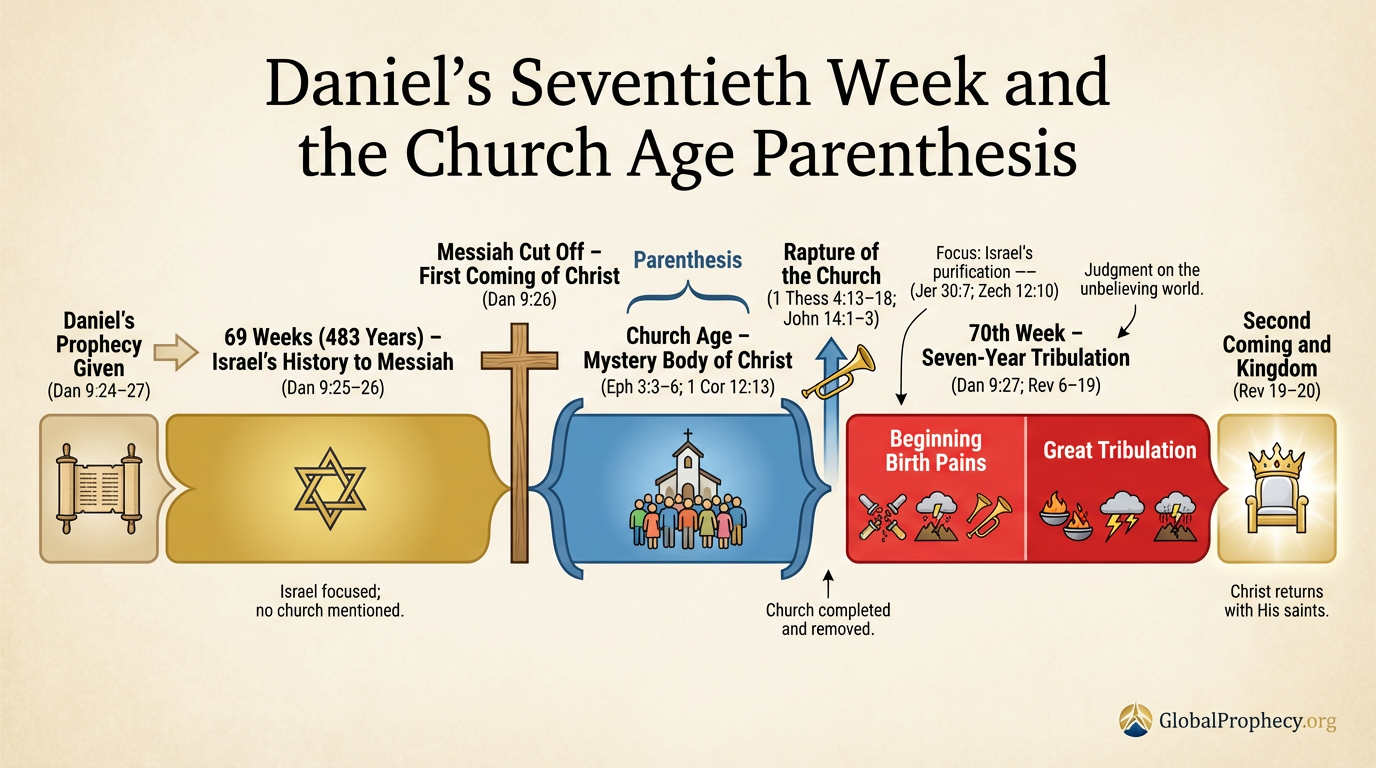
Pre-tribulationalism teaches that the rapture of the church—the catching up of living and dead believers to meet Christ in the air (1 Thessalonians 4:13–18)—occurs before the future seven‑year Tribulation (Daniel’s seventieth week, Daniel 9:24–27). After this period of unparalleled judgment, Christ returns in glory to the earth with His saints to establish His millennial kingdom (Revelation 19–20).
This article examines the pre‑tribulational rapture view, assessing its biblical foundations and key arguments. While other positions exist (mid‑tribulation, post‑tribulation, pre‑wrath, partial rapture), our focus is the claim that a pre‑Tribulation rapture best harmonizes Scripture, especially when we maintain a consistent, literal, dispensational interpretation of prophecy.
2. Distinction Between Israel and the Church
A core feature of pre‑tribulationalism is the distinction between Israel and the church in God’s prophetic program.
2.1 The Church as a New, Unique People
The New Testament presents the church as a “mystery” not revealed in the Old Testament but disclosed in the apostolic age (Ephesians 3:3–6; Colossians 1:26–27). Believers of this age are united into “one body” by the baptizing work of the Holy Spirit:
“For in one Spirit we were all baptized into one body—Jews or Greeks, slaves or free…”
— 1 Corinthians 12:13
This Spirit‑baptized body began at Pentecost (Acts 2) and will be completed at the rapture. No Old Testament passage clearly reveals this body; Israel and the church are not interchangeable.
2.2 Daniel’s Seventieth Week and Israel
The seventy “weeks” prophecy of Daniel 9:24–27 explicitly concerns:
“your people and your holy city”
— Daniel 9:24
“Your people” = Israel; “your holy city” = Jerusalem. The first 69 “weeks” (units of seven years) culminated in Messiah’s first coming and rejection (Daniel 9:26). The seventieth week—a future seven‑year period—remains unfulfilled and is tied to Israel’s ultimate restoration.
It is striking that the church did not exist during the first 69 weeks and is not mentioned in the prophecy. This strongly suggests that the seventieth week is likewise focused on Israel and not on the church. Pre‑tribulationalism naturally fits this structure: the church age is a parenthesis between the 69th and 70th “weeks”; the church is completed and removed before God resumes His covenant dealings with Israel in the Tribulation.
2.3 The Purpose of the Tribulation
The Tribulation is consistently described as Israel‑centered:
- “a time of distress for Jacob” (Jeremiah 30:7)
- a period culminating in Israel’s national repentance (Zechariah 12:10; Romans 11:26–27)
The primary purposes are:
- To purify and prepare Israel for receiving her Messiah.
- To judge the unbelieving world (the “earth‑dwellers” in Revelation).
The church, already justified and sanctified positionally in Christ (Romans 8:1; Ephesians 1:3–7), is not the object of this wrath. This Israel/church distinction is a key structural reason to expect the church’s removal before the seventieth week begins.
3. Exemption From Divine Wrath
The New Testament explicitly promises that church‑age believers are not appointed to divine wrath.
3.1 1 Thessalonians: Delivered From the Coming Wrath
Paul commends the Thessalonians for their conversion and hope:
“…to wait for his Son from heaven, whom he raised from the dead, Jesus who delivers us from the wrath to come.”
— 1 Thessalonians 1:10
Later he states:
“For God has not destined us for wrath, but to obtain salvation through our Lord Jesus Christ.”
— 1 Thessalonians 5:9
In context:
- 1 Thessalonians 4:13–18 describes the rapture.
- 1 Thessalonians 5:1–11 discusses the Day of the Lord—a time of sudden destruction and darkness upon the unbelieving world.
Believers are clearly distinguished from those on whom this destruction falls (note the pronouns “they…them” vs. “you…we” in 1 Thessalonians 5:3–5). The church’s destiny is salvation, not wrath; we are to “encourage one another with these words” (4:18; 5:11). This strongly supports a pre‑wrath removal, best explained by a pre‑Tribulation rapture.
3.2 Revelation 3:10 – Kept From the Hour
Christ’s promise to the faithful church in Philadelphia is programmatic:
“Because you have kept my word about patient endurance, I will keep you from the hour of trial that is coming on the whole world, to try those who dwell on the earth.”
— Revelation 3:10, ESV
Key observations:
- The promise is not merely to be kept in trial, but “kept from the hour of trial”—from the very time period (“hour”) of global testing.
- The scope is “the whole world”; this is not a localized persecution but a comprehensive judgment, matching the Tribulation in Revelation 6–19.
- The means of protection is linked to His coming: “I am coming soon” (Revelation 3:11).
The Greek phrase tēreō ek (“keep…from”) naturally means preservation outside of, not protection while inside. The only other New Testament use (John 17:15) speaks of being kept from the evil one, not preserved safely within his power. When we add that multitudes of believers are martyred in the Tribulation (Revelation 6:9–11; 7:9–14), the promise of Revelation 3:10 cannot mean “no believers will die”; it must mean the church as such will be removed from that hour.
Thus the church is promised exemption from the time of wrath—not merely from its most severe phase. This supports a rapture before the seven‑year Tribulation begins.
4. The Imminent Hope of Christ’s Coming
Pre‑tribulationalism uniquely preserves the New Testament’s teaching that Christ’s coming for His church is imminent—it can occur at any moment.
4.1 New Testament Language of Expectation
Believers are commanded to:
- “wait for his Son from heaven” (1 Thessalonians 1:10)
- “eagerly wait for a Savior” (Philippians 3:20)
- “look for the blessed hope and the appearing of the glory of our great God and Savior Jesus Christ” (Titus 2:13)
- live because “the Lord is at hand” (Philippians 4:5)
- know that “the Judge is standing at the door” (James 5:8–9)
The early church’s Aramaic watchword “Maranatha” (1 Corinthians 16:22)—“Our Lord, come!”—embodies this any‑moment expectancy. No intervening prophetic events are said to have to occur before the rapture.
4.2 Incompatibility of Imminence With Other Timings
All non‑pre‑trib views place known, prophesied events before the rapture:
- Mid‑trib: at least the first 3½ years, including initial judgments and the rise of Antichrist, must occur first.
- Pre‑wrath: roughly 5+ years of Tribulation must unfold before the “pre‑wrath” rapture.
- Post‑trib: the entire Tribulation, including the Abomination of Desolation, the trumpet and bowl judgments, and Armageddon, must precede the rapture.
In such schemes, believers cannot genuinely say, “Christ may come today”; they must say, “Christ cannot come until after X, Y, and Z occur.” This directly contradicts the New Testament’s posture of immediacy.
Only a pre‑tribulational rapture truly preserves the biblical doctrine of imminence.
5. The Absence of the Church in Revelation 4–19
The structural flow of Revelation strongly supports a pre‑Tribulation rapture.
5.1 Ekklesia in Revelation
- Revelation 1–3: the word ekklesia (“church”) occurs 19 times, in messages to actual first‑century churches that also represent the church age.
- Revelation 4–19: no mention of the church on earth.
- Revelation 22:16: ekklesia appears again in the epilogue.
From chapter 4 onward, the focus shifts from the church to Israel, nations, 144,000 from the tribes of Israel, and “those who dwell on the earth.” The seals, trumpets, and bowls describe global judgments without reference to the church’s presence or ministry. This is inexplicable if the church is supposedly central on earth during this period.
5.2 Who Are the Twenty‑Four Elders?
A compelling explanation is that the twenty‑four elders around God’s throne (Revelation 4:4, 10; 5:5–10; 7:11–13; 11:16; 19:4) represent the glorified church in heaven:
- They are called “elders”—a term tied to representation of God’s people, especially in church context.
- They sit on thrones, a privilege promised to overcomers in the church (Revelation 3:21).
- They wear white garments and crowns, which match the promises to church‑age believers (Revelation 2:10; 3:5, 18; 19:7–8).
- They sing a song of redemption from “every tribe and language and people and nation” (Revelation 5:9–10), fitting the multi‑ethnic church.
- They are clearly distinguished from angels (Revelation 5:11).
If these elders symbolize the completed church in heaven before the seal judgments begin (Revelation 6), the implication is obvious: the church has been raptured prior to the Tribulation.
6. The Restrainer and the Revelation of the Man of Lawlessness
2 Thessalonians 2 links the revelation of the Antichrist (“the man of lawlessness”) with the removal of a restraining influence:
“And you know what is restraining him now so that he may be revealed in his time.… only he who now restrains it will do so until he is out of the way. And then the lawless one will be revealed…”
— 2 Thessalonians 2:6–8
The restrainer:
- is presently active;
- restrains worldwide lawlessness and the Antichrist’s manifestation;
- will be removed (“out of the way”) before the man of sin is revealed.
The most consistent identification is the Holy Spirit’s restraining work through the church. When the church is caught up, this distinctive, corporate restraint ends, allowing the Antichrist to be revealed and Daniel’s seventieth week to begin.
This sequence—church removed → restrainer lifted → Antichrist revealed → Day of the Lord begins—fits pre‑tribulationism precisely and explains why the Thessalonians were alarmed at the false claim that the “day of the Lord has come” (2 Thessalonians 2:2): they expected to be removed first, not to find themselves inside that day.
7. Rapture and Second Coming: One Return in Two Phases
Scripture describes two distinct yet related aspects of Christ’s future coming:
- Rapture: Christ comes for His saints, in the air, to take them to the Father’s house (John 14:1–3; 1 Thessalonians 4:13–18).
- Revelation/Second Coming: Christ comes with His saints, to the earth, to judge and to reign (Zechariah 14:4–5; Matthew 24:29–31; Revelation 19:11–16).
A comparison reveals sharp differences:
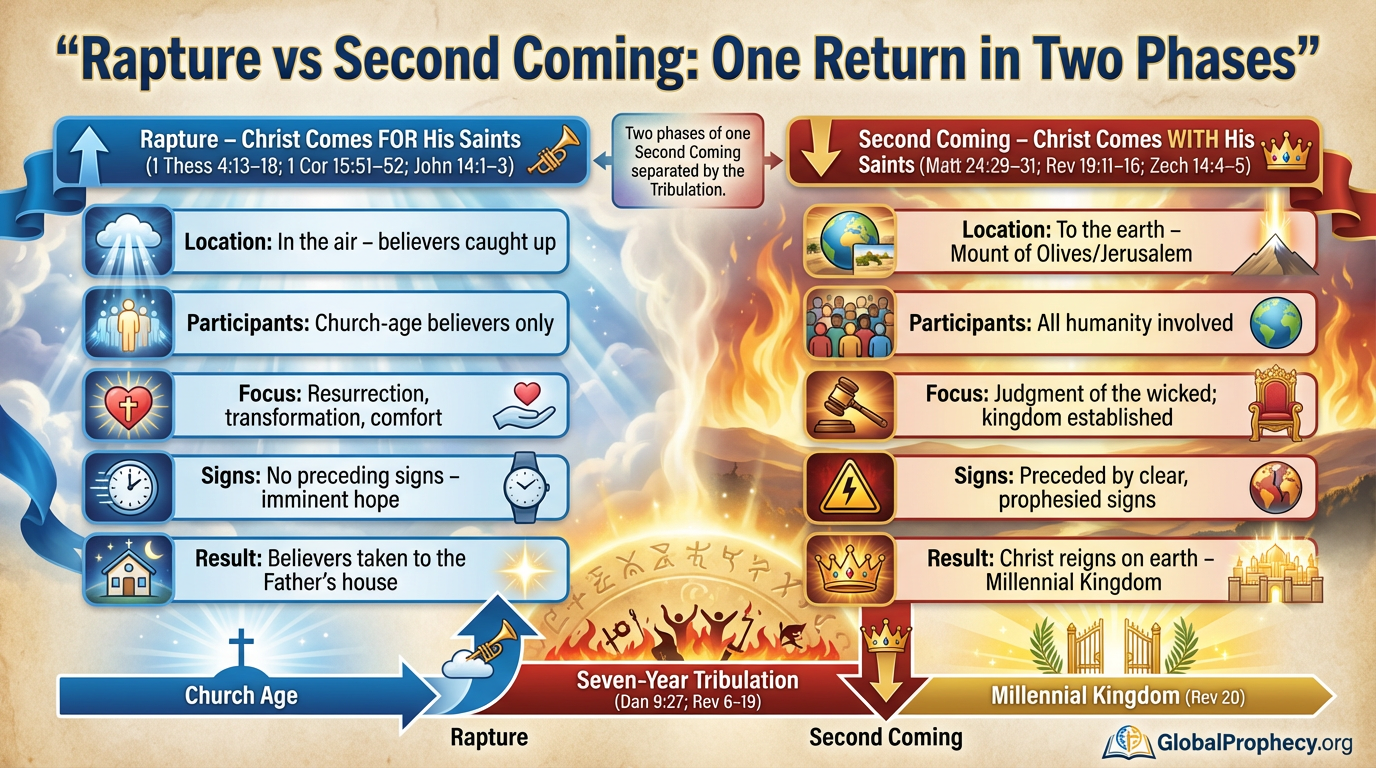
| Feature | Rapture (1 Thess 4; 1 Cor 15) | Second Coming (Matt 24; Rev 19) |
|---|---|---|
| Direction | Christ to the air; saints caught up | Christ descends to the earth |
| Participants | Believers only | All humanity involved |
| Focus | Resurrection and translation, comfort | Judgment and kingdom establishment |
| Signs | None given; imminent | Preceded by many prophesied signs |
| Destination | Saints taken to Father’s house | Saints return with Christ to rule on earth |
These are best understood as two phases of one Second Coming separated by the Tribulation. A pre‑trib rapture respects these distinctions and the differing pastoral emphases: comfort and hope versus warning and judgment.
8. Conclusion
When we synthesize the major lines of biblical evidence, pre‑tribulationalism emerges as the most coherent, textually grounded view of the rapture’s timing:
- It honors the distinction between Israel and the church, keeping Daniel’s seventieth week focused on Israel and the nations.
- It takes seriously the church’s promised exemption from divine wrath and the specific promise to be kept from the hour of global testing.
- It preserves the New Testament’s imminent expectation of Christ’s coming for His bride.
- It explains the absence of the church in Revelation 4–19 and the presence of the twenty‑four elders in heaven.
- It harmonizes 2 Thessalonians 2’s teaching about the restrainer and the revelation of the man of lawlessness.
- It fits the two‑phase pattern of Christ’s return—first for His saints, then with them.
Other rapture timings can marshal some arguments, but they invariably blur the Israel‑church distinction, weaken imminence, or create serious chronological and theological tensions (e.g., who populates the Millennium in natural bodies, how the judgment seat and marriage of the Lamb fit, why the church is never mentioned in key Tribulation texts).
From a consistent, literal, evangelical reading of prophetic Scripture, the pre‑tribulational rapture is not merely attractive—it is the most biblically consistent explanation of how Christ will gather His church before God’s final judgments fall on a rebellious world and before He turns again in covenant mercy to Israel.
Believers, therefore, are right to live in holy expectation, “waiting for our blessed hope, the appearing of the glory of our great God and Savior Jesus Christ” (Titus 2:13).
Frequently Asked Questions
What is pretribulationalism?
Why is the church exempt from the tribulation?
What does imminence mean for the rapture?
Why is the church absent from Revelation 4-19?
L. A. C.
Theologian specializing in eschatology, committed to helping believers understand God's prophetic Word.
Related Articles
Mid-Tribulationalism Examined
Mid-tribulationalism examined in depth: understand its last trumpet argument, compare rapture texts, and see biblical reasons the church misses all tribulation.
Post-Tribulationalism Examined
Post-tribulationalism examined with a fair summary of the posttrib rapture view plus biblical critiques on imminence, the tribulation, and the millennium.
The Pre-Wrath Rapture View Examined
Pre-wrath rapture view examined: timing in the second half of the tribulation, its Satan vs. God's wrath distinction, and why wrath begins at the seals.
When Will the Rapture Happen?
Rapture timing explained from a pretribulation view, showing why the rapture occurs before the tribulation using key Bible texts and arguments for today.