
Premillennialism Examined: The Biblical Case for Christ's Earthly Reign
1. Introduction
Premillennialism teaches that Jesus Christ will return bodily to earth before a future thousand‑year kingdom, during which He will reign over the nations in righteousness and peace. This view rests not on speculative systems but on a straightforward, grammatical‑historical reading of Scripture, especially Revelation 19–20 and key Old Testament kingdom prophecies.
This article presents the biblical case for premillennialism—that Christ’s reign will be earthly, future, and inaugurated at His second coming.
2. The Structure of Revelation 19–20: Christ Comes Before the Kingdom
2.1 Sequential “Then I Saw”
A central text is Revelation 19:11–21 followed by Revelation 20:1–6. John repeatedly marks a chronological sequence with the phrase “Then I saw”:
- “Then I saw heaven opened, and behold, a white horse!” — Rev 19:11 (second coming)
- “Then I saw an angel coming down from heaven…” — Rev 20:1 (binding of Satan)
- “Then I saw thrones, and seated on them were those to whom the authority to judge was committed.” — Rev 20:4 (saints reigning)
In this flow:
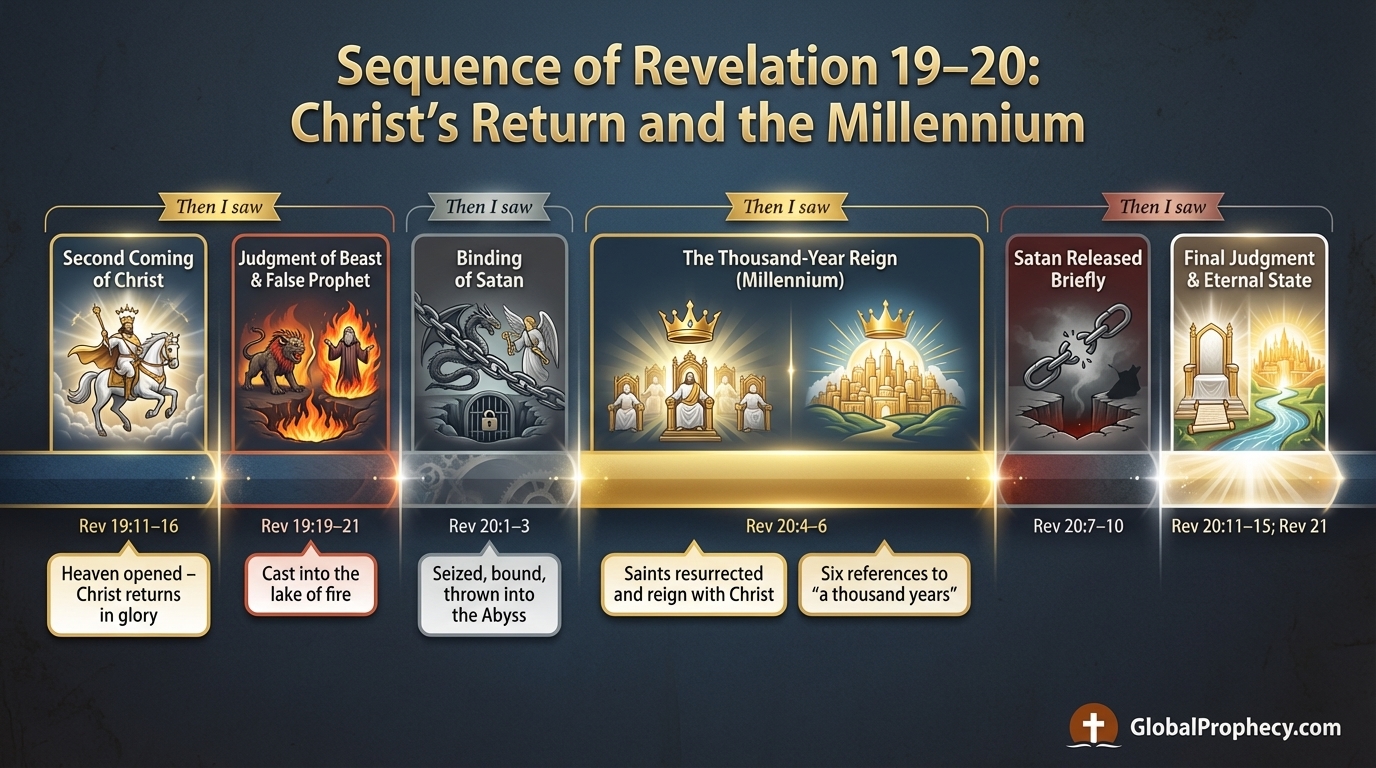
- Christ returns in glory (19:11–16).
- The beast and false prophet are cast into the lake of fire (19:19–21).
- Satan is bound for a thousand years (20:1–3).
- Resurrected saints reign with Christ for a thousand years (20:4–6).
The most natural reading is that the millennial reign follows the second coming, not that the millennium symbolizes the present age. Six explicit references to “a thousand years” (Rev 20:2–7) underscore a real, defined period, not a vague idea of “a long time.”
3. The Binding of Satan: Future, Complete, and Earth‑Focused
3.1 The Language of Total Incarceration
In Revelation 20:1–3 Satan is:
“seized … bound … thrown into the pit … shut … and sealed over him, so that he might not deceive the nations any longer, until the thousand years were ended.”
This is not slight restriction; it is total removal from earthly activity. He is confined in “the pit” (the Abyss), the same prison feared by demons (Luke 8:31).
Yet in this present age, Scripture portrays Satan as:
- “the god of this world” who blinds unbelievers (2 Cor 4:4)
- “the ruler of this world” (John 12:31; 14:30)
- “like a roaring lion, seeking someone to devour” (1 Pet 5:8)
- One who must still be resisted (Jas 4:7) and who hinders Christian ministry (1 Thess 2:18).
These descriptions do not fit a Satan already bound as in Revelation 20. Premillennialism alone does justice to both passages by placing the binding of Satan after Christ’s return, in a distinctive millennial era when global deception ceases.
4. The Two Resurrections of Revelation 20
4.1 Same Verb, Same Sense
Revelation 20:4–6 states:
“They came to life and reigned with Christ for a thousand years. The rest of the dead did not come to life until the thousand years were ended. This is the first resurrection.”
— Rev 20:4–5
Key observations:
- The verb “came to life” (ezēsan) is used for both groups (v. 4, v. 5).
- The passage explicitly calls the first event “the first resurrection” (v. 5–6).
- The noun “resurrection” (anastasis) appears 42 times in the New Testament; 41 times it clearly refers to bodily resurrection.
To claim that the first resurrection is “spiritual” (e.g., regeneration or entrance into heaven) while the second is bodily splits the language in an arbitrary way. As Henry Alford famously warned, if the first “came to life” is spiritual and the second physical:
“Then there is an end of all significance in language.”
The text itself distinguishes:
- First resurrection – of the righteous martyrs (and, by extension, the righteous dead), before the thousand years;
- Second resurrection – of “the rest of the dead” (the wicked), after the thousand years, for judgment (Rev 20:11–15).
This matches premillennialism: two bodily resurrections separated by Christ’s earthly reign.
5. Old Testament Kingdom Prophecies That Demand an Earthly Millennium
5.1 Isaiah 65: A World Better Than Now, Not Yet Eternity
Isaiah 65:17–25 describes a transformed world:
- Extended human life: “he who dies at a hundred years will be thought a youth” (Isa 65:20).
- Presence of sin and curse: “the sinner a hundred years old shall be accursed” (v. 20).
- Yet harmony in nature: “The wolf and the lamb shall graze together” (v. 25).
These conditions:
- Do not fit the present church age (we do not see lifespans so dramatically extended nor world‑wide peace and righteousness).
- Do not fit the eternal state, where there is no death, curse, or sin (Rev 21:4; 22:3).
Thus Isaiah points to an intermediate kingdom: a renewed earth with long life and justice, but where death is still possible—exactly what premillennialism calls the millennium.
5.2 Zechariah 14: Messiah Reigning Over Repentant, Yet Still‑Sinful Nations
Zechariah 14 presents:
- A visible coming of the LORD: “His feet shall stand on the Mount of Olives” (Zech 14:4).
- The LORD reigning as “king over all the earth” (14:9).
- Survivors from the nations coming annually to worship at Jerusalem (14:16).
- Disobedient nations punished with drought and plague (14:17–19).
Again, this cannot describe:
- The present age (Christ is not reigning openly from Jerusalem, and nations do not annually worship Him there), nor
- The eternal state (where no sin or judgment remains).
It fits a future, earthly reign of Messiah over nations still capable of sin—the millennial kingdom of premillennialism.
6. The Covenants with Abraham and David: Unfinished Business on Earth
6.1 Abrahamic Covenant: Land, Seed, and Blessing
God promised Abraham:
“To your offspring I give this land, from the river of Egypt to the great river, the river Euphrates.”
— Gen 15:18
And:
“I will establish my covenant between me and you and your offspring after you throughout their generations for an everlasting covenant … And I will give to you and to your offspring … all the land of Canaan, for an everlasting possession.”
— Gen 17:7–8
This covenant is:
- Unilateral – ratified by God alone passing between the pieces (Gen 15:17).
- Everlasting – repeatedly called an “everlasting covenant”.
Israel has never yet possessed all this specified territory in perpetual security and righteousness. Nor can this land promise be fulfilled merely in the “new earth” after all national distinctions disappear. Premillennialism expects a future earthly reign where Abraham’s descendants enjoy the covenant land under Messiah’s rule.
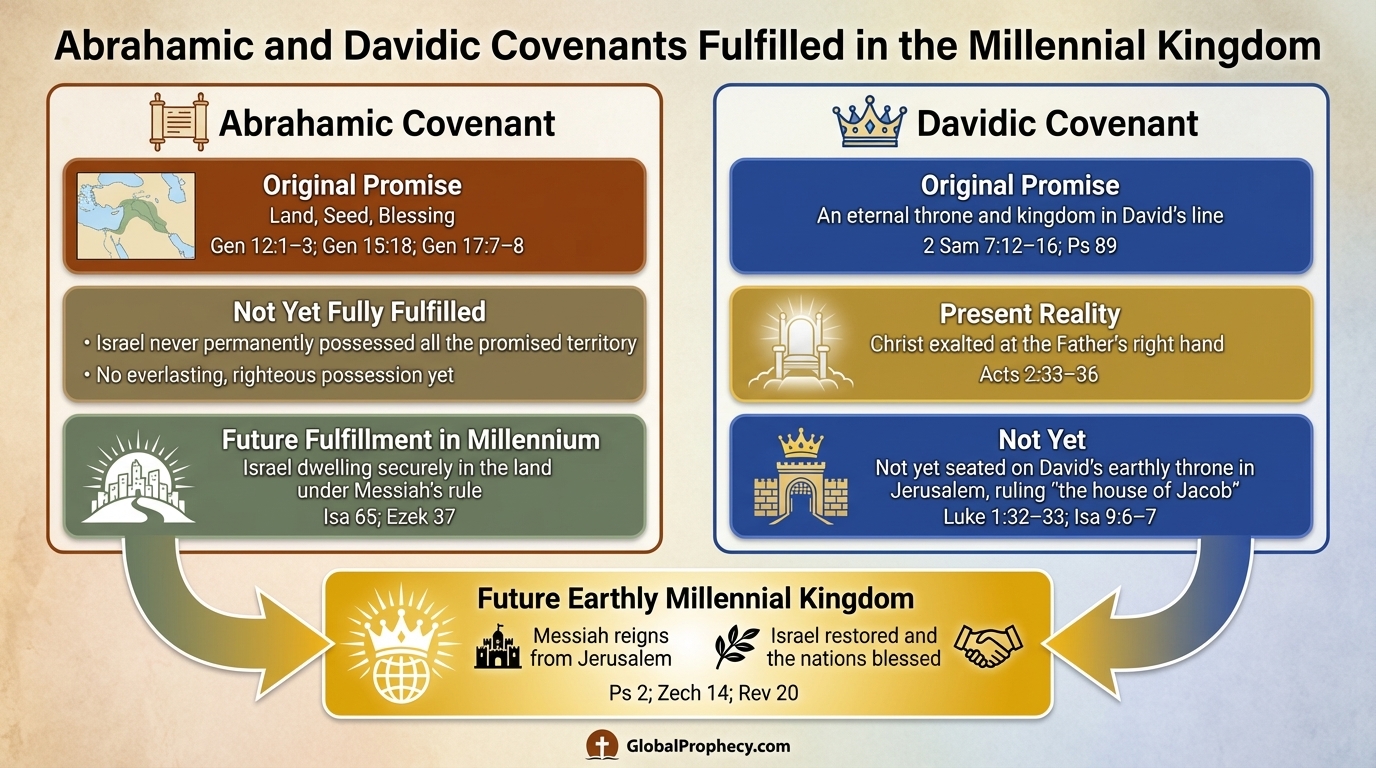
6.2 Davidic Covenant: A Throne in David’s Line Forever
God promised David:
“Your house and your kingdom shall be made sure forever before me. Your throne shall be established forever.”
— 2 Sam 7:16
The angel Gabriel applies this directly to Jesus:
“The Lord God will give to him the throne of his father David, and he will reign over the house of Jacob forever, and of his kingdom there will be no end.”
— Luke 1:32–33
Premillennialism recognizes:
- Christ is now exalted at the Father’s right hand in heaven (Acts 2:33–36),
- But He has not yet sat on David’s earthly throne in Jerusalem ruling “the house of Jacob” as such.
The Davidic covenant requires that David’s greater Son literally reign from David’s city over Israel and the nations (Ps 2; Isa 9:6–7). A future millennium provides the setting in which this covenant is fulfilled on earth, prior to the eternal state.
7. Jesus, the Apostles, and Israel’s Future
7.1 Jesus’ Promise of Thrones in Israel
Jesus told His disciples:
“In the new world, when the Son of Man will sit on his glorious throne, you who have followed me will also sit on twelve thrones, judging the twelve tribes of Israel.”
— Matt 19:28; cf. Luke 22:28–30
This is:
- A promise of judicial authority over literal Israel,
- Linked to a future “new world” (palingenesia, “regeneration” of all things).
It naturally belongs to a messianic kingdom on earth, not merely to the church age or a purely heavenly scene.
7.2 Acts 1:6–7: Jesus Does Not Cancel Israel’s Kingdom Hope
After forty days of post‑resurrection instruction “about the kingdom of God” (Acts 1:3), the disciples ask:
“Lord, will you at this time restore the kingdom to Israel?”
— Acts 1:6
If their expectation of a restored, national kingdom for Israel were mistaken, this was the moment for Jesus to correct them. Instead, He replies:
“It is not for you to know times or seasons that the Father has fixed by his own authority.”
— Acts 1:7
He affirms that such a restoration is on the Father’s calendar but withholds the timing. Premillennialism takes this at face value: a future restoration of the kingdom to Israel, inaugurated when Christ returns.
7.3 Romans 11: The Future Salvation of National Israel
Paul writes:
“A partial hardening has come upon Israel, until the fullness of the Gentiles has come in. And in this way all Israel will be saved.”
— Rom 11:25–26
He supports this with Isaiah 59:
“The Deliverer will come from Zion, he will banish ungodliness from Jacob.”
Here “all Israel” is contrasted with “the Gentiles”; it refers to ethnic Israel, not the church. Israel’s hardening is:
- Partial (some Jews are saved now),
- Temporary (“until the fullness of the Gentiles has come in”).
Premillennialism sees in this a future national turning of Israel to her Messiah, followed by her restoration to the covenant blessings promised in the Abrahamic and Davidic covenants—precisely what the millennium describes.
8. Why a Literal Thousand Years?
Some object that “thousand” can be symbolic in Scripture (Ps 50:10; 2 Pet 3:8). It is true that numbers can carry symbolic overtones. Yet in Revelation:
- Time indicators like “forty‑two months” (Rev 11:2; 13:5), “1,260 days” (11:3; 12:6), and “three and a half days” (11:9) are treated as definite periods.
- The number “thousand” is used in specific counts (e.g., 144,000 in Rev 7:4; 14:1), not merely as metaphor.
Thus a literal thousand years can still be symbolically significant (fullness, completeness), just as Israel’s literal forty years in the wilderness tested the nation yet also symbolized a period of testing. There is no contextual signal in Revelation 20 that “thousand years” must be purely figurative or collapsed into the entire church age.
Premillennialism therefore reads “thousand years” literally, while acknowledging its symbolic richness.
9. Conclusion
Premillennialism offers a coherent, text‑driven account of biblical eschatology:
- It respects the sequential flow of Revelation 19–20.
- It takes seriously the future, total binding of Satan and the two bodily resurrections of Revelation 20.
- It provides a natural home for Old Testament kingdom prophecies that fit neither this age nor the eternal state (e.g., Isa 65; Zech 14).
- It honors the unconditional covenants with Abraham and David, expecting their literal fulfillment in history.
- It maintains the integrity of Jesus’ promises to His apostles and Paul’s forecast of Israel’s future salvation and restoration.
From Genesis to Revelation, the storyline anticipates not only a crucified and risen Messiah but a reigning Messiah, ruling on the earth from David’s throne, with Israel restored, the nations subdued, creation renewed, and the saints reigning with Him. That is the millennial kingdom, inaugurated after His return and consummated in the eternal state.
Premillennialism, rightly understood, is simply the consistent outworking of a grammatical‑historical reading of Scripture and the sure confidence that every promise of God—temporal and eternal—will be fulfilled in Christ.
FAQ
Q: Where in the Bible is the millennium specifically mentioned?
The term “thousand years” appears six times in Revelation 20:2–7. This passage describes Satan’s binding, the resurrection of the saints, and their reign with Christ for a thousand years, followed by the release of Satan and final judgment. Other Old Testament texts (e.g., Isa 65; Zech 14; Ps 72) describe conditions that fit this millennial kingdom, though they do not use the word “millennium.”
Q: Why does premillennialism insist on a literal thousand years in Revelation 20?
Because the passage repeats the time frame six times and gives no contextual signal that it is purely metaphorical. In Revelation and other apocalyptic texts, numbers normally denote real quantities even when they carry symbolic meaning. A literal thousand years can still be a symbol of fullness, but it remains a definite, future period of Christ’s earthly reign.
Q: How does premillennialism differ from amillennialism and postmillennialism?
Premillennialism teaches that Christ returns before the millennium and then reigns bodily on earth for a thousand years. Amillennialism sees the millennium as the present church age, with Christ reigning spiritually from heaven and no future earthly kingdom. Postmillennialism views the millennium as a golden age within this age, brought about through the success of the gospel, with Christ returning only after the world is largely Christianized.
Q: What role does Israel play in premillennialism?
Premillennialism maintains a future for national Israel distinct from the church. Based on the Abrahamic and Davidic covenants and texts like Romans 11:25–29 and Acts 1:6–7, it expects a future national conversion and restoration of Israel under Messiah’s reign, in the land promised to the patriarchs, within the millennial kingdom.
Q: Does premillennialism deny that Christ is reigning now?
No. Premillennialism affirms that Christ is currently exalted at the Father’s right hand, sovereign over heaven and earth, and reigning spiritually over His church. It also holds that there is a future, distinct phase of His reign—the messianic kingdom on earth—in which He will sit on David’s throne in Jerusalem, rule the nations with a rod of iron, and fulfill the earthly promises made to Israel and the saints.
Frequently Asked Questions
Where in the Bible is the millennium specifically mentioned?
Why does premillennialism insist on a literal thousand years in Revelation 20?
How does premillennialism differ from amillennialism and postmillennialism?
What role does Israel play in premillennialism?
Does premillennialism deny that Christ is reigning now?
L. A. C.
Theologian specializing in eschatology, committed to helping believers understand God's prophetic Word.
Related Articles
Amillennialism Examined: Is the Church the Millennial Kingdom?
Amillennialism examined: is the church the millennial kingdom? Explore its claims, symbols, and a biblical critique of this end-times view.
Comparing the Millennial Views: Which View Is Biblical?
Millennial views compared: premillennialism, amillennialism, and postmillennialism. Examine key texts to see which view best fits Scripture.
What is the Millennium? The 1000-Year Reign of Christ
Millennium: the 1000-year reign of Christ explained. Discover its duration, nature, and prophetic significance in God’s future kingdom plan.
The Millennium Explained: What the Bible Teaches About the 1000-Year Reign
Millennium explained from Scripture: explore the Bible’s teaching on Christ’s 1000-year reign, its purpose, timing, and promises for Israel and the nations.