
The Pre-Wrath Rapture View Examined
1. Introduction
Among modern evangelical rapture positions, the pre‑wrath rapture view (associated chiefly with Marvin Rosenthal and Robert Van Kampen) is one of the more recent and complex. It is a variation of midtribulationism, but with distinctive terminology and a unique partitioning of Daniel’s seventieth week.
This article will (1) summarize the core claims of the pre‑wrath view, (2) examine its central exegetical pillars, and (3) show, from Scripture, that God’s wrath begins with the seal judgments, not only with the later trumpet or bowl judgments. Along the way we will address the key distinction pre‑wrath proponents make between “Satan’s wrath” and “God’s wrath,” and why that distinction fails to sustain their scheme.
2. Core Claims of the Pre‑Wrath Rapture View
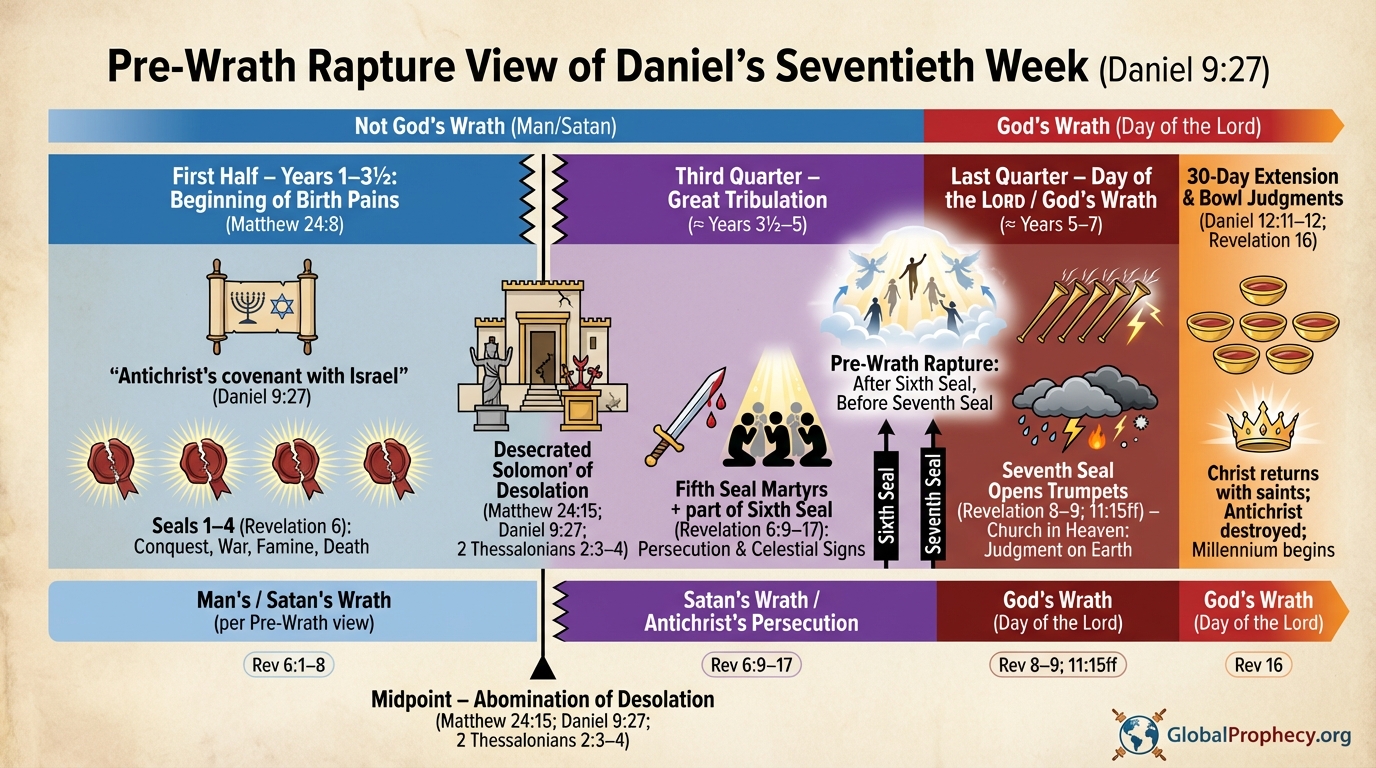
While individual proponents differ in details, pre‑wrath teaching generally affirms the following structure of Daniel’s seventieth week (Daniel 9:27):
-
First half (years 1–3½): “Beginning of birth pains”
- Initiated by the Antichrist’s covenant with Israel.
- Identified with the first four seals of Revelation 6.
- Labeled a time of “man’s wrath,” not divine wrath.
- Not “the tribulation” in the technical, prophetic sense.
-
Midpoint: Abomination of desolation (Matthew 24:15; Daniel 9:27; 2 Thessalonians 2:3–4)
- Antichrist reveals his true character, desecrates the temple, and begins persecuting Israel.
-
Third quarter (roughly years 3½–5 or so): The “Great Tribulation”
- Begins at the mid‑week abomination.
- Identified with the fifth seal (martyrs) and part of the sixth seal (cosmic disturbance).
- Defined as Satan’s wrath and Antichrist’s persecution, not God’s wrath.
- According to Matthew 24:22, “cut short” so that it lasts less than a full 3½ years.
-
Pre‑wrath rapture: sometime after the sixth seal but before the seventh
- Christ appears; the church is raptured between the sixth and seventh seals.
- The rapture is said to occur “before the wrath” (hence “pre‑wrath”), but within the second half of the seventieth week.
-
Last quarter (about 1½–2 years): The Day of the Lord / God’s wrath
- Begins with the seventh seal (Revelation 8:1).
- Comprises the trumpet judgments (Revelation 8–9; 11:15ff).
- God’s wrath falls on an unbelieving world; the church is now in heaven.
-
Thirty‑day extension and bowl judgments (Daniel 12:11–12)
- The bowl judgments (Revelation 16) are often placed in this post‑week period.
- Christ returns to earth with His saints at the end of these judgments to destroy Antichrist and inaugurate the millennial kingdom.
Under this scheme, the “rapture of the church” and the “Second Coming” are not totally conflated as in strict posttribulationism; rather, the rapture is placed late in the second half, but before the climactic Day‑of‑the‑Lord wrath that begins at the seventh seal.
The key theological driver is simple: the church is not appointed to God’s wrath (1 Thessalonians 1:10; 5:9), therefore the rapture must occur before that wrath begins. Pre‑wrath argues that God’s wrath does not begin until after the sixth seal.
3. Does God’s Wrath Begin Only with the Seventh Seal?
The decisive question is: When does the Bible say the wrath of God begins in the Apocalypse? Pre‑wrath says: “With the seventh seal.” The text of Revelation, however, points earlier—already within the seal judgments.
3.1. The Lamb Opens Every Seal
Revelation 5–6 portrays the glorified Christ as the only One worthy to open the sealed scroll:
“He went and took the scroll from the right hand of him who was seated on the throne.”
— Revelation 5:7
Then:
“Now I watched when the Lamb opened one of the seven seals…”
— Revelation 6:1
…and the same formula precedes each seal (6:3, 5, 7, 9, 12; 8:1).
The seals are not initiated by Satan, Antichrist, or blind historical forces. They are inaugurated by the Lamb Himself, acting in direct execution of the Father’s judicial plan (cf. John 5:22). Thus the seals are as much acts of God as the trumpets and bowls which follow.
To label the first six seals “man’s wrath” or “Satan’s wrath” and only the seventh seal “God’s wrath” cuts across the grain of the text. Instrumentally, God may use human and satanic agency, but their activity is secondary, not primary (cf. Isaiah 10:5–15; Ezekiel 14:21; Romans 13:1–4).
3.2. The Sixth Seal: “The Great Day of Their Wrath Has Come”
Revelation 6:12–17, the sixth seal, is decisive:
“Then the kings of the earth and the great ones… hid themselves in the caves… calling to the mountains and rocks, ‘Fall on us and hide us from the face of him who is seated on the throne, and from the wrath of the Lamb, for the great day of their wrath has come, and who can stand?’”
— Revelation 6:15–17, ESV
Several points must be noted:
-
The people themselves interpret the events as “the wrath of the Lamb.”
- These are unbelieving kings, generals, the mighty—hardly friendly to Christ. Yet even they perceive the source as divinely judicial, not merely natural or satanic.
-
The grammar indicates that wrath has already arrived.
- The verb “has come” (ἦλθεν, ēlthen) is an aorist indicative. In Revelation, John does not use this construction for something merely about to occur. Elsewhere it clearly denotes arrival or past inception.
- The most straightforward reading is that the great day of wrath has already begun and is now climactically unfolding in the sixth seal; it is not merely pending.
-
The “great day of their wrath” is not limited to a single instant.
- In prophetic usage, a “day” (especially “the Day of the LORD”) can encompass an extended period in which judgment unfolds (cf. Joel 2; 1 Thessalonians 5:2–3).
- Thus Revelation 6:17 is best read as a summary of the seals as a whole—the day of wrath has begun with these judgments, now reaching a terrifying crescendo.
If the Lamb is opening each seal, and if the great day of His wrath “has come” in connection with the sixth seal, it is exegetically artificial to push the beginning of God’s wrath down to the seventh seal. The biblical text itself locates divine wrath inside the seal series, not only after it.
4. Seals, Trumpets, and Bowls: One Seamless Stream of Wrath
Pre‑wrath insists on sharply dividing the seals from the trumpets and bowls: seals = man/Satan; trumpets/bowls = God. Scripture, however, portrays them as a single escalating sequence of divine judgments.
4.1. Common Source: The Throne and the Lamb
- The seals are opened by the Lamb (Revelation 6).
- The trumpets emerge from the opening of the seventh seal (Revelation 8:1–6); they are not an independent, later program.
- The bowls are poured out as the completion of God’s wrath (Revelation 15:1).
All three series issue from the same heavenly court (cf. Revelation 4–5), are announced or executed by heavenly beings, and are freighted with Old Testament Day‑of‑the‑LORD imagery. There is no textual indication that they shift from “human wrath” to “divine wrath” at some mid‑point. Rather, they represent intensifying waves of the same divine judicial program.
4.2. Common Phenomena and Motifs
- Cosmic disturbances attend the sixth seal (Revelation 6:12–14), the seventh trumpet (Revelation 11:15–19), and the seventh bowl (Revelation 16:17–21).
- The language of “plagues,” “wrath,” and “judgment” is used across the whole sweep (Revelation 6–16).
- The seals themselves contain classic covenant‑curse instruments (sword, famine, pestilence, wild beasts; cf. Ezekiel 14:21), which in the Old Testament are explicitly God’s chastisements, not Satan’s.
To argue that only the last quarter of Daniel’s week is “the Day of the LORD” and that the seals are something categorically different runs against this integrated, escalating structure.
5. The Distinction Between Satan’s Wrath and God’s Wrath
Pre‑wrath advocates rightly observe that Satan has wrath (cf. Revelation 12:12) and that Antichrist will persecute the saints (Daniel 7:21, 25; Revelation 13:5–7). They then argue:
- The great tribulation (Matthew 24:21) is primarily Satan’s wrath against the saints, mediated through Antichrist.
- The Day of the LORD is God’s wrath, poured on unbelievers.
- Therefore, the church can be present under “Satan’s wrath” but must be removed before “God’s wrath.”
This distinction is inadequate on multiple fronts.
5.1. Concurrent, Overlapping Wraths
Scripture nowhere teaches that Satan’s wrath and God’s wrath are mutually exclusive in time. In fact, God frequently uses wicked instruments to accomplish His judgments, even as they themselves act out of sinful motives (see Habakkuk 1–2; Isaiah 10:5–12).
In the Tribulation, two things happen simultaneously:
- Satan and Antichrist vent their fury on God’s people.
- God uses those very persecutions—as well as ecological, cosmic, and military catastrophes—to judge the world and discipline Israel.
Labeling one block of time “only Satan’s wrath” and another block “only God’s wrath” imposes an artificial dichotomy. The Bible presents the end‑time scenario as a complex interplay of divine sovereignty and human/satanic agency, not as discrete, non‑overlapping “wrath periods.”
5.2. Believers Suffer Under God‑Directed Judgments Too
Even granting that Antichrist’s persecution is Satanic, pre‑wrath must still explain how believers are supposedly shielded from God’s judgments prior to the rapture if those judgments are already falling globally.
For example:
- In the fourth seal, a quarter of earth’s population dies through sword, famine, pestilence, and wild beasts (Revelation 6:8).
- In the sixth seal, cosmic upheaval affects “every slave and free” (6:15).
The text gives no hint that church‑age believers on earth are exempt from these effects. To maintain a pre‑wrath scheme, one must either:
- Deny these are God’s judgments (contradicting Revelation 6:16–17), or
- Assert a universal divine protection of believers from collateral damage—something Revelation never promises.
Yet, by contrast, God’s promise to the church is not preservation in wrath, but deliverance from the wrath to come (1 Thessalonians 1:10; 5:9; Revelation 3:10).
6. The Church and “Wrath”: New Testament Promises
Pre‑wrath rightly emphasizes texts such as:
“Jesus… delivers us from the wrath to come.”
— 1 Thessalonians 1:10
“For God has not destined us for wrath, but to obtain salvation through our Lord Jesus Christ.”
— 1 Thessalonians 5:9
“…I will keep you from the hour of trial that is coming on the whole world, to try those who dwell on the earth.”
— Revelation 3:10
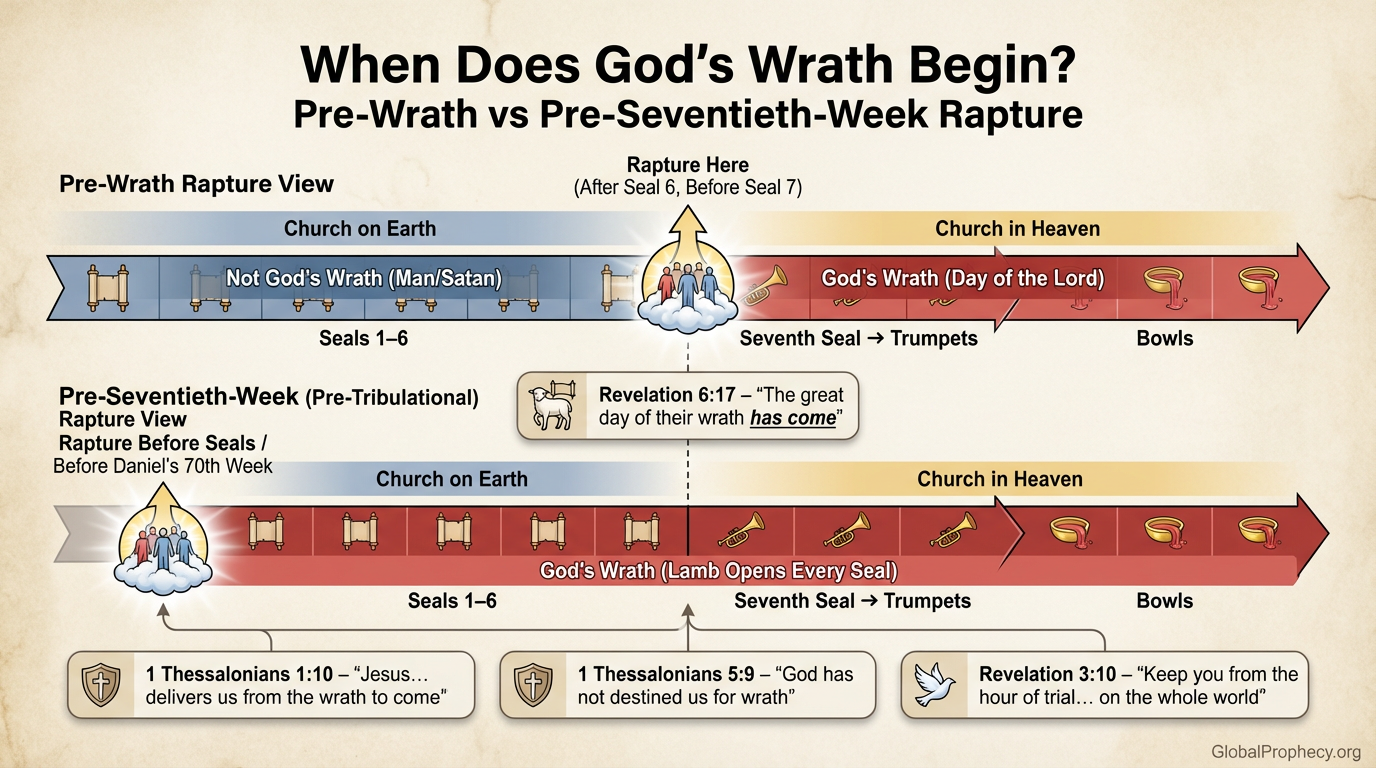
However, having mis‑dated the onset of wrath, the view mis‑locates the rapture. If wrath begins with the seals, then a rapture after the sixth seal is not “pre‑wrath” in the biblical sense. It is, at best, mid‑wrath.
A consistent reading would be:
- If believers are promised deliverance from the coming wrath.
- And if that wrath is already active in the seals.
- Then the rapture must occur before the seal judgments begin—that is, before the seventieth week’s series of judgments unfolds.
Thus, the very passages pre‑wrath uses to justify a late‑Tribulation rapture, when read alongside Revelation 6, actually support a pre‑seventieth‑week (pre‑seal, pre‑tribulational) rapture.
7. Conclusion
The pre‑wrath rapture view deserves to be taken seriously: it affirms the authority of Scripture, anticipates a future, literal tribulation, and attempts to honor the church’s exemption from divine wrath. Yet its distinctive claim—that God’s wrath does not begin until after the sixth seal, and that the earlier seals are “man’s wrath” or “Satan’s wrath”—cannot stand under close biblical scrutiny.
- The Lamb opens each seal.
- The great day of God’s wrath “has come” already by the sixth seal (Revelation 6:17).
- The seals, trumpets, and bowls form one continuous stream of divinely initiated judgment.
- Satan’s wrath and God’s wrath are concurrent, not neatly separated eras.
Once the text is allowed to speak on its own terms, it becomes clear that the Day of the LORD’s wrath encompasses the entire sequence of judgments beginning with the seals. Therefore, if the church is truly promised deliverance from “the wrath to come” (1 Thessalonians 1:10; 5:9), the rapture must precede not merely the trumpets and bowls, but the seal judgments themselves.
In that light, the pre‑wrath rapture is mis‑named. It is not actually before wrath; it is after the onset of the Lamb’s wrath. An examination of the pre‑wrath view thus leads, not to its confirmation, but to a renewed confidence that God’s design is to remove His church before the entire seventieth‑week outpouring of His judicial anger—exactly what a pretribulational, pre‑seventieth‑week rapture teaches.
Frequently Asked Questions
What is the pre-wrath rapture view?
Does God's wrath begin only with the seventh seal?
Is there a difference between Satan's wrath and God's wrath?
Why is the pre-wrath view misnamed?
L. A. C.
Theologian specializing in eschatology, committed to helping believers understand God's prophetic Word.
Related Articles
Mid-Tribulationalism Examined
Mid-tribulationalism examined in depth: understand its last trumpet argument, compare rapture texts, and see biblical reasons the church misses all tribulation.
Post-Tribulationalism Examined
Post-tribulationalism examined with a fair summary of the posttrib rapture view plus biblical critiques on imminence, the tribulation, and the millennium.
Pre-Tribulationalism Examined
Pretribulationalism examined: a detailed defense of the pre-trib rapture, Israel–Church distinction, exemption from wrath, and the doctrine of imminence.
The Partial Rapture View Examined
Partial rapture view examined and refuted biblically, showing from New Testament texts that Christ will rapture all true believers, not only the watchful few.