
The Rapture as a Mystery
1. Introduction
In the New Testament, the apostle Paul calls the rapture “a mystery” (1 Corinthians 15:51). This term is not casual or poetic; it is a precise theological category. Understanding why the rapture is a mystery clarifies both its uniqueness and its place in God’s prophetic program.
This article will explain the New Testament concept of mystery (mystērion), show how the rapture fits that category, and highlight what makes the rapture unprecedented in biblical revelation—especially the reality that an entire generation of believers may pass into glory without ever dying.
2. The New Testament Meaning of “Mystery” (mystērion)
2.1 Not a puzzle, but a revealed secret
In common English, a “mystery” is something strange or hard to figure out. In the New Testament, however, a mystery is a divine secret once hidden but now revealed by God. It is truth that:
- Was not knowable by human investigation.
- Was not disclosed in the Old Testament.
- Has now been made known through Christ and His apostles.
Paul describes this category clearly:
“The mystery hidden for ages and generations but now revealed to his saints.”
— Colossians 1:26
In other words, a mystērion is not something eternally obscure; it is a previously unrevealed aspect of God’s plan that He has chosen to unveil in the New Testament era.
Examples include:
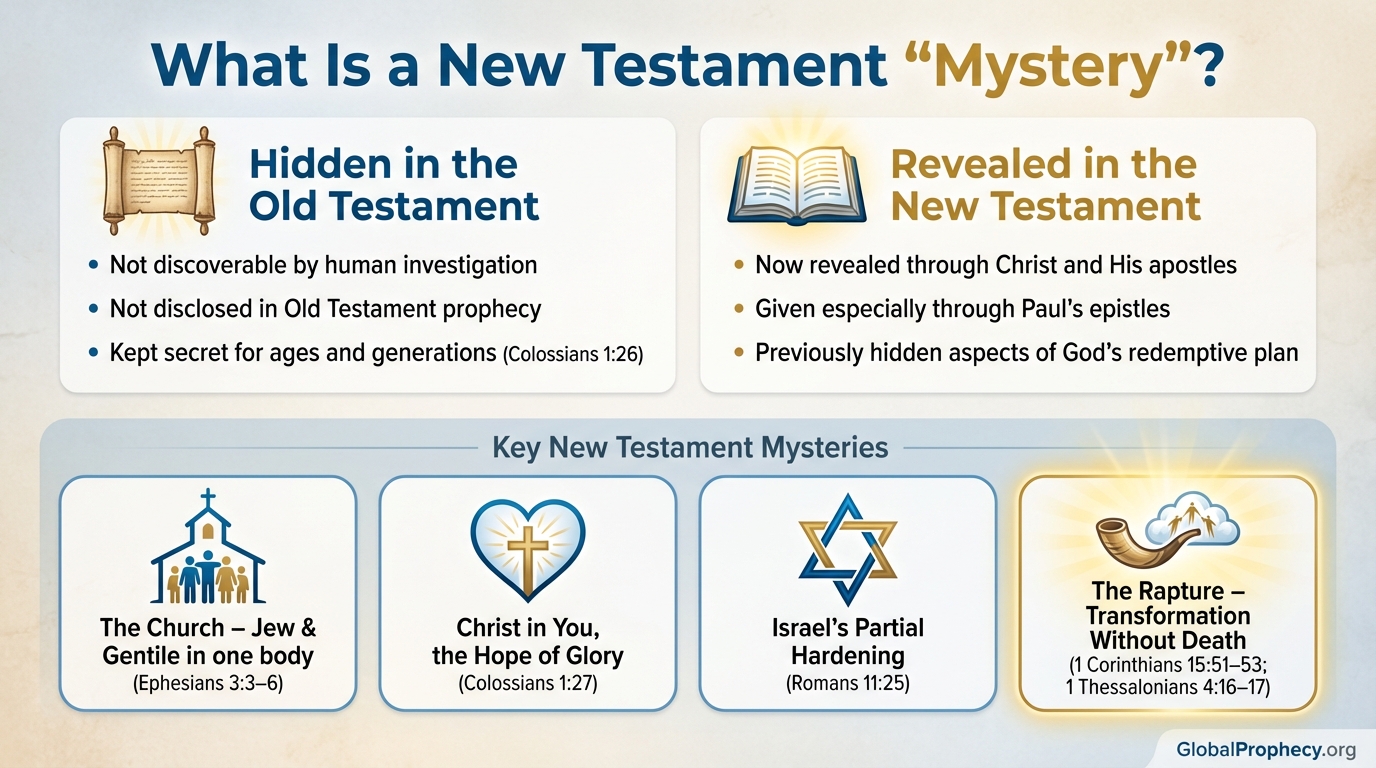
- The church—Jews and Gentiles united in one body in Christ (Ephesians 3:3–6).
- Christ in you, the hope of glory (Colossians 1:27).
- The partial hardening of Israel until the fullness of the Gentiles (Romans 11:25).
To this list Paul adds the rapture as a mystery.
3. “Behold, I Tell You a Mystery”: The Rapture in 1 Corinthians 15:51
The central text is 1 Corinthians 15:51–53:
“Behold! I tell you a mystery. We shall not all sleep, but we shall all be changed,
in a moment, in the twinkling of an eye, at the last trumpet. For the trumpet will sound,
and the dead will be raised imperishable, and we shall be changed.
For this perishable must put on the imperishable, and this mortal must put on immortality.”
Paul explicitly labels what he is about to reveal as “a mystery”. What is the content of this mystery? At least three elements:
- “We shall not all sleep” – Not all believers will experience physical death.
- “We shall all be changed” – Both dead and living believers will receive glorified bodies.
- “In a moment, in the twinkling of an eye” – This transformation will be instantaneous and simultaneous.
The distinctive, newly revealed truth is not that there will be a resurrection—that was already known from the Old Testament—but that a whole generation of believers will bypass death entirely while still being transformed.
4. The Rapture Was Not Revealed in the Old Testament
4.1 Resurrection was known; rapture was not
The Old Testament clearly affirms bodily resurrection. For example:
- Daniel 12:2: “Many of those who sleep in the dust of the earth shall awake, some to everlasting life…”
- Isaiah 26:19: “Your dead shall live; their bodies shall rise.”
What these passages do not reveal is:
- A catching up of living saints to meet the Lord in the air.
- A simultaneous transformation of both dead and living believers into glorified, immortal bodies.
- The possibility that a large company of saints will never experience death at all.
These rapture-specific elements are entirely absent from Old Testament prophecy. They are new revelation, given only after Christ’s death and resurrection and entrusted especially to Paul.
4.2 New Testament revelation of the rapture
Three key New Testament passages together unfold this mystery:
- John 14:1–3 – Jesus’ promise to take His own to the Father’s house.
- 1 Thessalonians 4:13–17 – Detailed description of the catching up of dead and living believers.
- 1 Corinthians 15:51–53 – Emphasis on the mystery of transformation without death.
In John 14:3 Jesus says:
“I will come again and will take you to myself, that where I am you may be also.”
This is the first clear announcement in biblical revelation of Christ coming to receive His people to heaven, not to set up His kingdom on earth. But the mechanics of how this would occur remained largely undefined until Paul’s later teaching.
In 1 Thessalonians 4:16–17, Paul fills in the structure:
“The dead in Christ will rise first. Then we who are alive, who are left, will be caught up together with them in the clouds
to meet the Lord in the air, and so we will always be with the Lord.”
Then in 1 Corinthians 15, he explains the transformation aspect as a previously hidden mystery.
5. What Exactly Is New About the Rapture?
5.1 The unprecedented promise: some believers will never die
The most striking new element of the rapture mystery is summed up in the simple line:
“We shall not all sleep, but we shall all be changed” (1 Corinthians 15:51).
In biblical language, “sleep” is a common metaphor for the death of believers (1 Thessalonians 4:13–14). Paul is saying:
- A final generation of Christians will be alive on earth when Christ comes.
- These believers will not experience physical death.
- Yet they will still undergo the necessary change from mortal to immortal.
This is something no Old Testament believer could have inferred. The consistent pattern until this revelation was:
Life → Death → Resurrection → Glory.
The rapture mystery reveals a new pattern for one generation:
Life → Instant Transformation → Glory.
5.2 The corporate, instantaneous nature of the event
Another new aspect is the corporate and instantaneous nature of the transformation:
- “In a moment” – The Greek word (atomos) suggests an indivisible instant.
- “In the twinkling of an eye” – The fastest observable human motion.
- “We shall all be changed” – No believer is excluded, whether recently converted or long-matured; all in Christ are transformed.
This simultaneous transformation of the entire living church, together with the resurrection of all dead believers of the church age, is a unique event in God’s program—unrevealed before the New Testament.
5.3 Meeting the Lord in the air and going to the Father’s house
A further element of the mystery is the destination and mode of meeting:
- “Caught up… in the clouds to meet the Lord in the air” (1 Thessalonians 4:17).
- Taken to the Father’s house (John 14:2–3).
Old Testament prophecy overwhelmingly anticipates the Messiah coming to earth to reign, with His saints enjoying blessing in a renewed, earthly kingdom. The idea that:
- Christ would descend partway,
- His saints would ascend to meet Him in the air,
- And He would then escort them to the Father’s house in heaven,
is distinctive to New Testament revelation and is never described in Old Testament prophetic expectation.
6. The Rapture in Relation to Other “Mysteries”
Paul’s labeling of the rapture as a mystērion places it alongside other key New Testament revelations that define the church age:
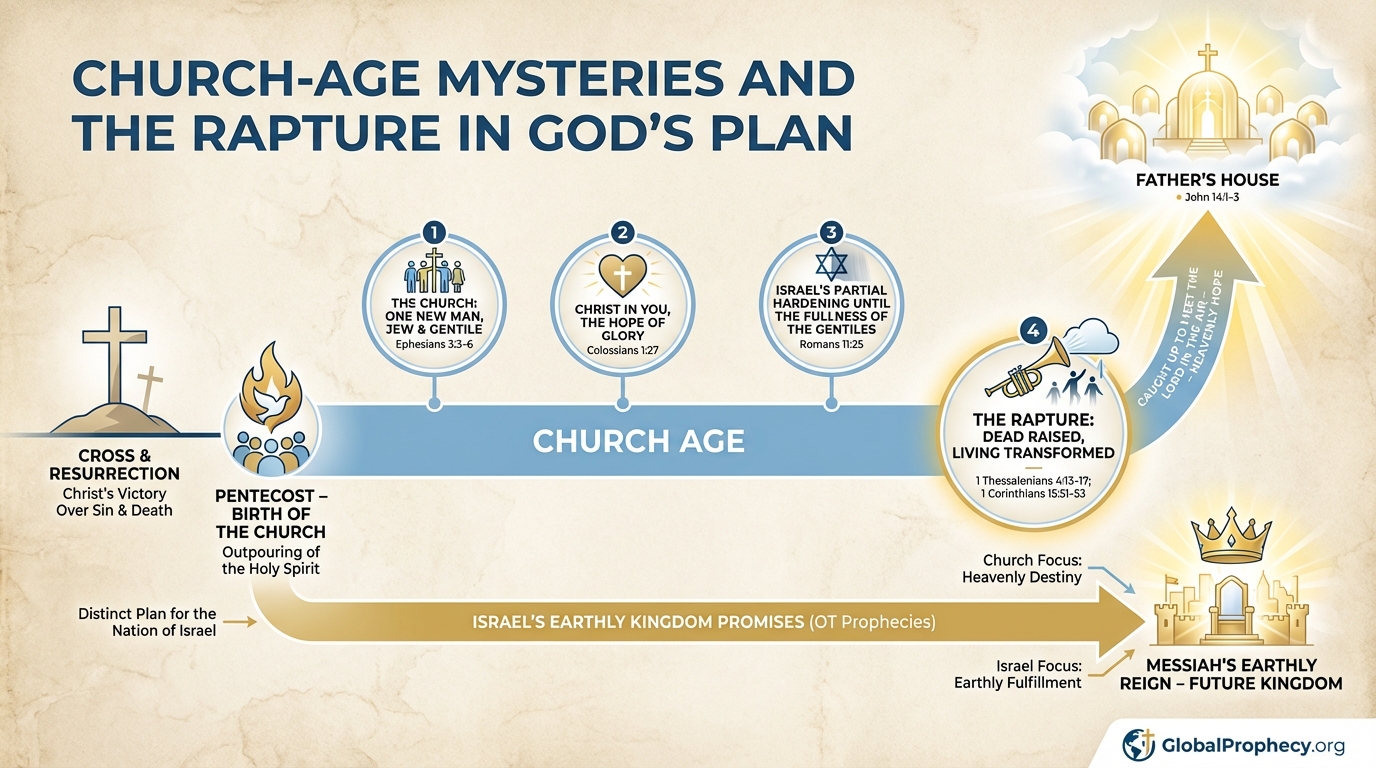
- The church as one new man, Jew and Gentile united in one body (Ephesians 3:3–6).
- Christ indwelling believers, “Christ in you, the hope of glory” (Colossians 1:27).
- The partial hardening of Israel until the fullness of the Gentiles (Romans 11:25).
Each of these:
- Was not revealed in the Old Testament.
- Concerns God’s distinctive work in the present age.
- Is unfolded especially in Paul’s epistles.
The rapture as a mystery fits this same pattern. It is tightly bound to the doctrine of the church—Christ’s body, formed by the Spirit at Pentecost and completed at the rapture. The rapture is, in effect, the church’s “exodus” from this world, just as uniquely as Pentecost was its supernatural birth into the world.
7. Why the Rapture Must Be a Revealed Mystery
7.1 It depends on Christ’s finished work and the church’s existence
The rapture could not be disclosed in advance of:
- Christ’s death and resurrection, which secured the victory over death and the guarantee of resurrection and glorification.
- The formation of the church, a distinct people united to Christ as His body and bride.
Only once these redemptive realities are in view can God unveil His plan to:
- Conclude the church age by catching up the entire body of Christ.
- Transform both dead and living believers into Christlike glory.
Thus, the timing of the revelation itself marks the rapture as a mystery. It belongs to the era after the cross and after Pentecost, and therefore could not be known in Old Testament times.
7.2 It guards against confusion with Old Testament kingdom expectations
By withholding this truth until the New Testament, God prevents the blending of two distinct prophetic trajectories:
- Israel’s earthly kingdom hope—Messiah reigning from Jerusalem over restored Israel and the nations.
- The church’s heavenly hope—to be caught up to meet Christ and be with Him where He is.
Revealing the rapture as a distinct mystērion allows us to respect both lines of prophecy without conflating them.
8. Practical Implications of the Rapture as Mystery
8.1 A call to expectancy
Because the rapture is not tethered to visible Old Testament signs, but arises from new revelation directly to the church, it is presented as an imminent event for believers:
- Believers are told to wait for His Son from heaven (1 Thessalonians 1:10).
- To look for the blessed hope (Titus 2:13).
- To be ready, so as not to be ashamed at His coming (1 John 2:28).
8.2 A unique comfort in the face of death
Paul introduces the rapture teaching in 1 Thessalonians 4:13–18 expressly:
“…that you may not grieve as others do who have no hope.”
Because of the rapture mystery, believers can say, even at the grave:
- The dead in Christ will rise first.
- We who are alive will be reunited with them.
- An entire generation may never die at all.
This double assurance—resurrection of the dead and transformation of the living—rests precisely on the newly revealed mystery Paul unveiled.
9. Conclusion
When Paul writes, “Behold, I tell you a mystery” (1 Corinthians 15:51), he is not embellishing a familiar doctrine but unveiling an entirely new facet of God’s redemptive plan. The rapture is a mystery because:
- It was not revealed in the Old Testament.
- It depends on Christ’s finished work and the existence of the church.
- It introduces a wholly unprecedented reality: that some believers will never die, yet will be transformed in an instant to immortal glory.
This newly revealed truth does not cancel Old Testament promises; it complements them. As part of the fuller New Testament revelation, the rapture displays the grace of God toward His church and underscores the certainty of our final transformation:
“For this perishable body must put on the imperishable, and this mortal body must put on immortality.”
— 1 Corinthians 15:53
To understand the rapture as a mystery is to see it as pure revelation—a gift of divine insight into God’s purposes for His people in the present age and their extraordinary exit from this world at the coming of the Lord.
Frequently Asked Questions
Why did Paul call the rapture a 'mystery'?
What is the mystery about the rapture?
Was the rapture taught in the Old Testament?
How does the rapture differ from Old Testament prophecy?
L. A. C.
Theologian specializing in eschatology, committed to helping believers understand God's prophetic Word.
Related Articles
Rapture vs Second Coming: What's the Difference?
Rapture vs Second Coming: learn how Scripture distinguishes Christ coming for His saints from coming with them—different purposes, audiences, outcomes.
The 144,000 Sealed Israelites
144,000 sealed Israelites in Revelation identified and explained—their identity, purpose, and distinct role as preserved witnesses during the Tribulation.
Babylon the Great
Babylon the Great in Revelation 17–18 reveals end-time religious and commercial rebellion against God and its sudden, final destruction in judgment.
What is the Battle of Armageddon?
Armageddon, the climactic end-times battle, is described in Revelation 16 and 19. Learn what this final conflict is and when it will occur.