
Rapture vs Second Coming: What's the Difference?
1. Introduction
Among all end‑times themes in biblical eschatology, few are more often confused than the rapture of the church and the Second Coming of Christ. Scripture presents both as aspects of Christ’s future return, yet they are not the same event.
From a careful reading of the New Testament, the rapture is Christ’s coming for His saints, catching them up to meet Him in the air and taking them to the Father’s house. The Second Coming is Christ’s coming with His saints, descending in power and glory to the earth to judge and to reign.
Some premillennial dispensationalists describe these as two phases of one broader “second coming” (the rapture before the Tribulation and the revelation after it). Others prefer to speak of them as two distinct but related events. In either case, the biblical contrasts are clear.
This article will set out those contrasts: different subjects, locations, purposes, timing, signs, visibility, and outcomes.
2. The Rapture: Christ Comes for His Church
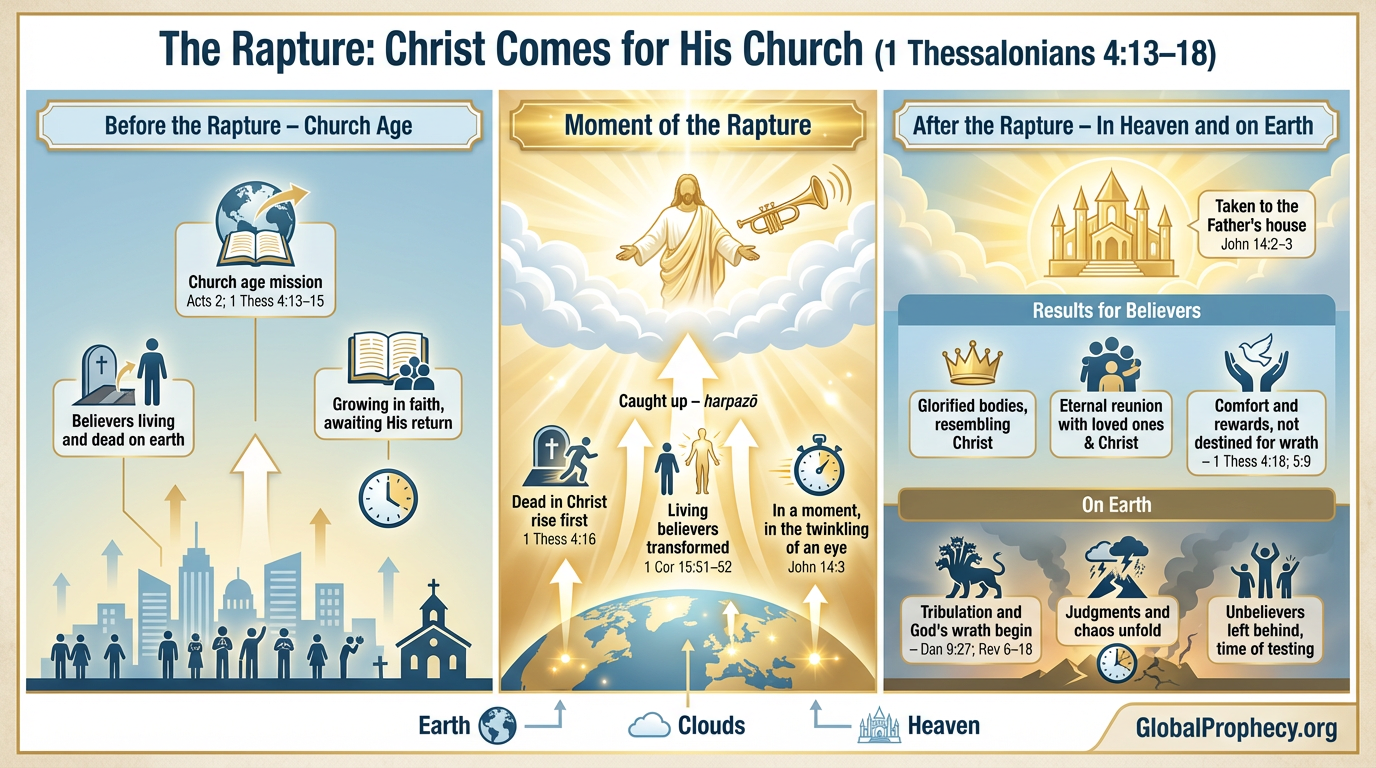
The central rapture passages are John 14:1–3; 1 Thessalonians 4:13–18; 1 Corinthians 15:51–52.
2.1 Core Texts
- John 14:2–3
“In my Father’s house are many rooms. … I go to prepare a place for you. And if I go and prepare a place for you, I will come again and will take you to myself, that where I am you may be also.”
Here Christ promises to return to take His disciples from earth to the Father’s house.
- 1 Thessalonians 4:16–17
“For the Lord himself will descend from heaven with a cry of command … and the dead in Christ will rise first. Then we who are alive, who are left, will be caught up together with them in the clouds to meet the Lord in the air, and so we will always be with the Lord.”
- 1 Corinthians 15:51–52
“Behold! I tell you a mystery. We shall not all sleep, but we shall all be changed, in a moment, in the twinkling of an eye….”
The “mystery” is that an entire generation of believers will receive glorified bodies without dying.
2.2 Key Characteristics
From these and related passages:
- Direction: Christ descends from heaven to the air, not all the way to earth (1 Thess 4:17).
- Destination: Believers are taken from earth to heaven—to the Father’s house (John 14:2–3).
- Participants: Only those “in Christ”—church‑age believers, living and dead (1 Thess 4:16).
- Action: Believers are “caught up” (Greek harpazō, snatched away) to meet the Lord in the air.
- Result: All church saints receive glorified, immortal bodies (1 Cor 15:51–53).
- Purpose: Comfort, reunion, and deliverance “from the wrath to come” (1 Thess 1:10; 4:18).
At the rapture, Christ comes for His bride (the church) and escorts her to heaven prior to the outpouring of divine wrath in the Tribulation.
3. The Second Coming: Christ Comes with His Saints
The Second Coming proper (often called the revelation of Christ) is described in Matthew 24:29–31; Zechariah 14:1–9; Revelation 19:11–16.
3.1 Core Texts
- Revelation 19:11, 14
“Then I saw heaven opened, and behold, a white horse! The one sitting on it is called Faithful and True…. And the armies of heaven, arrayed in fine linen, white and pure, were following him on white horses.”
The “armies in heaven” in fine linen correspond to the bride of Revelation 19:7–8—the glorified saints—returning with Christ.
- Zechariah 14:4
“On that day his feet shall stand on the Mount of Olives that lies before Jerusalem on the east….”
- Matthew 24:30–31
“Then will appear in heaven the sign of the Son of Man… and they will see the Son of Man coming on the clouds of heaven with power and great glory. And he will send out his angels with a loud trumpet call, and they will gather his elect from the four winds….”
Here Christ comes to the earth, visibly and publicly, in judgment and glory.
3.2 Key Characteristics
- Direction: Christ descends all the way to the earth, His feet standing on the Mount of Olives (Zech 14:4).
- Accompaniment: He comes with all His saints (1 Thess 3:13; Rev 19:14).
- Purpose: To judge the nations and establish His millennial kingdom (Matt 25:31–46; Rev 20:1–6).
- Scope: It is worldwide and visible to all: “every eye will see him” (Rev 1:7).
- Outcome: The Antichrist is destroyed, Satan is bound, Israel is saved, and the kingdom is inaugurated (2 Thess 2:8; Rev 19–20; Rom 11:26–27).
At the Second Coming, Christ does not remove the church from the earth; rather, already‑glorified saints return with Him to rule and reign.
4. Two Events or Two Phases?
From a dispensational, premillennial reading of Scripture:
- The rapture occurs before Daniel’s seventieth week (the seven‑year Tribulation; Dan 9:27).
- The Second Coming occurs after the Tribulation (Matt 24:29–30; Rev 19).
Whether we call these “two phases of Christ’s return” or “two distinct events,” they are separated in time and function:
- The rapture ends the church age and removes the church from the earth.
- The Second Coming terminates the Tribulation and introduces the millennial kingdom.
Confusing these two leads to serious interpretive problems, particularly regarding imminence, wrath, and who enters the kingdom in mortal bodies.
5. Side‑by‑Side Comparison: Rapture vs. Second Coming
The following table synthesizes key biblical contrasts, focusing on the fact that at the rapture Christ comes for His saints, while at the Second Coming He comes with His saints.
| Aspect | Rapture (Christ comes for His saints) | Second Coming (Christ comes with His saints) |
|---|---|---|
| Primary Texts | John 14:1–3; 1 Thess 4:13–18; 1 Cor 15:51–52 | Matt 24:29–31; Zech 14:1–9; Rev 19:11–16 |
| Direction & Location | Christ descends to the air; believers meet Him in the clouds (1 Thess 4:17). | Christ descends to the earth; His feet stand on the Mount of Olives (Zech 14:4). |
| Who Is Involved? | Christ comes for believers (“the dead in Christ” and living church saints). | Christ comes with believers (“all his saints,” “the armies of heaven”), and to Israel and the nations. |
| Destination of Saints | Saints are taken from earth to the Father’s house in heaven (John 14:2–3). | Saints return from heaven to earth to share in Christ’s rule (Rev 20:4–6). |
| Primary Purpose | To resurrect and transform church saints and deliver them from coming wrath (1 Thess 1:10; 5:9). | To judge the nations, destroy the Antichrist, save Israel, and establish the kingdom (Matt 25; Rev 19–20). |
| Visibility | Described as a sudden, “twinkling of an eye” event for believers (1 Cor 15:52); not said to be seen by the world. | “Every eye will see him” (Rev 1:7); accompanied by cosmic signs and great glory (Matt 24:29–30). |
| Timing relative to Tribulation | Before the day of the Lord’s wrath; church is promised deliverance “from the hour of trial” (1 Thess 1:10; Rev 3:10). | After the Tribulation: “Immediately after the tribulation … they will see the Son of Man coming” (Matt 24:29–30). |
| Relation to God’s Wrath | Church is removed from the time of wrath; “not destined for wrath” (1 Thess 5:9). | Christ personally executes wrath; “He treads the winepress of the fury of the wrath of God” (Rev 19:15). |
| Judgment vs. Comfort | Emphasis on comfort and hope: “Therefore encourage one another with these words” (1 Thess 4:18). | Emphasis on judgment and mourning among the unrepentant (Matt 24:30; Rev 19:15–21). |
| Imminence | Presented as an imminent, signless hope (“the Lord is at hand,” Phil 4:5; Titus 2:13). | Preceded by clear, identifiable signs in heavens and earth (Matt 24:15–30; Rev 6–18). |
| Effect on Believers’ Bodies | All church saints are glorified—“we shall all be changed” (1 Cor 15:51). | Believers who survive the Tribulation remain in mortal bodies to repopulate the kingdom (Matt 25:31–34; Isa 65:20–23). |
These contrasts are not arbitrary. They arise naturally from comparing the relevant texts.
6. Different Audiences and Programs: Church vs. Israel and the Nations
6.1 The Rapture and the Church
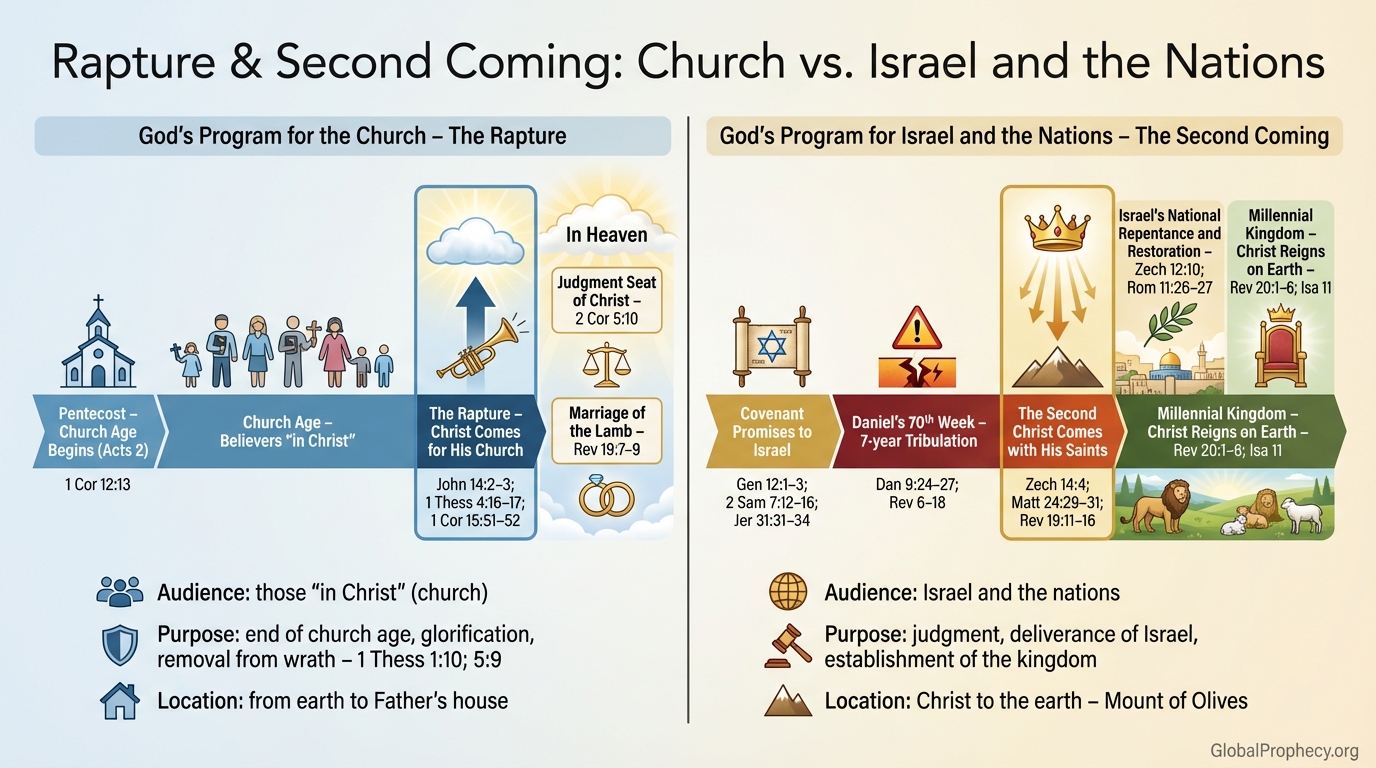
The rapture explicitly concerns those who are “in Christ” (1 Thess 4:16; 1 Cor 15:22–23). That phrase is specific to the church age, beginning at Pentecost with the baptism of the Spirit (Acts 2; 1 Cor 12:13). At the rapture:
- The church’s earthly mission ends.
- The church is taken to the Father’s house (John 14:2–3).
- The judgment seat of Christ and the marriage of the Lamb take place in heaven (2 Cor 5:10; Rev 19:7–9).
6.2 The Second Coming and Israel/Nations
By contrast, the Second Coming focuses on Israel and the Gentile nations:
- It fulfills Old Testament covenants and promises to Israel (Gen 12:1–3; 2 Sam 7:12–16; Jer 31:31–34).
- It culminates Daniel’s seventieth week, decreed upon “your people and your holy city” (Dan 9:24).
- It inaugurates Israel’s national repentance and restoration (Zech 12:10; 13:1; Rom 11:26–27).
- It brings the sheep and goat judgment of the nations (Matt 25:31–46).
Thus, the rapture pertains primarily to God’s program for the church, while the Second Coming pertains to His program for Israel and the world.
7. Different Practical Implications
Because the rapture and the Second Coming are different in nature and timing, they generate different applications for believers.
7.1 The Rapture: Purifying Hope
The imminent hope that Christ may come at any moment for His church:
- Motivates holy living:
“Everyone who thus hopes in him purifies himself as he is pure.” (1 John 3:3)
- Encourages steadfast service:
“Be steadfast, immovable, always abounding in the work of the Lord.” (1 Cor 15:58)
- Provides profound comfort in bereavement:
“That you may not grieve as others do who have no hope.” (1 Thess 4:13)
7.2 The Second Coming: Sobering Warning
The certainty that Christ will come in judgment with His saints:
- Warns the lost of coming wrath and accountability (Acts 17:31; Rev 19:11–16).
- Assures believers that righteousness will finally prevail, and evil will be judged.
- Anchors our expectation of a future, earthly kingdom where Christ reigns in righteousness (Rev 20:1–6; Isa 11; Ps 2).
8. Conclusion
Biblical eschatology distinguishes clearly between:
- The rapture—when Christ comes for His saints, in the air, to take them to the Father’s house before the outpouring of divine wrath; and
- The Second Coming—when Christ comes with His saints, to the earth, in visible power and glory, to judge and to reign.
Whether described as two phases of Christ’s return or as two related events, their contrasts in participants, place, purpose, timing, visibility, and outcome are too significant to merge into a single occurrence.
Holding these distinctions preserves:
- The imminent, comforting hope of the church’s rapture, and
- The awesome, public triumph of Christ’s return in glory.
Both are certain. Christ will come for His own; later He will come with His own. The pressing question is not when these events will occur, but whether you are among those who belong to Him and are ready for His coming.
Frequently Asked Questions
What is the difference between the rapture and the Second Coming?
Are the rapture and Second Coming the same event?
Where do believers go at the rapture?
What happens at the Second Coming?
L. A. C.
Theologian specializing in eschatology, committed to helping believers understand God's prophetic Word.
Related Articles
The Rapture as a Mystery
Rapture mystery: explore why Paul called the rapture a 'mystery' in 1 Corinthians 15:51 and how this newly revealed truth means some believers never die.
The Second Coming vs The Rapture: Understanding Two Distinct Events
The Second Coming vs the Rapture: explore timing, purpose, and key differences between these two distinct end-times events in biblical prophecy.
The 144,000 Sealed Israelites
144,000 sealed Israelites in Revelation identified and explained—their identity, purpose, and distinct role as preserved witnesses during the Tribulation.
Babylon the Great
Babylon the Great in Revelation 17–18 reveals end-time religious and commercial rebellion against God and its sudden, final destruction in judgment.