
What Is the Resurrection of the Body?
1. Introduction
The resurrection of the body is a central doctrine of biblical eschatology. Christianity does not teach escape from the body into a purely spiritual existence; it proclaims that God will raise the dead and give them transformed, immortal bodies suited for eternal life or eternal judgment. This teaching runs from Job and Daniel through Jesus and Paul, and it shapes the whole Christian hope.
This article explains what the resurrection of the body is, its biblical basis, the nature of the resurrection body, the resurrection of both believers and unbelievers, and why this doctrine is so important for Christian faith and life.
2. Biblical Foundations for the Resurrection of the Body
2.1 Old Testament Witness
Though the Old Testament gives fewer explicit passages than the New, it clearly anticipates bodily resurrection.
Job confesses a physical hope beyond death:
"For I know that my Redeemer lives,
and at the last he will stand upon the earth.
And after my skin has been thus destroyed,
yet in my flesh I shall see God."
— Job 19:25–26
Isaiah promises that the dead of God’s people will rise:
"Your dead shall live; their bodies shall rise.
You who dwell in the dust, awake and sing for joy!...
the earth will give birth to the dead."
— Isaiah 26:19
Daniel speaks of resurrection for both the righteous and the wicked:
"And many of those who sleep in the dust of the earth shall awake,
some to everlasting life, and some to shame and everlasting contempt."
— Daniel 12:2
In these texts, “sleep in the dust,” “awake,” “bodies shall rise,” “in my flesh I shall see” all point to the reanimation and transformation of the body, not merely the survival of the soul.
2.2 Jesus’ Teaching
Jesus explicitly affirmed a future bodily resurrection for all humanity:
"For an hour is coming when all who are in the tombs will hear his voice and come out, those who have done good to the resurrection of life, and those who have done evil to the resurrection of judgment."
— John 5:28–29
When refuting the Sadducees (who denied resurrection), Jesus appealed to Exodus 3:6:
"And as for the resurrection of the dead, have you not read what was said to you by God: 'I am the God of Abraham, and the God of Isaac, and the God of Jacob'? He is not God of the dead, but of the living."
— Matthew 22:31–32
If God remains the God of Abraham, Isaac, and Jacob, their ultimate destiny must include ongoing personal, embodied life.
Jesus also linked saving faith with resurrection hope:
"I am the resurrection and the life. Whoever believes in me, though he die, yet shall he live."
— John 11:25
2.3 Christ’s Resurrection as Firstfruits
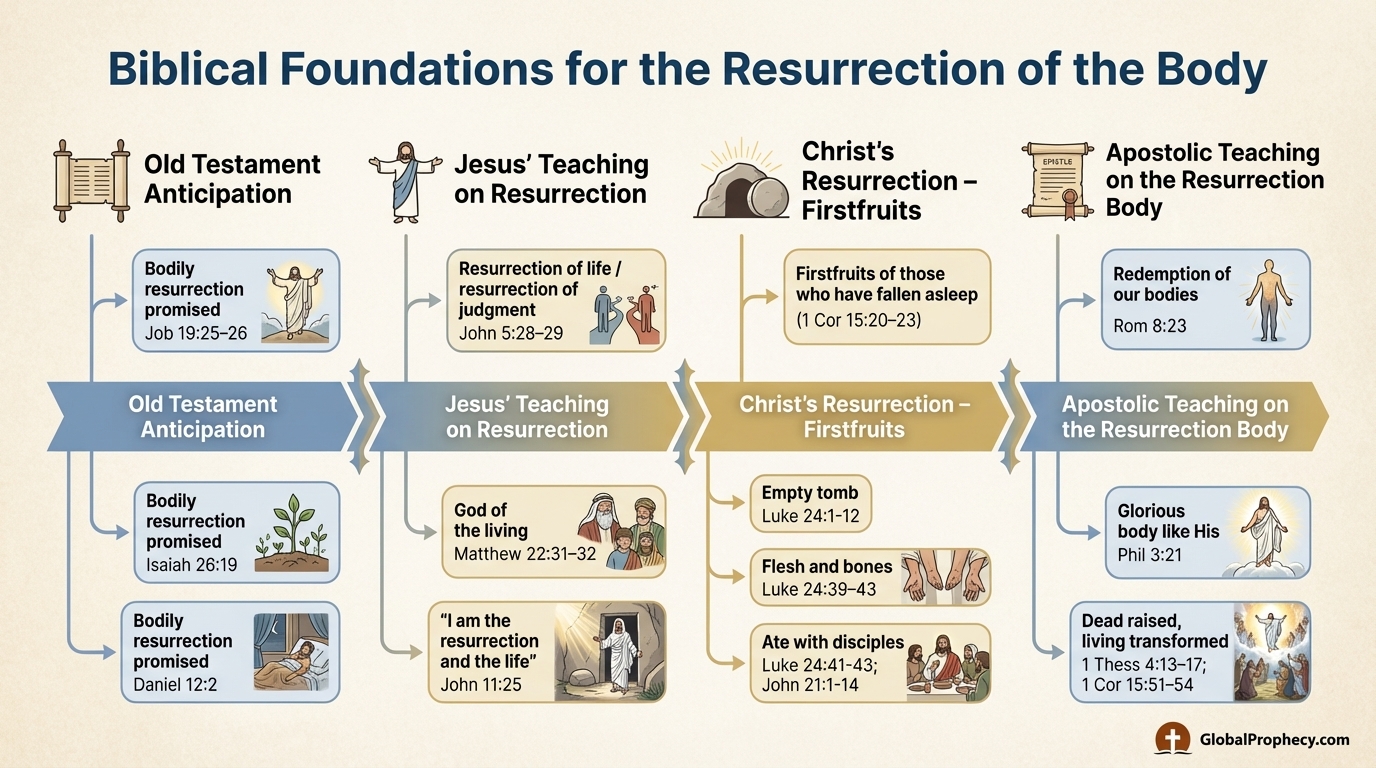
The bodily resurrection of Jesus is the pattern and guarantee of the resurrection of believers.
"But in fact Christ has been raised from the dead, the firstfruits of those who have fallen asleep."
— 1 Corinthians 15:20
In Israel, the “firstfruits” offering was the initial portion of the harvest that guaranteed the rest. Likewise, Christ’s resurrection with a glorified, deathless body guarantees that those who belong to Him will also be raised in glory (1 Cor 15:23).
The empty tomb and the physical nature of His risen body demonstrate this:
- His original body left the tomb (John 20:6–7).
- He bore the crucifixion scars (John 20:27).
- He ate with the disciples (Luke 24:41–43; John 21:12–13).
- He insisted,
"See my hands and my feet, that it is I myself. Touch me, and see. For a spirit does not have flesh and bones as you see that I have."
— Luke 24:39
Christ’s resurrection is not a mere “spiritual survival”; it is bodily, glorified life after death, and it defines what resurrection means in Scripture.
2.4 Apostolic Teaching
The most extensive New Testament teaching on the resurrection of the body is 1 Corinthians 15. Paul answers two questions (1 Cor 15:35):
- "How are the dead raised?"
- "With what kind of body do they come?"
He insists that if there is no resurrection of the dead, then Christ has not been raised, preaching is empty, faith is futile, and believers remain in their sins (1 Cor 15:13–17). The resurrection of the body is thus essential to the gospel, not an optional add-on.
Elsewhere Paul teaches:
- Believers await “the redemption of our bodies” (Romans 8:23).
- Christ “will transform our lowly body to be like his glorious body” (Philippians 3:21).
- At Christ’s coming, the dead in Christ will be raised and living believers transformed (1 Thessalonians 4:13–17; 1 Corinthians 15:51–54).
The repeated emphasis is not merely on the soul’s survival, but on the raising and transforming of the body.
3. What Is the Resurrection Body?
The biblical doctrine of the resurrection of the body includes continuity (it is truly our body) and transformation (it is wonderfully changed).
3.1 Real Continuity with Our Present Bodies
Resurrection is not the creation of an entirely different being. It is the raising and glorifying of the very body that died.
Key lines of evidence:
- The term “resurrection” itself implies that what died is what is raised; otherwise it would be a replacement, not a resurrection.
- Jesus’ risen body was the same body that was crucified, now glorified:
- The tomb was empty (John 20:1–8).
- His scars remained as recognizable marks (John 20:27).
- He said, “It is I myself” (Luke 24:39).
- Paul says,
"This perishable body must put on the imperishable, and this mortal body must put on immortality."
— 1 Corinthians 15:53
He speaks of the same body being “clothed” with new qualities, not exchanged for another.
This means personal identity, memory, and personality are preserved. The “you” who dies is the “you” who will be raised.
3.2 A Truly Physical, Material Body
Scripture rejects the idea that the final state is a disembodied, ghost-like existence. Humanity was created as body–soul unity (Gen 2:7), and redemption restores that unity.
- Jesus’ resurrection body had “flesh and bones” (Luke 24:39).
- He could be touched (Matthew 28:9; John 20:27).
- He ate food after His resurrection (Luke 24:42–43).
- Paul speaks of the “redemption of our bodies” (Romans 8:23), not escape from them.
When Paul says, “Flesh and blood cannot inherit the kingdom of God” (1 Cor 15:50), he is not denying physicality. “Flesh and blood” is a Jewish idiom for mortal, perishable humanity. Our present, corruptible condition cannot inherit God’s kingdom; therefore our bodies must be transformed, not discarded.
3.3 Glorified and Transformed
In 1 Corinthians 15:42–44, Paul contrasts our present bodies with our resurrection bodies:
| Present body | Resurrection body |
|---|---|
| Perishable | Imperishable |
| Sown in dishonor | Raised in glory |
| Sown in weakness | Raised in power |
| Natural body | Spiritual body |
Briefly:
-
Imperishable (1 Cor 15:42)
No decay, disease, or death. The resurrection body is deathless and incorruptible. -
Glorious (1 Cor 15:43; Phil 3:21)
Freed from the shame of sin and mortality; radiant with the beauty of holiness. -
Powerful (1 Cor 15:43)
No fatigue, frailty, or limitation due to weakness. Our capacities for service, worship, and joy will be vastly enlarged. -
Spiritual (1 Cor 15:44)
“Spiritual” here does not mean non-physical; it means Spirit-governed rather than sin-governed. The resurrection body is fully physical yet fully directed and empowered by the Holy Spirit.
Paul summarizes:
"Just as we have borne the image of the man of dust, we shall also bear the image of the man of heaven."
— 1 Corinthians 15:49
Our resurrection bodies will be like Christ’s:
- Conformed to His glorious body (Philippians 3:21).
- “We shall be like him, because we shall see him as he is” (1 John 3:2).
Christ’s post-resurrection abilities—such as appearing in a locked room (John 20:19)—suggest that the glorified body is not limited in the same way as our present bodies, yet remains truly physical and recognizable.
4. Resurrection of Believers and Unbelievers
Scripture teaches a universal resurrection of the body—but with radically different outcomes.
4.1 Resurrection of the Righteous
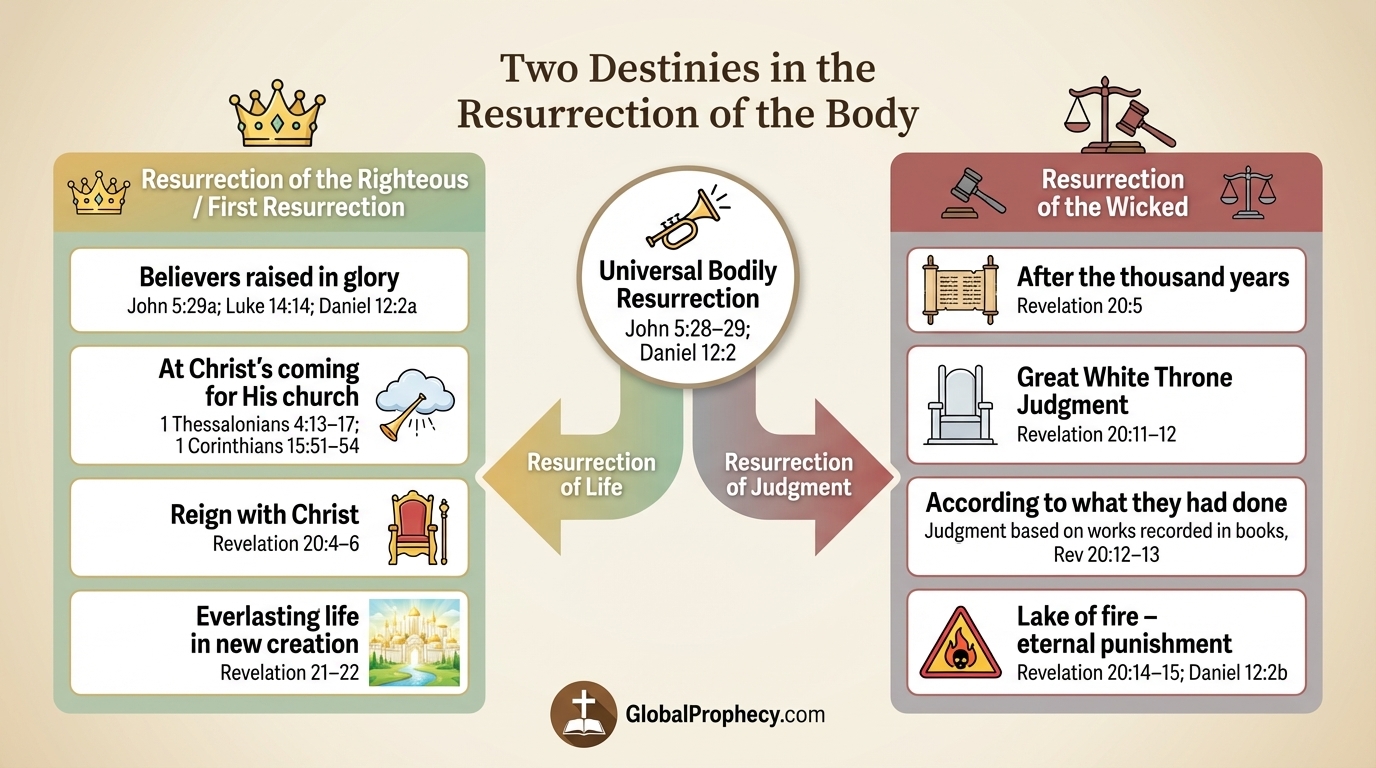
Those who belong to Christ participate in what Revelation calls the “first resurrection” (Revelation 20:4–6), also described as:
- The “resurrection of life” (John 5:29).
- The “resurrection of the righteous” (Luke 14:14).
- “Everlasting life” (Daniel 12:2).
Believers will be raised in glory:
- Church-age believers receive resurrection bodies at Christ’s coming for His church (1 Thess 4:13–17; 1 Cor 15:51–54).
- Old Testament saints and martyrs from the future tribulation will also be raised to reign with Christ in His kingdom (Daniel 12:2; Revelation 20:4).
All these events are aspects of the resurrection of the redeemed—a resurrection unto life, joy, and everlasting fellowship with God in a new heavens and new earth (Revelation 21–22).
4.2 Resurrection of the Wicked
The unsaved will also experience bodily resurrection, but unto judgment.
As Jesus said:
"Those who have done evil [will rise] to the resurrection of judgment."
— John 5:29
Daniel likewise spoke of some awakening to “shame and everlasting contempt” (Daniel 12:2).
Revelation describes this as the final resurrection after Christ’s millennial reign:
"The rest of the dead did not come to life until the thousand years were ended."
— Revelation 20:5
Then John sees:
"And I saw the dead, great and small, standing before the throne, and books were opened…And the dead were judged by what was written in the books, according to what they had done."
— Revelation 20:12
Those not written in the book of life are thrown into the lake of fire (Revelation 20:15). Their resurrection bodies are suited, not for glory, but for eternal conscious punishment.
Thus, the doctrine of the resurrection of the body teaches: every human being will live forever in a body—either glorified in the presence of God, or raised for judgment away from His favorable presence.
5. Why the Resurrection of the Body Matters
5.1 It Affirms God’s Good Creation
The resurrection of the body declares that matter is not evil and the body is not a prison to escape. God created the physical world and called it “very good” (Genesis 1:31). Redemption does not abandon creation; it renews and glorifies it. The future new earth is a real, physical world, and resurrected saints will inhabit it in real, physical bodies.
5.2 It Completes Our Salvation
Salvation in Scripture is holistic: God saves body and soul.
- Our spirits are made alive now (Ephesians 2:5).
- Our minds are being renewed (Romans 12:2).
- But our bodies still groan under the curse (Romans 8:22–23).
Paul says believers are waiting “for adoption as sons, the redemption of our bodies” (Rom 8:23). Full salvation is not complete until the resurrection. Without bodily resurrection, death would still hold part of us. With it, death is “swallowed up in victory” (1 Cor 15:54).
5.3 It Grounds Christian Ethics
Because our bodies will be raised and glorified, what we do in the body now matters eternally.
Paul argues against sexual immorality on this basis:
"God raised the Lord and will also raise us up by his power. Do you not know that your bodies are members of Christ?"
— 1 Corinthians 6:14–15
The future resurrection gives weight to bodily obedience, holiness, and service in the present.
5.4 It Comforts Sufferers and the Bereaved
The resurrection of the body gives deep, concrete hope in the face of suffering, disability, aging, and death.
- Every sickness and disability will be undone in the resurrection body: no more pain, no more decay.
- Every believing loved one who has died will be raised and recognizable, with identity and memory intact.
- Grief remains real, but not hopeless:
"We do not want you to be uninformed, brothers, about those who are asleep, that you may not grieve as others do who have no hope."
— 1 Thessalonians 4:13
5.5 It Centers Hope on Christ Himself
Ultimately, the resurrection of the body matters because it brings us into full, embodied fellowship with the risen Christ:
"Because I live, you also will live."
— John 14:19
We will see Him with our eyes, hear Him with our ears, and serve Him with glorified hands in a renewed creation. That is the final goal of biblical eschatology.
6. Conclusion
The resurrection of the body is the biblical promise that God will raise the dead and transform their bodies for eternal destinies. Rooted in the Old Testament, revealed by Jesus, and expounded by the apostles, this doctrine affirms:
- The goodness of creation and the body.
- The physical, glorified nature of our future existence.
- The certainty of judgment and eternal life.
- The centrality of Christ’s own bodily resurrection as firstfruits and pattern.
Believers will be raised imperishable, glorious, powerful, and spiritual, conformed to the image of the risen Christ and fitted for unending life in the new creation. Unbelievers, too, will be raised, but unto judgment.
Far from being speculative, the resurrection of the body is essential to the gospel, vital for Christian ethics, and profoundly comforting for all who trust in Christ. It calls us to live now in light of the day when death will be finally defeated and our whole person—body and soul—will share forever in the life of the risen Lord.
FAQ
Q: What does “resurrection of the body” mean in Christianity?
The “resurrection of the body” means that at God’s appointed time He will raise the dead and give them new, immortal bodies. It is not just the survival of the soul; it is the reanimation and transformation of our physical bodies, patterned after the risen body of Jesus Christ and suited for eternal life or eternal judgment.
Q: Is the resurrection body physical or spiritual?
The resurrection body is both physical and spiritual. It is physical in that it has real substance, “flesh and bones” like Jesus’ risen body, and can be seen and touched. It is spiritual in that it is fully governed and empowered by the Holy Spirit—imperishable, glorified, and free from sin and weakness.
Q: Will unbelievers also experience resurrection?
Yes. Scripture teaches a universal resurrection: those who belong to Christ are raised to the resurrection of life, and those who reject Him are raised to the resurrection of judgment (John 5:28–29; Daniel 12:2; Revelation 20:11–15). Both groups receive bodies suited to their eternal destiny.
Q: How is the resurrection of the body related to Jesus’ resurrection?
Jesus’ bodily resurrection is the firstfruits of the resurrection harvest. His empty tomb and glorified body are the pattern and guarantee of the future resurrection of believers (1 Corinthians 15:20–23). Because He lives in a resurrected body, those united to Him by faith will also be raised in bodies like His (Philippians 3:21; 1 John 3:2).
Q: Why is belief in the resurrection of the body so important for Christians?
Belief in the resurrection of the body is crucial because without it the gospel collapses and death still reigns. It assures us that salvation includes the whole person, that our present bodily life matters, and that suffering and death do not have the final word. It anchors Christian hope in a concrete future: embodied life with Christ in a renewed creation.
Frequently Asked Questions
What does “resurrection of the body” mean in Christianity?
Is the resurrection body physical or spiritual?
Will unbelievers also experience resurrection?
How is the resurrection of the body related to Jesus’ resurrection?
Why is belief in the resurrection of the body so important for Christians?
L. A. C.
Theologian specializing in eschatology, committed to helping believers understand God's prophetic Word.
Related Articles
Resurrection vs Resuscitation: What's the Difference?
Resurrection vs resuscitation: learn the biblical difference between temporary return to mortal life and permanent, glorified life after death.
The Abrahamic Covenant: God's Unconditional Promise to Israel
Abrahamic Covenant explained as God’s unconditional promise to Israel, defining land, seed and blessing and shaping key end-times Bible prophecy.
The Nature of the Believer's Resurrection Body
Resurrection body of believers explained: explore 1 Corinthians 15 on the glorified, imperishable, Christlike nature of the believer’s future body.
What the Bible Says about Antichrist?
Antichrist in the Bible: discover what Scripture reveals about his identity, character, deceptive power, and end-time role in the Tribulation.