
Resurrection vs Resuscitation: What's the Difference?
1. Introduction
In discussions of biblical eschatology, people often confuse resurrection with resuscitation. Scripture records several people who died and were brought back to life, but only one true resurrection has yet occurred in history: that of Jesus Christ, the “firstfruits” (1 Cor 15:20). Understanding the difference between resurrection and resuscitation is essential for grasping the Christian hope of eternal life and the future resurrection of believers.
This article will define both concepts, trace their biblical examples, and highlight why resurrection vs resuscitation is not a minor technicality but a major theological distinction.
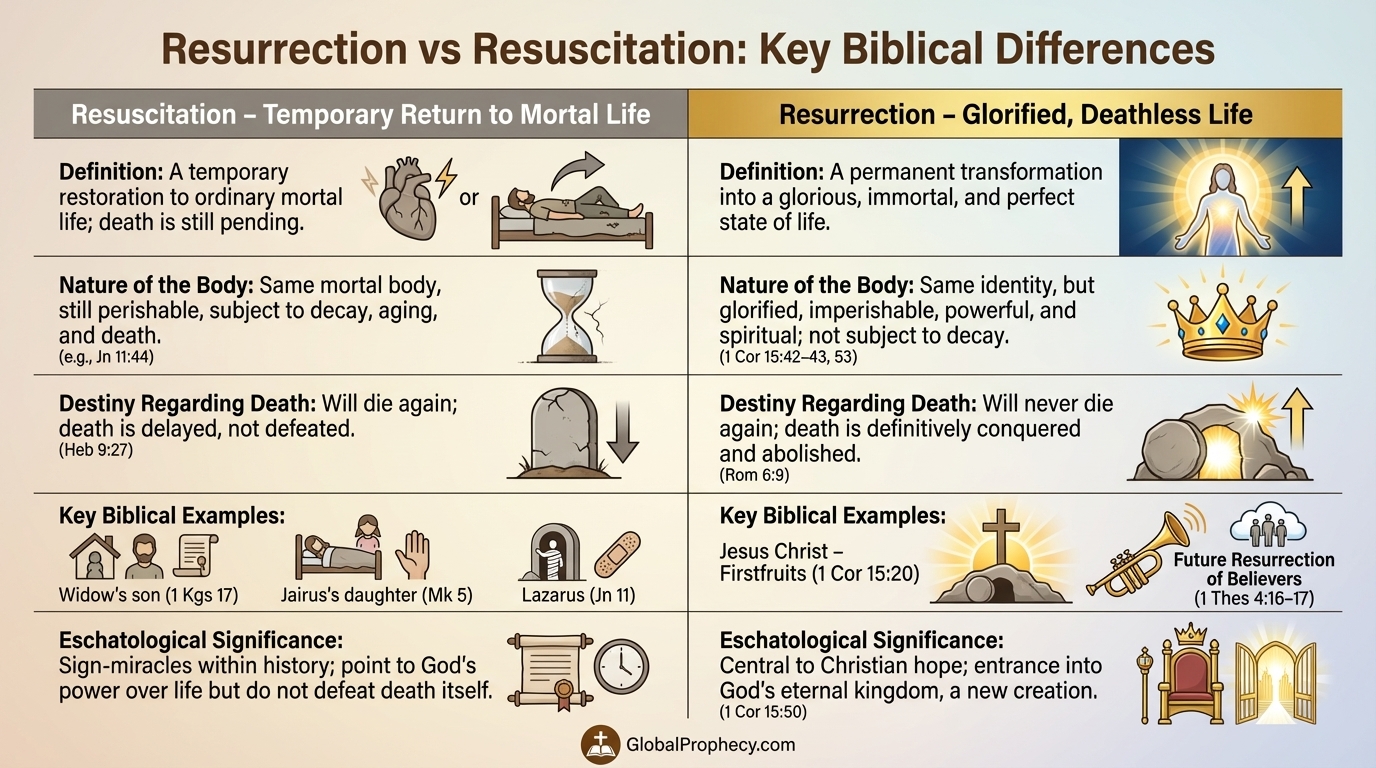
2. Defining the Terms: Resurrection vs Resuscitation
2.1 What Is Resurrection?
Biblically, resurrection is:
- A divine act in which God raises the dead
- Restoring the same body, yet transforming it into a glorified, immortal, imperishable body
- A permanent victory over death—those raised in true resurrection never die again
Paul describes this transformation:
"What is sown is perishable; what is raised is imperishable. It is sown in dishonor; it is raised in glory. It is sown in weakness; it is raised in power."
— 1 Corinthians 15:42–43
And again:
"For this perishable body must put on the imperishable, and this mortal body must put on immortality."
— 1 Corinthians 15:53
Resurrection, therefore, is not merely coming back to the old life. It is entering a new mode of bodily existence—incorruptible, Spirit-empowered, and fitted for God’s eternal kingdom (1 Cor 15:50; Phil 3:20–21).
2.2 What Is Resuscitation?
Resuscitation (sometimes called restoration to life) is very different:
- A person returns to ordinary mortal life in the same kind of body they had before
- The body remains perishable and subject to aging, sickness, and death
- The person who is resuscitated will die again at some later point
The Bible records several such events (e.g., the widow’s son, Jairus’s daughter, Lazarus). These are real miracles, but they are not resurrection in the full eschatological sense. As one theologian notes about such cases, “All previous resurrections were temporary in that the persons died again”; only Christ’s resurrection is final and deathless.
3. Biblical Examples of Resuscitation (Temporary Return to Mortal Life)
The Bible includes multiple instances where God or His prophets brought dead people back to this present life. These are best described as resuscitations, not full eschatological resurrections.
3.1 Old Testament Resuscitations
-
Widow’s son at Zarephath (1 Kings 17:17–24)
Elijah cries to the Lord, and the boy’s life returns to him. -
Shunammite woman’s son (2 Kings 4:32–35)
Elisha prays, stretches himself upon the child, and the boy is restored to life. -
The man who touched Elisha’s bones (2 Kings 13:21)
A dead man is hastily thrown into Elisha’s tomb; when he touches Elisha’s bones, he comes to life and stands on his feet.
These people were truly dead and truly restored, but their bodies were not transformed into immortal, glorified bodies. They eventually died again.
3.2 New Testament Resuscitations
Jesus’ earthly ministry also included several restorations to mortal life:
-
Jairus’s daughter
- Mark 5:35–43; Luke 8:49–56
Jesus takes her by the hand and says, “Child, arise.” Her spirit returns, and she gets up—yet she returns to normal life and later dies like all other mortals.
- Mark 5:35–43; Luke 8:49–56
-
The widow’s son at Nain
- Luke 7:11–17
Jesus touches the bier, commands, “Young man, I say to you, arise,” and he sits up and begins to speak.
- Luke 7:11–17
-
Lazarus of Bethany
- John 11:1–44
After four days in the tomb, Lazarus comes out at Jesus’ command, still bound with grave clothes. He resumes ordinary life in a mortal body and will die again.
- John 11:1–44
-
Tabitha (Dorcas)
- Acts 9:36–42
Peter prays, calls her to arise; she opens her eyes and sits up.
- Acts 9:36–42
-
Eutychus
- Acts 20:7–12
After falling from a window, he is taken up dead, but God restores his life through Paul.
- Acts 20:7–12
These events foreshadow God’s power over death and point toward the future resurrection, but they are not examples of final, glorified resurrection. They are signs, not the ultimate state.
4. The Unique Resurrection of Jesus Christ
The clearest biblical contrast between resurrection and resuscitation is found in the resurrection of Jesus.
4.1 Jesus as “Firstfruits” and “Firstborn from the Dead”
Paul states:
"But in fact Christ has been raised from the dead, the firstfruits of those who have fallen asleep."
— 1 Corinthians 15:20
And again:
"He is the beginning, the firstborn from the dead."
— Colossians 1:18
“Firstfruits” and “firstborn” indicate:
- Jesus is the first to rise with a glorified, deathless body
- His resurrection is the pattern and guarantee of the future resurrection of believers
- All previous raisings (Lazarus, Jairus’s daughter, etc.) were not of this type; they were temporary
Romans 6:9 emphasizes the crucial difference:
"We know that Christ, being raised from the dead, will never die again; death no longer has dominion over him."
No biblical text says that of Lazarus or anyone else restored to life. That “never die again” is exactly what distinguishes resurrection from resuscitation.
4.2 Features of Christ’s Resurrection Body
Christ’s post-resurrection appearances demonstrate a real, physical, glorified body:
-
Continuity with His pre-death body
- The tomb was empty (Matt 28; Luke 24; John 20).
- The nail scars and spear wound remained (John 20:27).
- Jesus says, “See my hands and my feet, that it is I myself” (Luke 24:39).
-
Physicality (not a mere spirit)
- “A spirit does not have flesh and bones as you see that I have” (Luke 24:39).
- He eats fish and honeycomb in their presence (Luke 24:41–43; John 21:12–13).
- Mary and the other women clasp His feet (Matt 28:9).
-
New capacities
- He appears in a locked room (John 20:19), then vanishes from Emmaus (Luke 24:31), indicating a transformed, Spirit-empowered body.
This is not a simple return to mortal life. It is the inaugural example of the imperishable, glorified resurrection body described in 1 Corinthians 15:42–44 and Philippians 3:20–21.
5. Future Resurrection of Believers vs Past Resuscitations
The New Testament connects our future resurrection directly to Christ’s resurrection, not to cases of resuscitation.
5.1 Believers Will Share Christ’s Type of Resurrection
Key texts:
-
Philippians 3:20–21
"[He] will transform our lowly body to be like his glorious body…"
-
1 John 3:2
"We know that when he appears we shall be like him, because we shall see him as he is."
-
Romans 8:23
"We wait eagerly for adoption as sons, the redemption of our bodies."
These promises concern resurrection, not mere survival of the soul, and certainly not just a temporary extension of earthly life. Our bodies will be:
- Imperishable – no decay, disease, or death (1 Cor 15:42, 53)
- Glorious – freed from dishonor, fully reflecting God’s intention (1 Cor 15:43; Phil 3:21)
- Powerful – no weakness, fatigue, or limitation as we know it (1 Cor 15:43)
- Spiritual – not non-physical, but fully governed and energized by the Holy Spirit (1 Cor 15:44; Rom 8:11)
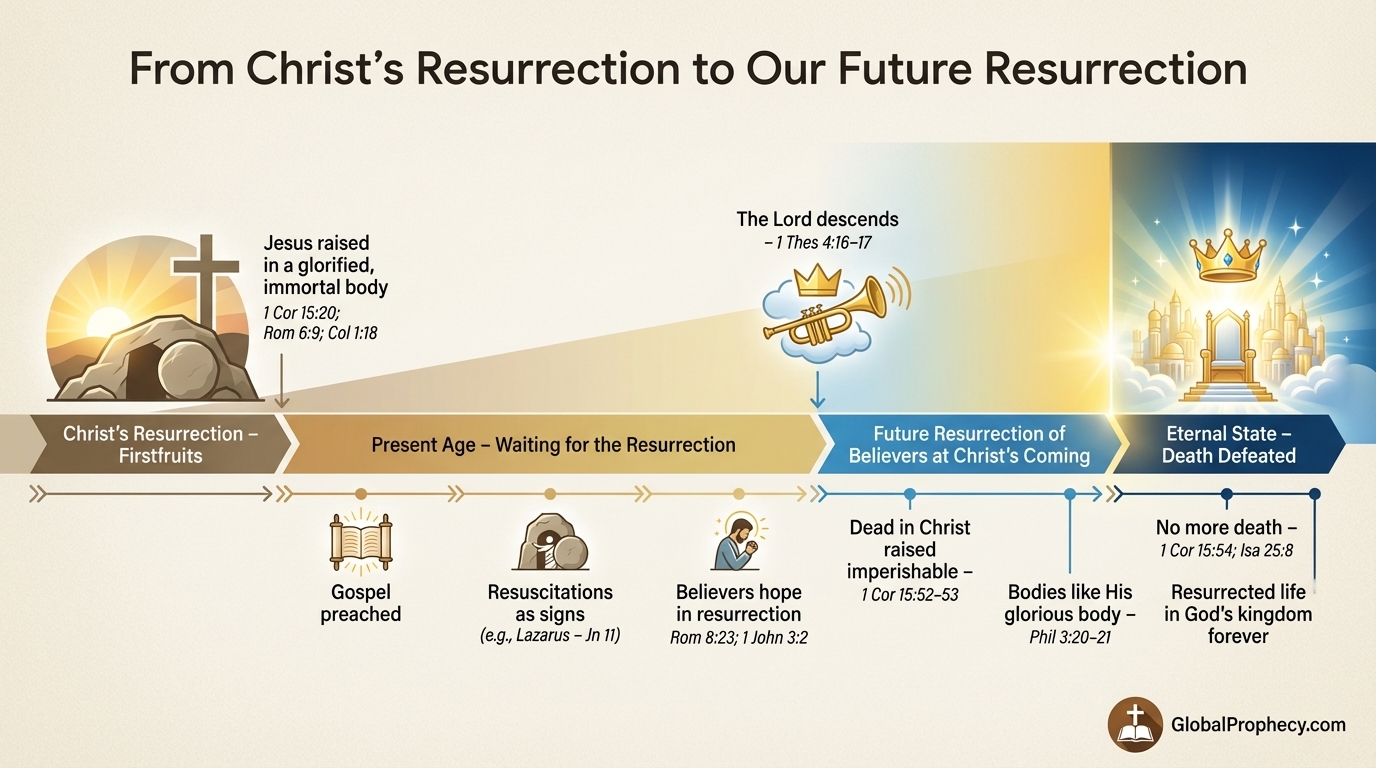
5.2 Why Resuscitation Is Not Our Ultimate Hope
If believers only experienced what Lazarus did—a return to fallen, aging life—death would still be undefeated. But Scripture insists that the believer’s hope is not resuscitation, but resurrection:
"For this perishable body must put on the imperishable, and this mortal body must put on immortality."
— 1 Corinthians 15:53
Resuscitation helps us see God’s power, but it leaves the person still within the realm of death. Resurrection, by contrast, is entrance into a condition where death is no longer possible.
Paul concludes the resurrection chapter with this triumphant note:
"Death is swallowed up in victory."
— 1 Corinthians 15:54; cf. Isa 25:8
That can never be said of resuscitation events; it applies only to resurrection.
6. Summary Table: Resurrection vs Resuscitation
| Feature | Resurrection | Resuscitation |
|---|---|---|
| Definition | Permanent raising in a glorified, immortal body | Temporary restoration to ordinary mortal life |
| Body | Same identity, but transformed: imperishable, glorious | Same mortal body, unchanged in nature |
| Susceptible to death again? | No – “never die again” (Rom 6:9) | Yes – will die later |
| Key Example | Jesus Christ (1 Cor 15:20; Col 1:18) | Lazarus (John 11), Jairus’s daughter, widow’s son, etc. |
| Eschatological? | Yes – central to future hope | No – sign-miracles within history |
| Outcome | Fits for eternal life in God’s kingdom (1 Cor 15:50) | Returns to present fallen world |
| Who will experience it? | Christ already; all believers in future resurrections | Select individuals at specific points in redemptive history |
7. Conclusion
The Bible’s distinction between resurrection and resuscitation is foundational for Christian eschatology. Resuscitations—whether in Elijah’s ministry, Jesus’ miracles, or the early church—are real acts of God, yet they restore people only to temporary mortal life. They point beyond themselves to something greater.
Resurrection, as uniquely revealed in Jesus Christ’s own rising, is a decisive, irreversible transformation into a glorified, immortal state. Christ is the firstfruits, the firstborn from the dead, and all who belong to Him will one day share His kind of resurrection, not Lazarus’s.
Understanding resurrection vs resuscitation protects us from trivializing our future hope. Christians are not merely promised more of this life; they are promised a new, deathless life in a glorified body, forever with the Lord (1 Thess 4:16–17). That is the heart of biblical eschatology and the anchor of Christian hope.
FAQ
Q: What is the main difference between resurrection and resuscitation in the Bible?
Resurrection is a permanent, glorified raising from the dead, resulting in an immortal, imperishable body that will never die again. Resuscitation is a temporary restoration to normal mortal life; the person is truly raised but remains subject to sickness, aging, and eventual death.
Q: Was Lazarus resurrected or resuscitated?
Lazarus was resuscitated, not resurrected in the full eschatological sense. He came back to ordinary life in the same kind of mortal body and later died again. By contrast, Jesus’ resurrection introduced a glorified, deathless body, making Him “the firstfruits of those who have fallen asleep” (1 Cor 15:20).
Q: How does Jesus’ resurrection differ from all other raisings in Scripture?
Jesus is the only one whose resurrection is described as final and glorified. He rose in a body that is physical yet imperishable, and Scripture explicitly says He “will never die again” (Rom 6:9). All other biblical raisings (such as Jairus’s daughter, the widow’s son, and Lazarus) were temporary returns to mortal life.
Q: What kind of body will believers receive at the future resurrection?
Believers will receive bodies like Christ’s glorious body (Phil 3:21): imperishable, powerful, free from sin and death, yet truly physical and personal. Paul calls this a “spiritual body” (1 Cor 15:44), meaning a body fully empowered and perfected by the Holy Spirit, suited for eternal life in God’s kingdom.
Q: Why is understanding resurrection vs resuscitation important for Christian hope?
Because our hope is not merely for extended earthly life, but for eternal life in a glorified body. Confusing resurrection with resuscitation diminishes the depth of the Christian promise. Recognizing the difference clarifies that in Christ, death is not just delayed—it is defeated, and believers will share in His victorious, never-ending life.
Frequently Asked Questions
What is the main difference between resurrection and resuscitation in the Bible?
Was Lazarus resurrected or resuscitated?
How does Jesus’ resurrection differ from all other raisings in Scripture?
What kind of body will believers receive at the future resurrection?
Why is understanding resurrection vs resuscitation important for Christian hope?
L. A. C.
Theologian specializing in eschatology, committed to helping believers understand God's prophetic Word.
Related Articles
What Is the Resurrection of the Body?
Resurrection of the body explains how God will raise and transform believers’ bodies for eternal life with Christ. Discover its meaning, hope, and biblical basis.
The Nature of the Believer's Resurrection Body
Resurrection body of believers explained: explore 1 Corinthians 15 on the glorified, imperishable, Christlike nature of the believer’s future body.
What Is Death According to the Bible?
Death in the Bible is more than dying physically. Explore its origin in sin, the meaning of physical and spiritual death, and God’s answer in Christ.
Death and the Unbeliever
Death and the unbeliever explores what happens at death, conscious judgment, and the eternal destiny of those who die without saving faith in Christ.