
Satan's Final Rebellion: The End of the Millennium
1. Introduction
At the conclusion of Christ's thousand-year millennial reign on earth, a dramatic and unexpected event will unfold that reveals profound truths about human nature and divine justice. Satan, who has been bound in the abyss throughout the entire Millennium, will be released for a brief period to lead one final rebellion against God. This climactic event, recorded in Revelation 20:7-10, serves as the ultimate demonstration that even under perfect conditions with Christ physically reigning on earth, the unregenerate human heart remains inclined toward rebellion. Understanding Satan's final rebellion is essential for grasping God's complete plan for dealing with evil and vindicating His righteous judgment.
2. The Release of Satan from the Abyss
Revelation 20:7-8 describes this startling turn of events: "When the thousand years are ended, Satan will be released from his prison and will come out to deceive the nations that are at the four corners of the earth, Gog and Magog, to gather them for battle; their number is like the sand of the sea." After one thousand years of imprisonment in the bottomless pit, Satan emerges unchanged in character and unchanged in purpose.
The question naturally arises: Why would God release Satan after successfully binding him for a millennium? The answer reveals multiple divine purposes. First, Satan's release demonstrates that confinement has not reformed his character. Despite a thousand-year prison sentence, the devil immediately returns to his fundamental nature as "a liar and the father of lies" (John 8:44). His release proves that evil is not merely a product of circumstances but flows from a corrupted will that refuses to repent.
Second, and perhaps most significantly, Satan's release exposes the true condition of the human heart. Throughout the Millennium, only believers have entered Christ's kingdom—those who survived the Tribulation in their mortal bodies. However, these believers have continued to bear children throughout the thousand years. Many of these children, born under ideal conditions with Christ physically present and Satan completely absent, will nevertheless harbor unbelief in their hearts. They may outwardly conform to Christ's rule to avoid judgment, but inwardly they reject the King. Satan's release provides the catalyst that brings this hidden rebellion to the surface.
3. The Deception of the Nations
When Satan is loosed, he immediately engages in his characteristic activity: deception. The text says he will "come out to deceive the nations" (Revelation 20:8). Deception has always been central to Satan's strategy. From the Garden of Eden, where he deceived Eve (Genesis 3:4,13), to the end times, when he will deceive the whole world through the Antichrist (Revelation 12:9; 13:14), Satan's primary weapon is the lie.
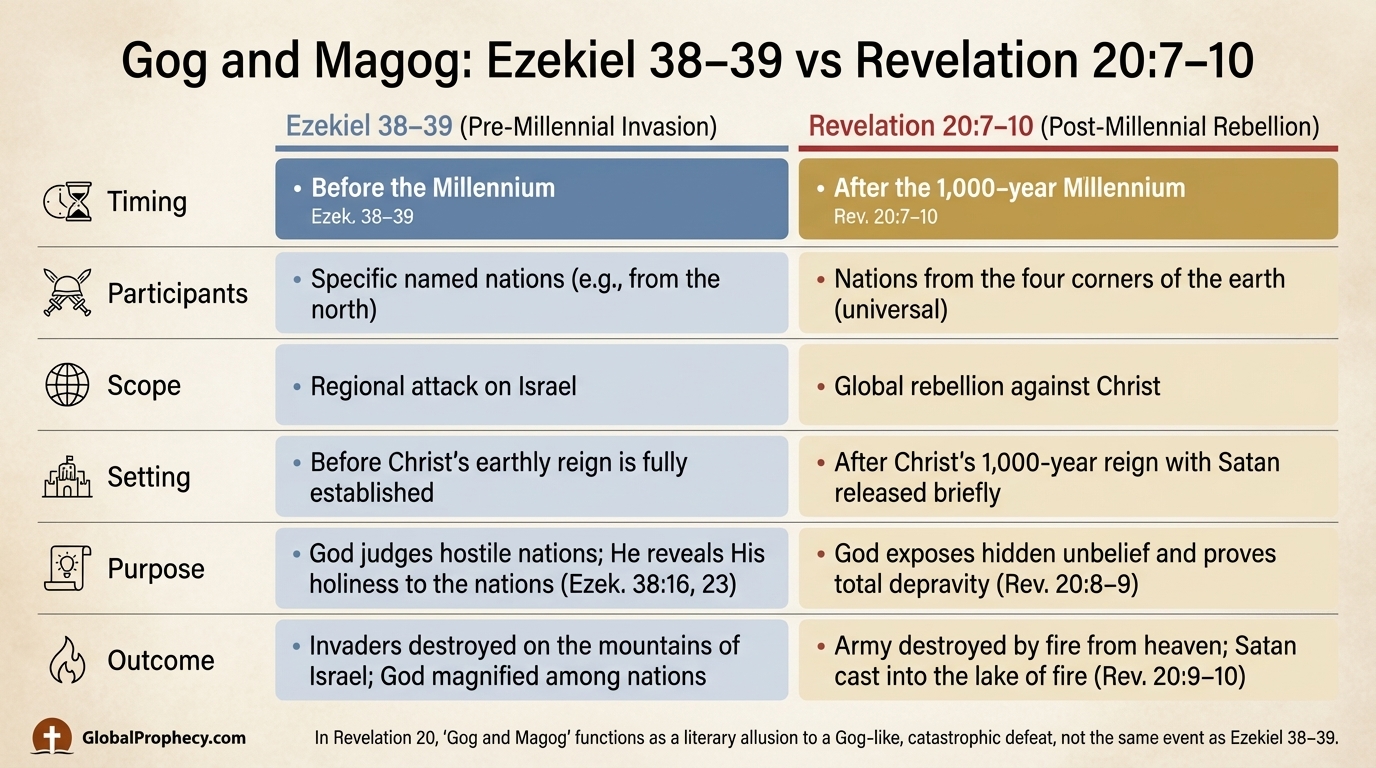
The designation "Gog and Magog" in Revelation 20:8 has confused some interpreters who equate this battle with the invasion described in Ezekiel 38-39. However, these are two distinct events separated by at least one thousand years. The Ezekiel invasion involves a coalition of specific nations attacking Israel before the Millennium, while the rebellion in Revelation 20 involves "the nations that are at the four corners of the earth"—a universal, global uprising occurring after the Millennium. The use of "Gog and Magog" in Revelation appears to be a literary allusion, similar to how we use "Waterloo" today to describe any crushing defeat. John is indicating that this final rebellion will be another Gog-and-Magog-like invasion—a massive military assault that ends in complete disaster for the attackers.
The remarkable aspect of Satan's deception is not merely that he attempts it, but that he succeeds in gathering an enormous army. The text describes their number as "like the sand of the sea" (Revelation 20:8). After living under Christ's perfect government for potentially hundreds of years, with universal knowledge of the Lord filling the earth (Isaiah 11:9), unprecedented peace and prosperity, and the complete absence of Satanic temptation, multitudes will still choose to follow Satan in open rebellion against Christ. This staggering fact underscores the depth of human depravity and the necessity of regeneration by the Holy Spirit.
4. The Nature of the Rebellion
The participants in this final revolt are those born during the Millennium who have never personally trusted in Christ as Savior. Matthew 25:31-46 makes clear that only believers enter the millennial kingdom at its inception. However, these believers retain their mortal bodies and sin natures, and they continue to have children throughout the thousand years. While Christ will rule with "a rod of iron" (Revelation 12:5; 19:15), swiftly judging overt rebellion and sin, He will not force genuine faith upon anyone.
Throughout the Millennium, the population will grow exponentially. With lifespans extended dramatically (Isaiah 65:20), with universal health and prosperity, and with families producing many children (Jeremiah 31:29; Ezekiel 47:22), the earth's population will swell to enormous numbers. Among this vast population will be those who render outward obedience to Christ but harbor inward rebellion. They conform externally to avoid judgment but have never experienced true spiritual transformation.
This situation demonstrates a profound theological truth: perfect external conditions cannot change the human heart. Even with Satan bound, with Christ physically present, with universal peace and prosperity, with perfect government and justice, and with the curse partially lifted from creation, the unregenerate heart remains capable of rebellion. The Millennium proves conclusively that humanity's fundamental problem is internal, not external—a truth that validates the necessity of the new birth and the transforming work of the Holy Spirit.
5. The Attack Against Jerusalem
Revelation 20:9 describes the military objective of this rebel army: "And they marched up over the broad plain of the earth and surrounded the camp of the saints and the beloved city." Jerusalem, which has served as the headquarters of Christ's government throughout the Millennium (Isaiah 2:1-5; Micah 4:1-2), becomes the target city of Satan's final revolt. This is entirely consistent with Satan's character and history—he has always sought to establish his throne in the place where God's glory dwells (Isaiah 14:12-14).
The reference to "the camp of the saints" and "the beloved city" emphasizes what makes this location special. This is not merely a political capital but the dwelling place of God's glory, the seat of Messiah's throne, and the gathering place of the saints. Throughout the Millennium, Jerusalem will have been the spiritual and governmental center of the earth, the place where all nations come to worship (Zechariah 14:16-19). Satan's attack is therefore not simply a political rebellion but a direct assault on the presence and authority of God Himself.
The fact that this massive army is able to surround Jerusalem suggests they achieve some level of initial military success in mobilizing and marching. The text indicates they traverse "the broad plain of the earth," gathering forces from every corner of the globe. This is a truly international rebellion, drawing participants from all nations. The sheer scope of the uprising reveals how widespread the hidden unbelief has been, even under ideal millennial conditions.
6. The Immediate and Final Judgment
The rebellion reaches its climax as quickly as it begins. Revelation 20:9 records: "But fire came down from heaven and consumed them." There is no prolonged battle, no protracted siege, no dramatic military campaign. The moment the rebel forces surround Jerusalem, divine judgment falls instantly and completely. Fire from heaven—a common mode of God's direct judgment in Scripture (Genesis 19:24; Leviticus 10:2; Numbers 16:35; 2 Kings 1:10-14)—incinerates the entire army.
This swift and decisive judgment serves multiple purposes. First, it demonstrates the absolute futility of rebelling against God. Despite their vast numbers and apparent initial success in mobilizing, the rebels have no chance whatsoever against divine power. They are destroyed in an instant, without even the opportunity to engage in battle. Second, the immediate judgment reveals God's patience has limits. Throughout the Millennium, God has extended grace and opportunity for salvation to countless individuals. Now, at this final provocation, judgment falls without delay. Third, this destruction prepares the way for the Great White Throne judgment (Revelation 20:11-15) by demonstrating God's justice and power one final time before the eternal state begins.
The fact that none of the rebels escape or survive emphasizes the completeness of God's victory. This is not merely a defeat but an execution—the final and total destruction of organized human rebellion against God.
7. Satan Cast Into the Lake of Fire
Following the destruction of the rebel army, Revelation 20:10 records Satan's ultimate fate: "And the devil who had deceived them was thrown into the lake of fire and sulfur where the beast and the false prophet were, and they will be tormented day and night forever and ever." This verse reveals several significant truths about Satan's final judgment.
First, Satan joins the Antichrist (the beast) and the false prophet, who were cast into the lake of fire one thousand years earlier at the beginning of the Millennium (Revelation 19:20). The fact that these two are still there after a thousand years, and that Satan will join them in ongoing torment, confirms the eternal and conscious nature of punishment in the lake of fire. This is not annihilation but everlasting, conscious torment.
Second, all three members of the counterfeit trinity—Satan, the Antichrist, and the false prophet—suffer the same dire destiny. Throughout history, Satan has sought to establish himself as God, the Antichrist as the false messiah, and the false prophet as the spokesperson of this counterfeit system. Now all three receive identical judgment in the lake of fire.
Third, the judgment is explicitly described as eternal: "day and night forever and ever." The Greek phrase eis tous aionas ton aionon (into the ages of the ages) emphasizes the unending nature of this punishment. There is no possibility of escape, no hope of annihilation, no prospect of eventual reconciliation. Satan's rebellion, which began before the creation of humanity, finally reaches its permanent conclusion.
Fourth, this judgment includes all demonic spirits who have served under Satan. Matthew 25:41 refers to "the eternal fire prepared for the devil and his angels," indicating that Satan's demonic followers share his fate. The spiritual beings who have harassed believers throughout history, who have opposed God's purposes, and who have corrupted human society, will finally receive their just punishment.
8. The Theological Significance of Satan's Final Rebellion
Satan's final rebellion carries profound theological implications that extend far beyond the dramatic narrative of Revelation 20. This event serves as the ultimate apologetic for several crucial biblical doctrines.
The Doctrine of Total Depravity. The rebellion proves beyond any doubt that humanity's fundamental problem is not environmental, educational, or circumstantial, but moral and spiritual. Even under perfect conditions—with a perfect ruler, perfect government, perfect peace, prosperity, and health, with Satan bound and the curse partially lifted—human beings born during the Millennium will still harbor rebellion in their hearts and choose to follow Satan when given the opportunity. This validates the biblical teaching that the human heart is "deceitful above all things, and desperately sick" (Jeremiah 17:9) and that "none is righteous, no, not one" (Romans 3:10) apart from God's transforming grace.
The Necessity of Regeneration. The rebellion demonstrates that external reform, education, and even living under Christ's direct rule cannot change the human heart. Only the new birth—the supernatural work of the Holy Spirit creating a new nature within—can produce genuine faith and obedience. Jesus told Nicodemus, "Unless one is born again he cannot see the kingdom of God" (John 3:3). The millennial rebellion proves this truth conclusively.
The Justice of Eternal Punishment. Some have questioned whether eternal punishment is just or proportionate to temporal sins. However, Satan's release and the subsequent rebellion demonstrate that given any opportunity, the unregenerate heart will choose rebellion against God. These rebels have lived under ideal conditions, with full knowledge of God's power, goodness, and justice, yet they still choose to follow Satan. This proves that apart from God's grace, rebellion is not merely a choice but a fixed disposition of the heart—one that would continue eternally if given the opportunity. Eternal punishment is therefore just because the rebellious disposition is itself eternal.
The Glory of God's Grace. By contrast, the rebellion magnifies the grace of God in salvation. Every person who trusts in Christ—whether during this present age, the Tribulation, or the Millennium—is saved purely by God's grace through faith (Ephesians 2:8-9). The stark difference between those who rebel and those who believe highlights that salvation is entirely God's work, not human achievement. The final rebellion thus serves to magnify the grace of God throughout all eternity.
9. Conclusion
Satan's final rebellion at the end of the Millennium represents the last chapter in the long history of organized opposition to God. After one thousand years of Christ's perfect rule, Satan is released to lead a final revolt that attracts an army "like the sand of the sea." This rebellion is immediately crushed by fire from heaven, and Satan is cast into the lake of fire to join the Antichrist and false prophet in eternal torment.
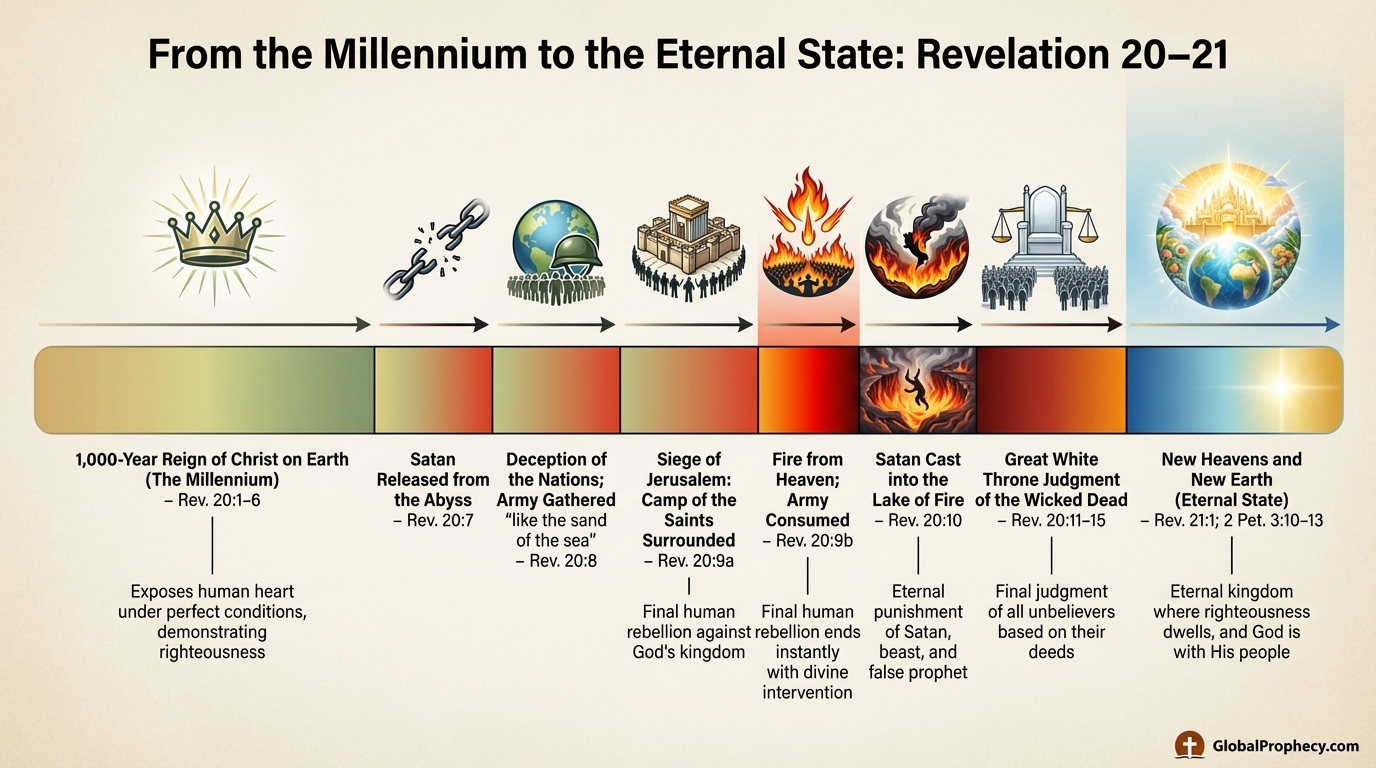
This dramatic event serves multiple divine purposes: it demonstrates Satan's incorrigible nature, exposes the depth of human depravity, validates the necessity of spiritual regeneration, justifies eternal punishment, and magnifies God's grace. The rebellion proves that humanity's fundamental problem is not circumstances but the condition of the heart—a problem that only God's transforming grace can solve.
Following this final rebellion, God will resurrect all the wicked dead to face judgment at the Great White Throne (Revelation 20:11-15), after which the present heavens and earth will be destroyed and replaced with new heavens and a new earth where righteousness dwells (Revelation 21:1; 2 Peter 3:10-13). The story of Satan's final rebellion thus marks the transition from the millennial kingdom to the eternal state, completing God's plan to deal with evil once and for all and to establish His eternal kingdom where sin and rebellion will never again raise their heads.
FAQ
Q: Why does God release Satan after binding him for a thousand years?
God releases Satan to accomplish several purposes: to demonstrate that imprisonment has not reformed Satan's character, to expose hidden unbelief in the hearts of those born during the Millennium who outwardly conformed but never truly believed, and to provide a final, definitive demonstration of human depravity even under perfect conditions. This release proves that humanity's problem is the sinful heart, not merely external circumstances or Satan's influence.
Q: Who participates in Satan's final rebellion at the end of the Millennium?
The rebels are people born during the Millennium who never personally trusted in Christ as Savior. While only believers enter the millennial kingdom at its beginning, these believers have children throughout the thousand years. Many of these children, despite growing up under Christ's perfect rule with Satan bound, will harbor unbelief in their hearts. When Satan is released, he deceives them into joining his final rebellion against Christ and Jerusalem.
Q: How is Satan's final rebellion different from the battle of Gog and Magog in Ezekiel 38-39?
These are two distinct events separated by at least one thousand years. The Ezekiel 38-39 invasion involves specific nations (Russia, Iran, Turkey, and others) attacking Israel before the Millennium, while Revelation 20:7-10 describes a universal rebellion involving nations from "the four corners of the earth" after the Millennium. The term "Gog and Magog" in Revelation 20 is likely a literary allusion indicating this final rebellion will be another massive invasion that ends in complete defeat, similar to Ezekiel's prophecy.
Frequently Asked Questions
Why does God release Satan after binding him for a thousand years?
Who participates in Satan's final rebellion at the end of the Millennium?
How is Satan's final rebellion different from the battle of Gog and Magog in Ezekiel 38-39?
L. A. C.
Theologian specializing in eschatology, committed to helping believers understand God's prophetic Word.
Related Articles
The 144,000 Sealed Israelites
144,000 sealed Israelites in Revelation identified and explained—their identity, purpose, and distinct role as preserved witnesses during the Tribulation.
Amillennialism Examined: Is the Church the Millennial Kingdom?
Amillennialism examined: is the church the millennial kingdom? Explore its claims, symbols, and a biblical critique of this end-times view.
Babylon the Great
Babylon the Great in Revelation 17–18 reveals end-time religious and commercial rebellion against God and its sudden, final destruction in judgment.
What is the Battle of Armageddon?
Armageddon, the climactic end-times battle, is described in Revelation 16 and 19. Learn what this final conflict is and when it will occur.