
The Second Coming of Christ: What the Bible Really Says
1. Introduction
The Second Coming of Christ is the climactic event of biblical eschatology. From Genesis to Revelation, Scripture moves toward the visible, glorious return of Jesus to this earth to judge evil and establish His righteous rule.
While the exact phrase “second coming of Christ” is rare, the doctrine itself is clear.
“Christ…will appear a second time, not to deal with sin but to save those who are eagerly waiting for him.”
— Hebrews 9:28
This article explains what the Bible really says about the Second Coming—its biblical promise, its nature, its timing in relation to the end-time tribulation, and its purposes in God’s plan.
2. The Biblical Promise and Necessity of the Second Coming
2.1 Old Testament anticipation
The Old Testament presents the Messiah both as a suffering servant and a reigning king, but without clearly separating these roles into two comings. Passages like Isaiah 53 describe His suffering, while others like Psalm 2; Isaiah 9:6–7; Daniel 7:13–14; Zechariah 14 speak of His universal reign, judgment, and glory.
For example:
“I saw in the night visions, and behold, with the clouds of heaven there came one like a son of man…And to him was given dominion and glory and a kingdom, that all peoples, nations, and languages should serve him.”
— Daniel 7:13–14
These royal, world‑ruling prophecies were not fulfilled at Christ’s first coming, which means they await His Second Coming.
2.2 New Testament confirmation
The New Testament explicitly teaches that Jesus will return again:
- Jesus promised:
“I will come again and will take you to myself.” — John 14:3
- Angels promised at the Ascension:
“This Jesus…will come in the same way as you saw him go into heaven.” — Acts 1:11
- The apostles proclaimed His return (e.g., 1 Thessalonians 1:10; 2 Thessalonians 1:7–10; 2 Peter 3:3–13).
- Revelation opens with the announcement:
“Behold, he is coming with the clouds, and every eye will see him.” — Revelation 1:7
The Second Coming is therefore necessary to:
- Complete the work of salvation (glorification and final deliverance, Heb 9:28).
- Fulfill the remaining kingdom promises given to Israel and the nations.
- Bring final judgment and the visible reign of Christ on earth.
3. The Nature and Characteristics of Christ’s Second Coming
The Bible describes the Second Coming with rich and varied terms, but they consistently point to a literal, physical, visible, glorious, and climactic event at the end of the age.
3.1 Personal and bodily
Christ’s return will be personal—the same Jesus who ascended will return.
“This Jesus, who was taken up from you into heaven, will come in the same way as you saw him go into heaven.”
— Acts 1:11
Jesus was raised in a real, glorified body (Luke 24:36–43), and He ascended bodily. He will therefore return in that same resurrected humanity.
3.2 Visible and public
The Second Coming will not be secret or merely “spiritual.” It will be openly observable:
“Behold, he is coming with the clouds, and every eye will see him, even those who pierced him, and all tribes of the earth will wail on account of him.”
— Revelation 1:7
Jesus Himself taught:
“They will see the Son of Man coming on the clouds of heaven with power and great glory.”
— Matthew 24:30
The language of “seeing” (horaō), “appearing” (epiphaneia), and “revelation” (apokalypsis) emphasizes a public, worldwide manifestation of Christ’s glory.
3.3 Glorious and supernatural
The Second Coming is a revelation of Christ’s glory:
- He returns “with power and great glory” (Matt 24:30).
- He is revealed “from heaven with his mighty angels in flaming fire” (2 Thessalonians 1:7).
- John sees Him as the Rider on a white horse, called “Faithful and True…The Word of God,” with eyes “like a flame of fire” and many crowns (Revelation 19:11–13).
This glory is also associated with clouds, a frequent symbol of God’s visible presence (Exodus 40:34–35; Matt 17:5; 24:30).
3.4 Sudden and climactic
The Second Coming will be sudden and decisive, not a drawn‑out, ambiguous process.
Jesus said it would be:
- Like lightning flashing from east to west (Matt 24:27).
- Accompanied by great cosmic disturbances (Matt 24:29; Luke 21:25–26).
There is no indication of a prolonged, gradual manifestation; rather, a single, overwhelming intervention of the Son of Man “immediately after the tribulation of those days” (Matt 24:29–30).
4. When and Where: The Second Coming in God’s End‑Time Plan
4.1 The Second Coming after the Tribulation
In a premillennial framework, Christ’s Second Coming occurs after a final period of unprecedented distress, often called the Great Tribulation.
Jesus’ Olivet Discourse is explicit:
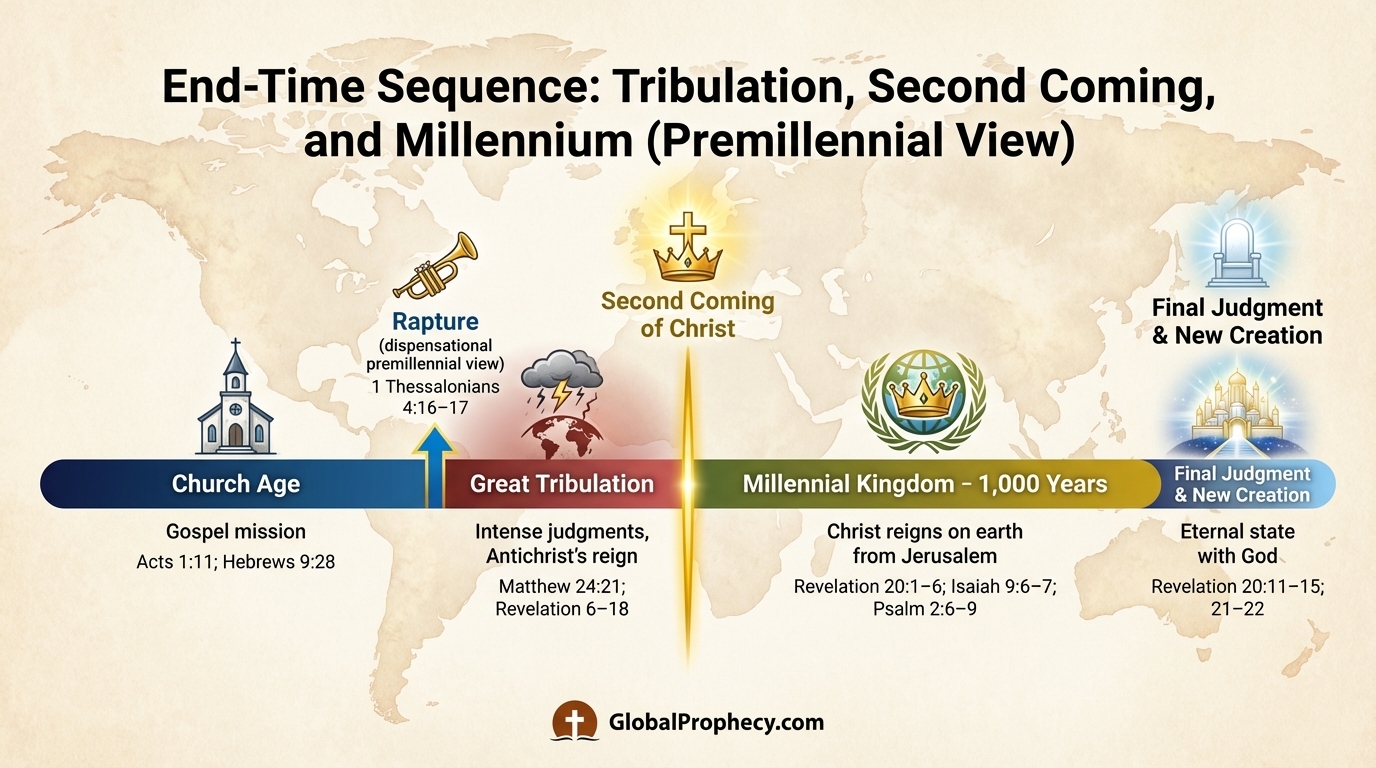
“Immediately after the tribulation of those days…they will see the Son of Man coming on the clouds of heaven with power and great glory.”
— Matthew 24:29–30
The book of Revelation (chapters 6–18) describes escalating judgments (seals, trumpets, bowls) that culminate in Christ’s descent in Revelation 19:11–16. This Second Coming ends the Antichrist’s reign and the tribulational judgments, and introduces the millennial kingdom (Rev 20:1–6).
4.2 The geographical place: the Mount of Olives
Scripture identifies a specific location for Christ’s return to earth:
“On that day his feet shall stand on the Mount of Olives that lies before Jerusalem on the east.”
— Zechariah 14:4
This prophecy, not fulfilled at Christ’s first coming, aligns with:
- Jesus’ ascension from the Mount of Olives (Acts 1:12).
- The angelic promise that He will return “in the same way” (Acts 1:11).
Thus, the Bible presents a coherent picture: Jesus ascended from the Mount of Olives and will return to that same mount in power and glory to deliver Jerusalem and rule the nations (Zech 14:3–9).
5. What the Second Coming Accomplishes
The Second Coming is not only an event to be observed; it is the turning point of redemptive history. The Bible highlights several key purposes and results.
5.1 Judgment of the wicked and vindication of God’s justice
Christ returns as Judge.
“From his mouth comes a sharp sword with which to strike down the nations, and he will rule them with a rod of iron. He will tread the winepress of the fury of the wrath of God the Almighty.”
— Revelation 19:15
Key aspects include:
- Destruction of the Antichrist and his armies at Armageddon (Rev 19:19–21).
- Judgment of the nations (the “sheep and goats” judgment) based on their response to Christ and His brethren (Matthew 25:31–46).
- Day of the Lord wrath poured out on unrepentant humanity (2 Thessalonians 1:7–10; Isaiah 24).
The Second Coming reveals that divine patience has an end and that God’s holiness demands final, public justice.
5.2 Salvation and restoration for Israel
The Second Coming is also a day of deliverance for Israel:
- “All Israel will be saved” when “the Deliverer will come from Zion” (Romans 11:26–27).
- The Lord comes to fight for Jerusalem and rescue the remnant (Zech 14:1–5).
- He regathers and restores believing Israel to covenant blessing (Deuteronomy 30:3–6; Matthew 24:31).
Thus Christ’s return fulfills Old Testament promises of a repentant, restored Israel under Messiah’s reign (Isaiah 11; Jeremiah 31:31–40; Ezekiel 36–37).
5.3 Resurrection and reward of saints
The Second Coming brings a resurrection and reward for believers who were not part of the earlier church‑age resurrection (which occurs at the rapture):
- Revelation 20:4–6 speaks of the resurrection of Tribulation martyrs and, by implication, Old Testament saints to reign with Christ.
- Believers returning with Christ share in His glory and kingdom:
“When Christ who is your life appears, then you also will appear with him in glory.”
— Colossians 3:4
The Second Coming, therefore, is a turning point from suffering to reigning for all who belong to Christ.
5.4 Establishment of Christ’s millennial kingdom
Christ’s return inaugurates His thousand‑year reign on earth (Revelation 20:1–6), fulfilling texts such as:
- Psalm 2:6–9 — God installs His King on Zion to rule the nations with a rod of iron.
- Isaiah 9:6–7 — “Of the increase of his government and of peace there will be no end.”
- Zechariah 14:9 — “The LORD will be king over all the earth.”
In premillennial understanding, the Second Coming is the gateway to the Millennium—a renewed, righteous order on this present earth under the visible rule of Christ.
6. Living in Light of the Second Coming
Biblical eschatology is never given merely to satisfy curiosity. The doctrine of the Second Coming is deeply practical. Scripture ties Christ’s return to:
-
Holiness and purity
“Everyone who thus hopes in him purifies himself as he is pure.”
— 1 John 3:3 -
Perseverance in suffering
“Rejoice insofar as you share Christ’s sufferings, that you may also rejoice and be glad when his glory is revealed.”
— 1 Peter 4:13 -
Watchfulness and readiness
“You also must be ready, for the Son of Man is coming at an hour you do not expect.”
— Matthew 24:44 -
Comfort and encouragement
Believers facing death and loss are to encourage one another with the reality of Christ’s return and our future with Him (1 Thessalonians 4:18; 5:11).
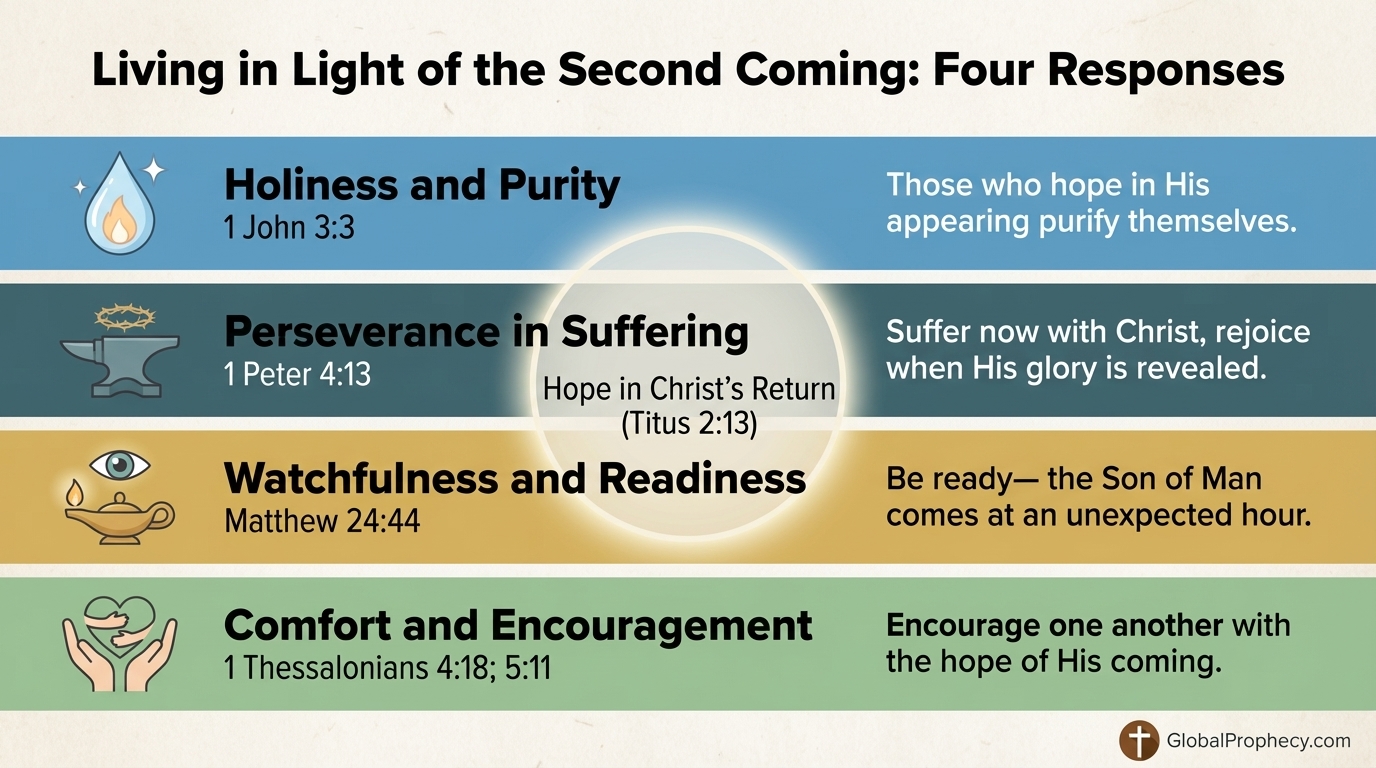
Rightly understood, the Second Coming of Christ is not a speculative doctrine but a motivating hope that shapes how Christians think, live, suffer, and serve now.
7. Conclusion
The Second Coming of Christ stands at the center of biblical prophecy and Christian hope. The Bible presents it as:
- Promised by Christ, His angels, and His apostles.
- Personal, bodily, visible, glorious, and sudden.
- Post‑tribulational, terminating the Antichrist’s rule and the Day of the Lord judgments.
- The decisive moment of judgment for the wicked, deliverance and restoration for Israel, resurrection and reward for the saints, and the inauguration of Christ’s earthly kingdom.
To understand biblical eschatology is to recognize that history is moving toward this great event when the crucified and risen Lord will be publicly vindicated as King of kings and Lord of lords (Revelation 19:16).
The crucial question is not whether Christ will return—Scripture is unequivocal—but whether we are ready. Those who have trusted in His first coming for salvation are those who will rejoice at His Second Coming in glory.
FAQ
Q: What is the Second Coming of Christ according to the Bible?
The Second Coming of Christ is the future, visible, bodily return of Jesus to earth, after the end‑time tribulation, to judge the nations, defeat the Antichrist, restore Israel, raise and reward saints, and establish His millennial kingdom (see Matthew 24:29–31; Acts 1:11; Revelation 19:11–16; 20:1–6). It is distinct from His first coming in humility and suffering.
Q: How will Jesus return at the Second Coming?
Jesus will return personally, literally, and publicly. He will come “on the clouds of heaven with power and great glory” (Matt 24:30), accompanied by His holy ones and mighty angels (2 Thess 1:7; Zech 14:5; Rev 19:14). Every eye will see Him (Rev 1:7), and His coming will be sudden and climactic, like lightning across the sky (Matt 24:27).
Q: Where will Christ return to earth?
The Bible indicates that Jesus will return to the Mount of Olives, east of Jerusalem. Zechariah 14:4 states that “on that day his feet shall stand on the Mount of Olives,” and Acts 1:11–12 connects His future return with the place of His ascension. From there He will deliver Jerusalem and begin His reign over the nations.
Q: What is the difference between the Second Coming and the rapture?
From a dispensational premillennial perspective, the rapture is Christ’s coming for His church, catching believers up to meet Him in the air (1 Thess 4:16–17), before the tribulation. The Second Coming is Christ’s return with His saints to the earth after the tribulation (Rev 19:11–16). The rapture is a rescue; the Second Coming is a revelation in glory and judgment.
Q: Why is belief in the Second Coming important for Christians today?
Belief in the Second Coming is essential because it completes the biblical picture of salvation and kingdom hope. It assures believers that evil will be judged, righteousness will prevail, and Christ will reign openly. Practically, it motivates holiness, perseverance, watchfulness, and comfort, as Christians live in expectation of the day when faith becomes sight (Titus 2:11–13; 1 John 3:2–3).
Frequently Asked Questions
What is the Second Coming of Christ according to the Bible?
How will Jesus return at the Second Coming?
Where will Christ return to earth?
What is the difference between the Second Coming and the rapture?
Why is belief in the Second Coming important for Christians today?
L. A. C.
Theologian specializing in eschatology, committed to helping believers understand God's prophetic Word.
Related Articles
How Will Jesus Return? The Nature of Christ's Second Coming
Christ’s second coming explained: how Jesus will return visibly, physically, and in power and glory, as Scripture describes His future appearing.
What the Bible Says about Antichrist?
Antichrist in the Bible: discover what Scripture reveals about his identity, character, deceptive power, and end-time role in the Tribulation.
What the Bible Says about False Prophet?
False Prophet biblical identity and role in end times. Discover what Scripture reveals about this key figure in Revelation's tribulation prophecy.
The Biblical Covenants: Framework for Understanding Prophecy
Biblical covenants form the framework for understanding prophecy, clarifying Israel, the church, and God’s kingdom plan across the Old and New Testaments.