
The Second Coming vs The Rapture: Understanding Two Distinct Events
1. Introduction
Within biblical eschatology, few topics are more debated or more critical than the relationship between the Rapture and the Second Coming of Christ. Are they the same event described in different ways, or two distinct stages of Christ’s return?
This article argues that Scripture presents two related but distinct events:
- Christ’s coming in the air for His church (the Rapture), and
- Christ’s coming to earth with His saints in power and glory (the Second Coming).
Clarifying this distinction helps make sense of prophetic passages, harmonizes key texts, and preserves the plain meaning of many end-times prophecies.
2. Defining the Two Events
2.1 The Rapture
The Rapture is the catching up and transformation of church-age believers, living and dead, to meet Christ in the air and be taken to heaven.
Key texts include:
"For the Lord himself will descend from heaven with a cry of command, with the voice of an archangel, and with the sound of the trumpet of God. And the dead in Christ will rise first. Then we who are alive, who are left, will be caught up together with them in the clouds to meet the Lord in the air, and so we will always be with the Lord."
— 1 Thessalonians 4:16–17
"Behold! I tell you a mystery. We shall not all sleep, but we shall all be changed, in a moment, in the twinkling of an eye…"
— 1 Corinthians 15:51–52
Here, Christ does not come to the earth; believers are “caught up” (harpazō) to meet Him “in the air.” This is presented as a mystery truth (previously unrevealed) and is directly connected with the church.
2.2 The Second Coming (Revelation of Christ)
The Second Coming (or Revelation of Christ) is Jesus’ visible, bodily return to the earth in glory at the end of the Tribulation to judge the nations and establish His millennial kingdom.
Representative texts:
"Then will appear in heaven the sign of the Son of Man, and then all the tribes of the earth will mourn, and they will see the Son of Man coming on the clouds of heaven with power and great glory."
— Matthew 24:30
"Then I saw heaven opened, and behold, a white horse! The one sitting on it is called Faithful and True… And the armies of heaven, arrayed in fine linen, white and pure, were following him on white horses."
— Revelation 19:11, 14
At this coming, His feet stand on the Mount of Olives (Zechariah 14:4), He destroys the gathered armies, judges the nations, and sets up His reign on earth.
3. Why the Rapture and Second Coming Are Distinct
Though both are facets of Christ’s “coming,” several lines of biblical evidence show they are not the same event.
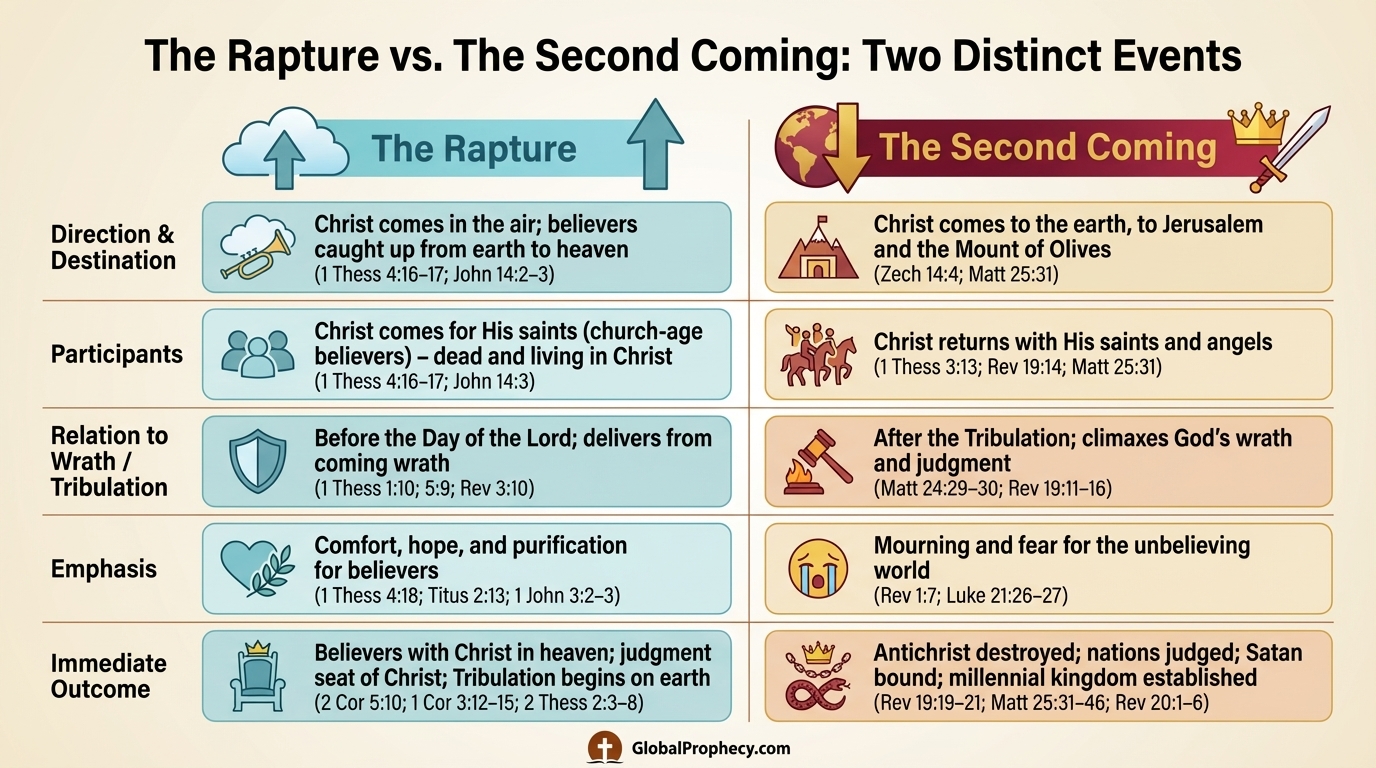
3.1 Different Direction and Destination
-
Rapture: Christ comes in the air, believers are caught up from earth to heaven.
- 1 Thessalonians 4:17 – “to meet the Lord in the air”
- John 14:2–3 – “I will come again and will take you to myself, that where I am you may be also”
-
Second Coming: Christ comes to the earth, particularly to Jerusalem and the Mount of Olives, to reign.
- Zechariah 14:4 – “On that day his feet shall stand on the Mount of Olives”
- Matthew 25:31 – “When the Son of Man comes in his glory… then he will sit on his glorious throne”
3.2 Different Participants
-
At the Rapture, Christ comes for His saints (church-age believers).
- 1 Thessalonians 4:16–17 – dead and living believers are caught up to Him.
- John 14:3 – “I will come again and will take you to myself”
-
At the Second Coming, Christ returns with His saints and angels.
- 1 Thessalonians 3:13 – “the coming of our Lord Jesus with all his saints”
- Revelation 19:14 – “the armies of heaven… were following him on white horses”
- Matthew 25:31 – “all the angels with him”
Believers who were previously caught up are now part of the “armies of heaven” returning with Him.
3.3 Different Relationship to Wrath and the Tribulation
-
The Rapture occurs before the outpouring of divine wrath known as the Day of the Lord / Tribulation:
- 1 Thessalonians 1:10 – “Jesus who delivers us from the wrath to come”
- 1 Thessalonians 5:9 – “God has not destined us for wrath”
- Revelation 3:10 – promise to keep the church “from the hour of trial that is coming on the whole world”
-
The Second Coming occurs after the Tribulation and climaxes that period of wrath:
- Matthew 24:29–30 – “Immediately after the tribulation of those days… they will see the Son of Man coming”
- Revelation 19 – Christ returns to “strike down the nations” (Rev 19:15) after the seal, trumpet, and bowl judgments.
Thus, the Rapture is Christ’s rescue of His church from coming wrath; the Second Coming is Christ’s judgment of the world after wrath has been poured out.
3.4 Different Emphasis: Comfort vs. Terror
-
The Rapture is held out as a source of comfort, hope, and purification:
- 1 Thessalonians 4:18 – “Therefore encourage one another with these words.”
- Titus 2:13 – “waiting for our blessed hope, the appearing of the glory of our great God and Savior Jesus Christ”
- 1 John 3:2–3 – hope of seeing Him produces purity.
-
The Second Coming brings mourning and fear to the unbelieving world:
- Revelation 1:7 – “all tribes of the earth will wail on account of him”
- Luke 21:26–27 – “people fainting with fear… and then they will see the Son of Man coming in a cloud with power and great glory”
3.5 Different Immediate Outcomes
-
After the Rapture:
- Believers appear before the judgment seat of Christ in heaven for rewards (2 Corinthians 5:10; 1 Corinthians 3:12–15).
- On earth, evil accelerates; the man of lawlessness (Antichrist) is revealed and the Tribulation unfolds (2 Thessalonians 2:3–8; Revelation 6–19).
-
After the Second Coming:
- Christ destroys the Antichrist and his armies (Revelation 19:19–21).
- He judges surviving Jews and Gentiles to determine who enters the kingdom (Ezekiel 20:33–38; Matthew 25:31–46).
- He binds Satan and inaugurates the millennial kingdom (Revelation 20:1–6).
The two events therefore launch different phases of God’s prophetic program.
4. Key Scriptural Contrasts in Overview
The following table summarizes major contrasts often cited in dispensational eschatology:
| Aspect | The Rapture | The Second Coming |
|---|---|---|
| Primary passages | 1 Thess 4:13–18; 1 Cor 15:50–57; John 14:1–3 | Matt 24:29–31; Zech 14:3–4; Rev 19:11–16 |
| Christ comes… | In the air | To the earth (Mount of Olives, Jerusalem) |
| For / with saints | Christ comes for His church | Christ comes with His saints |
| Destination of saints | Taken to heaven to the Father’s house | Believing survivors remain on earth to enter the kingdom |
| Relation to Tribulation | Before the Day of the Lord; removes church from wrath | After the Tribulation; climaxes judgment |
| Visibility | For the church; not said to be seen by the world | “Every eye will see him” (Rev 1:7) |
| Focus | The church (Jew/Gentile one body) | Israel and the nations, fulfillment of covenant promises |
| Immediate result | Judgment seat of Christ in heaven; Tribulation begins on earth | Binding of Satan; establishment of the millennial reign |
These distinctions arise not from forcing a system onto the text, but from comparing Scripture with Scripture carefully and literally.
5. The Rapture as the First Phase of Christ’s Return
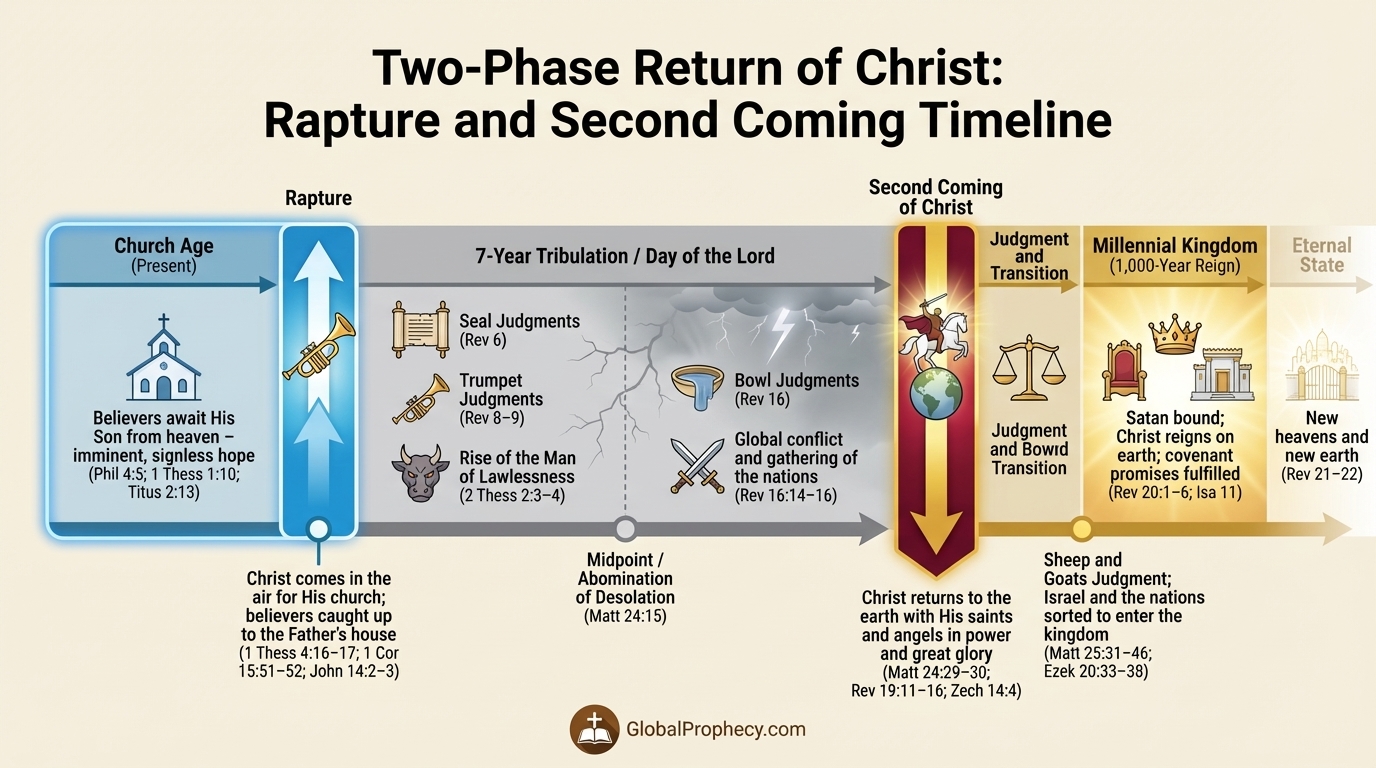
The New Testament uses several terms for Christ’s future coming—parousia (“coming, presence”), apokalupsis (“revelation”), epiphaneia (“appearing”)—and applies them to both aspects of His return, depending on context. From a comprehensive view of prophecy:
-
The Rapture is the first phase of Christ’s second coming program:
- A “mystery” truth revealed specifically in the New Testament (1 Cor 15:51).
- Directly related to the church, which did not exist in the Old Testament (Ephesians 3:4–6).
-
The Revelation/Second Coming is the climactic, globally visible phase:
- Foretold extensively in both Testaments (e.g., Daniel 7:13–14; Zechariah 14; Matthew 24; Revelation 19).
This two-phase understanding allows all relevant texts to stand in their natural sense: Christ first comes for His bride, then later returns with His bride to reign.
6. Theological and Practical Implications
6.1 Preserving Israel–Church Distinctions
Seeing the Rapture and Second Coming as separate events safeguards the biblical distinction between Israel and the church:
- The Rapture deals with Christ’s body, the church, taken to the Father’s house (John 14:2–3).
- The Second Coming finishes God’s program for Israel and the nations, fulfilling covenant promises about a kingdom on earth (Isaiah 11; Jeremiah 23:5–8; Romans 11:25–27).
6.2 Maintaining Imminence
The Rapture is repeatedly portrayed as an imminent hope—an event that can occur at any time, without preceding prophetic signs:
- Philippians 4:5 – “The Lord is at hand”
- 1 Thessalonians 1:10 – believers “wait for his Son from heaven”
- Titus 2:13 – “waiting for our blessed hope”
If the church must pass through the specific events of Matthew 24 before being caught up, that imminence is lost. Distinguishing the Rapture from the Second Coming preserves both the signless expectancy of the Rapture and the sign-laden chronology leading to Christ’s visible return.
6.3 Encouragement and Sobriety
- For believers, the Rapture fosters comfort, holiness, and watchfulness: “encourage one another” (1 Thess 4:18), “everyone who thus hopes in him purifies himself” (1 John 3:3).
- The Second Coming underscores God’s holiness and coming judgment, calling unbelievers to repentance and reminding believers that history is moving toward a righteous King and kingdom.
7. Conclusion
Biblical eschatology presents a coherent, ordered picture of Christ’s return when we distinguish the Rapture from the Second Coming:
- At the Rapture, Christ comes in the air for His church, catching up believers, resurrecting the dead in Christ, and taking His bride to heaven before the Day of the Lord’s wrath.
- At the Second Coming, Christ returns to the earth with His saints and angels, visibly, gloriously, and triumphantly, to defeat His enemies, restore Israel, judge the nations, bind Satan, and establish His millennial kingdom.
These are not contradictory events but complementary phases of one grand divine program. Holding them together—but distinct—honors the full range of biblical prophecy and provides both blessed hope and solemn warning for our generation.
FAQ
Q: Are the Rapture and the Second Coming the same event?
No. The Rapture is Christ’s coming in the air for His church to catch up believers and take them to heaven (1 Thess 4:16–17; John 14:3). The Second Coming is Christ’s return to the earth with His saints in power and glory to judge the nations and establish His kingdom (Matt 24:30; Rev 19:11–16; Zech 14:4).
Q: Where in the Bible is the Rapture taught?
The clearest Rapture passages are 1 Thessalonians 4:13–18 and 1 Corinthians 15:50–57, which describe believers being transformed and “caught up” to meet the Lord in the air. John 14:2–3 also anticipates Christ coming to take His own to the Father’s house in heaven.
Q: How is the Second Coming different from the Rapture in terms of timing?
From a pretribulational perspective, the Rapture occurs before the Tribulation and the outpouring of God’s wrath (1 Thess 1:10; Rev 3:10), whereas the Second Coming occurs after the Tribulation and climaxes it (Matt 24:29–30; Rev 19:11–21). The Rapture is imminent and signless; the Second Coming is preceded by specific prophesied signs.
Q: Will unbelievers see the Rapture?
Scripture does not explicitly say whether unbelievers will see Christ at the Rapture, only that believers will be caught up “in the twinkling of an eye” (1 Cor 15:52). By contrast, the Second Coming is explicitly said to be visible to “every eye” and accompanied by cosmic signs (Rev 1:7; Matt 24:29–30).
Q: Why is it important to distinguish the Rapture and the Second Coming in eschatology?
Distinguishing the two events allows us to harmonize prophetic passages without forcing them into one scenario. It preserves the imminence of the church’s blessed hope, maintains the biblical distinction between Israel and the church, and clarifies God’s ordered plan: rescue of His bride, then judgment and kingdom.
Frequently Asked Questions
Are the Rapture and the Second Coming the same event?
Where in the Bible is the Rapture taught?
How is the Second Coming different from the Rapture in terms of timing?
Will unbelievers see the Rapture?
Why is it important to distinguish the Rapture and the Second Coming in eschatology?
L. A. C.
Theologian specializing in eschatology, committed to helping believers understand God's prophetic Word.
Related Articles
Rapture vs Second Coming: What's the Difference?
Rapture vs Second Coming: learn how Scripture distinguishes Christ coming for His saints from coming with them—different purposes, audiences, outcomes.
The Campaign of Armageddon vs Gog and Magog
Armageddon vs Gog and Magog: explore key differences in timing, geography, and participants to see why these prophetic end-time battles are distinct.
Christ vs Antichrist
Christ vs Antichrist explores their sharp prophetic contrast, revealing how the true Messiah and his counterfeit enemy stand in total opposition.
The Great White Throne vs. The Judgment Seat of Christ
Great White Throne vs. Judgment Seat of Christ: compare who is judged, when each occurs, and how their distinct purposes shape every believer’s eternal outlook.