
The Seven Future Judgments: A Complete Overview
1. Introduction
Biblical eschatology teaches not one single “general judgment,” but a series of distinct future judgments, each with its own time, participants, basis, and outcome. Understanding these seven future judgments clarifies God’s plan for the church, Israel, the nations, angels, and the unsaved, and shows how perfectly He will vindicate His holiness and grace in history.
This overview presents the seven major future judgments:
- Judgment of believers’ works (Judgment Seat of Christ)
- Judgment of Old Testament saints
- Judgment of Tribulation martyrs/saints
- Judgment of living Israel
- Judgment of living Gentile nations
- Judgment of fallen angels (including Satan)
- Judgment of the unsaved at the Great White Throne
All are administered by the Lord Jesus Christ, to whom the Father “has given all judgment” (John 5:22).
2. Judgment of Believers’ Works (Judgment Seat of Christ)
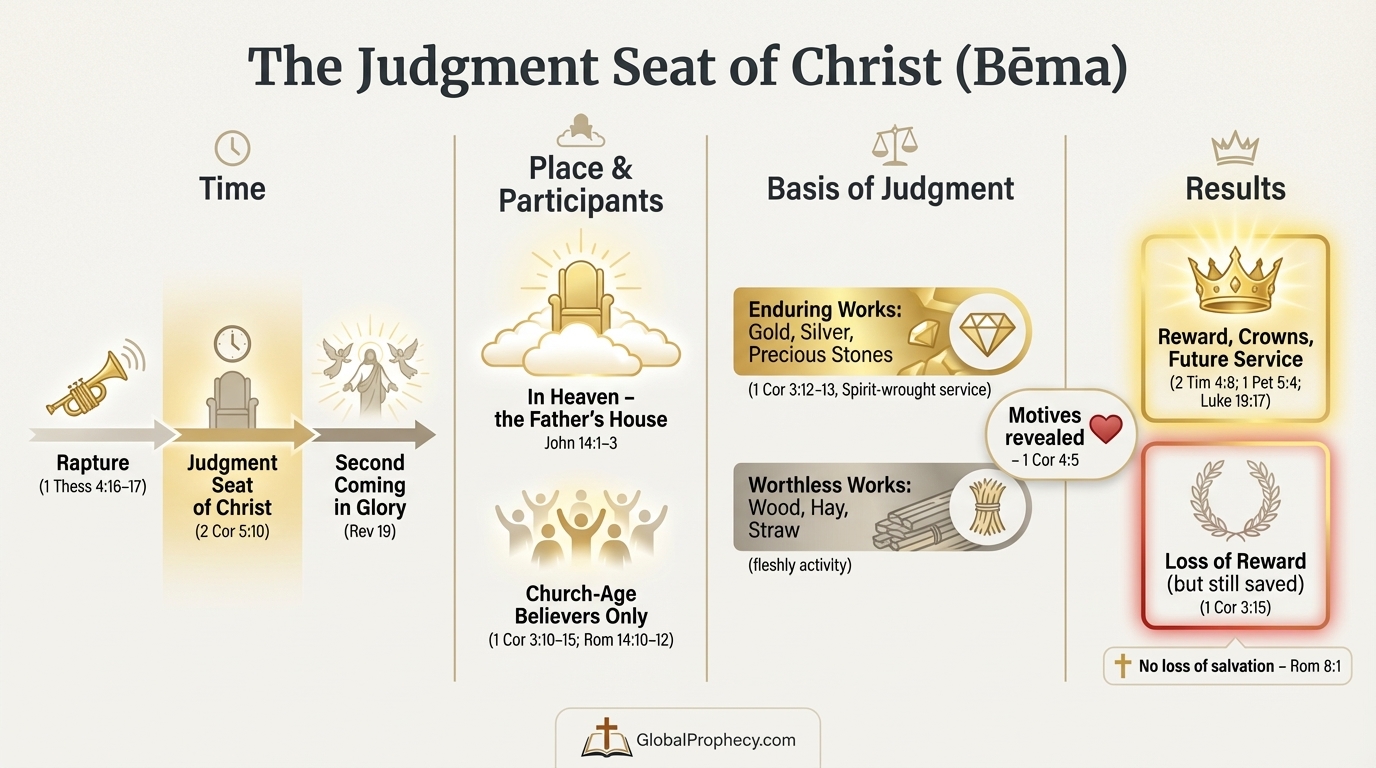
Primary passages: 1 Corinthians 3:10–15; 2 Corinthians 5:10; Romans 14:10–12; 1 Corinthians 4:1–5
This is the judgment seat of Christ (Greek: bēma), a tribunal for believers’ works, not for their salvation.
“For we must all appear before the judgment seat of Christ, so that each one may receive what is due for what he has done in the body, whether good or evil.”
— 2 Corinthians 5:10
Time
- Immediately after the Rapture of the church, before the Revelation of Christ in glory.
- Implied by rewards “at His coming” (1 Cor 4:5; 2 Tim 4:8; Rev 22:12) and by crowned elders already in heaven in Revelation 4:4.
Place
- In heaven, in the Father’s house to which Christ takes His church (John 14:1–3).
Participants
- Church-age believers only (those in the body of Christ from Pentecost to the Rapture).
- Paul’s “we” in 2 Cor 5:10 and Rom 14:10 is clearly the church.
Basis of judgment
- Not whether one is saved—justification is settled by faith alone (Rom 8:1).
- The quality of post-conversion works, symbolized as:
- “gold, silver, precious stones” (enduring, Spirit-wrought service)
- “wood, hay, straw” (worthless, fleshly activity) — 1 Cor 3:12–13
- Motives as well as actions: the Lord “will disclose the purposes of the heart” (1 Cor 4:5).
Result
- Rewards or loss of reward, not loss of salvation:
- “If anyone’s work is burned up, he will suffer loss, though he himself will be saved” (1 Cor 3:15).
- Crowns and capacities for service in Christ’s kingdom (e.g., 2 Tim 4:8; 1 Pet 5:4; Luke 19:17).
- Potential shame at His coming for unfaithfulness (1 John 2:28), yet every believer receives some commendation (1 Cor 4:5).
3. Judgment of Old Testament Saints
Primary passages: Daniel 12:1–3; Malachi 3:16–18
This judgment concerns believers who lived before Pentecost, from Adam to the birth of the church.
“And many of those who sleep in the dust of the earth shall awake, some to everlasting life… And those who are wise shall shine like the brightness of the sky above.”
— Daniel 12:2–3
Time
- After the Great Tribulation, in connection with the Second Coming.
- Most likely within the 75‑day interval between the end of the Tribulation and the official inauguration of the Millennium (Dan 12:11–12).
Place
- Scripture does not specify; likely somewhere in the land of Israel, connected to Christ’s return and Israel’s restoration.
Participants
- All Old Testament believers, from before the cross and before the church age.
Basis of judgment
- Faith demonstrated by faithfulness to the revelation given in their dispensation.
- Daniel highlights those who had “insight” and “turn many to righteousness” (Dan 12:3).
Result
- Resurrection to “everlasting life” and glorious positions in the Messianic Kingdom, pictured as shining “like the stars forever and ever” (Dan 12:3).
- They are assigned roles of honor and service in Christ’s millennial and eternal reign.
4. Judgment of Tribulation Martyrs and Saints
Primary passages: Revelation 20:4–6
This judgment concerns those who come to faith during the seven-year Tribulation and die for Christ.
“Also I saw the souls of those who had been beheaded for the testimony of Jesus and for the word of God… They came to life and reigned with Christ for a thousand years.”
— Revelation 20:4
Time
- After the Second Coming, before the Millennial Kingdom begins in fullness.
- Fits within the same 75‑day post-tribulational interval as Daniel 12.
Place
- Not specified; linked contextually with Christ’s throne and the inauguration of the Millennium.
Participants
- Tribulation martyrs: those who refused to worship the beast or receive his mark (Rev 20:4).
- By extension, all faithful Tribulation saints who die during that period.
Basis of judgment
- Their faith in Christ and faithfulness under persecution, especially refusal of the beast’s worship and mark.
Result
- They “came to life and reigned with Christ for a thousand years” (Rev 20:4).
- They share priestly and kingly service: “They will be priests of God and of Christ, and they will reign with him for a thousand years” (Rev 20:6).
These two resurrection-judgments (OT saints and Tribulation saints) complete the “first resurrection” category of the righteous (Rev 20:5–6), joining the already-resurrected church.
5. Judgment of Living Israel
Primary passages: Ezekiel 20:33–38; Matthew 25:1–13; Romans 11:26–27
This judgment concerns Jews who survive the Tribulation and are still alive on earth when Christ returns.
“I will bring you into the wilderness of the peoples, and there I will enter into judgment with you face to face.”
— Ezekiel 20:35
Time
- After the Second Coming, before the Millennium starts.
- Occurs as part of God’s final regathering and purging of Israel (Ezek 20:33–38).
Place
- “The wilderness of the peoples” (Ezek 20:35), likely the region south of Israel (often associated with the Kadesh-Barnea area), in a setting parallel to the wilderness testing after the Exodus.
Participants
- Living Jewish survivors of the Tribulation, regathered “from the countries where you have been scattered” (Ezek 20:34).
Basis of judgment
- Their response to the New Covenant and kingdom message—that is, genuine faith in the Messiah Jesus.
- Those who come into “the bond of the covenant” are the believing remnant (Ezek 20:37; Rom 11:26–27).
Result
- Believing Jews:
- “I will bring you into the bond of the covenant” (Ezek 20:37).
- They enter the Millennial Kingdom in natural bodies and inherit Israel’s covenant blessings.
- Unbelieving Jews (“rebels”):
- “I will purge out the rebels from among you… they shall not enter the land of Israel” (Ezek 20:38).
- They are cut off in judgment and excluded from the kingdom.
Parables like the wise and foolish virgins (Matt 25:1–13) vividly picture this separation within Israel, with the prepared (believing) remnant entering the marriage feast (the kingdom) and the unprepared left outside.
6. Judgment of the Gentile Nations (Sheep and Goats)
Primary passages: Matthew 25:31–46; Joel 3:1–3, 12–14
This is the judgment of living Gentiles who survive the Tribulation, often called the Sheep and Goat Judgment. It is distinct from the Great White Throne.
“When the Son of Man comes in his glory… then he will sit on his glorious throne. Before him will be gathered all the nations, and he will separate people one from another as a shepherd separates the sheep from the goats.”
— Matthew 25:31–32
Time
- Immediately after the Second Coming, before the Millennium.
- Joel links it with the restoration of Judah and Jerusalem (Joel 3:1–2), and Jesus with His coming in glory (Matt 25:31).
Place
- “The Valley of Jehoshaphat” (Joel 3:2), likely a valley near Jerusalem—commonly associated with the Kidron Valley or a new valley formed when the Mount of Olives splits (Zech 14:4).
Participants
- Living Gentiles (non-Jews) who have passed through the Tribulation in natural bodies.
- “All the nations” (ethnē) are gathered, but the judgment is of individuals (sheep and goats), not corporate political entities.
Basis of judgment
- Their treatment of Christ’s “brothers” during the Tribulation, which reveals their heart response to Christ Himself:
- “As you did it to one of the least of these my brothers, you did it to me.” (Matt 25:40).
- In light of Joel 3 and the Tribulation context, “brothers” most naturally refers to Jewish believers—especially the 144,000 Jewish witnesses.
- This is not salvation by works:
- Works of mercy under intense persecution evidence genuine saving faith; refusal to aid or active hostility reveals unbelief (cf. Rom 2:5–11; James 2:14–18).
Result
- Sheep (righteous Gentiles):
- “Come, you who are blessed by my Father, inherit the kingdom prepared for you” (Matt 25:34).
- They enter the Millennium in natural bodies and share in “eternal life” (Matt 25:46).
- Goats (unbelieving Gentiles):
- “Depart from me, you cursed, into the eternal fire prepared for the devil and his angels” (Matt 25:41).
- They go away “into eternal punishment” (Matt 25:46).
7. Judgment of Fallen Angels (Including Satan)
Primary passages: Matthew 25:41; 2 Peter 2:4; Jude 6; Revelation 20:1–3, 7–10
Scripture teaches that fallen angels and Satan himself will face a final, irreversible judgment.
“Then he will say to those on his left, ‘Depart from me, you cursed, into the eternal fire prepared for the devil and his angels.’”
— Matthew 25:41
Time
- The final sentencing of Satan and the fallen angels takes place after the Millennium:
- Satan is bound at the beginning of the Millennium (Rev 20:1–3).
- He is released briefly at the end, leads a last rebellion, and is then cast into the lake of fire (Rev 20:7–10).
- The demons reserved in “chains” (2 Pet 2:4; Jude 6) are likewise consigned to the same eternal fire.
Place
- Ultimately, the lake of fire, the “eternal fire” prepared specifically “for the devil and his angels” (Matt 25:41; Rev 20:10).
Participants
- Satan (the devil) and all fallen angels who rebelled with him.
Basis of judgment
- Their original rebellion against God and continued opposition to His purposes (Isa 14:12–15; Ezek 28:12–17), along with their role in deceiving and corrupting humanity.
Result
- Eternal, conscious torment in the lake of fire:
- “They will be tormented day and night forever and ever” (Rev 20:10).
- Evil spiritual powers are permanently removed from the created order.
8. Judgment of the Unsaved at the Great White Throne
Primary passages: Revelation 20:11–15; John 5:28–29; Daniel 12:2
This is the final judgment of all unsaved human beings of all ages.
“Then I saw a great white throne and him who was seated on it… And I saw the dead, great and small, standing before the throne, and books were opened.”
— Revelation 20:11–12
Time
- After the 1,000-year reign of Christ and after Satan’s final defeat (Rev 20:7–10).
- Immediately prior to the creation of the new heavens and new earth (Rev 21:1).
Place
- In a unique setting where “earth and sky fled away” (Rev 20:11), indicating that this occurs outside the present created order, which is dissolved (2 Pet 3:10–12).
Participants
- “The dead, great and small” (Rev 20:12):
- All unsaved people from every era, whose bodies are raised in the “resurrection of judgment” (John 5:29).
- They are distinct from “the dead in Christ” who were raised earlier.
Basis of judgment
- Two sets of records:
- “Books”: a complete record of their deeds—demonstrating their guilt and degrees of punishment (Rev 20:12–13; Luke 12:47–48).
- “Book of life”: a roster of the redeemed; anyone not found written there is consigned to the lake of fire (Rev 20:15).
- This judgment does not determine whether they might be saved; it confirms their already-chosen state of unbelief and rebellion.
Result
- “This is the second death, the lake of fire” (Rev 20:14).
- “If anyone’s name was not found written in the book of life, he was thrown into the lake of fire” (Rev 20:15).
- Death and Hades themselves are abolished; all evil is quarantined forever, clearing the way for the eternal state.
9. Summary Table of the Seven Future Judgments
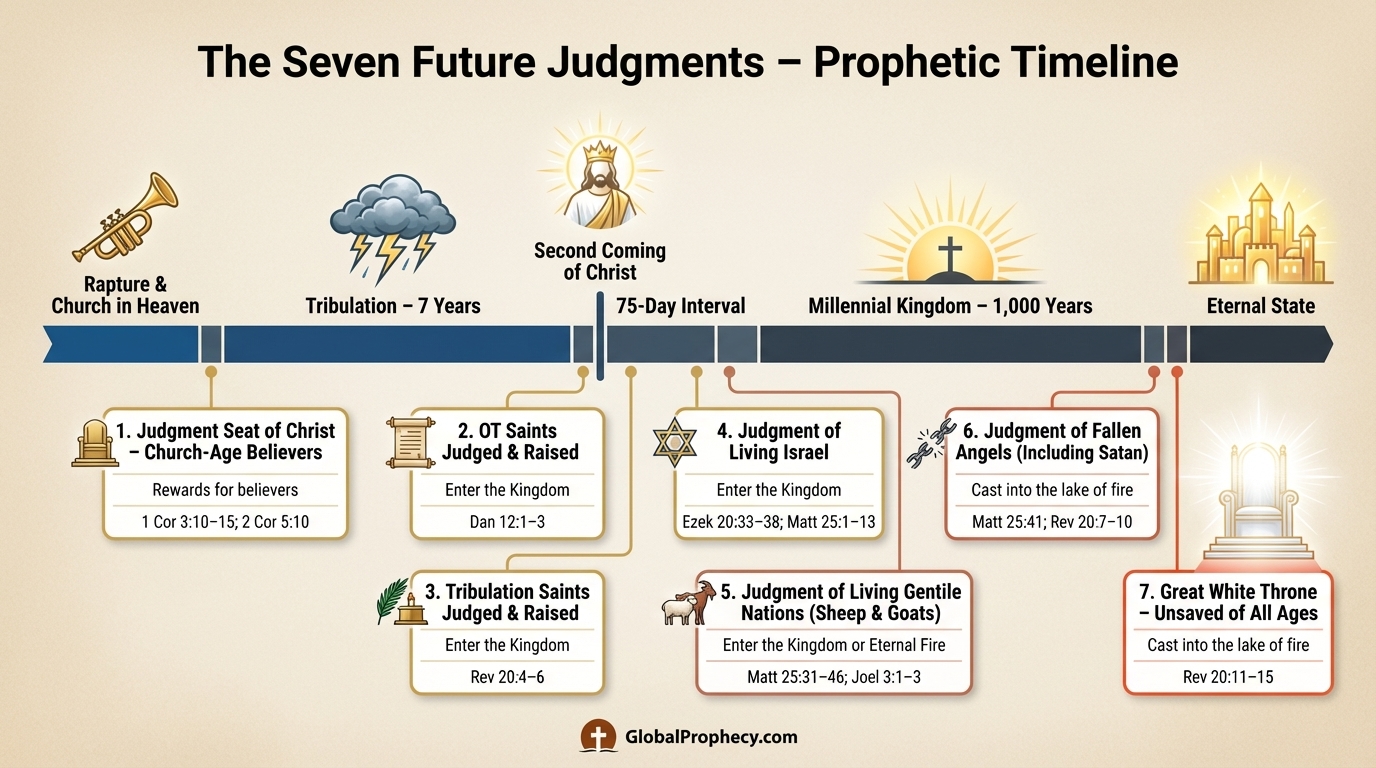
| # | Judgment | Time (Relative) | Participants | Primary Basis | Main Result |
|---|---|---|---|---|---|
| 1 | Judgment Seat of Christ (Believers’ Works) | After the Rapture, before Second Coming | Church-age believers | Quality of post-salvation works and motives | Rewards or loss of reward; all saved |
| 2 | Judgment of Old Testament Saints | After Tribulation, before Millennium | OT believers (pre-church) | Faithfulness to revealed light | Resurrection and positions of glory in the kingdom |
| 3 | Judgment of Tribulation Saints | After Tribulation, before Millennium | Tribulation martyrs and saints | Faith and faithfulness under Antichrist | Resurrection to reign with Christ 1,000 years |
| 4 | Judgment of Living Israel | After Second Coming, before Millennium | Jewish survivors of Tribulation | Response to Messiah / New Covenant | Believing remnant enters kingdom; rebels purged |
| 5 | Judgment of Living Gentile Nations (Sheep & Goats) | After Second Coming, before Millennium | Gentile survivors of Tribulation | Treatment of Christ’s brothers (revealing faith/unbelief) | Saved Gentiles enter kingdom; unsaved to eternal fire |
| 6 | Judgment of Fallen Angels | After Millennium | Satan and fallen angels | Rebellion against God and continued opposition | Cast eternally into lake of fire |
| 7 | Great White Throne Judgment | After Millennium, before eternal state | Unsaved humans of all ages | Works recorded in books; absence from book of life | All cast into lake of fire (second death) |
10. Conclusion
The seven future judgments reveal a coherent, ordered program in biblical eschatology. God does not compress all evaluation into a single “judgment day,” but unfolds separate judgments for the church, Old Testament saints, Tribulation believers, Israel, the Gentile nations, fallen angels, and the unsaved.
Across these tribunals two core principles stand out:
- Grace – Salvation itself is always by grace through faith, grounded in Christ’s atonement, never by works.
- Justice – Works and motives are evaluated, rewards are given, and penalties assigned, so that God’s verdicts are manifestly righteous and tailored to each person or class.
For believers, the coming judgment of works should not inspire terror but sobriety and hope, calling us to live in light of eternity. For the unbeliever, the certainty of the Great White Throne underscores the urgency of responding now to the gospel of Christ, “who delivers us from the wrath to come” (1 Thessalonians 1:10).
FAQ
Q: Are the Judgment Seat of Christ and the Great White Throne judgment the same?
No. The Judgment Seat of Christ (bēma) occurs after the Rapture and concerns only believers’ works, resulting in rewards or loss of reward (2 Cor 5:10; 1 Cor 3:10–15). The Great White Throne occurs after the Millennium and concerns only the unsaved, resulting in their consignment to the lake of fire (Rev 20:11–15).
Q: What is the difference between the judgment of the nations and the Great White Throne?
The judgment of the nations in Matthew 25:31–46 takes place at Christ’s Second Coming, involves living Gentiles (sheep and goats), and determines who enters the Millennial Kingdom. The Great White Throne judgment in Revelation 20:11–15 happens after the Millennium, involves resurrected unbelievers of all ages, and leads to eternal punishment in the lake of fire.
Q: Will believers be judged for their sins in the future?
Believers’ sins were fully judged at the cross (1 Pet 2:24; Rom 8:1). At the Judgment Seat of Christ, believers are evaluated not for condemnation but for faithfulness, with rewards or loss of reward based on their works and motives (1 Cor 3:12–15; 2 Cor 5:10). Their eternal destiny is not at stake.
Q: How many future judgments does the Bible teach?
From a dispensational reading of prophetic Scripture, we can distinguish seven major future judgments: the Judgment Seat of Christ, the judgment of Old Testament saints, Tribulation saints, living Israel, living Gentiles (nations), fallen angels, and the Great White Throne judgment of the unsaved. These occur at different times and involve different groups.
Q: How should Christians live in light of these seven future judgments?
Christians should live with eternal accountability in view—abiding in Christ, serving in the power of the Spirit, and investing in works that endure (1 Cor 3:10–15; 1 John 2:28). The prospect of reward, combined with the certainty of Christ’s just evaluation, is meant to motivate holy living, steadfast service, and faithful proclamation of the gospel.
Frequently Asked Questions
Are the Judgment Seat of Christ and the Great White Throne judgment the same?
What is the difference between the judgment of the nations and the Great White Throne?
Will believers be judged for their sins in the future?
How many future judgments does the Bible teach?
How should Christians live in light of these seven future judgments?
L. A. C.
Theologian specializing in eschatology, committed to helping believers understand God's prophetic Word.
Related Articles
The Millennium Explained: What the Bible Teaches About the 1000-Year Reign
Millennium explained from Scripture: explore the Bible’s teaching on Christ’s 1000-year reign, its purpose, timing, and promises for Israel and the nations.
The Abrahamic Covenant: God's Unconditional Promise to Israel
Abrahamic Covenant explained as God’s unconditional promise to Israel, defining land, seed and blessing and shaping key end-times Bible prophecy.
Amillennialism Examined: Is the Church the Millennial Kingdom?
Amillennialism examined: is the church the millennial kingdom? Explore its claims, symbols, and a biblical critique of this end-times view.
What the Bible Says about Antichrist?
Antichrist in the Bible: discover what Scripture reveals about his identity, character, deceptive power, and end-time role in the Tribulation.