
What Is Sheol/Hades?
1. Introduction
In biblical eschatology, Sheol (Old Testament) and Hades (New Testament) name the realm of the dead—the invisible world where departed souls go between physical death and bodily resurrection. Understanding what Scripture teaches about Sheol and Hades is essential for clarifying:
- What happens immediately after death
- How this state differs from the final hell (Gehenna / lake of fire)
- How Christ’s death and resurrection changed the condition of the saved dead
This article explains the biblical meaning of Sheol and Hades, their relationship, and how they differ from “hell” in its ultimate sense.
2. Sheol in the Old Testament: The Realm of the Dead
2.1 Meaning and Basic Usage
Sheol is the main Old Testament term for the place of the departed dead. It occurs around 65 times. Key points:
- It is “down” or “below”, not up (e.g., Gen 37:35; Isa 14:9; Ezek 32:18).
- It is the unseen realm; a “netherworld” or “the depths of the earth” (Ps 63:9).
- Both righteous and wicked are said to go there.
Importantly, Sheol is not identical to:
-
Death itself – Death is the event; Sheol is the destination after death.
“Like sheep they are appointed for Sheol; death shall be their shepherd.”
— Psalm 49:14 -
The grave only – Hebrew has a distinct word for grave (qeber).
Sheol is often distinguished from burial. For example, the king of Babylon is cast out of his tomb (grave), yet still said to be brought down to Sheol as a conscious person (Isa 14:9, 15, 19–20).
2.2 The Inhabitants of Sheol
The Old Testament consistently presents real, personal existence after death in Sheol.
The wicked
- “The wicked shall return to Sheol, all the nations that forget God.” — Psalm 9:17
- It is described as a place of God’s anger and judgment (Deut 32:22; Prov 9:18).
The righteous
- Jacob expects to go to Sheol and be reunited with his son (Gen 37:35).
- Job wishes to be “hidden in Sheol” from God’s wrath (Job 14:13).
- Hezekiah speaks of “the gates of Sheol” as his expected destination (Isa 38:10).
- Concerning the Messiah:
“For you will not abandon my soul to Sheol, or let your holy one see corruption.”
— Psalm 16:10
So in Old Testament expectation, both righteous and wicked went to Sheol, but their conditions within it differed.
2.3 Conscious Existence and Divine Control
Sheol is a real, God-governed place, not an unconscious void:
-
God is present and sovereign there:
“If I make my bed in Sheol, you are there!” — Psalm 139:8
“Sheol and Abaddon lie open before the LORD.” — Proverbs 15:11 -
It is inescapable by human power:
“What man can live and never see death? Who can deliver his soul from the power of Sheol?”
— Psalm 89:48 -
It is associated with the loss of earthly activity, not the loss of consciousness (Eccl 9:10); the point is that in Sheol one cannot continue earthly works, not that the soul ceases to exist.
2.4 Two “Compartments” in Sheol (Pre‑Christ)
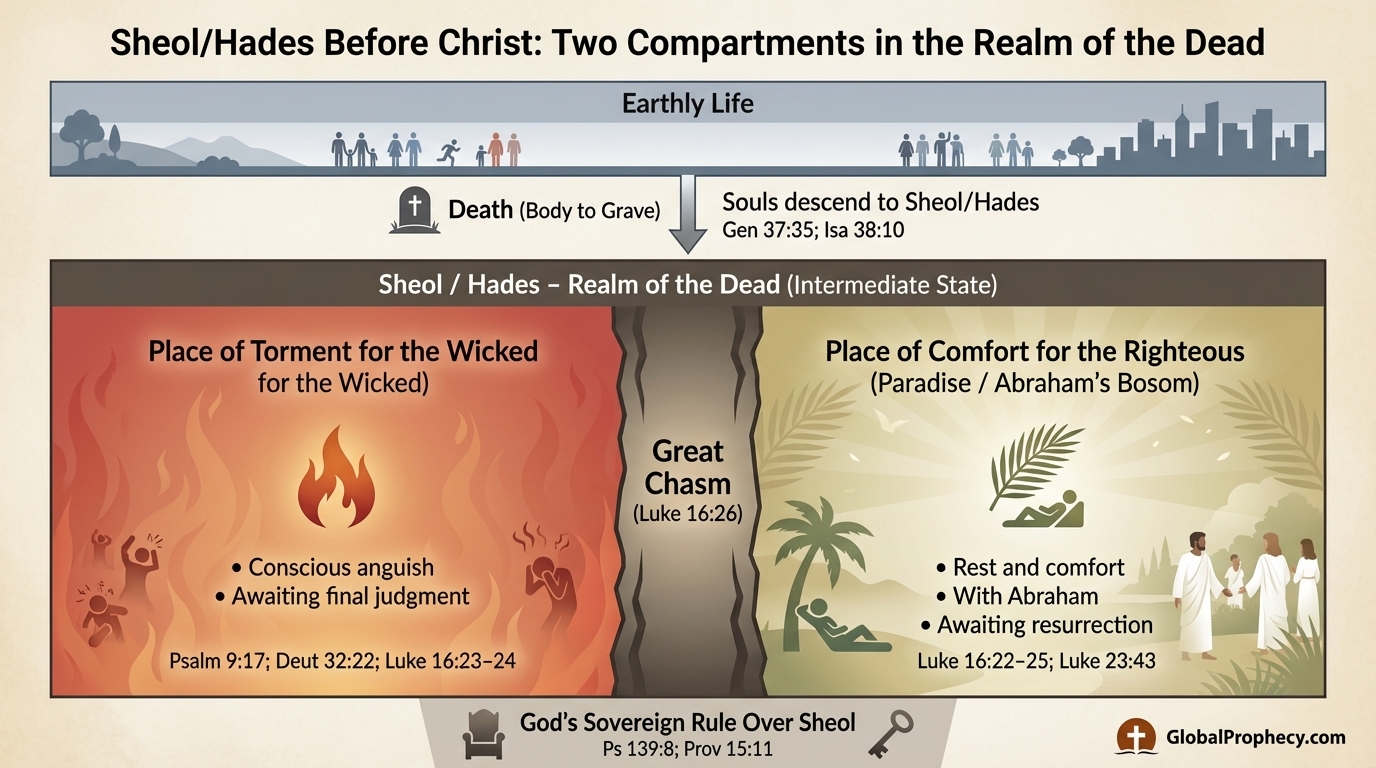
From the combined witness of Old and New Testaments, many interpreters conclude that before Christ’s resurrection Sheol/Hades had two distinct regions:
- A place of punishment for the wicked (“lowest Sheol” – Deut 32:22; Ps 86:13; Prov 9:18).
- A place of rest and comfort for the righteous, often identified later as “Paradise” or “Abraham’s bosom” (Luke 16:22–26).
In this understanding, the Old Testament righteous were in a blessed section of Sheol, awaiting the completion of redemption and the resurrection.
3. Hades in the New Testament: Continuity with Sheol
3.1 Hades as the Greek Equivalent of Sheol
The New Testament uses the Greek word Hades as the primary term for the realm of the dead. It is:
- The regular Greek equivalent of Hebrew Sheol in the Septuagint (Greek OT).
- Explicitly equated with Sheol in Acts 2:27, 31, where Peter cites Psalm 16:10:
“you will not abandon my soul to Hades” (Acts 2:27)
Thus, Sheol and Hades refer to the same basic reality—the intermediate realm of the dead.
New Testament passages distinguish Hades from death and from the lake of fire:
“And Death and Hades gave up the dead who were in them… Then Death and Hades were thrown into the lake of fire.”
— Revelation 20:13–14
Here:
- Death yields up bodies.
- Hades yields up souls.
- Both are finally thrown into the lake of fire, a different, ultimate reality.
3.2 Hades as the Temporary Place of the Lost Dead
In the New Testament, Hades is consistently negative when specified, a place of torment for the unsaved dead awaiting final judgment.
The clearest passage is Luke 16:19–31:
- The rich man dies and is buried; “in Hades, being in torment, he lifted up his eyes” (Luke 16:23).
- He is conscious, remembers his life, feels thirst and anguish in the flame (vv. 23–24).
- He can see Lazarus comforted “at Abraham’s side” (v. 22).
- A great chasm is fixed; no crossing between the two states is possible (v. 26).
This shows:
- Hades is a real place of conscious punishment for the wicked dead.
- At that time, the righteous dead were in a distinct place of comfort (Abraham’s bosom / Paradise), separated but in view.
Jesus also speaks of Hades as the opposite of exaltation:
“And you, Capernaum, will you be exalted to heaven? You will be brought down to Hades.”
— Matthew 11:23; cf. Luke 10:15
3.3 Christ and Hades
Christ Himself entered the realm of the dead but was not abandoned there:
“For you will not abandon my soul to Hades, or let your Holy One see corruption.”
— Acts 2:27
Jesus promised the repentant thief:
“Truly, I say to you, today you will be with me in Paradise.”
— Luke 23:43
Before Christ’s resurrection, “Paradise” is best understood as the blessed region of Sheol/Hades (“Abraham’s bosom,” Luke 16:22). After His resurrection and ascension, Paradise is spoken of as being in the third heaven, the very presence of God (2 Cor 12:2–4; Rev 2:7). This indicates a change in the location of the righteous dead, which we will address below.
4. Sheol/Hades vs. Hell: Crucial Distinctions
In many English Bibles—especially older ones—the words “hell,” “grave,” “Sheol,” and “Hades” are sometimes blurred in translation. For biblical eschatology, we must distinguish three key terms:
| Term | Language/Testament | Basic Meaning | Timeframe |
|---|---|---|---|
| Sheol | Hebrew, OT | Realm of the dead (intermediate) | Before Christ’s return |
| Hades | Greek, NT | Realm of the dead (intermediate) | Before final judgment |
| Gehenna / Lake of Fire | Greek, NT | Final place of eternal punishment (hell) | After final judgment |
4.1 Hades Is Not the Final Hell
The New Testament makes a clear temporal sequence:
- At death, the wicked go to Hades, a temporary place of conscious torment.
- At the final judgment (Great White Throne), they are raised bodily.
- Then they are cast into the lake of fire, the second death:
“Then Death and Hades were thrown into the lake of fire. This is the second death, the lake of fire.”
— Revelation 20:14
Thus:
- Sheol/Hades = present intermediate state of the dead.
- Hell (Gehenna / lake of fire) = final, eternal state of the lost after resurrection and judgment.
To say “people go to hell when they die” is imprecise. Biblically:
- Unsaved people now go to Hades,
- and only after the resurrection and judgment do they enter hell in its full and eternal sense.
5. What Changed After Christ’s Death and Resurrection?
From a biblical-eschatological perspective, Christ’s resurrection and ascension marked a major turning point in the structure of the intermediate state.
5.1 Paradise Moved from Sheol to Heaven
Before Christ’s resurrection:
- Righteous dead were described as being in Sheol/Hades, in a blessed area called “Abraham’s bosom” or “Paradise” (Luke 16:22–25; 23:43).
After Christ’s resurrection and ascension:
-
Paradise is now located in the third heaven, where God’s throne is:
“caught up to the third heaven… caught up into Paradise” — 2 Corinthians 12:2–4
-
The New Testament consistently teaches that believers who die now go immediately into Christ’s presence:
“We would rather be away from the body and at home with the Lord.”
— 2 Corinthians 5:8
“My desire is to depart and be with Christ, for that is far better.”
— Philippians 1:23
“Lord Jesus, receive my spirit.” — Acts 7:59
This supports the view that Christ, having fully accomplished redemption, relocated the dwelling-place of the saved dead from the “Paradise” section of Sheol/Hades to heaven itself.
5.2 The Present Situation
In light of Christ’s work, the present biblical picture is:
-
For believers
- The body goes to the grave.
- The soul/spirit goes immediately to be with Christ in heaven (not to Hades).
- They await the resurrection of the body at Christ’s coming (1 Thess 4:13–17).
-
For unbelievers
- The body goes to the grave.
- The soul/spirit goes to Hades, a place of conscious torment.
- They await resurrection and final judgment, after which they will be cast into the lake of fire (Rev 20:11–15).
In this present era, Hades functions only as the temporary prison of the lost, while the saved are in heaven with Christ.
6. Theological and Pastoral Significance
6.1 Certainty of Conscious Existence After Death
Sheol/Hades in Scripture implies ongoing personal identity and awareness after death:
- The rich man and Lazarus are fully self-aware (Luke 16:19–31).
- Old Testament texts imply continued existence with God or away from Him.
- New Testament texts explicitly reject any notion of post-mortem “soul sleep.”
There is no biblical room for:
- Annihilation (ceasing to exist)
- Reincarnation
- A second chance after death (Heb 9:27; Luke 16:26)
6.2 God’s Sovereignty Over the Realm of the Dead
Both Sheol and Hades are depicted as fully under God’s control:
“Sheol and Abaddon lie open before the LORD.” — Proverbs 15:11
Christ holds “the keys of Death and Hades.” — Revelation 1:18
This underscores:
- No one goes to Sheol/Hades outside of God’s decree.
- No one can escape Hades or enter heaven apart from Christ’s saving work.
6.3 The Seriousness of Final Hell
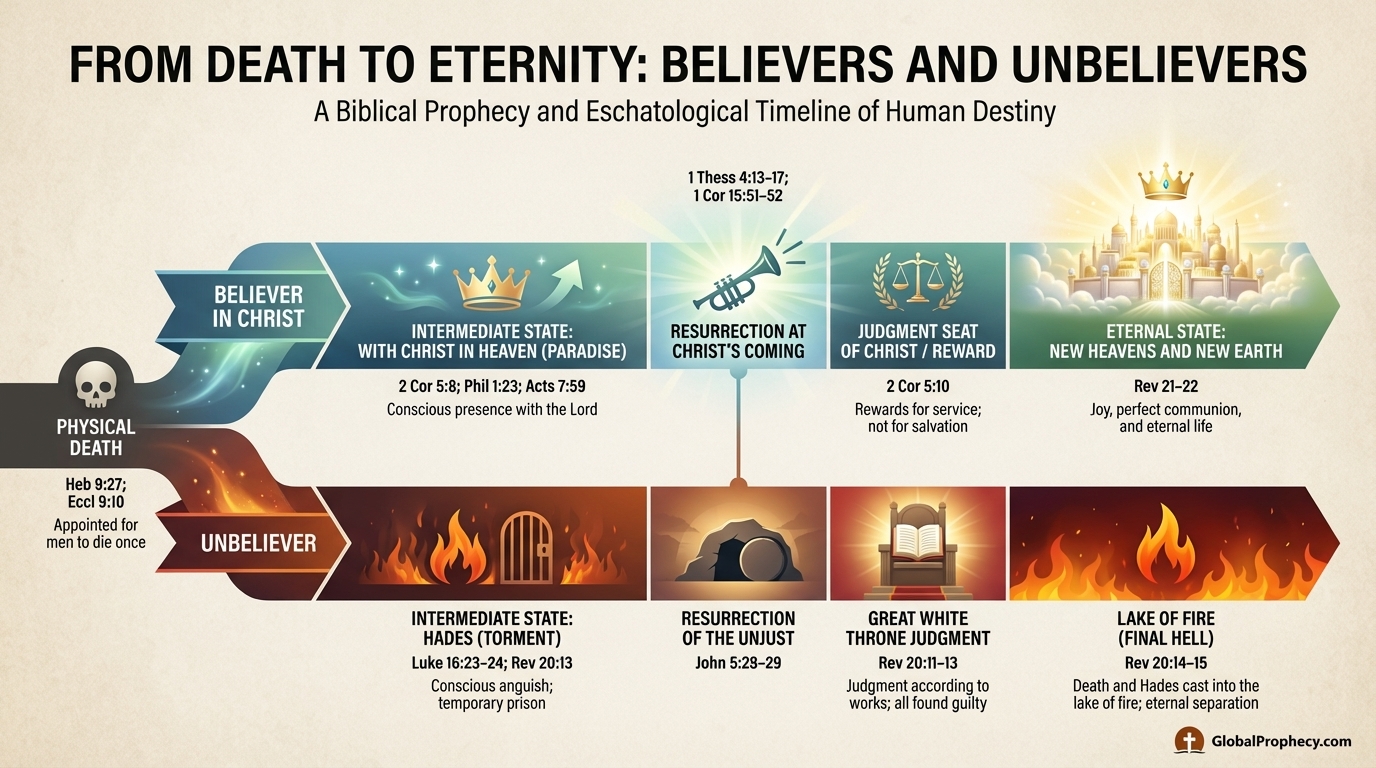
Because Sheol/Hades is not yet the final state, it foreshadows something even more terrible for the unrepentant:
- Hades is torment now, but temporary.
- The lake of fire is eternal judgment (Rev 20:10, 14–15).
Understanding the difference between Hades and hell heightens the urgency to:
- Flee from the wrath to come by faith in Christ.
- Proclaim the gospel while it is still “the day of salvation” (2 Cor 6:2).
7. Conclusion
Biblically, Sheol and Hades designate the intermediate realm of the dead, not the final hell. In the Old Testament, Sheol is the unseen realm where both righteous and wicked go, though in very different conditions. In the New Testament, Hades continues this function, especially as the temporary place of torment for the unsaved dead.
With the death, resurrection, and ascension of Christ, the situation of the righteous changed decisively:
- Paradise, once associated with the blessed region of Sheol/Hades, is now located in heaven.
- Believers who die go immediately into the presence of the Lord, while unbelievers go to Hades awaiting final judgment.
- At the end, Death and Hades themselves will be thrown into the lake of fire, the true “hell” of eternal punishment.
A biblically grounded understanding of Sheol and Hades guards us from confusion, highlights the certainty of conscious existence after death, and directs our hope not to the intermediate state itself, but to the resurrection and eternal life promised in Christ.
FAQ
Q: Is Sheol just another word for “grave” in the Old Testament?
No. While some passages use Sheol metaphorically for the grave, Hebrew has a separate word (qeber) for the physical grave. Sheol is the realm of the dead, where souls go after death. Old Testament texts often distinguish Sheol from literal burial and speak of conscious existence there.
Q: Are Sheol and Hades the same thing?
Yes. Hades is the Greek New Testament equivalent of the Hebrew Sheol. The Septuagint routinely translates Sheol as Hades, and Acts 2:27, 31 explicitly apply the Sheol text of Psalm 16:10 to Christ using the word Hades. Both refer to the intermediate realm of the dead, not the final hell.
Q: How is Hades different from hell?
Hades is the temporary place of the unsaved dead between death and resurrection, a place of conscious torment. Hell in the ultimate sense is the lake of fire (Gehenna) described in Revelation 20:14–15, the final and eternal state of punishment after the resurrection and judgment. Scripture says “Death and Hades” will themselves be thrown into the lake of fire.
Q: Where do believers go when they die—Sheol, Hades, or heaven?
Since Christ’s resurrection and ascension, believers who die go directly to be with Christ in heaven (2 Cor 5:8; Phil 1:23; Acts 7:59). Before Christ, the righteous dead were described as in a blessed region (“Paradise,” “Abraham’s bosom”) associated with Sheol/Hades, but now “Paradise” is located in the third heaven (2 Cor 12:2–4).
Q: Are people conscious in Sheol/Hades, or is it like “soul sleep”?
People are conscious in Sheol/Hades. The rich man and Lazarus in Luke 16:19–31 remember, speak, feel pain or comfort, and are aware of their condition. Passages about being “asleep” refer to the body in death or use a metaphor for death, not to the soul’s unconsciousness. The Bible does not teach “soul sleep” between death and resurrection.
Frequently Asked Questions
Is Sheol just another word for “grave” in the Old Testament?
Are Sheol and Hades the same thing?
How is Hades different from hell?
Where do believers go when they die—Sheol, Hades, or heaven?
Are people conscious in Sheol/Hades, or is it like “soul sleep”?
L. A. C.
Theologian specializing in eschatology, committed to helping believers understand God's prophetic Word.
Related Articles
What Is Death According to the Bible?
Death in the Bible is more than dying physically. Explore its origin in sin, the meaning of physical and spiritual death, and God’s answer in Christ.
Death and the Unbeliever
Death and the unbeliever explores what happens at death, conscious judgment, and the eternal destiny of those who die without saving faith in Christ.
What Is the Intermediate State?
Intermediate state explained: what happens to the soul between death and resurrection, for believers and unbelievers, in the biblical afterlife timeline.
Resurrection vs Resuscitation: What's the Difference?
Resurrection vs resuscitation: learn the biblical difference between temporary return to mortal life and permanent, glorified life after death.