
The Two Witnesses
1. Introduction
The two witnesses in Revelation 11 are among the most striking figures in biblical eschatology. Their brief but powerful appearance during the end times concentrates key themes of Revelation: divine testimony, prophetic power, intense persecution, death, resurrection, and vindication.
Revelation 11:3–13 presents a compact narrative of who these two witnesses are, the nature of their ministry during the Great Tribulation, and their dramatic fate before the visible return of Christ. This article focuses exclusively on these two witnesses—exploring their identity, their mission, their protection and martyrdom, and their resurrection and ascension.
2. Identity of the Two Witnesses
2.1 Literal or symbolic?
Interpreters have long debated whether the two witnesses are symbolic (e.g., representing the Law and the Prophets, or the Old and New Testaments) or literal individuals. Revelation 11, however, portrays them in strongly personal terms:
- They wear sackcloth (Rev 11:3)
- They prophesy for a fixed period (1,260 days)
- They perform specific miracles (Rev 11:5–6)
- They are killed, their dead bodies lie in a specific city (Rev 11:7–8)
- They are visibly raised and taken up to heaven (Rev 11:11–12)
Such concrete details are far more consistent with actual human persons than with purely symbolic entities. While their ministry certainly has symbolic significance, the text itself most naturally supports the view that the two witnesses are literal, historical individuals who will appear in the future Tribulation.
2.2 “Two olive trees and two lampstands”
Revelation describes the witnesses in Old Testament imagery:
"These are the two olive trees and the two lampstands that stand before the Lord of the earth."
— Revelation 11:4
This language recalls Zechariah 4, where Joshua the high priest and Zerubbabel the governor are pictured as olive trees supplying oil to a lampstand, symbolizing Spirit-empowered leadership in Israel’s restoration. In Revelation 11, the two witnesses are likewise:
- Lampstands – bearers of divine light and testimony in a dark age
- Olive trees – channels of the Holy Spirit’s power for their prophetic ministry
The imagery reinforces that these witnesses are Spirit-empowered human prophets, raised up by God at a critical moment in redemptive history.
2.3 Are the witnesses Moses and Elijah?
While Revelation does not name the two witnesses, many scholars identify them as Moses and Elijah. This view arises from several converging lines of evidence:
-
Similarity of miracles (Rev 11:5–6)
- They “have power to shut the sky, that no rain may fall during the days of their prophesying” (Rev 11:6), echoing Elijah’s drought in 1 Kings 17:1; James 5:17.
- They have power “over the waters to turn them into blood and to strike the earth with every kind of plague” (Rev 11:6), recalling Moses’s miracles in Egypt (Exodus 7–11).
-
Appearance at the Transfiguration
Moses and Elijah appeared with Jesus on the Mount of Transfiguration (Matt 17:1–3), a preview of His kingdom glory. Their participation there with the glorified Christ foreshadows their eschatological role connected to His return. -
Old Testament expectation of Elijah’s future ministry
Malachi foretells:"Behold, I will send you Elijah the prophet before the great and awesome day of the LORD comes."
— Malachi 4:5While John the Baptist came “in the spirit and power of Elijah” (Luke 1:17), he did not fulfill all eschatological expectations. A future, Elijah-like ministry fits well with Revelation 11.
-
Law and Prophets represented together
Moses represents the Law; Elijah represents the Prophets. Their joint appearance emphasizes the full witness of the Hebrew Scriptures converging in the final testimony to Christ during the Tribulation.
Other identifications have been proposed (e.g., Enoch and Elijah, or two as-yet-unknown prophets), and absolute certainty is not possible. However, within a futurist, premillennial reading, the Moses–Elijah identification best harmonizes the textual, historical, and theological data.
3. The Ministry of the Two Witnesses
3.1 Duration and timing
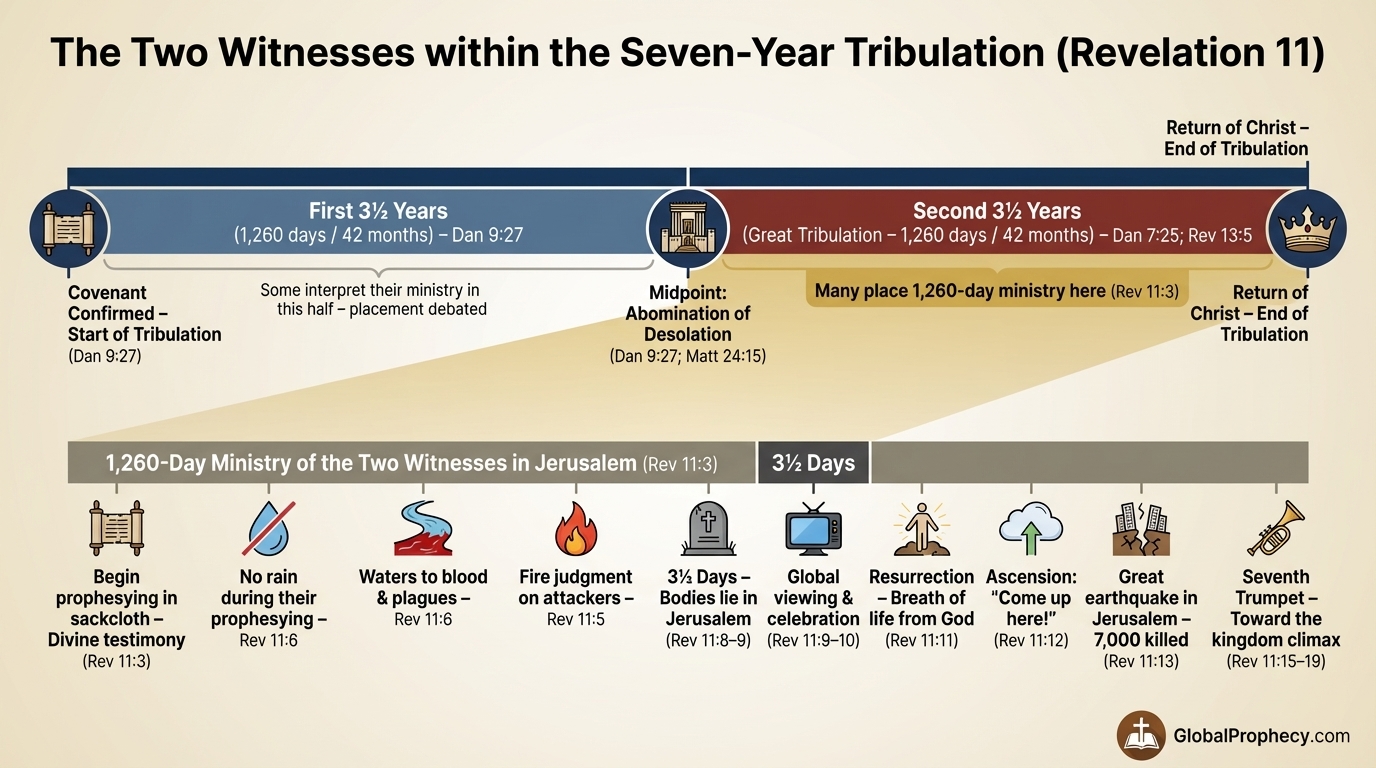
Revelation states explicitly:
"I will grant authority to my two witnesses, and they will prophesy for 1,260 days, clothed in sackcloth."
— Revelation 11:3
- 1,260 days equals three and a half years, a key prophetic period also described as:
- “forty-two months” (Rev 11:2; 13:5)
- “a time, and times, and half a time” (Dan 7:25; 12:7; Rev 12:14)
In a standard Tribulation framework of seven years (based on Daniel 9:27), their 1,260-day ministry occupies half of that period. Many interpreters place their ministry in the second half (the Great Tribulation), due to:
- The close connection with the trampling of Jerusalem for “forty-two months” (Rev 11:2), a period associated with Antichrist’s domination.
- Their ongoing conflict with “the beast that rises from the bottomless pit” (Rev 11:7), whose full manifestation is especially evident in the latter half.
- The immediate segue from their ministry and resurrection to the sounding of the seventh trumpet (Rev 11:15–19), which points toward the climax of the Tribulation.
Others place them in the first half. While the exact half is debated, the central truth remains: for a defined three-and-a-half-year period, God will preserve and empower these men as His special representatives in Jerusalem.
3.2 Location and audience
The setting of their ministry is clearly identified:
"…their dead bodies will lie in the street of the great city that symbolically is called Sodom and Egypt, where their Lord was crucified."
— Revelation 11:8
“Where their Lord was crucified” can refer only to Jerusalem. Thus, their primary sphere of ministry is:
- Geographical: Jerusalem, the religious and political focal point of end-time events
- Ethnic: Particularly Israel, though their testimony will have global reach due to its miraculous nature and worldwide coverage
Jerusalem is described symbolically as “Sodom and Egypt,” underscoring its spiritual apostasy, moral corruption, and bondage to idolatry during the Tribulation. Into this context of darkness, the two witnesses shine as prophetic lights, calling Israel and the nations to repentance.
3.3 Nature of their message
The two witnesses are said to “prophesy” (Rev 11:3), and they wear sackcloth, a traditional garment of grief and repentance. Their ministry includes:
- Proclamation of judgment – announcing God’s impending wrath on a rebellious world
- Call to repentance – urging Israel and the nations to turn from sin to the true God
- Announcement of the coming kingdom – heralding the nearness of Christ’s return and the establishment of His reign
Their sackcloth signals mourning over sin, lament over spiritual apostasy, and urgent summons to repentance in the final days before the Second Coming.
3.4 Miraculous powers
God grants the two witnesses extraordinary supernatural authority:
"And if anyone would harm them, fire pours from their mouth and consumes their foes. If anyone would harm them, this is how he is doomed to be killed. They have the power to shut the sky, that no rain may fall during the days of their prophesying, and they have power over the waters to turn them into blood and to strike the earth with every kind of plague, as often as they desire."
— Revelation 11:5–6
Key aspects of their power include:
- Protection by fire: Anyone who attempts to harm them is destroyed. Whether this is literal fire or symbolic of instantaneous divine judgment, the effect is real and lethal.
- Control of rainfall: They shut the heavens so that no rain falls during their entire prophetic period—echoing Elijah’s drought.
- Judgments upon earth and waters: They turn water into blood and unleash “every kind of plague,” reminiscent of Moses’s plagues on Egypt.
These miracles function as:
- Authenticating signs of their divine commission
- Judicial acts of God against a hardened world
- Foretastes and possibly instruments of the judgments described in the trumpet and bowl sequences
Throughout their appointed mission, they remain invincible. No human or demonic power can silence them until God’s purpose for their testimony is complete.
4. The Fate of the Two Witnesses
4.1 Their martyrdom
Revelation 11 underscores a crucial turning point:
"And when they have finished their testimony, the beast that rises from the bottomless pit will make war on them and conquer them and kill them."
— Revelation 11:7
The sequence is highly significant:
- Only “when they have finished their testimony” does God allow them to be killed. Their time and manner of death are under divine sovereignty.
- Their killer is “the beast that rises from the bottomless pit,” identified with the Antichrist, the final world ruler energized by Satan.
Their ministry ends in martyrdom. Yet even this apparent defeat is under God’s control and sets the stage for a greater display of His power.
4.2 Public display and global celebration
Their treatment in death reveals the spiritual state of the world:
"…their dead bodies will lie in the street of the great city… For three and a half days some from the peoples and tribes and languages and nations will gaze at their dead bodies and refuse to let them be placed in a tomb, and those who dwell on the earth will rejoice over them and make merry and exchange presents, because these two prophets had been a torment to those who dwell on the earth."
— Revelation 11:8–10
Key elements:
- Their bodies are left unburied in Jerusalem’s streets, a deliberate act of contempt and humiliation.
- People from “peoples and tribes and languages and nations” look on. In the modern era, this is readily understood as global media coverage, where the entire world can watch the scene in real time.
- The unbelieving world rejoices, celebrates, and exchanges gifts, treating their death as a kind of blasphemous holiday. The two witnesses had “tormented” them—meaning their prophetic preaching and plagues confronted a world determined to reject God.
This grotesque celebration is one of the starkest pictures in Scripture of end-time hardness of heart. Humanity will prefer the lie of Antichrist to the truth of God, even when confronted by miraculous, undeniable signs.
4.3 Resurrection and ascension
God’s final word on the ministry of the two witnesses is not death but resurrection and exaltation:
"But after the three and a half days a breath of life from God entered them, and they stood up on their feet, and great fear fell on those who saw them. Then they heard a loud voice from heaven saying to them, 'Come up here!' And they went up to heaven in a cloud, and their enemies watched them."
— Revelation 11:11–12
This climactic moment unfolds in three stages:
-
Resurrection
- “A breath of life from God” enters them, recalling Ezekiel 37 and God’s sovereign power over death.
- They “stood up on their feet,” visibly alive in the very place where the world celebrated their corpses.
-
Worldwide terror
- “Great fear fell on those who saw them.” The global audience that watched their death and mocked their God now witnesses a public, undeniable resurrection.
-
Ascension
- They hear the command, “Come up here!” similar to the call in Revelation 4:1.
- They ascend to heaven “in a cloud,” reminiscent of Christ’s ascension (Acts 1:9) and the rapture imagery (1 Thess 4:17).
- Their enemies explicitly “watched them,” ensuring that this event functions as a visible, eschatological sign of the true God’s supremacy.
Their resurrection and ascension constitute a powerful vindication of their testimony and a direct rebuke to the Antichrist’s claims to power.
4.4 Immediate aftermath
Following their ascension, Revelation adds:
"And at that hour there was a great earthquake, and a tenth of the city fell. Seven thousand people were killed in the earthquake, and the rest were terrified and gave glory to the God of heaven."
— Revelation 11:13
The result:
- A devastating earthquake strikes Jerusalem.
- A tenth of the city collapses.
- Seven thousand perish—likely significant leaders or notable persons.
- “The rest…gave glory to the God of heaven,” suggesting at least some measure of repentance or acknowledgment of God’s reality and power.
Thus, the ministry of the two witnesses bears fruit even after their departure, contributing to God’s ongoing purposes of judgment and salvation during the Tribulation.
5. The Theological Significance of the Two Witnesses
From a biblical eschatology perspective, the two witnesses illustrate several key truths:
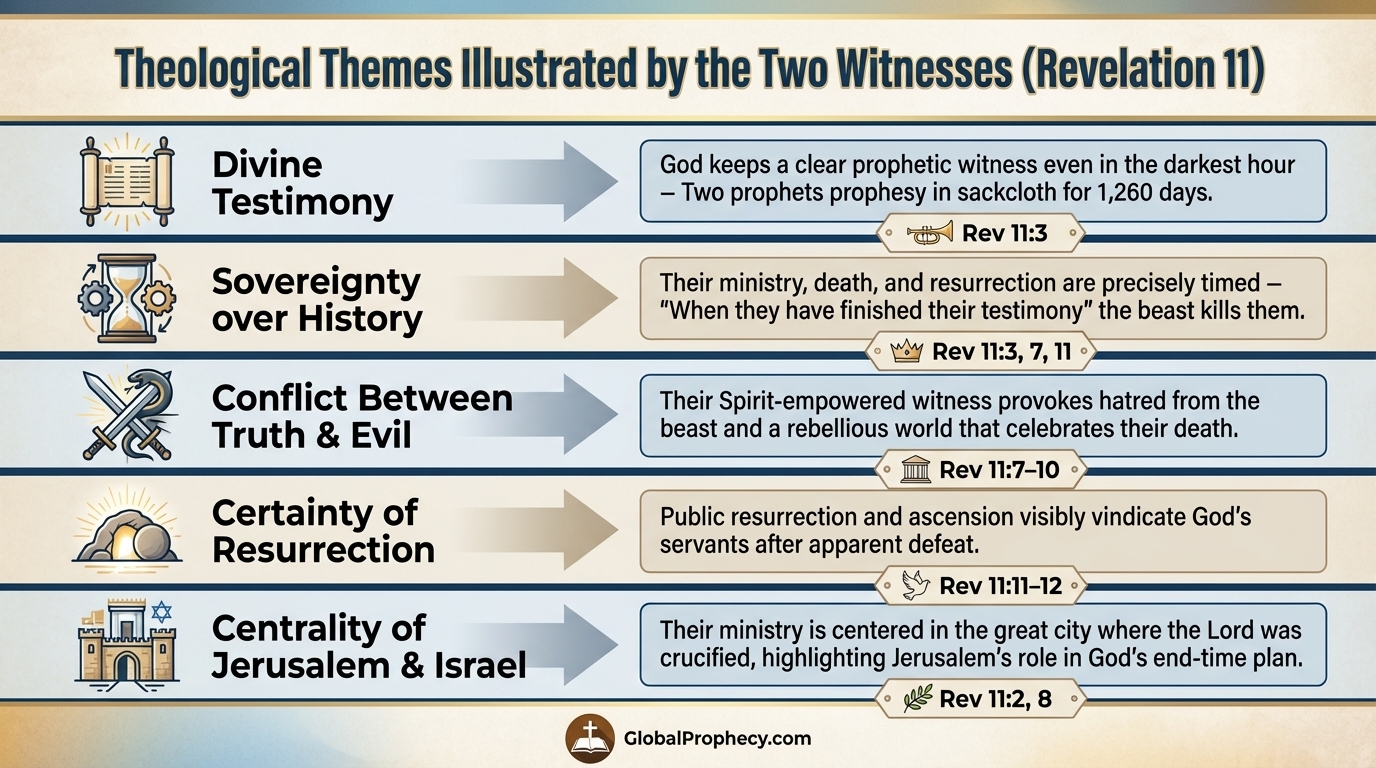
| Theme | How the Two Witnesses Illustrate It |
|---|---|
| Divine testimony | God never leaves Himself without a witness, even in the darkest hour. |
| Sovereignty over history | Their ministry length, death, and resurrection are all precisely timed. |
| Conflict between truth & evil | Their ministry provokes the hatred of the beast and the world. |
| Certainty of resurrection | God publicly vindicates His servants after apparent defeat. |
| Centrality of Jerusalem & Israel | Their ministry is centered in Jerusalem, focusing God’s program on Israel. |
In a world dominated by Antichrist’s deception, the two witnesses stand as God’s official spokesmen, authenticated by spectacular signs and sealed by martyrdom and resurrection. Their story prefigures the ultimate triumph of Christ, who will return to overthrow the beast and establish His kingdom.
6. Conclusion
The two witnesses of Revelation 11 are not marginal figures in biblical prophecy but central actors in the drama of the end times. As literal, Spirit-empowered prophets—likely Moses and Elijah—they will minister in Jerusalem for three and a half years during the Tribulation.
Clothed in sackcloth, they will proclaim judgment and call for repentance, wielding miraculous powers that echo the great acts of God in Israel’s past. Protected until their task is complete, they will finally be killed by the beast, publicly humiliated, and celebrated by a rebellious world. Yet after three and a half days, God will raise them to life and call them to heaven in full view of their enemies, accompanied by a great earthquake and a measure of renewed fear of God.
In the larger sweep of eschatology, the two witnesses demonstrate that God’s word will be proclaimed to the end, that His servants are secure within His purposes, and that death and opposition cannot thwart His plan. Their ministry is both a solemn warning and a profound encouragement: even in the darkest period of human history, God will still speak, still save, and ultimately vindicate His truth before the eyes of the world.
FAQ
Q: Who are the two witnesses in Revelation 11?
The two witnesses in Revelation 11 are future end-time prophets whom God will raise up during the Tribulation to minister in Jerusalem for 1,260 days. While their names are not given in the text, many interpreters identify them as Moses and Elijah due to the similarity of their miracles and their joint appearance with Jesus at the Transfiguration.
Q: What will the two witnesses do during their ministry?
The two witnesses will prophesy, call people to repentance, and announce God’s coming judgment and kingdom. They will perform powerful miracles, including withholding rain, turning water into blood, and striking the earth with plagues. Their ministry will be a public, Spirit-empowered testimony to the true God in the midst of the Great Tribulation.
Q: How long will the two witnesses minister?
Revelation 11:3 states that the two witnesses will prophesy for 1,260 days, which equals three and a half years. This period corresponds to half of the seven-year Tribulation, and many scholars place their ministry in the latter half, when the Antichrist’s persecution of Jerusalem is most intense.
Q: What happens to the two witnesses at the end of their ministry?
When they have finished their testimony, the beast (Antichrist) will kill them, and their bodies will lie in the streets of Jerusalem for three and a half days while the world celebrates their death (Rev 11:7–10). After that, God will raise them from the dead and call them up to heaven in full view of their enemies (Rev 11:11–12).
Q: Why are the two witnesses important in biblical eschatology?
The two witnesses are important because they embody God’s final prophetic testimony before Christ’s return. They show that God maintains a clear, powerful witness even under Antichrist’s rule, that He is sovereign over life and death, and that He will ultimately vindicate His servants through resurrection and exaltation. Their ministry highlights the conflict between divine truth and global rebellion in the last days.
Frequently Asked Questions
Who are the two witnesses in Revelation 11?
What will the two witnesses do during their ministry?
How long will the two witnesses minister?
What happens to the two witnesses at the end of their ministry?
Why are the two witnesses important in biblical eschatology?
L. A. C.
Theologian specializing in eschatology, committed to helping believers understand God's prophetic Word.
Related Articles
Babylon the Great
Babylon the Great in Revelation 17–18 reveals end-time religious and commercial rebellion against God and its sudden, final destruction in judgment.
The 144,000 Sealed Israelites
144,000 sealed Israelites in Revelation identified and explained—their identity, purpose, and distinct role as preserved witnesses during the Tribulation.
What is the Battle of Armageddon?
Armageddon, the climactic end-times battle, is described in Revelation 16 and 19. Learn what this final conflict is and when it will occur.
What the Bible Says about Antichrist?
Antichrist in the Bible: discover what Scripture reveals about his identity, character, deceptive power, and end-time role in the Tribulation.