
What Will Happen at the Rapture?
1. Introduction
The New Testament describes a future event in which Jesus Christ will personally return for His church, resurrecting dead believers and transforming living believers in an instant. This event is commonly called the rapture (from the Latin rapturo, translating the Greek harpazō—“caught up,” 1 Thessalonians 4:17).
This article traces, step by step, what will happen at the rapture, in biblical order, and describes what believers will experience when it occurs.
2. The Lord Descends from Heaven
2.1 Christ leaves the Father’s house
Right now Christ is in heaven, at the Father’s right hand (Hebrews 1:3), preparing a place for His people:
“I go to prepare a place for you. And if I go and prepare a place for you, I will come again and will take you to myself, that where I am you may be also.”
— John 14:2–3
At the rapture, the same Jesus who ascended (Acts 1:11) will personally leave the Father’s house and descend toward the earth.
2.2 His descent is real, visible, and authoritative
Paul describes this descent:
“For the Lord himself will descend from heaven …”
— 1 Thessalonians 4:16
- It is the Lord Himself, not merely an angel, who comes.
- He descends from heaven, the place where He has been since His ascension.
- He comes in glory and authority, to claim His bride, the church.
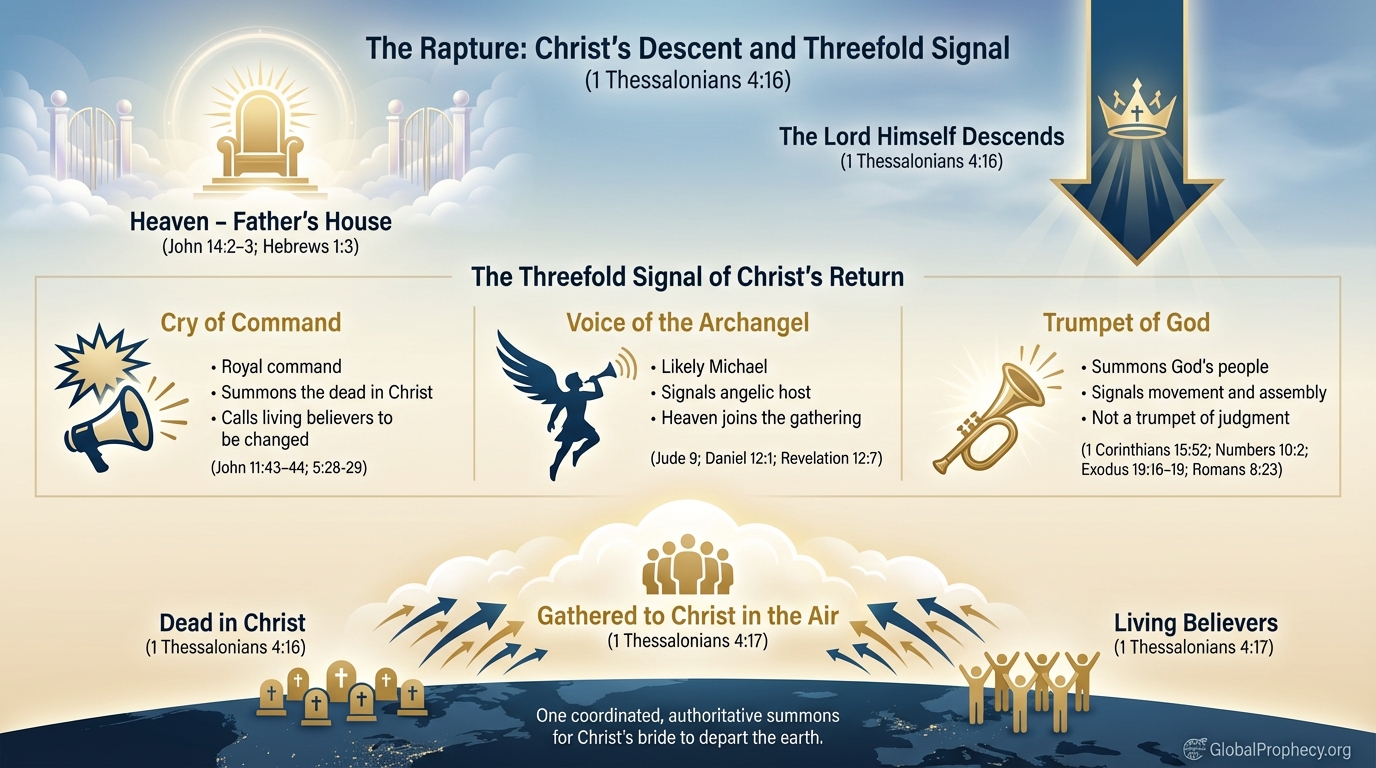
3. The Threefold Signal: Shout, Voice, Trumpet
As Christ descends, three coordinated sounds announce the rapture.
“For the Lord himself will descend from heaven with a cry of command, with the voice of an archangel, and with the sound of the trumpet of God …”
— 1 Thessalonians 4:16
3.1 A cry of command
The first sound is a loud command (Greek: keleusma), a royal or military order. Scripture does not quote the exact words, but it may be similar to Christ’s command to Lazarus:
“He cried out with a loud voice, ‘Lazarus, come out.’ The man who had died came out …”
— John 11:43–44
At the rapture, Christ’s command summons the dead in Christ to rise and the living in Christ to be transformed and caught up.
3.2 The voice of the archangel
Alongside the Lord’s command comes the voice of an archangel, likely Michael (cf. Jude 9). This voice:
- Signals the angelic host to attend the King’s action.
- Proclaims heaven’s participation as Christ gathers His people.
3.3 The trumpet of God
A third sound is “the trumpet of God”:
- In Scripture, trumpets summon God’s people (Numbers 10:2),
- announce divine intervention (Exodus 19:16–19), and
- signal movement or assembly.
This “trumpet of God” (1 Corinthians 15:52; 1 Thessalonians 4:16) is God’s call for the church to assemble and depart. It is a signal of gathering and departure, not a trumpet of judgment.
All three sounds together mark a single, coordinated divine action: Christ’s authoritative summons for His people to leave the earth and gather to Him.
4. The Resurrection of the Dead in Christ
The very first result of Christ’s descent and the threefold signal is the resurrection of dead believers.
“… and the dead in Christ will rise first.”
— 1 Thessalonians 4:16
4.1 Who are “the dead in Christ”?
- They are believers who have died during the church age, from Pentecost (Acts 2) until the moment of the rapture.
- Their spirits are already with Christ (2 Corinthians 5:8; Philippians 1:23), but their bodies are buried, decayed, or scattered on earth.
4.2 What happens to them?
At the rapture:
-
Their bodies are raised from the grave, sea, or wherever they have returned to dust.
-
Their raised bodies are transformed into immortal, incorruptible, glorified bodies:
“The dead will be raised imperishable … this perishable body must put on the imperishable, and this mortal body must put on immortality.”
— 1 Corinthians 15:52–53 -
Their glorified bodies are reunited with their already-perfect spirits, which Christ brings with Him from heaven (1 Thessalonians 4:14).
Thus the first phase of the rapture is a bodily resurrection and glorification of all who have died in Christ.
5. The Instant Transformation of Living Believers
Immediately after the dead in Christ are raised, believers still alive on earth are transformed.
“Then we who are alive, who are left, will be caught up together with them in the clouds to meet the Lord in the air …”
— 1 Thessalonians 4:17
Paul adds crucial detail:
“We shall not all sleep [die], but we shall all be changed, in a moment, in the twinkling of an eye, at the last trumpet.”
— 1 Corinthians 15:51–52
5.1 “We shall not all sleep, but we shall all be changed”
- Not all believers will die. One generation—those alive at the rapture—will never experience physical death.
- But all believers, dead and living, “shall be changed”—glorified.
5.2 The speed of the transformation
The change happens:
- “In a moment” (Greek: atomos—an indivisible instant),
- “in the twinkling of an eye”—as fast as a blink.
In that split second:
- Every living believer’s mortal, aging, sin-affected body is instantly transformed into a glorified, immortal, sinless body, like Christ’s resurrected body (Philippians 3:20–21).
- They become physically suited for heaven and for eternal fellowship with the Lord.
6. The Catching Up: Meeting the Lord in the Air
Once the dead in Christ are raised and living believers are transformed, both groups together experience the catching up—what we call the rapture.
“Then we who are alive, who are left, will be caught up together with them in the clouds to meet the Lord in the air …”
— 1 Thessalonians 4:17
6.1 “Caught up” (harpazō)
The verb harpazō means:
- To seize,
- To snatch away suddenly,
- To remove by irresistible force.
Christ, by His sovereign power, suddenly snatches His people from the earth:
- They leave the ground,
- Rise through the atmosphere,
- And enter the region described as “the clouds” and “the air”.
6.2 A unified gathering
Notice the togetherness:
- “Caught up together with them”—resurrected believers and transformed believers rise as one vast company.
- No believer is left behind among the true church; “we will all be changed” (1 Corinthians 15:51).
6.3 The meeting in the air
The destination of this upward movement is:
- “To meet the Lord in the air” (1 Thessalonians 4:17).
- Christ does not yet descend to the Mount of Olives (that belongs to His later visible return to earth).
- Here He meets His church in the atmospheric heavens, above the earth but below the Father’s house.
This meeting is:
- Personal (“to meet the Lord”),
- Corporate (all church-age believers together),
- Triumphant—death is swallowed up in victory (1 Corinthians 15:54–55).
7. The Journey to the Father’s House
John 14 connects this meeting in the air with our being taken to the Father’s house.
“I will come again and will take you to myself, that where I am you may be also.”
— John 14:3
Putting John 14 and 1 Thessalonians 4 together:
- Christ leaves the Father’s house and descends.
- He raises and transforms His people and meets them in the air.
- He then escorts them back to the Father’s house in heaven.
This fulfills His promise:
- The raptured church is brought into the prepared dwelling places (“many rooms,” John 14:2).
- The long-awaited union of Christ and His bride is realized.
8. The Believer’s Experience at the Rapture
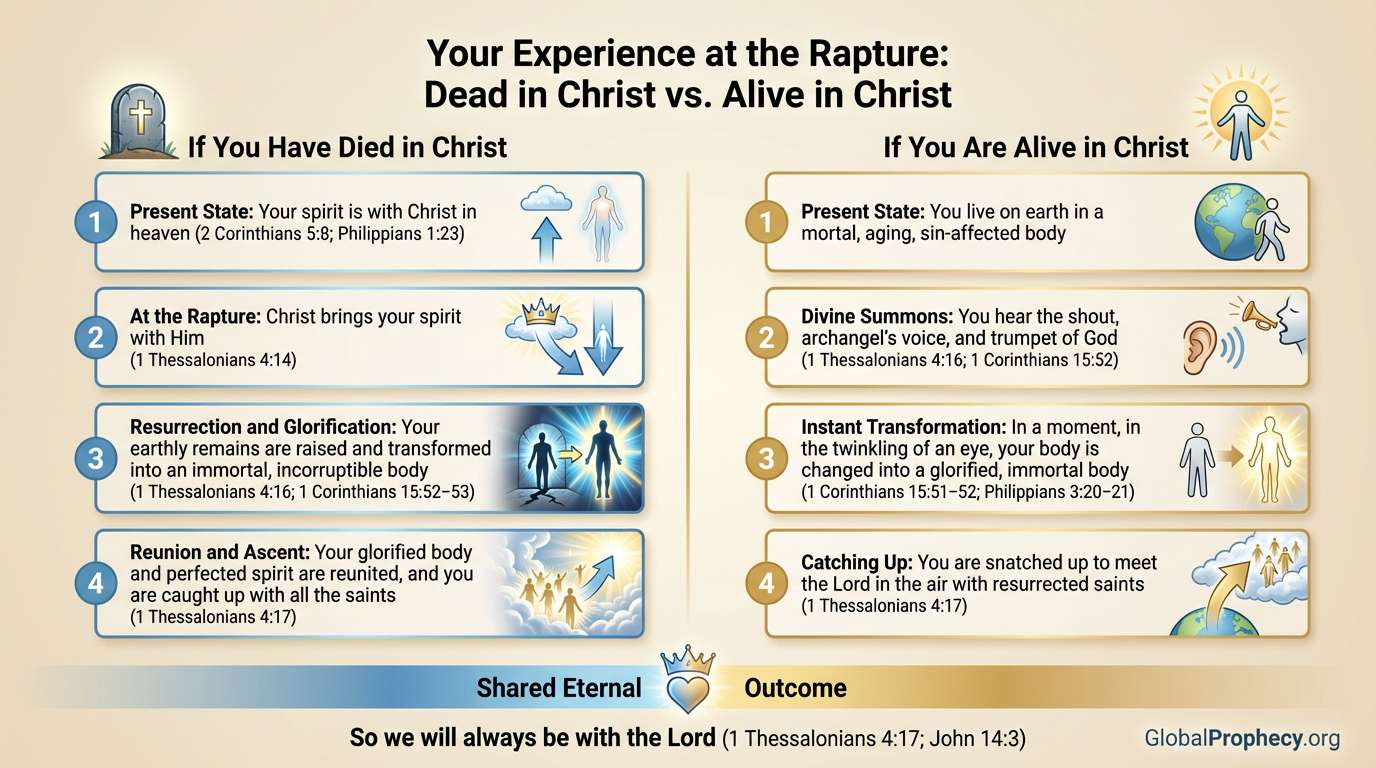
For an individual believer, the rapture will mean:
8.1 If you have died in Christ
- Your spirit has been with Christ since the moment of death (2 Corinthians 5:8).
- At the rapture, you will return with Him (1 Thessalonians 4:14).
- Your earthly remains will be raised and transformed into a glorified body.
- Your perfected spirit and glorified body will be reunited forever.
- You will join the living saints in being caught up to meet the Lord in the air.
8.2 If you are alive in Christ
- In an instant, without warning, you will hear the divine summons—the shout, voice, and trumpet.
- Your body will be instantly changed—no aging, no sickness, no remaining sin.
- You will feel yourself lifted from the earth, joining resurrected saints in ascent.
- You will see your Lord face to face for the first time (1 John 3:2).
- You will be escorted with the whole redeemed church into the Father’s presence.
In either case, Paul’s conclusion applies:
“And so we will always be with the Lord.”
— 1 Thessalonians 4:17
9. The Permanent Result: Forever with the Lord
The climax of the rapture is not merely escape from earth but eternal union with Christ:
- “Where I am you may be also” (John 14:3).
- “We will always be with the Lord” (1 Thessalonians 4:17).
This means:
- Never again separated from Christ,
- Never again subject to sin, death, or decay,
- Everlastingly in His presence, sharing His glory (Colossians 3:4).
The rapture is the decisive moment when salvation is completed in body as well as soul (Romans 8:23), and the church’s earthly pilgrimage ends.
10. The Purpose: Comfort and Hope
The Holy Spirit gave this detailed sequence not to satisfy curiosity but to stabilize hearts and encourage believers.
“Therefore encourage one another with these words.”
— 1 Thessalonians 4:18
Because of what will happen at the rapture:
- Christian grief over deceased believers is real but hopeful, not hopeless (1 Thessalonians 4:13–14).
- The fear of death is broken—some will never die, and all will be raised.
- Present trials are framed by a sure, glorious future.
To summarize the sequence:
| Step | Event at the Rapture | Key Texts |
|---|---|---|
| 1 | Christ leaves the Father’s house, descends from heaven | John 14:1–3; 1 Thess 4:16 |
| 2 | Shout, archangel’s voice, and trumpet of God sound | 1 Thess 4:16; 1 Cor 15:52 |
| 3 | Dead in Christ are raised and glorified | 1 Thess 4:16; 1 Cor 15:52–53 |
| 4 | Living believers are instantly transformed | 1 Cor 15:51–52; Phil 3:20–21 |
| 5 | All believers are caught up together in the air | 1 Thess 4:17 |
| 6 | The church meets the Lord in the air | 1 Thess 4:17 |
| 7 | Christ escorts His bride to the Father’s house | John 14:2–3 |
| 8 | Believers are forever with the Lord | 1 Thess 4:17; 1 John 3:2 |
11. Conclusion
According to Scripture, the rapture is a sudden, divine intervention in which:
- Christ personally descends,
- Calls His own with sovereign authority,
- Raises the dead in Christ,
- Transforms the living in Christ,
- Catches all believers up to Himself in the air,
- Brings them into the Father’s house,
- And unites them to Himself forever.
For every believer, the rapture is not speculation but promised certainty, and its detailed biblical order is meant to fill the church with steady hope, holy expectation, and mutual comfort as we “wait for his Son from heaven” (1 Thessalonians 1:10).
Frequently Asked Questions
What is the sequence of events at the rapture?
What happens to believers who have died?
Will living believers experience death at the rapture?
Where do believers go after the rapture?
L. A. C.
Theologian specializing in eschatology, committed to helping believers understand God's prophetic Word.
Related Articles
The Nature of the Believer's Resurrection Body
Resurrection body of believers explained: explore 1 Corinthians 15 on the glorified, imperishable, Christlike nature of the believer’s future body.
Mid-Tribulationalism Examined
Mid-tribulationalism examined in depth: understand its last trumpet argument, compare rapture texts, and see biblical reasons the church misses all tribulation.
The Order of the Resurrections
The order of the resurrections explained: Christ’s resurrection, the first resurrection at the rapture, and the second resurrection at the final judgment.
The Partial Rapture View Examined
Partial rapture view examined and refuted biblically, showing from New Testament texts that Christ will rapture all true believers, not only the watchful few.