
What Is Death According to the Bible?
1. Introduction
According to the Bible, death is not merely a biological event or the end of consciousness. Biblical eschatology presents death as a profound theological reality that affects every human being. Scripture explains what death is, where it came from, and what it means for our relationship with God and for our eternal destiny.
To understand death biblically, we must distinguish between physical death, spiritual death, and eternal death, and see how all three flow from humanity’s fall into sin.
2. The Basic Biblical Definition of Death: Separation, Not Annihilation
The core biblical idea of death is separation, not extinction of being.
When Rachel died, Genesis describes the moment this way:
"And as her soul was departing (for she was dying)…" — Genesis 35:18
Her soul was departing from her body; she did not cease to exist. James defines physical death in similar terms:
"For as the body apart from the spirit is dead, so also faith apart from works is dead." — James 2:26
In biblical theology, then:
- Life = the proper union of what God has joined (body and soul; creature and Creator).
- Death = the rupture of that union.
Death is therefore:
- Not non-existence
- Not the end of the person
- A transition to a different mode of existence, characterized by separation at different levels.
This fundamental definition underlies all three types of death the Bible describes.
3. Physical Death: Separation of Body and Soul
3.1 Nature of Physical Death
Physical death is the separation of the immaterial part of a person (soul/spirit) from the body. The body ceases to function and returns to the earth, but the person continues consciously in another realm.
Ecclesiastes gives a concise description:
"And the dust returns to the earth as it was, and the spirit returns to God who gave it." — Ecclesiastes 12:7
Key aspects of physical death in Scripture:
- It concerns the body, not the annihilation of the soul (Matthew 10:28).
- The body returns to dust (Genesis 3:19).
- The spirit/soul continues in conscious existence (e.g., Luke 16:19–31; 2 Corinthians 5:8).
3.2 Origin of Physical Death
Physical death is not presented as a neutral biological process; it is a direct consequence of sin.
God warned Adam in the garden:
"…for in the day that you eat of it you shall surely die." — Genesis 2:17
Paul interprets this in terms of universal human experience:
"Therefore, just as sin came into the world through one man, and death through sin, and so death spread to all men because all sinned…" — Romans 5:12
Important implications:
-
Physical death entered human experience through Adam’s sin, not as part of God’s original design.
-
Death is described as an enemy, not as something neutral or inherently good:
"The last enemy to be destroyed is death." — 1 Corinthians 15:26
Thus, according to the Bible, physical death is:
- Real – an actual, historical consequence of the fall.
- Universal – "it is appointed for man to die once" (Hebrews 9:27).
- Unnatural in origin – an intruder into God’s good creation, destined one day to be abolished (Revelation 21:4; Revelation 20:14).
4. Spiritual Death: Separation from God in This Life
The Bible also speaks of people who are alive physically but dead spiritually. This is spiritual death, the present state of alienation from God.
Paul writes to believers, reminding them of their former condition:
"And you were dead in the trespasses and sins in which you once walked…" — Ephesians 2:1–2
Here, "dead" cannot mean non-existent, because they were actively "walking" in sin. It describes a relational and moral condition:
- Separated from God (Isaiah 59:2).
- Insensitive or unresponsive to spiritual truth.
- Under sin’s dominion and guilt.
Biblically:
- All humans are born into this state because of Adam’s transgression and inherited sin nature (Psalm 51:5; Romans 5:12).
- Spiritual death precedes and grounds physical death. Humanity dies physically because it is already spiritually separated from the God who is life.
Spiritual death is therefore:
- Present, not future, for the unbeliever.
- A condition of the soul in this life.
- Reversible only through God’s saving work in Christ, who "made us alive together with Christ" (Ephesians 2:5).
5. Eternal Death: Final, Conscious Separation from God
The culmination of spiritual death is what Scripture calls the "second death"—final, irreversible separation from God in judgment.
Revelation describes this solemn reality:
"Then Death and Hades were thrown into the lake of fire. This is the second death, the lake of fire." — Revelation 20:14
This eternal death:
- Follows physical death and final judgment (Hebrews 9:27; Revelation 20:11–15).
- Involves the whole person—resurrected body and soul—banished from God’s favorable presence (2 Thessalonians 1:9).
- Is conscious and unending, not temporary or annihilating.
It is experienced only by those who die still in a state of spiritual death, without saving faith in Christ. By contrast, believers are explicitly promised deliverance from this final separation:
"Blessed and holy is the one who shares in the first resurrection! Over such the second death has no power…" — Revelation 20:6
In biblical eschatology, eternal death is the ultimate expression of what death means theologically: permanent rupture of fellowship with the God of life.
6. Summary: Three Kinds of Death in the Bible
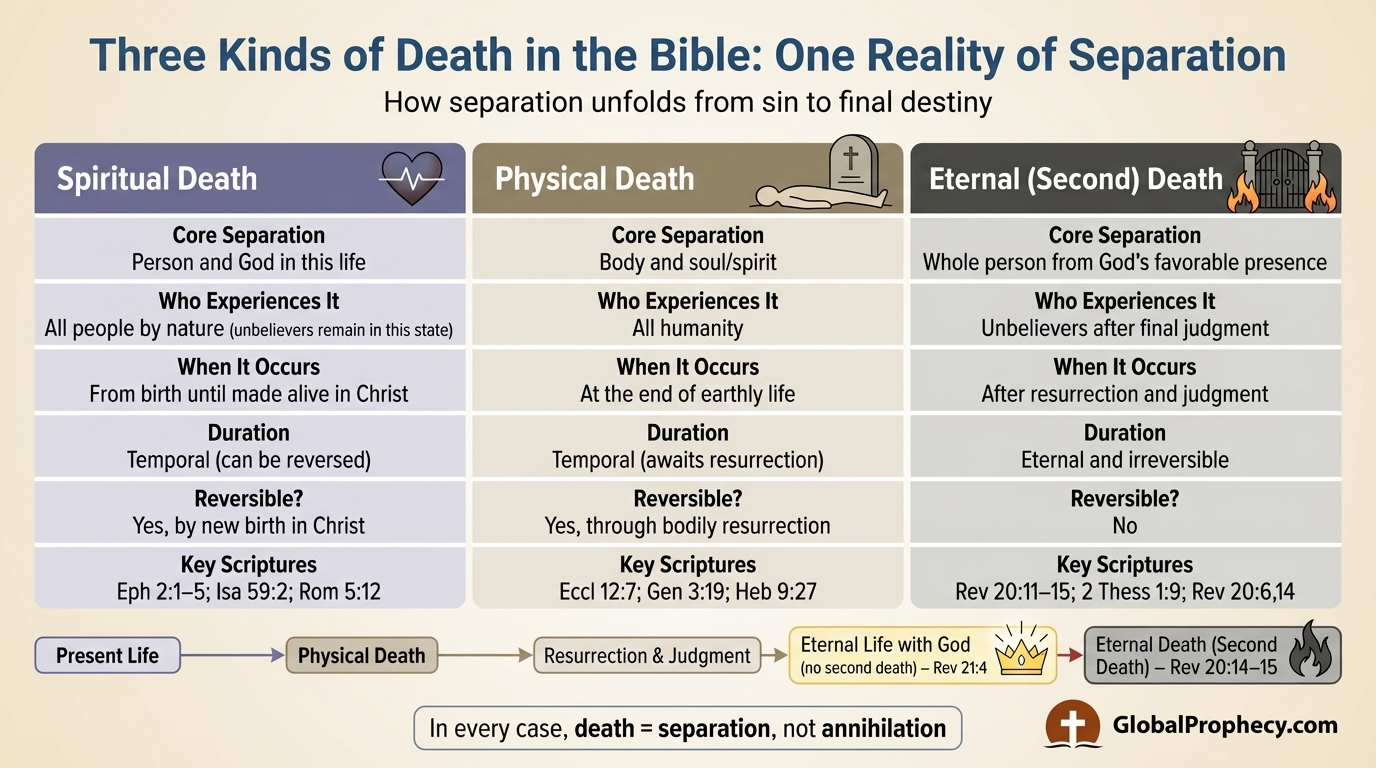
To clarify the biblical teaching on death, it is helpful to compare the three major kinds of death:
| Type of Death | Core Separation | Who Experiences It | Duration | Key Focus |
|---|---|---|---|---|
| Spiritual | Person and God | All unbelievers in this life | Temporal (reversible by salvation) | Condition of the soul now |
| Physical | Body and soul/spirit | All humanity | Temporal | End of earthly bodily life |
| Eternal (Second) | Person and God in final judgment | Only unbelievers | Eternal | Final state after resurrection |
In each case, separation is central. None of these imply extinction of the person; all involve continued existence in different relational and existential states before God.
7. The Theological Meaning and Destiny of Death
7.1 Death as Wages of Sin
From Genesis to Revelation, the Bible consistently characterizes death as the consequence of sin:
"For the wages of sin is death, but the free gift of God is eternal life in Christ Jesus our Lord." — Romans 6:23
"Wages" implies:
- Death is earned; it is the just payment for rebellion against God.
- Death is moral and judicial, not merely physical or biological.
This includes:
- Spiritual death (present separation),
- Physical death (temporal bodily dissolution),
- Eternal death (final judgment).
7.2 Death as Enemy and Its Future Defeat
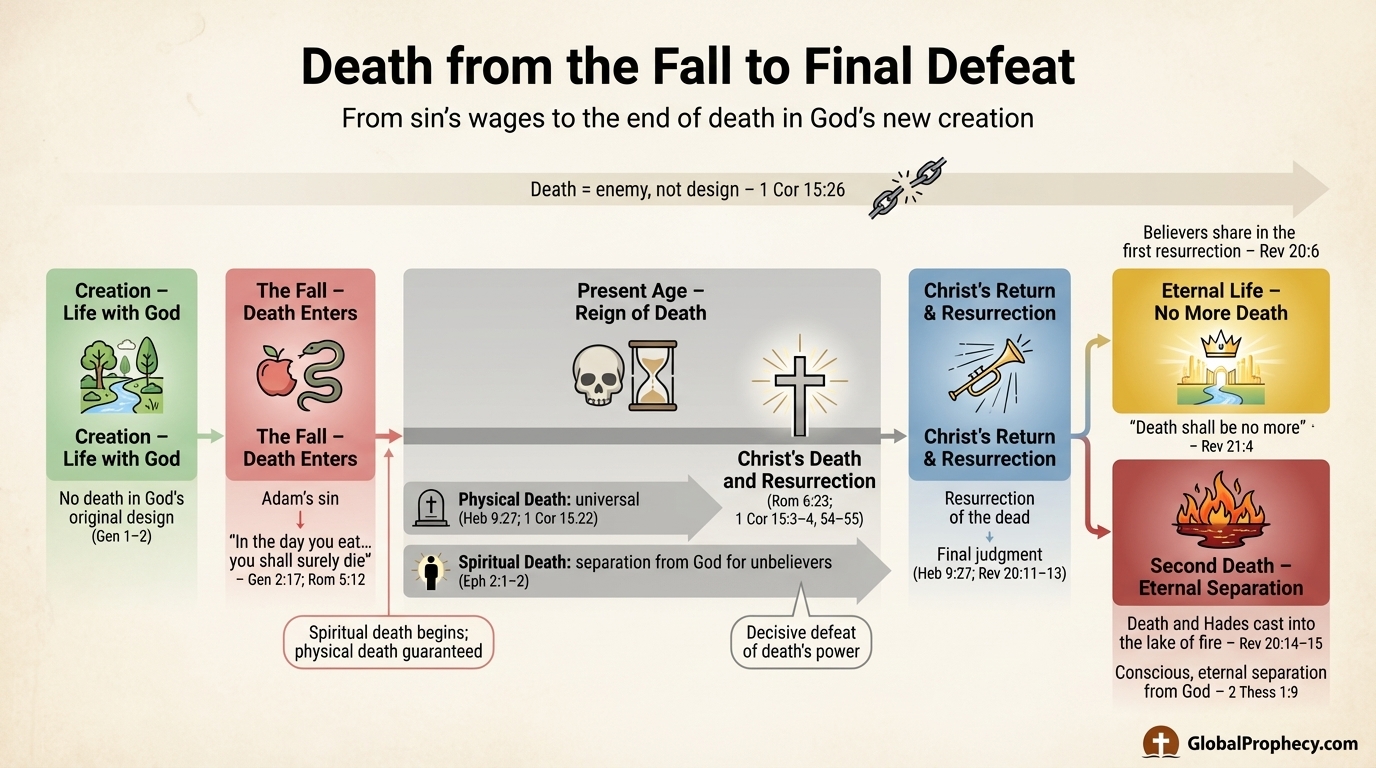
Although death is presently universal and inescapable, Scripture stresses that its reign is temporary. Christ’s death and resurrection have decisively broken its power.
Paul writes of the resurrection:
"Death is swallowed up in victory."
"O death, where is your victory?
O death, where is your sting?" — 1 Corinthians 15:54–55
The Bible teaches that:
- Death is the "last enemy" to be destroyed (1 Corinthians 15:26).
- After the final judgment, death itself is cast into the lake of fire (Revelation 20:14).
- In the new heaven and new earth, "death shall be no more" (Revelation 21:4).
Thus, within biblical eschatology, death is:
- A real and fearful enemy now,
- A consequence of sin and sign of a fallen creation,
- Yet ultimately a defeated enemy, destined to vanish from God’s renewed creation.
8. Conclusion
According to the Bible, death is far more than the stopping of heartbeat and brain activity. It is a multi-layered reality rooted in humanity’s fall into sin:
- Physical death: the separation of body and soul, universal to all people.
- Spiritual death: the present separation of the person from God because of sin.
- Eternal death: the final, irreversible separation from God in judgment for those who remain spiritually dead.
In every form, death is separation, not annihilation. It is unnatural, an enemy, and the wages of sin—yet, in God’s redemptive plan, it is also a defeated enemy. Through the death and resurrection of Jesus Christ, Scripture promises that death’s power will ultimately be abolished, and that for those united to Christ by faith, death cannot separate them from the love of God but instead becomes a passage into His presence.
Understanding what death is according to the Bible is therefore essential for understanding sin, judgment, salvation, and the hope of resurrection at the heart of biblical eschatology.
FAQ
Q: What is death according to the Bible?
According to the Bible, death is fundamentally separation, not annihilation. Physical death is the separation of the soul or spirit from the body, spiritual death is separation from God in this life, and eternal death is final separation from God after judgment for those who die without salvation in Christ.
Q: How did death enter the world according to Scripture?
Scripture teaches that death entered the world through sin. When Adam disobeyed God in the garden, sin came into the world, "and death through sin" (Romans 5:12). Physical, spiritual, and eventual eternal death all flow from humanity’s rebellion against God.
Q: What is the difference between physical and spiritual death?
Physical death is the cessation of bodily life and the separation of body and soul; it affects everyone and is visible and biological. Spiritual death is a present condition of alienation from God—people can be physically alive but spiritually dead, "dead in the trespasses and sins" (Ephesians 2:1).
Q: What does the Bible mean by the "second death"?
The "second death" refers to eternal death, the final state of judgment for unbelievers. It is described as the lake of fire in Revelation 20:14–15, and it signifies everlasting separation from God’s favorable presence after the resurrection and final judgment.
Q: Does the Bible teach that death is the end of existence?
No. The Bible clearly denies that death is the end of existence. The body returns to dust, but the soul or spirit continues consciously, either in God’s presence or apart from Him. Death is a change of condition and relation, not a transition from being to non-being.
Frequently Asked Questions
What is death according to the Bible?
How did death enter the world according to Scripture?
What is the difference between physical and spiritual death?
What does the Bible mean by the "second death"?
Does the Bible teach that death is the end of existence?
L. A. C.
Theologian specializing in eschatology, committed to helping believers understand God's prophetic Word.
Related Articles
The Abrahamic Covenant: God's Unconditional Promise to Israel
Abrahamic Covenant explained as God’s unconditional promise to Israel, defining land, seed and blessing and shaping key end-times Bible prophecy.
What the Bible Says about Antichrist?
Antichrist in the Bible: discover what Scripture reveals about his identity, character, deceptive power, and end-time role in the Tribulation.
What the Bible Says about False Prophet?
False Prophet biblical identity and role in end times. Discover what Scripture reveals about this key figure in Revelation's tribulation prophecy.
The Biblical Covenants: Framework for Understanding Prophecy
Biblical covenants form the framework for understanding prophecy, clarifying Israel, the church, and God’s kingdom plan across the Old and New Testaments.