
What Is Heaven?
1. Introduction
In biblical eschatology, heaven is not a vague spiritual ideal but a real, God‑created reality. Scripture speaks of heaven in more than one sense, yet always in relation to God’s presence, rule, and fellowship with His redeemed people. To understand what heaven is and what it means, we must trace how the Bible uses the word “heaven,” distinguish the different “heavens,” and then look closely at heaven as the final, eternal home of the saved.
This article will focus on:
- The biblical meanings of “heaven”
- The distinction between the different heavens
- Heaven as God’s present dwelling
- Heaven as the new heaven and new earth with the New Jerusalem
- The essential character of heaven according to Scripture
All quotations are in ESV style.
2. The Biblical Term “Heaven” and Its Three Uses
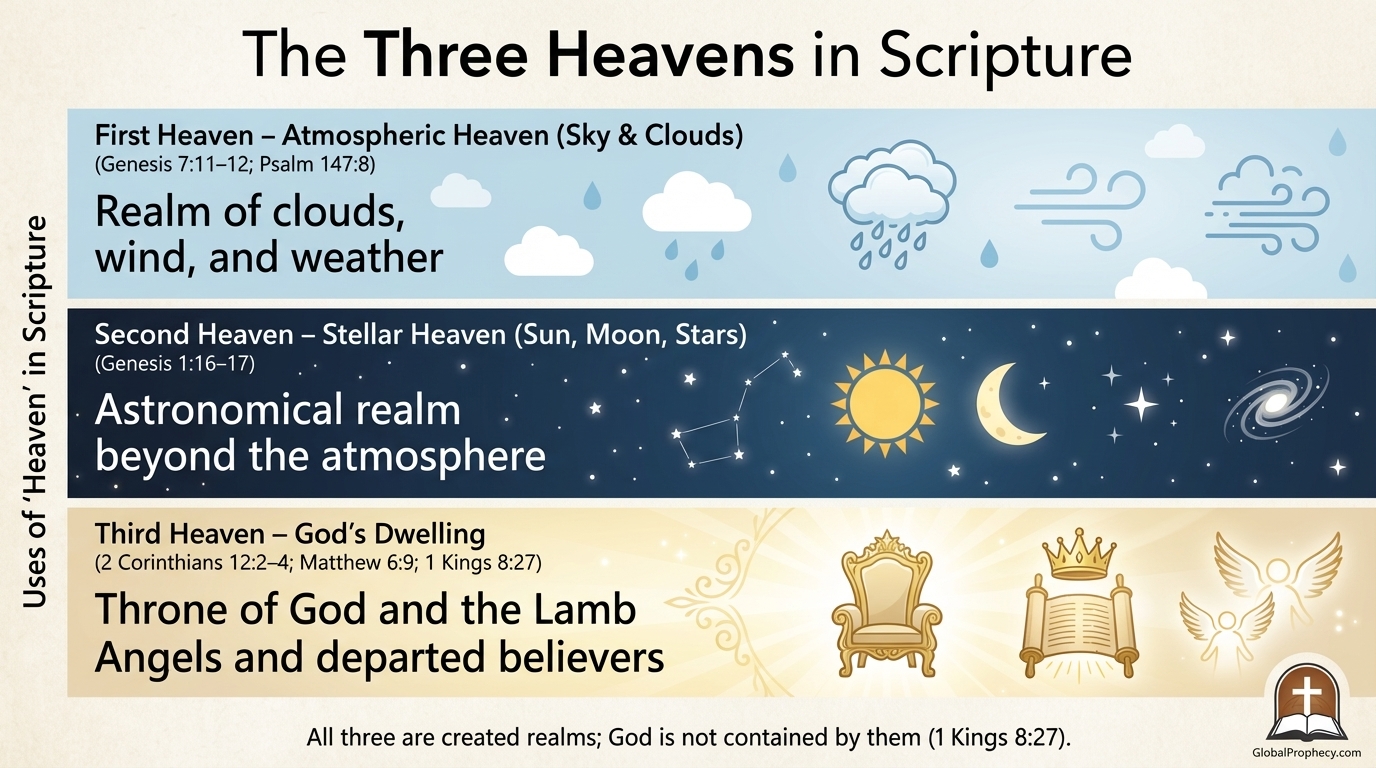
The Bible uses the words translated “heaven” (Hebrew shamayim, Greek ouranos) in three main ways. Recognizing these is crucial for a biblical doctrine of heaven.
2.1 The Atmospheric Heaven (First Heaven)
This is the sky—the realm of clouds, wind, and weather.
-
In the Flood narrative we read:
“the windows of the heavens were opened. And rain fell upon the earth forty days and forty nights.”
— Genesis 7:11–12 -
Psalm 147:8 speaks of God who “covers the heavens with clouds.”
Here “heavens” refers to the earth’s atmosphere, the visible sky above us.
2.2 The Stellar or Planetary Heaven (Second Heaven)
This is the cosmic heaven—space with sun, moon, stars, and galaxies.
- On the fourth day of creation:
“And God made the two great lights… and the stars. And God set them in the expanse of the heavens to give light on the earth.”
— Genesis 1:16–17
This is the astronomical realm, the universe beyond the atmosphere.
2.3 The Third Heaven: God’s Dwelling
The third heaven is the invisible, spiritual realm where:
- God’s throne is located
- Holy angels dwell
- Departed believers are now present with Christ
Paul records:
“I know a man in Christ who fourteen years ago was caught up to the third heaven… caught up into paradise… and he heard things that cannot be told.”
— 2 Corinthians 12:2–4
This “third heaven” is distinct from the sky and stars. It is where Jesus teaches us to address God:
“Our Father in heaven, hallowed be your name.”
— Matthew 6:9
Yet, saying God “dwells in heaven” does not mean He is restricted to a place. God is omnipresent:
“Behold, heaven and the highest heaven cannot contain you.”
— 1 Kings 8:27
The third heaven is the center of His manifest rule and glory—His royal “headquarters,” if you will.
3. Heaven as God’s Present Dwelling Place
3.1 The Throne of God and the Lamb
The book of Revelation opens heaven’s door to us:
“Behold, a throne stood in heaven, with one seated on the throne.”
— Revelation 4:2
From that throne:
- God governs all creation (Psalm 103:19)
- Angelic beings worship Him continually (Revelation 4–5)
- Christ ministers as High Priest and Advocate for believers:
“Christ Jesus… is at the right hand of God, who indeed is interceding for us.”
— Romans 8:34
“We have an advocate with the Father, Jesus Christ the righteous.”
— 1 John 2:1
3.2 The Present Abode of Departed Believers
When a believer dies, he or she goes immediately into the presence of Christ in heaven, not into soul‑sleep or annihilation.
Paul could say:
“My desire is to depart and be with Christ, for that is far better.”
— Philippians 1:23
And again:
“We would rather be away from the body and at home with the Lord.”
— 2 Corinthians 5:8
Hebrews speaks of:
“the city of the living God, the heavenly Jerusalem… and… the spirits of the righteous made perfect.”
— Hebrews 12:22–23
This present heaven is not yet the believer’s final state. It is an intermediate heavenly dwelling while history moves toward the resurrection, the return of Christ, and the creation of a new heaven and new earth.
4. Heaven as the Believer’s Eternal Home: New Heaven, New Earth, New Jerusalem
The climactic biblical answer to “What is heaven?” is given in Revelation 21–22: heaven in its final sense is the new creation where God dwells with His people forever.
4.1 The New Heavens and New Earth
After the final judgment, John writes:
“Then I saw a new heaven and a new earth, for the first heaven and the first earth had passed away.”
— Revelation 21:1
Peter speaks of the same reality:
“But according to his promise we are waiting for new heavens and a new earth in which righteousness dwells.”
— 2 Peter 3:13
Key points:
- The present cosmos—heavens and earth—is destined for fiery dissolution (2 Peter 3:7, 10–12).
- God will then create “new heavens and a new earth,” free from the curse and marked by righteousness.
- This is not merely “going up to heaven” but heaven coming down to earth in a transformed creation.
Thus, in its eternal sense, heaven is the whole renewed order of things—the new universe in which God’s presence fills all.
4.2 The New Jerusalem: Heaven’s Capital City
At the heart of the new creation is a real city:
“And I saw the holy city, new Jerusalem, coming down out of heaven from God, prepared as a bride adorned for her husband.”
— Revelation 21:2
This New Jerusalem is:
- The central dwelling place of God with His people
- A literal, gloriously adorned city with gates, walls, foundations, and streets
- Described with real dimensions:
“The city lies foursquare, its length the same as its width… 12,000 stadia [~1,400–1,500 miles].”
— Revelation 21:16
Features include:
- Twelve gates of pearl, inscribed with the names of the twelve tribes of Israel (Revelation 21:12–13, 21)
- Twelve foundations adorned with precious stones, bearing the names of the twelve apostles (Revelation 21:14, 19–20)
- A wall of jasper and streets of “pure gold, like transparent glass” (Revelation 21:18, 21)
This city comes down from the present third heaven to the new earth and becomes the eternal, visible center of God’s kingdom.
4.3 Heaven “Coming Down”: God Dwelling with Man
The greatest reality of this eternal heaven‑on‑earth is God’s immediate presence:
“Behold, the dwelling place of God is with man. He will dwell with them, and they will be his people… He will wipe away every tear from their eyes, and death shall be no more.”
— Revelation 21:3–4
There is no temple in the New Jerusalem:
“I saw no temple in the city, for its temple is the Lord God the Almighty and the Lamb.”
— Revelation 21:22
Heaven in its final form is God Himself with His people in a perfected creation, not simply disembodied souls in a distant realm.
5. The Nature of Heaven: What Characterizes It?
Biblically, heaven is defined more by who is there and what is (and is not) present than by abstract ideas. Key biblical themes include:
5.1 The Presence and Glory of God
The dominant feature of heaven is the glory of God:
“The city has no need of sun or moon to shine on it, for the glory of God gives it light, and its lamp is the Lamb.”
— Revelation 21:23
Believers experience what theologians call the Beatific Vision:
“They will see his face, and his name will be on their foreheads.”
— Revelation 22:4
To see God “face to face” (cf. 1 Corinthians 13:12) is:
- The fulfillment of all desire
- The end of faith and hope in sight and reality
- The source of unending joy and worship
5.2 Freedom from Curse, Sin, and Death
Heaven is a world without the Fall:
“No longer will there be anything accursed.”
— Revelation 22:3
“He will wipe away every tear from their eyes, and death shall be no more, neither shall there be mourning, nor crying, nor pain anymore.”
— Revelation 21:4
Thus, in heaven:
- No sin and no possibility of sin
- No sorrow, pain, or regret
- No death, decay, or corruption
- No injustice or impurity:
“Nothing unclean will ever enter it… but only those who are written in the Lamb’s book of life.”
— Revelation 21:27
5.3 Perfected People in Glorified Bodies
Heaven is embodied life. Believers will be raised and transformed:
“He will transform our lowly body to be like his glorious body.”
— Philippians 3:21
“The dead will be raised imperishable, and we shall be changed.”
— 1 Corinthians 15:52
Glorified bodies are:
- Immortal (no death)
- Imperishable (no decay)
- Powerful and glorious (suited to worshipful service)
- Still truly human, yet fully freed from sin
5.4 Unceasing Worship and Joyful Service
Heaven is a place of worship and meaningful activity, not idle boredom.
-
Worship:
“Day and night they never cease to say, ‘Holy, holy, holy, is the Lord God Almighty.’”
— Revelation 4:8 -
Service and reign:
“His servants will worship him… and they will reign forever and ever.”
— Revelation 22:3, 5
Believers will:
- Serve as a kingdom of priests (Revelation 1:6; 5:10)
- Reign with Christ in His eternal kingdom
- Continually grow in their knowledge of God (finite creatures delighting forever in the infinite Creator)
5.5 Perfect Community and Holy Diversity
Heaven is deeply communal:
“A great multitude that no one could number, from every nation, from all tribes and peoples and languages, standing before the throne.”
— Revelation 7:9
And on the new earth:
“By its light will the nations walk, and the kings of the earth will bring their glory into it.”
— Revelation 21:24
Implications:
- Genuine recognition and fellowship among the redeemed
- Ongoing national and ethnic distinctives, now purified of all sin
- No broken relationships; love is perfect and unending (1 Corinthians 13:13)
6. Who Is in Heaven?
Scripture identifies the inhabitants of heaven in both its current and eternal forms.
6.1 The Triune God
- God the Father: “He who sits in the heavens laughs” (Psalm 2:4)
- God the Son: exalted at the Father’s right hand (Hebrews 1:3), the Lamb on the throne (Revelation 5:6–14)
- God the Holy Spirit: present before the throne (Revelation 1:4), active in heavenly worship and in calling people to salvation (Revelation 22:17)
6.2 Holy Angels
Myriads of angels serve and praise God:
“Then I looked, and I heard around the throne… the voice of many angels, numbering myriads of myriads and thousands of thousands.”
— Revelation 5:11
They:
- Worship God
- Carry out His commands
- Minister to the “heirs of salvation” (Hebrews 1:14)
6.3 The Redeemed from All Ages
Hebrews 12:22–23 presents a composite picture of the heavenly city’s citizens:
- “thousands upon thousands of angels in joyful assembly”
- “the church of the firstborn who are enrolled in heaven” (New Testament believers)
- “the spirits of the righteous made perfect” (Old Testament and all other saints)
Revelation 21–22 adds that:
- Only those whose names are written in the Lamb’s book of life enter the city (Revelation 21:27)
- All others—unbelieving and impenitent—are consigned to the lake of fire (Revelation 20:11–15; 21:8)
Heaven, therefore, is exclusively the eternal home of the saved—those who have trusted in Christ alone for salvation.
7. Conclusion
According to Scripture, heaven is:
- In one sense, the sky and the starry universe (the first and second heavens)
- In a deeper sense, the third heaven, the present dwelling place of God, angels, and departed believers
- In its full, eternal sense, the new heavens and new earth with the New Jerusalem, where God dwells with His redeemed people forever
Heaven is both a place and a state:
- A real, created realm—new universe and real city—described in concrete terms
- A perfected condition—no sin, no curse, no death, perfect joy, perfect love, perfect worship
Above all, heaven is the presence of God in unclouded fellowship:
“In your presence there is fullness of joy; at your right hand are pleasures forevermore.”
— Psalm 16:11
To understand heaven biblically is to see it not as an escape from creation, but as creation renewed, filled with the glory of God and the joy of His people, forever centered on “the throne of God and of the Lamb” (Revelation 22:1).
FAQ
Q: How many heavens are there in the Bible?
The Bible uses “heaven” in three main ways: the atmospheric heaven (the sky and clouds), the stellar heaven (outer space with sun, moon, and stars), and the third heaven, which is God’s dwelling place. Paul explicitly mentions being caught up to the “third heaven” in 2 Corinthians 12:2, distinguishing it from the visible heavens.
Q: Is heaven a physical place or just a spiritual state?
Biblically, heaven is both. The present third heaven is a real, spiritual realm where God’s throne is. In the future eternal state, heaven includes a new heaven and new earth and a literal New Jerusalem with measurable dimensions, gates, walls, and streets (Revelation 21–22). It is not merely a state of mind but a real, renewed creation.
Q: What will we do in heaven?
Scripture emphasizes worship and service. God’s people will “serve him” and “reign forever and ever” (Revelation 22:3, 5). They will see God’s face, learn of Him endlessly, and exercise meaningful, sinless activity in a perfected creation. Heaven is not idleness but joyful, unwearied service and fellowship in God’s presence.
Q: Will we recognize one another in heaven?
Yes. The Bible assumes ongoing personal identity and recognition. At the Transfiguration, the disciples recognized Moses and Elijah (Matthew 17:1–4). Hebrews 12:23 speaks of “the spirits of the righteous made perfect,” indicating distinct, perfected persons in fellowship. Our glorified bodies will be recognizable continuations of our present selves (1 Corinthians 15:42–49).
Q: What is the difference between the present heaven and the future “new heaven and new earth”?
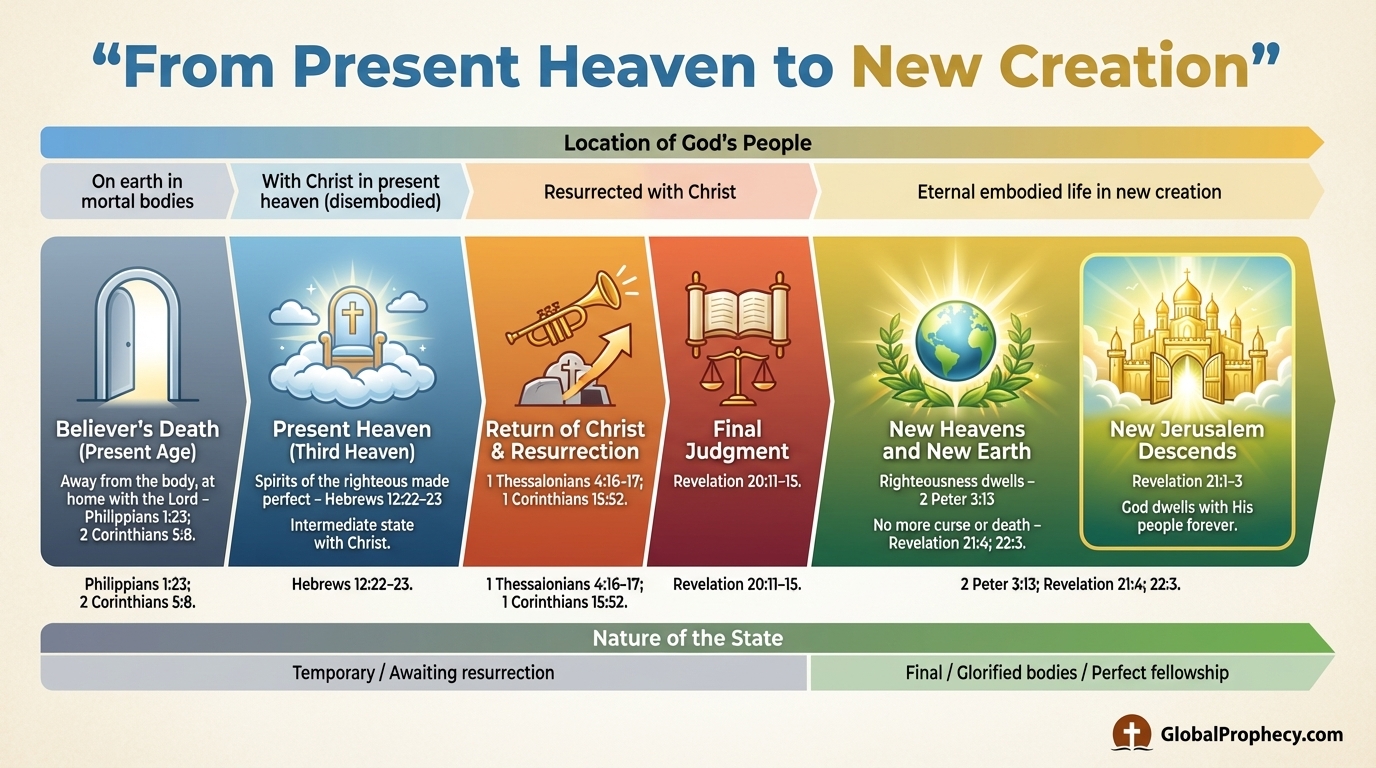
The present heaven (third heaven) is where God now manifests His glory and where believers go at death to be “with Christ” (Philippians 1:23). After Christ’s return, the final judgment, and the destruction of the present cosmos, God will create a new heaven and new earth. The New Jerusalem will descend, and God will dwell with His people forever (Revelation 21:1–3). That renewed creation is heaven in its final, eternal form.
Frequently Asked Questions
How many heavens are there in the Bible?
Is heaven a physical place or just a spiritual state?
What will we do in heaven?
Will we recognize one another in heaven?
What is the difference between the present heaven and the future “new heaven and new earth”?
L. A. C.
Theologian specializing in eschatology, committed to helping believers understand God's prophetic Word.
Related Articles
Will We Eat and Drink in Heaven?
Will we eat and drink in heaven? Explore what Scripture reveals about dining in eternity, the marriage supper of the Lamb, and our resurrected bodies.
Heaven vs Hell: The Great Contrast
Heaven vs hell: explore the great contrast between eternal life and eternal punishment, highlighting destiny, judgment, joy, and separation from God.
Will We Know Each Other in Heaven?
Will we know each other in heaven? Explore biblical evidence for personal recognition, enduring relationships, and perfected fellowship in eternity.
The New Jerusalem
New Jerusalem, the eternal dwelling place of believers, revealed in Revelation 21–22: explore its glory, structure, and promise of life with God.