
What Is Hell?
1. Introduction
Hell stands as one of the most sobering and debated doctrines in Christian theology. The question "What is hell?" has profound implications for how we understand God's justice, human destiny, and the urgency of the gospel message. Despite contemporary attempts to soften, redefine, or deny this doctrine, Scripture presents hell as a terrifying reality—a place of eternal, conscious punishment for those who reject God's offer of salvation through Jesus Christ.
The biblical teaching on hell is not peripheral or obscure. Jesus Christ Himself spoke more about hell than about heaven, using vivid and unmistakable language to warn people of its horrors. The apostles continued this teaching, and the book of Revelation provides the most detailed descriptions of hell's eternal nature. Understanding what the Bible teaches about hell is essential for grasping the full scope of God's character, the seriousness of sin, and the wonder of salvation.
2. Biblical Terms for Hell
Scripture employs several different terms to describe the place of eternal punishment, each contributing to our understanding of hell's nature and characteristics.
Sheol and Hades
The Old Testament Hebrew word sheol appears 65 times and can mean "grave" or refer to the realm of departed spirits. The Septuagint translators typically rendered sheol as hades in Greek. While these terms sometimes simply mean "grave," they often indicate something beyond physical burial—a place of conscious existence after death.
Psalm 9:17 declares, "The wicked shall be turned into hell [sheol], and all the nations that forget God" (NKJV). The rich man in Luke 16:23 found himself in hades, "being in torments," demonstrating that hades involves conscious suffering, not mere non-existence.
Gehenna
The most significant New Testament term for hell is gehenna (Greek), used twelve times—eleven by Jesus Himself. This word derives from "Ge-Hinnom" (Valley of Hinnom), a ravine south of Jerusalem where ancient Israelites committed the abomination of child sacrifice to Molech (2 Kings 23:10; Jeremiah 7:31). King Josiah later desecrated this site, and it became Jerusalem's garbage dump where fires burned continuously and worms consumed refuse.
Jesus used this vivid imagery intentionally: "It is better for you to enter the kingdom of God with one eye, than having two eyes, to be cast into hell [gehenna], where their worm does not die, and the fire is not quenched" (Mark 9:47-48). His quotation from Isaiah 66:24 makes clear that gehenna refers not to a literal valley but to the place of eternal punishment.
Tartarus and the Abyss
Second Peter 2:4 uses tartarus (the only occurrence in Scripture) to describe where God cast sinful angels, confining them "in chains of gloomy darkness to be held for judgment." This appears to be a special place of confinement for certain fallen angels who committed particularly heinous sins.
The Abyss (Greek: abyssos) appears as a prison for demons (Luke 8:31; Revelation 9:1-2) and the temporary confinement place for Satan during the Millennium (Revelation 20:1-3).
The Lake of Fire
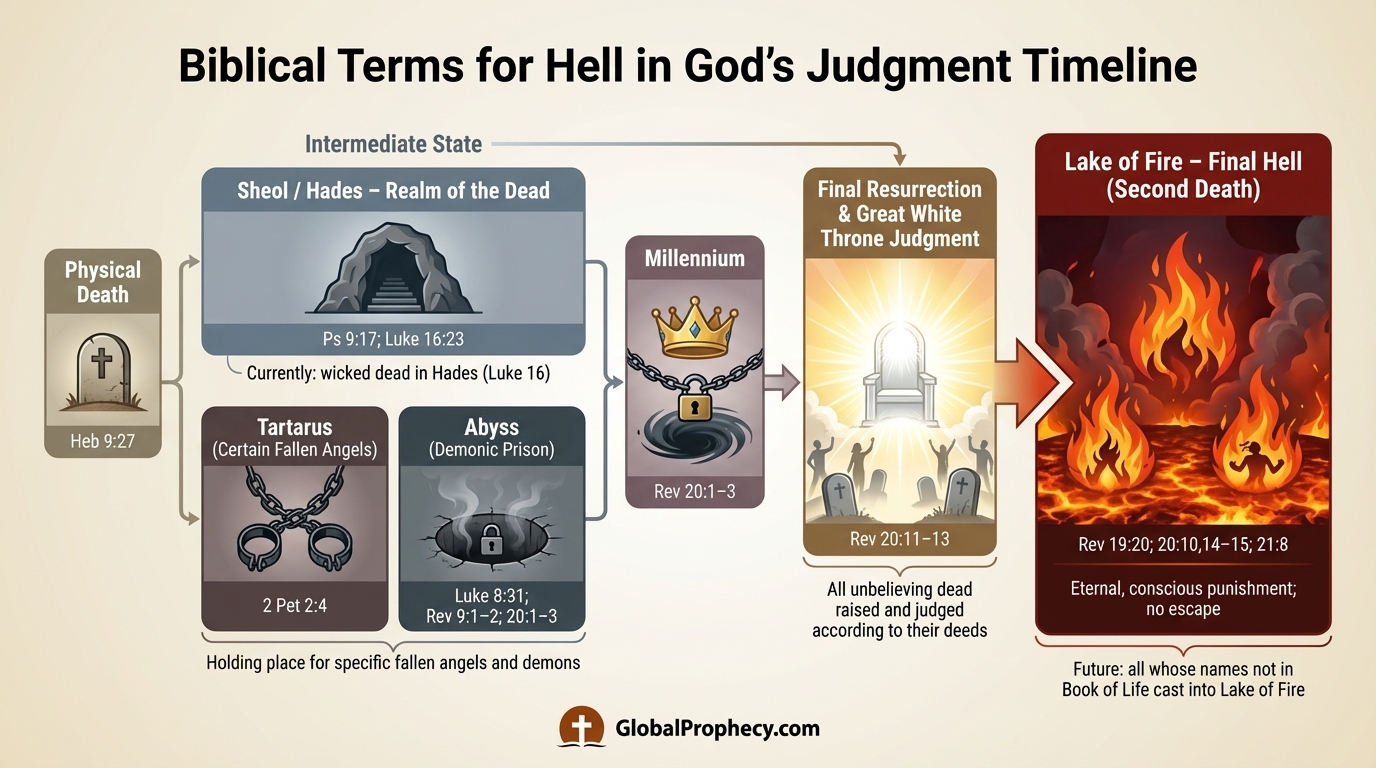
The ultimate and permanent place of punishment is called the lake of fire. This term appears five times in Revelation (19:20; 20:10, 14-15; 21:8). Currently, no one resides in the lake of fire. The Beast and False Prophet will be its first occupants (Revelation 19:20), followed by Satan after his final rebellion (Revelation 20:10), and ultimately all whose names are not written in the Book of Life (Revelation 20:15). The lake of fire represents the final, eternal state of punishment—what is called "the second death."
3. The Nature and Characteristics of Hell
Scripture provides detailed descriptions of hell's horrifying characteristics, making clear that it is a place of unimaginable suffering.
Eternal Fire and Unquenchable Flame
Hell is consistently described as a place of fire. Jesus warned of "the eternal fire prepared for the devil and his angels" (Matthew 25:41) and "the furnace of fire" where "there will be weeping and gnashing of teeth" (Matthew 13:42). He spoke of gehenna "where the fire is not quenched" (Mark 9:48).
Whether this fire is literal or metaphorical of God's wrath, the reality is horrifying. Scripture repeatedly associates fire with God's judgment: "Our God is a consuming fire" (Hebrews 12:29); "His wrath is poured out like fire" (Nahum 1:6). The lake of fire is described as "burning with fire and brimstone" (Revelation 19:20; 21:8).
Conscious Torment
Hell involves full consciousness and awareness of suffering. The rich man in hades was "in torment" (Luke 16:23), could speak, remember his past life, and feel intense agony. He cried out, "I am in agony in this flame" (Luke 16:24). Revelation 14:10-11 describes those who worship the Beast: "He will be tormented with fire and brimstone... And the smoke of their torment goes up forever and ever; they have no rest day and night."
This is not annihilation or unconscious existence—it is eternal, conscious suffering.
Outer Darkness
Jesus repeatedly described hell as "outer darkness" (Matthew 8:12; 22:13; 25:30). This darkness represents exclusion from God's presence, the source of all light. Second Peter 2:17 and Jude 13 speak of "the black darkness" reserved for the wicked forever. This darkness coexists with fire—both literal and symbolic elements describing the multifaceted horror of hell.
Weeping and Gnashing of Teeth
Jesus used this phrase repeatedly (Matthew 8:12; 13:42, 50; 22:13; 24:51; 25:30). The weeping indicates profound grief, anguish, and remorse. The gnashing of teeth suggests rage, frustration, and bitter anger—at oneself, at sin, at Satan, at the opportunity for salvation that was rejected.
Memory and Regret
Hell includes the torment of memory. Abraham told the rich man, "Remember that during your life you received your good things" (Luke 16:25). Those in hell will recall specific occasions when they heard the gospel and rejected it, when friends or family witnessed to them, when conviction touched their hearts—but they refused to repent. This mental anguish compounds the physical suffering.
Complete Separation from God
Second Thessalonians 1:9 describes hell as "everlasting destruction and exclusion from the presence of the Lord and from the glory of His power." While God is omnipresent, hell represents absolute exclusion from His mercy, grace, and blessing. As C.S. Lewis observed, hell is God ultimately saying to those who rejected Him throughout life, "Thy will be done."
The Undying Worm
Jesus quoted Isaiah 66:24, speaking of a place "where their worm does not die" (Mark 9:48). This may refer to the gnawings of conscience and remorse that course through the memory ceaselessly, or to the perpetual consciousness of the damned who, like an undying worm, continue in their corruption forever.
4. The Duration of Hell: An Eternal Reality
Perhaps no aspect of hell's doctrine is more contested than its eternality. Yet Scripture leaves no ambiguity on this point.
The Meaning of "Eternal"
The Greek word aiōnios (eternal/everlasting) is used 71 times in the New Testament. It describes God's eternal nature (Romans 16:26), eternal life for believers (John 3:16), and eternal punishment for the wicked (Matthew 25:46). To deny the eternality of punishment while affirming eternal life for believers is exegetically inconsistent—the same word in the same contexts must mean the same thing.
Jesus stated clearly: "These will go away into eternal punishment, but the righteous into eternal life" (Matthew 25:46). The parallelism is unmistakable—if life is everlasting, so is punishment.
Forever and Ever
Revelation 14:11 describes the fate of Beast-worshipers: "The smoke of their torment goes up forever and ever; they have no rest day and night." Revelation 20:10 declares that the devil, beast, and false prophet "will be tormented day and night forever and ever" in the lake of fire.
The phrase "forever and ever" (Greek: eis tous aiōnas tōn aiōnōn) is used of God's eternal throne (Hebrews 1:8), Christ's eternal existence (Revelation 1:18), and the saints' eternal reign (Revelation 22:5). If these realities are truly eternal, so is the punishment of the wicked.
No Second Chance After Death
Hebrews 9:27 establishes the finality of death: "It is appointed for men to die once, and after that comes judgment." There is no purgatory, no second opportunity, no postmortem conversion. The story of the rich man and Lazarus confirms this: "Between us and you there is a great chasm fixed, so that those who wish to come over from here to you will not be able, and that none may cross over from there to us" (Luke 16:26).
5. Who Goes to Hell?
Scripture clearly identifies who will suffer eternal punishment.
Satan and Fallen Angels
Hell was originally "prepared for the devil and his angels" (Matthew 25:41). It was not created for humanity but for rebellious angelic beings who chose to oppose God. Satan, the Beast, and the False Prophet will be "tormented day and night forever and ever" in the lake of fire (Revelation 20:10).
Certain fallen angels are already confined in tartarus or the Abyss, awaiting final judgment (2 Peter 2:4; Jude 6). All demons will ultimately share Satan's fate in eternal fire.
All Who Reject Christ
Jesus declared, "He who does not believe has been condemned already, because he has not believed in the name of the only begotten Son of God" (John 3:18). Those who die without accepting Christ's atoning sacrifice remain under God's wrath: "He who does not obey the Son will not see life, but the wrath of God abides on him" (John 3:36).
Paul wrote that those "who do not know God and do not obey the gospel of our Lord Jesus" will suffer "eternal destruction, away from the presence of the Lord" (2 Thessalonians 1:8-9). Revelation 21:8 lists specific categories: "The cowardly and unbelieving and abominable and murderers and immoral persons and sorcerers and idolaters and all liars, their part will be in the lake that burns with fire and brimstone, which is the second death."
Based on Rejection, Not Ignorance Alone
Romans 1:18-20 makes clear that all humanity has sufficient revelation through creation and conscience to be "without excuse." God's wrath is revealed against those who "suppress the truth in unrighteousness." Those who have never heard the gospel are not judged for rejecting a message they never received, but for rejecting the light they did receive and for their willful sin against God.
However, Scripture provides no support for the idea that sincere pagans can be saved apart from Christ. Jesus said, "I am the way, and the truth, and the life; no one comes to the Father but through Me" (John 14:6). Acts 4:12 affirms, "There is salvation in no one else; for there is no other name under heaven that has been given among men by which we must be saved."
6. Degrees of Punishment in Hell
While all in hell suffer eternally, Scripture indicates varying degrees of punishment based on knowledge and deeds.
Based on Light Received
Jesus pronounced greater judgment on cities that witnessed His miracles but didn't repent: "It will be more tolerable for Tyre and Sidon in the day of judgment than for you" (Matthew 11:22). He said of Capernaum, "It will be more tolerable for the land of Sodom in the day of judgment, than for you" (Matthew 11:24).
In the parable of the servants, Jesus taught: "That slave who knew his master's will and did not get ready or act in accord with his will, will receive many lashes, but the one who did not know it, and committed deeds worthy of a flogging, will receive but few" (Luke 12:47-48).
Based on Deeds Committed
At the Great White Throne judgment, "books were opened... and the dead were judged from the things which were written in the books, according to their deeds" (Revelation 20:12). Paul affirmed that God "will render to each person according to his deeds" (Romans 2:6).
This does not suggest that works save anyone, but that the degree of punishment will correspond to the extent of one's wickedness. Greater knowledge brings greater accountability; heinous sins merit more severe punishment than lesser transgressions.
7. False Views of Hell Refuted
Throughout church history, various errors have attempted to soften or deny the biblical doctrine of hell.
Universalism
Universalism teaches that all people will eventually be saved. Proponents cite verses like John 12:32 ("I will draw all men to Myself") and 1 Timothy 2:4 ("God desires all men to be saved"). However, these verses express God's desire and provision for salvation, not a guarantee of universal salvation.
Jesus' own words refute universalism: "These will go away into eternal punishment" (Matthew 25:46). He warned that the road to destruction is broad and "many are those who enter through it" (Matthew 7:13). If all were saved, Christ's repeated warnings about hell would be meaningless deception.
Annihilationism (Conditional Immortality)
This view holds that the wicked will eventually cease to exist rather than suffer eternally. Annihilationists argue that "eternal" describes the permanence of extinction, not the duration of suffering.
However, Revelation 14:11 explicitly states that "the smoke of their torment goes up forever and ever; they have no rest day and night." Rest implies consciousness. Furthermore, if "eternal punishment" in Matthew 25:46 means temporary punishment followed by annihilation, then "eternal life" must mean temporary life followed by extinction—an impossible interpretation.
The language of Scripture consistently describes ongoing, conscious torment. Jesus spoke of a place "where their worm does not die, and the fire is not quenched" (Mark 9:48)—continuous, not momentary suffering followed by extinction.
Purgatory
Roman Catholic theology teaches purgatory as an intermediate state where Christians undergo purification before entering heaven. However, this doctrine has no biblical support. Hebrews 9:27 states, "It is appointed for men to die once and after this comes judgment"—not death, purgatory, then judgment.
Furthermore, Christ's sacrifice was complete: "He has perfected for all time those who are sanctified" (Hebrews 10:14). No additional purification is needed. The thief on the cross went immediately to paradise with Jesus (Luke 23:43), not to purgatory.
8. The Justice and Necessity of Hell
Many object to hell as incompatible with a loving God. However, hell demonstrates both God's justice and the seriousness of sin.
Infinite Offense Requires Infinite Punishment
Sin is not merely a finite offense against finite beings—it is rebellion against an infinitely holy God. The heinousness of any crime is measured by the dignity of the one offended. Since God is infinite in holiness and worth, sin against Him merits infinite punishment.
As Jonathan Edwards argued, the more terrible and fearsome the judgment, the brighter the display of God's justice. Hell vindicates God's majesty that the wicked refused to honor in life.
God Does Not Send People to Hell
C.S. Lewis observed that sinners spend their lives saying to God, "Go away and leave me alone." Hell is God ultimately saying, "Your will be done." People choose hell by rejecting Christ. God provides every opportunity for salvation—He "is patient toward you, not wishing for any to perish but for all to come to repentance" (2 Peter 3:9).
Hell was "prepared for the devil and his angels" (Matthew 25:41), not for humans. Yet those who ally themselves with Satan through unbelief share his destiny. God does not force anyone into hell; people choose it by rejecting His gracious offer of salvation.
Hell Preserves Heaven
Without eternal separation of evil from good, there could be no eternal heaven. Evil is contagious and must be quarantined. Jesus taught that at the end, the tares must be separated from the wheat (Matthew 13:24-30), otherwise the tares would choke out the wheat. Hell preserves the purity and joy of heaven by permanently removing all wickedness.
9. Practical Implications
The doctrine of hell carries profound implications for how we live.
Urgency of Evangelism
If hell is real and eternal, then the Great Commission takes on ultimate significance. Paul's passion to reach the unreached (Romans 15:20) and the martyrdom of the apostles make sense only if the lost truly face eternal punishment. Hell should motivate us to "persuade men" (2 Corinthians 5:11) and share the gospel urgently.
Gratitude for Salvation
Understanding hell magnifies the wonder of salvation. We deserved eternal punishment, but God provided a way of escape through Christ's substitutionary death. The cross demonstrates both the horror of sin (requiring such a sacrifice) and the magnificence of God's love (providing such a Savior).
Seriousness of Sin
Hell reveals how seriously God views sin. We often treat sin casually, but God's holiness demands perfect righteousness. Hell shows that every sin, no matter how "small" in human eyes, is an offense against infinite holiness and merits judgment.
Motivation for Holy Living
Jesus used hell as a motivation for radical holiness: "If your eye causes you to stumble, throw it out; it is better for you to enter the kingdom of God with one eye, than, having two eyes, to be cast into hell" (Mark 9:47). The reality of eternal consequences should drive us to pursue righteousness and flee from sin.
10. Conclusion
Hell is the most sobering doctrine in Scripture—a place of eternal, conscious punishment in fire, where the wicked suffer in complete separation from God's mercy and blessing. It was prepared for Satan and his fallen angels, but all who reject Christ's salvation will share this dreadful destiny.
The doctrine of hell is not cruel mythology but revealed truth from God's Word. Jesus Himself taught it more than anyone else, using the most vivid language possible to warn people of its horror. The apostles affirmed it, and Revelation describes it in detail.
Hell demonstrates God's perfect justice, the infinite seriousness of sin against an infinitely holy God, and the necessity of Christ's atoning sacrifice. It also reveals God's mercy—that He has done everything possible, short of violating human freedom, to provide salvation through His Son.
The existence of hell makes the gospel both urgent and precious. Those who trust in Christ will never see this place of torment, for Jesus bore God's wrath in their place. But those who reject Christ have "no more sacrifice for sins, but a terrifying expectation of judgment and the fury of a fire which will consume the adversaries" (Hebrews 10:26-27).
The most loving thing we can do is warn people about hell and point them to the only way of escape—Jesus Christ, who said, "I am the resurrection and the life; he who believes in Me will live even if he dies" (John 11:25). Hell is real, but so is God's offer of salvation to all who will believe.
FAQ
Q: How can a loving God send people to hell?
God doesn't send people to hell—they choose it by rejecting His offer of salvation. God has provided everything necessary for escape through Christ's death on the cross. He "desires all men to be saved" (1 Timothy 2:4) and is "patient, not wishing for any to perish" (2 Peter 3:9). Hell was originally prepared only for Satan and fallen angels (Matthew 25:41). Those who go there do so by choosing rebellion against God over His gracious offer of forgiveness. Hell is God ultimately saying "thy will be done" to those who spent their lives rejecting Him.
Q: Will people really suffer consciously forever in hell?
Yes. Scripture consistently describes eternal, conscious suffering in hell. Jesus spoke of a place "where their worm does not die, and the fire is not quenched" (Mark 9:48). Revelation 14:11 says "the smoke of their torment goes up forever and ever; they have no rest day and night." The rich man in Luke 16 was fully conscious, able to speak, remember, and feel intense agony. The same Greek word (aiōnios) used for "eternal life" is used for "eternal punishment" (Matthew 25:46)—if one is truly eternal, so is the other.
Q: Can people in hell ever escape or be given a second chance?
No. Hebrews 9:27 states "it is appointed for men to die once and after this comes judgment." In Luke 16:26, Abraham told the rich man "between us and you there is a great chasm fixed, so that those who wish to come over from here to you will not be able, and that none may cross over from there to us." Death finalizes one's eternal destiny. There is no purgatory, no second chance, no postmortem conversion opportunity. The time to respond to the gospel is during this life (2 Corinthians 6:2).
Q: What about people who never heard about Jesus?
Romans 1:18-20 teaches that all people have sufficient revelation through creation and conscience to know God exists and that they are accountable to Him, leaving them "without excuse." People are judged based on the light they received. However, Scripture provides no hope for salvation apart from Christ—He said "no one comes to the Father but through Me" (John 14:6), and Acts 4:12 declares "there is salvation in no one else." This makes evangelism and missions critically urgent, as people are lost without the gospel message.
Q: Will everyone in hell suffer the same punishment?
No. Scripture indicates degrees of punishment based on knowledge and deeds. Jesus said it would be "more tolerable" for Sodom than for Capernaum in judgment (Matthew 11:24). He taught that the servant who knew his master's will but didn't do it would receive "many lashes," while one who didn't know would receive "few" (Luke 12:47-48). At the Great White Throne, people are judged "according to their deeds" (Revelation 20:12). While all in hell suffer eternally, the intensity corresponds to the extent of their sin and the light they rejected.
Frequently Asked Questions
How can a loving God send people to hell?
Will people really suffer consciously forever in hell?
Can people in hell ever escape or be given a second chance?
What about people who never heard about Jesus?
Will everyone in hell suffer the same punishment?
L. A. C.
Theologian specializing in eschatology, committed to helping believers understand God's prophetic Word.
Related Articles
Is Hell's Punishment Eternal?
Is hell's punishment eternal or temporary? Explore key Bible texts, assess alternative views, and see why Scripture teaches conscious, everlasting judgment.
Are There Degrees of Punishment in Hell?
Hell degrees of punishment: explore Bible passages where Jesus and other texts teach varying levels of judgment and accountability in eternal torment.
The Lake of Fire Explained
The lake of fire is the final eternal destination for the unrighteous. Discover what Scripture reveals about this place of judgment and who will be cast there.
Annihilationism Examined and Refuted
Annihilationism examined and refuted from Scripture, showing why conditional immortality fails and hell is eternal conscious punishment for the lost.