
What is the Battle of Armageddon?
1. Introduction
The Battle of Armageddon is one of the most dramatic and disputed elements in biblical eschatology. In Scripture it marks the military and spiritual climax of the Tribulation period, when the nations of the world are gathered to war in the land of Israel and are decisively destroyed by the returning Jesus Christ.
This article explains, from Revelation 16 and Revelation 19, what Armageddon is and when it occurs in God’s prophetic timetable.
2. The Meaning and Location of Armageddon
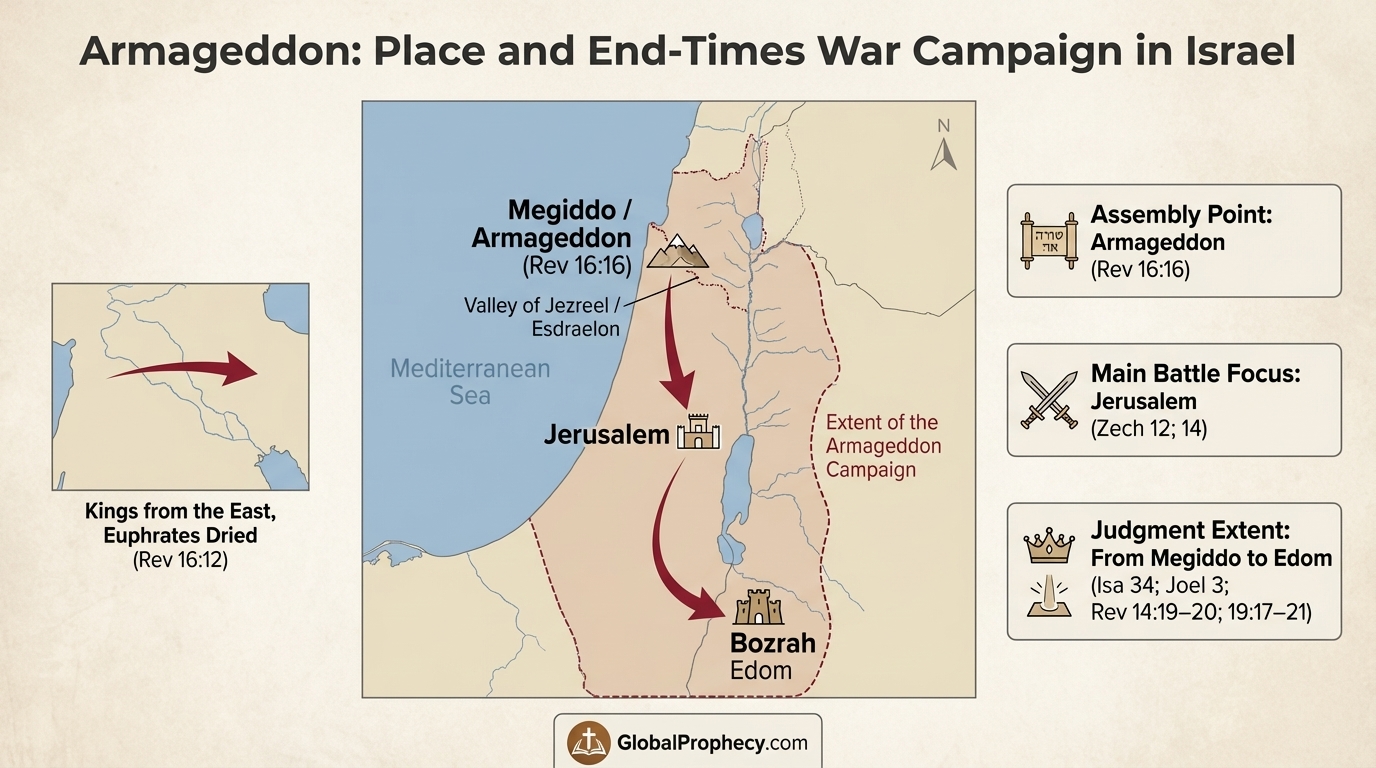
The word Armageddon appears only once in the Bible:
"And they assembled them at the place that in Hebrew is called Armageddon." — Revelation 16:16
The term Armageddon is derived from two Hebrew words:
- Har – “mountain” or “hill”
- Megiddo – an ancient city in northern Israel
Thus, Armageddon means “Mount of Megiddo.” Megiddo overlooks the broad Valley or Plain of Esdraelon (also called the Valley of Jezreel), a natural battlefield in northern Israel about 60 miles (100 km) north of Jerusalem.
From a biblical-prophetic perspective:
- Armageddon is both a place and a campaign.
- The armies of the world will assemble in the region of Megiddo (Rev 16:16).
- The actual fighting spreads throughout Israel, especially around Jerusalem and down toward Bozrah/Edom (Isa 34; Joel 3; Zech 12, 14; Rev 14:19–20; 19:17–21).
For SEO purposes, it is accurate to say that the Battle of Armageddon refers to the final war campaign in Israel at the end of the Tribulation.
3. Armageddon in Revelation 16: The Gathering of the Nations
Revelation 16 describes the bowl judgments, the final and most intense judgments of God during the Tribulation. The sixth bowl introduces the immediate setup for Armageddon:
"The sixth angel poured out his bowl on the great river Euphrates, and its water was dried up, to prepare the way for the kings from the east. And I saw, coming out of the mouth of the dragon and out of the mouth of the beast and out of the mouth of the false prophet, three unclean spirits like frogs. For they are demonic spirits, performing signs, who go abroad to the kings of the whole world, to assemble them for battle on the great day of God the Almighty." — Revelation 16:12–14
Key points from Revelation 16 about what Armageddon is:
-
A divinely orchestrated war campaign, not a random conflict
- The Euphrates is supernaturally dried up to open the way for “the kings from the east” (Rev 16:12).
- Demonic spirits from Satan (the dragon), the Antichrist (the beast), and the false prophet go out to deceive the rulers of the world and draw them into one vast conflict (Rev 16:13–14).
-
A global military assembly
- These spirits "go abroad to the kings of the whole world" to assemble them for battle.
- The word translated “battle” is the Greek polemos, better rendered “war” or “campaign” rather than a single skirmish. This suggests a series of related battles that comprise the war of Armageddon.
-
The theological description: “the great day of God the Almighty”
- Revelation 16:14 calls it “the great day of God the Almighty”.
- Armageddon is thus God’s day of climactic judgment upon rebellious nations.
-
The geographic focal point: Armageddon
- The armies finally assemble “at the place that in Hebrew is called Armageddon” (Rev 16:16).
- This identifies Megiddo and its surrounding plain as the staging ground for the final campaign.
In summary, Revelation 16 defines Armageddon primarily as the global gathering of the world’s armies under satanic influence, in preparation for direct confrontation with God and His Messiah.
4. Armageddon in Revelation 19: The Coming of Christ and the Destruction of the Armies
If Revelation 16 shows how the Battle of Armageddon is set up, Revelation 19 shows how it ends. Christ’s second coming is the central event that terminates the war.
4.1. Christ’s Appearing
Revelation 19:11–16 presents the glorious return of Jesus Christ:
"Then I saw heaven opened, and behold, a white horse! The one sitting on it is called Faithful and True, and in righteousness he judges and makes war... From his mouth comes a sharp sword with which to strike down the nations, and he will rule them with a rod of iron." — Revelation 19:11, 15
Important features:
- Christ comes visibly, gloriously, and militarily.
- He comes “to judge and make war”—this war is Armageddon’s final phase.
- The “sharp sword” from His mouth symbolizes the irresistible power of His word, by which He destroys His enemies.
4.2. The Confrontation with the Assembled Armies
Revelation 19 then connects this appearing directly to the Armageddon campaign:
"Then I saw the beast and the kings of the earth with their armies gathered to make war against him who was sitting on the horse and against his army." — Revelation 19:19
Notice:
- The beast (Antichrist), kings of the earth, and their armies are already “gathered”—this presupposes the assembly described in Revelation 16:12–16.
- Their purpose has now sharpened: they “make war against” Christ Himself.
Whatever their initial intent (for example, to destroy Israel), at the moment of His appearing their hostility focuses on direct rebellion against the returning King.
4.3. The Outcome of the Battle of Armageddon
The actual “battle” as described in Revelation 19 is stunningly brief and one-sided:
"And the beast was captured, and with it the false prophet... These two were thrown alive into the lake of fire that burns with sulfur. And the rest were slain by the sword that came from the mouth of him who was sitting on the horse..." — Revelation 19:20–21
From these verses we learn:
- The Antichrist and the False Prophet are personally seized and cast alive into the lake of fire (Rev 19:20).
This is the immediate and eternal judgment of the two leading human agents of Satan. - “The rest” of the assembled armies are slain by Christ’s word (Rev 19:21).
- This slaughter is linked to the “great supper of God” (Rev 19:17–18), in which birds are summoned to consume the corpses of kings, captains, mighty men, and all ranks—a vivid portrayal of the completeness of the defeat.
Thus, the Battle of Armageddon, in its final phase, ends not with a prolonged struggle but with the instantaneous victory of Christ at His second coming.
5. What Exactly Is the Battle of Armageddon?
Drawing specifically from Revelation 16 and 19, we can define the Battle of Armageddon in precise terms.
5.1. A War Campaign, Not Just a Single Clash
Although commonly called “the Battle of Armageddon,” the biblical data suggests:
- It is a multi-stage war campaign centered in the land of Israel.
- It involves several locations:
- The Plain of Megiddo / Armageddon – assembly point (Rev 16:16)
- Jerusalem and its environs – key battle focus (Zech 12:1–3; 14:1–3)
- The broader land from Megiddo to Edom/Bozrah – the extent of judgment (Isa 34; Joel 3; Rev 14:19–20; 19:17–21)
Yet, for practical purposes, “Battle of Armageddon” is an acceptable shorthand for the entire end-of-tribulation war against Christ, because Scripture itself highlights Armageddon as the named focal point of the campaign.
5.2. The Participants
From Revelation 16 and 19:
-
Leaders
- Satan (the dragon) – spiritual instigator (Rev 16:13)
- The Beast (Antichrist) – political head of the final world empire (Rev 16:13; 19:19)
- The False Prophet – religious propagandist of the beast (Rev 16:13; 19:20)
-
Human Armies
- “The kings of the whole world” (Rev 16:14)
- “The kings of the earth with their armies” (Rev 19:19) These phrases indicate a global coalition of nations, not a localized regional conflict.
-
Christ and His Heavenly Army
- Jesus Christ, “Faithful and True”, mounted on a white horse (Rev 19:11–16)
- “The armies of heaven, arrayed in fine linen, white and pure” (Rev 19:14)—likely including glorified saints and holy angels
5.3. The Purpose of Armageddon
From the standpoint of rebellious humanity and Satan:
-
Initially, the armies likely gather to crush Israel and secure global domination (see Rev 16:14; correlated with Joel 3:9–17; Zech 12:2–3; 14:1–3).
-
When Christ appears, their objective shifts into open warfare against Him:
"...to make war against him who was sitting on the horse and against his army." — Revelation 19:19
From the standpoint of God’s plan:
- Armageddon is the “great day of God the Almighty” (Rev 16:14)—His climactic judgment on the nations.
- It is the military prelude to the millennial reign of Christ (Rev 19:11–21 followed by Rev 20:1–6).
6. When Does the Battle of Armageddon Occur?
A crucial eschatological question is: Where does Armageddon fit in the end-times timeline? Revelation 16 and 19, read in sequence, give a clear answer.
6.1. Armageddon at the End of the Tribulation
Several indicators show that the Battle of Armageddon occurs at the very end of the seven-year Tribulation, just prior to the establishment of Christ’s millennial kingdom.
-
It is linked to the sixth and seventh bowl judgments
- The sixth bowl dries up the Euphrates and gathers the armies to Armageddon (Rev 16:12–16).
- The seventh bowl follows with a massive earthquake, global upheaval, and final judgments (Rev 16:17–21).
- The bowls are clearly at the end of God’s sequential judgments (seals → trumpets → bowls).
-
It is immediately associated with the visible second coming of Christ
- Revelation 19:11–21 describes Christ’s return and the instant defeat of the armies gathered against Him.
- His victory at Armageddon is the direct prelude to:
- The binding of Satan (Rev 20:1–3)
- The thousand-year reign (Rev 20:4–6)
-
It is followed by the millennial kingdom, not more tribulation
- After the destruction of the beast and his armies (Rev 19:20–21), no further global war occurs until after the thousand years, when a distinct conflict called Gog and Magog happens (Rev 20:7–10).
- This places Armageddon before the millennium, while Gog and Magog in Revelation 20 occur after it.
6.2. Chronological Summary
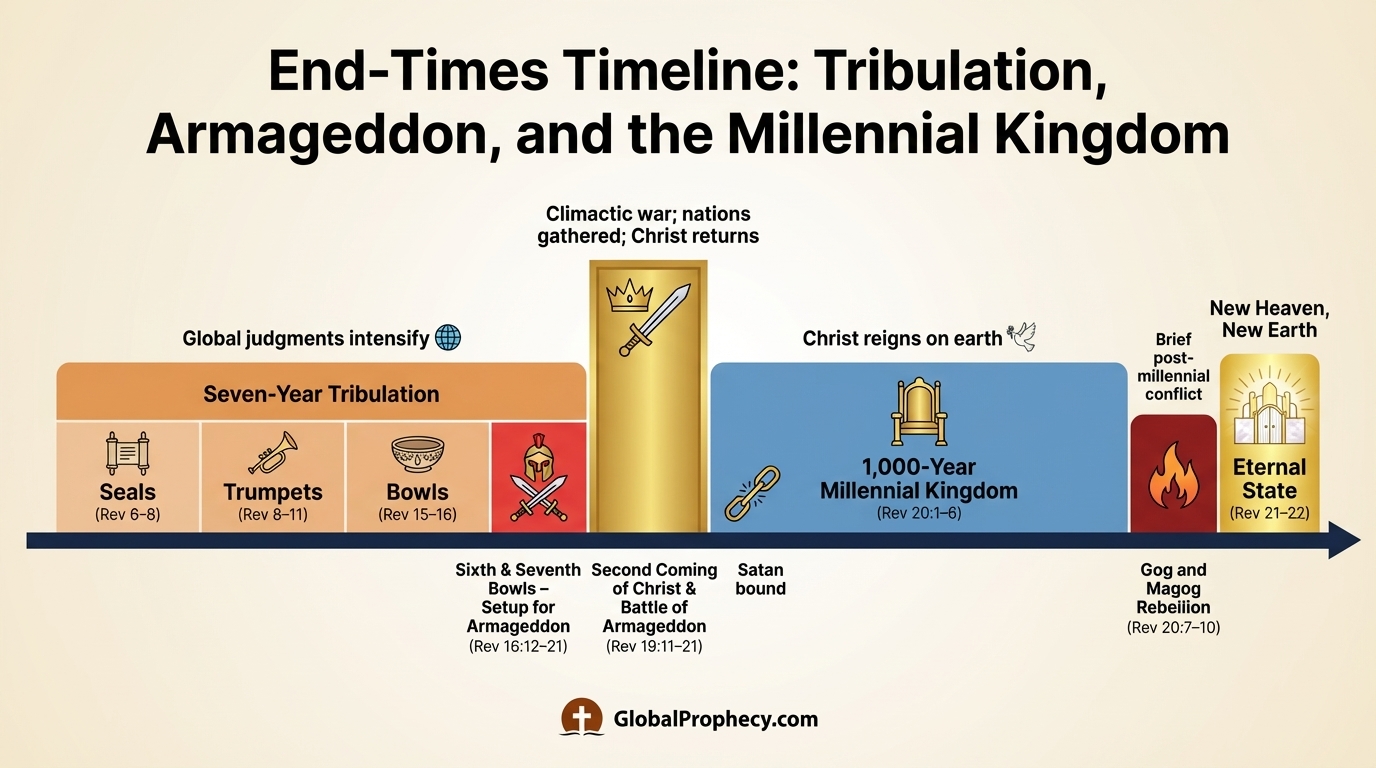
Within a premillennial, futurist reading of Revelation:
-
Seven-year Tribulation (Rev 6–18)
- Ends with the bowl judgments (Rev 16)
- The sixth bowl sets up Armageddon (Rev 16:12–16)
-
End-of-Tribulation War Campaign = Armageddon
- Nations gather in Israel, focusing on Armageddon and Jerusalem
- Israel is in existential danger
- Christ appears in glory (Rev 19:11–16)
- Christ destroys the armies and casts the beast and false prophet into the lake of fire (Rev 19:19–21)
-
After Armageddon
- Satan is bound for 1,000 years (Rev 20:1–3)
- Christ reigns in the millennial kingdom (Rev 20:4–6)
Thus, the Battle of Armageddon occurs at the close of the Tribulation, at the moment of Christ’s second coming, and serves as the transitional judgment that clears the way for His kingdom on earth.
7. The Theological Significance of Armageddon
Even when focusing strictly on Revelation 16 and 19, several theological themes emerge:
-
The Sovereignty of God Over History
- Though demonic spirits gather the kings of the earth, Scripture calls it “the great day of God the Almighty” (Rev 16:14).
- God uses even satanic rebellion to accomplish His predetermined judgment.
-
The Final Exposure of Human Rebellion
- At Armageddon, humanity—represented by “the kings of the earth” and their armies—chooses to fight against the returning Christ (Rev 19:19).
- This reveals the depth of fallen resistance to God and justifies the severity of the judgment.
-
The Triumph of Christ as Warrior-King
- Revelation 19 presents Jesus not only as Redeemer but as divine Warrior, “King of kings and Lord of lords” (Rev 19:16).
- The Battle of Armageddon is the public vindication of His authority over all nations.
-
The Transition from Judgment to Kingdom
- Armageddon is not an end in itself; it is the necessary judgment that precedes peace.
- Only after the rebel powers are destroyed can the promised kingdom of righteousness be established (Rev 20:4–6).
8. Conclusion
From Revelation 16 and Revelation 19, the Battle of Armageddon can be understood as:
- A final global war campaign in the land of Israel.
- Instigated by satanic deception, drawing the kings of the whole world to the region of Armageddon.
- Culminating in the visible second coming of Jesus Christ, who destroys the assembled armies, casts the Antichrist and False Prophet into the lake of fire, and prepares the way for His millennial reign.
In prophetic chronology, the Battle of Armageddon occurs at the end of the seven-year Tribulation and immediately coincides with Christ’s return in glory. It is the decisive moment when human and demonic opposition to God is crushed in a single, catastrophic campaign, and the authority of Christ as King of kings and Lord of lords is manifest to all.
FAQ
Q: What is the Battle of Armageddon in the Bible?
The Battle of Armageddon is the end-of-tribulation war campaign described in Revelation 16 and 19, where the nations of the world are gathered by demonic deception to the region of Armageddon (Megiddo) in Israel. When Jesus Christ returns in glory, He destroys these armies, casts the Antichrist and False Prophet into the lake of fire, and prepares the earth for His thousand-year reign.
Q: Where will the Battle of Armageddon take place?
According to Revelation 16:16, the armies assemble at a place called Armageddon, the Mount of Megiddo in northern Israel. However, related passages show that the fighting spreads across the land of Israel, focusing especially on Jerusalem and extending south toward Edom/Bozrah, making it a broad campaign rather than a single localized clash.
Q: When does the Battle of Armageddon occur in the end times?
The Battle of Armageddon occurs at the very end of the seven-year Tribulation period, during the pouring out of the sixth and seventh bowl judgments (Revelation 16). It climaxes at the second coming of Christ in Revelation 19, just before the binding of Satan and the beginning of Christ’s millennial kingdom (Revelation 20:1–6).
Q: Who fights in the Battle of Armageddon?
On one side are “the kings of the whole world” and their armies, led by the beast (Antichrist) and supported by the false prophet (Revelation 16:14; 19:19–20). On the other side is Jesus Christ, returning from heaven with the armies of heaven, composed of glorified saints and holy angels, who stand with Him as He wins the battle by the power of His word (Revelation 19:11–16).
Q: Is the Battle of Armageddon the same as the war of Gog and Magog?
No. The Battle of Armageddon occurs before the millennium at the end of the Tribulation (Revelation 16; 19), whereas the Gog and Magog revolt in Revelation 20:7–10 takes place after the thousand years when Satan is released for a final, brief rebellion. They are two distinct end-time conflicts separated by the millennial reign of Christ.
Frequently Asked Questions
What is the Battle of Armageddon in the Bible?
Where will the Battle of Armageddon take place?
When does the Battle of Armageddon occur in the end times?
Who fights in the Battle of Armageddon?
Is the Battle of Armageddon the same as the war of Gog and Magog?
L. A. C.
Theologian specializing in eschatology, committed to helping believers understand God's prophetic Word.
Related Articles
The Campaign of Armageddon
Armageddon campaign explained as a prophetic sequence of end-time battles, tracing how the final conflicts unfold across the Tribulation’s climax.
The 144,000 Sealed Israelites
144,000 sealed Israelites in Revelation identified and explained—their identity, purpose, and distinct role as preserved witnesses during the Tribulation.
Babylon the Great
Babylon the Great in Revelation 17–18 reveals end-time religious and commercial rebellion against God and its sudden, final destruction in judgment.
The Mark of the Beast
The mark of the beast from Revelation 13 explained: its identity as 666, prophetic significance, and role in end-times commerce and worship during the Tribulation.