
What is The Day of the Lord?
1. Introduction
The Day of the Lord is one of the central concepts in biblical eschatology. From the Old Testament prophets to the New Testament apostles, Scripture uses this phrase to describe decisive moments when God intervenes in history in an extraordinary way. Understanding what the Day of the Lord is—its meaning, timing, and events—is essential for grasping the Bible’s teaching on the end times.
In summary, the Day of the Lord is a period in which God openly asserts His rule: judging His enemies, delivering His people, and establishing His kingdom purposes in visible form.
2. Biblical Usage of “The Day of the Lord”
2.1 Old Testament Foundations
The exact phrase “the day of the LORD” (Hebrew: yom YHWH) appears nineteen times in the Old Testament (e.g., Joel 1:15; 2:1, 11, 31; Amos 5:18, 20; Isa. 13:6, 9; Zeph. 1:7, 14–18; Zech. 14:1; Mal. 4:5). Closely related expressions include “that day” and “the day of His wrath.”
In the prophets, the expression is used in two primary ways:
-
Near-historical days of the Lord
- Examples:
- Judgment on Israel or Judah by Assyria or Babylon (Amos 5:18–20; Isa. 13; Lam. 2).
- Judgment on Egypt (Jer. 46:10; Ezek. 30:3).
- These events are “days of the LORD” because God uses nations and wars as His instruments to judge sin and assert His sovereignty.
- Examples:
-
Far-future eschatological Day of the Lord
- Described as worldwide in scope and unmatched in severity:
- “The LORD will punish the world for its evil and the wicked for their iniquity” (Isa. 13:11).
- “A day of wrath… of distress and anguish… of ruin and devastation” (Zeph. 1:15).
- Involves cosmic signs: sun, moon, and stars darkened (Joel 2:31; Isa. 13:10).
- Culminates in God’s universal kingdom and Israel’s restoration (Joel 3; Zech. 14; Zeph. 3:14–20).
- Described as worldwide in scope and unmatched in severity:
In these texts, historical “days” function as previews or foreshadowings of the ultimate, climactic Day of the Lord still to come.
2.2 New Testament Development
The New Testament assumes this Old Testament background and consistently uses “the day of the Lord” in a future, eschatological sense:
- Acts 2:20 – Cites Joel: “The sun shall be turned to darkness and the moon to blood, before the day of the Lord comes, the great and magnificent day.”
- 1 Thessalonians 5:2 – “The day of the Lord will come like a thief in the night.”
- 2 Thessalonians 2:2 – Warns believers not to be deceived into thinking “the day of the Lord has come.”
- 2 Peter 3:10 – “The day of the Lord will come like a thief, and then the heavens will pass away with a roar…”
Other synonymous phrases include:
- “day of wrath” (Rom. 2:5)
- “day of visitation” (1 Pet. 2:12)
- “the great day of God the Almighty” (Rev. 16:14)
In all these cases, the Day of the Lord is a future period of divine intervention, centered on judgment but ultimately leading to a renewed creation.
3. What the Day of the Lord Is: Its Core Meaning
3.1 A Technical Term for Divine Intervention
Biblically, the Day of the Lord is not an ordinary calendar day. It is a theological term for God’s special, decisive interventions in human history:
“Alas for the day! For the day of the LORD is near, and as destruction from the Almighty it comes.”
— Joel 1:15
From a synthetic reading of Scripture, we can define it this way:
The Day of the Lord is an extended period in which God directly intervenes in history to judge the wicked, vindicate His people, and manifest His sovereign rule, climaxing in the establishment of His kingdom and, ultimately, a new heavens and new earth.
Key elements in this definition:
- Direct divine intervention – God “lays bare His holy arm” in unmistakable ways.
- Judgment on God’s enemies – Individual and national rebellion meets God’s wrath.
- Vindication and deliverance of His people – Especially Israel, but also believing Gentiles.
- Manifestation of His kingship – The rule of Satan and rebellious humanity is displaced by the visible rule of Christ.
3.2 Judgment and Blessing: Two Sides of One “Day”
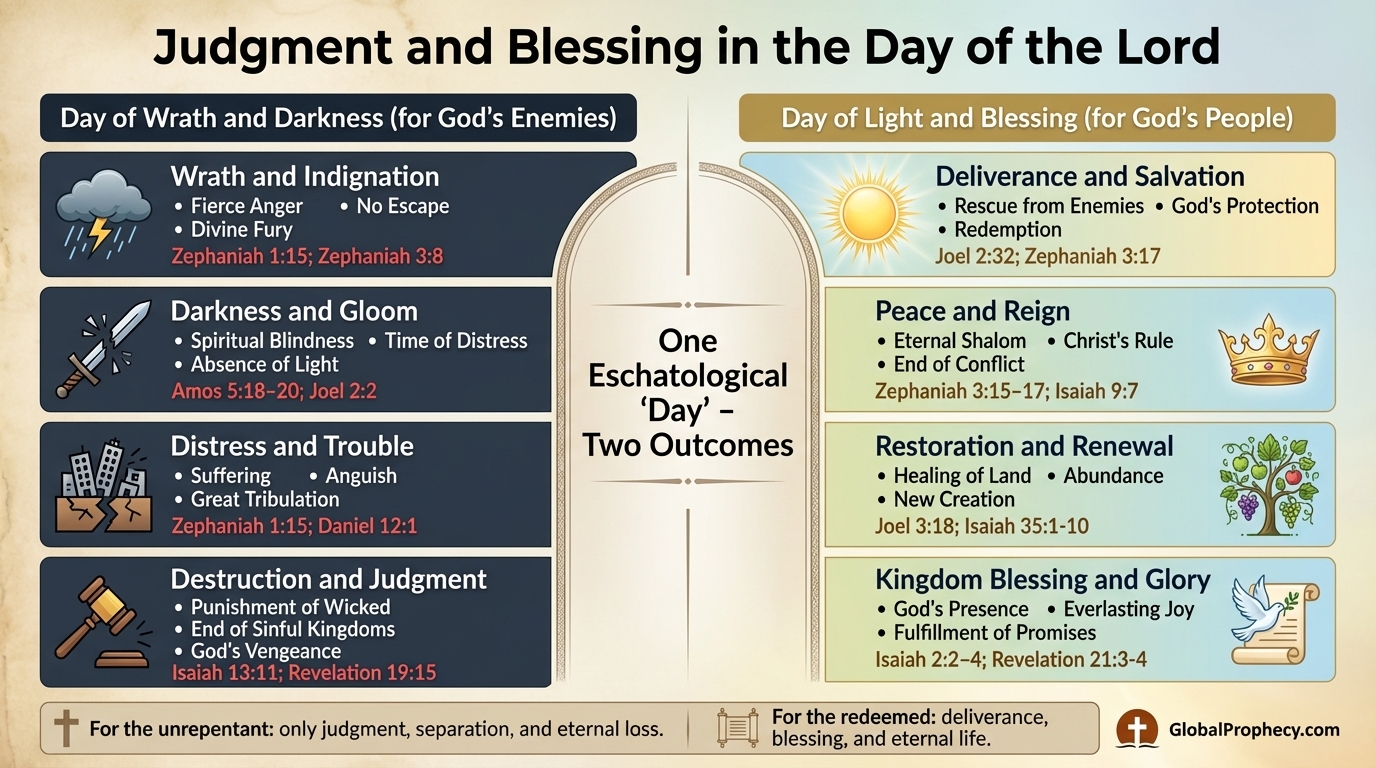
The Day of the Lord has a twofold character:
-
A day of wrath and darkness for God’s enemies
- “A day of wrath… of trouble and distress… of darkness and gloom” (Zeph. 1:15).
- “Will not the day of the LORD be darkness, and not light, and gloom with no brightness in it?” (Amos 5:20).
For the unrepentant, this “day” is only judgment.
-
A day of light and blessing for God’s people
- After describing the Day of the Lord’s judgment, Joel looks ahead:
“In that day the mountains shall drip sweet wine… and a fountain shall come forth from the house of the LORD.”
— Joel 3:18 - Zephaniah likewise moves from wrath to restoration:
“The LORD has taken away the judgments against you… The King of Israel, the LORD, is in your midst; you shall never again fear evil.”
— Zephaniah 3:15
- After describing the Day of the Lord’s judgment, Joel looks ahead:
Thus, the same eschatological “Day” that brings destruction to the rebellious brings deliverance and kingdom blessing to the redeemed.
4. The Structure and Phases of the Future Day of the Lord
4.1 “Day” as an Extended Period
Biblically, the word “day” can mean:
- The daylight portion of a 24‑hour day (Gen. 1:5),
- A full 24‑hour day,
- Or an extended period characterized by a certain kind of activity (“the day of trouble,” “the day of salvation”; cf. Gen. 2:4 NASB).
The Day of the Lord falls into this last category. It is an extended eschatological period, not merely a single literal day, though it includes climactic individual days within it.
4.2 Broad Sense: A Prophetic Era of Judgment and Rule
From a broad, prophetic standpoint, Scripture presents the future Day of the Lord as stretching across multiple eschatological stages:
| Aspect | Description | Key Texts |
|---|---|---|
| Judgment Phase | God’s wrath on a rebellious world in the end‑time Tribulation, climaxing with Christ’s return | Joel 2; Isa. 13; Zeph. 1; 1 Thess. 5:2–3; Rev. 6–19 |
| Kingdom/Blessing Phase | Christ’s millennial reign of peace and righteousness on earth | Isa. 2:2–4; 11:1–10; Zech. 14:8–11; Rev. 20:1–6 |
| Consummating Judgment | Final dissolution of the present heavens and earth and arrival of new creation | 2 Pet. 3:10–13; Rev. 20:11–21:1 |
In this broad sense, the Day of the Lord is like a single eschatological “day” that begins in deep night (wrath), moves to dawn (Christ’s appearing), shines in full light (millennial kingdom), and ends with the transition to the new heavens and new earth.
4.3 Narrow Sense: “The Great and Terrible Day of the Lord”
Within that extended period, Scripture also uses “Day of the Lord” in a narrow sense for a specific climactic day:
- Joel speaks of “the great and awesome day of the LORD” (Joel 2:31).
- Malachi echoes: “the great and awesome day of the LORD” (Mal. 4:5).
- Joel 3 links this climactic day with the gathering of the nations’ armies in Israel and the Lord’s direct intervention (Joel 3:9–16).
- Zechariah 14 describes the same event: the nations attack Jerusalem, the LORD comes and stands on the Mount of Olives, and the battle is decisively turned.
This narrow Day of the Lord corresponds with the Second Coming of Christ to earth:
“Then the LORD will go out and fight against those nations… On that day his feet shall stand on the Mount of Olives that lies before Jerusalem on the east.”
— Zechariah 14:3–4
So, in prophetic usage:
- Broad Day of the Lord – The entire end‑time complex: Tribulation judgments, Christ’s return, millennial kingdom, and transition to new creation.
- Narrow Day of the Lord – The climactic day of Christ’s return to fight, judge, and establish His rule, often called “the great and terrible day of the LORD.”
5. Timing of the Day of the Lord in Biblical Eschatology
5.1 Not Present, But Future
According to 1 Thessalonians 5:1–3, the Day of the Lord was still future in Paul’s time and will come unexpectedly on an unsuspecting world:
“For you yourselves are fully aware that the day of the Lord will come like a thief in the night… while people are saying, ‘There is peace and security’…”
— 1 Thessalonians 5:2–3
Nothing in history since Paul’s day matches the comprehensive, worldwide, cosmic, and kingdom‑establishing features attached to the Day of the Lord. It is therefore still future.
5.2 Relation to the Tribulation
The judgment phase of the Day of the Lord is closely tied to the 70th week of Daniel (Dan. 9:27), often called the Tribulation:
- Cosmic disturbances described for the Day of the Lord (Isa. 2:19–21; Joel 2:30–31) are echoed in the sixth seal of Revelation 6:12–17.
- Joel and Zechariah place the Day of the Lord at the time when all nations’ armies are gathered against Jerusalem (Joel 3; Zech. 14), which Revelation 16:12–16 associates with the final stages of the Tribulation.
- Thus, the Day of the Lord’s wrath begins within that future Tribulation period, builds in intensity, and reaches its zenith at Christ’s return.
5.3 Relation to Christ’s Return and the Kingdom
The narrow Day of the Lord is the day of Christ’s bodily return to earth:
- It comes after much of the Tribulation judgment has already unfolded.
- It climaxes God’s wrath on His enemies (Joel 3:14–16; Rev. 19:11–21).
- It inaugurates the millennial kingdom, the blessed phase of the Day of the Lord when Christ reigns from Jerusalem (Zech. 14:9; Rev. 20:1–6).
Then, looking further ahead, 2 Peter 3:10–13 connects the Day of the Lord with the final dissolution of the present heavens and earth and the creation of the new heavens and a new earth. This is the consummating act of God’s eschatological “day.”
6. Key Events Characterizing the Day of the Lord
While details are distributed across many prophetic passages, the Bible highlights several recurring features of the Day of the Lord.
6.1 Outpouring of Divine Wrath
The Day of the Lord is repeatedly called a “day of wrath”:
“A day of wrath is that day, a day of distress and anguish, a day of ruin and devastation, a day of darkness and gloom…”
— Zephaniah 1:15
- Universal scope: “I will punish the world for its evil” (Isa. 13:11).
- Economic and military collapse: fortified cities, wealth, and power cannot deliver (Zeph. 1:16, 18).
- Finality: “He will make a complete end… of all the inhabitants of the earth” (Zeph. 1:18).
This wrath unfolds in escalating judgments (seals, trumpets, bowls in Revelation 6–16) during the judgment phase of the Day.
6.2 Cosmic Disturbances
Cosmic signs mark the approach and nearness of the Day of the Lord:
- “The sun will be turned to darkness and the moon to blood, before the great and awesome day of the LORD comes” (Joel 2:31).
- “The heavens will be black above them; the stars will not give their light” (Isa. 13:10).
- Ultimately, “the heavens will pass away with a roar, and the heavenly bodies will be burned up and dissolved” (2 Pet. 3:10).
These phenomena underscore that the Day of the Lord is not a merely local crisis, but a universe‑shaking divine intervention.
6.3 Gathering and Judgment of the Nations
End‑time Day of the Lord passages highlight a global military and judicial confrontation:
- The nations’ armies gather in and around Israel (Joel 3:9–14; Zech. 14:1–2; Rev. 16:14–16).
- The LORD Himself fights against them (Zech. 14:3; Rev. 19:11–21).
- This is called the “valley of decision” (Joel 3:14), where God renders an irrevocable verdict against the rebellious world system.
6.4 Salvation and Restoration for Israel and the Nations
The Day of the Lord also features deliverance:
- A faithful remnant of Israel is preserved and purified (Joel 2:32; Zeph. 3:12–13; Rom. 11:26–27).
- The Messiah reigns from Jerusalem, and the nations stream there to learn God’s ways:
“He shall judge between the nations… they shall beat their swords into plowshares… neither shall they learn war anymore.”
— Isaiah 2:4
- The land of Israel is transformed and abundantly fruitful (Joel 3:18; Isa. 35).
6.5 Transition to the New Heavens and New Earth
Finally, the Day of the Lord includes the ultimate renewal of creation:
“But the day of the Lord will come like a thief, and then the heavens will pass away with a roar… and the earth and the works that are done on it will be exposed.”
— 2 Peter 3:10
After final judgment at the end of the millennium (Rev. 20:11–15), God brings in “new heavens and a new earth in which righteousness dwells” (2 Pet. 3:13; Rev. 21:1). This is the terminal point of the Day of the Lord in its broadest, consummate sense.
7. Conclusion
According to Scripture, the Day of the Lord is not a vague spiritual idea but a structured, future reality in God’s prophetic timetable.
- In essence, it is the period when God openly asserts His sovereignty: judging the rebellious, vindicating His people, and manifesting His rule.
- In character, it is both a day of wrath (darkness, anguish, destruction) and a day of blessing (light, peace, kingdom glory), depending on one’s relationship to the Lord.
- In scope, it spans from the future Tribulation judgments, through the return of Christ and His millennial kingdom, to the final dissolution of the present creation and the dawn of the new heavens and new earth.
- In climax, its “great and terrible” focal point is the Second Coming of Christ, when He personally confronts the gathered nations, ends the rule of evil, and inaugurates His righteous reign.
To understand biblical eschatology, one must understand the Day of the Lord. It is the divinely appointed turning point when “the day of man” and the day of Satan give way forever to the day of the Lord.
FAQ
Q: What is the Day of the Lord in the Bible?
The Day of the Lord is a biblical term for a future period when God will directly intervene in world history to judge the wicked, deliver His people, and establish His visible rule. It includes both severe judgment (especially during the Tribulation) and great blessing (during Christ’s millennial kingdom and the new creation).
Q: Is the Day of the Lord the same as the Tribulation?
The Tribulation corresponds to the judgment phase of the Day of the Lord, when God’s wrath is poured out on a rebellious world. However, in its broader sense the Day of the Lord also includes Christ’s return, His millennial reign, and the final renewal of the heavens and the earth.
Q: When will the Day of the Lord happen?
According to Scripture, the Day of the Lord is still future and will arrive “like a thief in the night” on an unsuspecting world (1 Thess. 5:2). It begins with end‑time judgments associated with the Tribulation, reaches its climax at Christ’s return, continues through His thousand‑year reign, and concludes with the creation of the new heavens and new earth.
Q: Why is it called “the great and terrible day of the Lord”?
Joel and Malachi describe the climactic Day of the Lord as “great and awesome” or “great and terrible” because it is the decisive moment when Christ returns, confronts the gathered nations, and brings an end to the rule of evil. For God’s enemies it is a day of terror; for God’s people it is the gateway to final deliverance and kingdom blessing.
Q: Is the Day of the Lord only about judgment?
No. While many passages emphasize its wrath and darkness for the unrepentant, the Day of the Lord also brings restoration and blessing. It results in Israel’s salvation, Christ’s righteous rule over the nations, and ultimately the creation of a new heavens and new earth where righteousness dwells.
Frequently Asked Questions
What is the Day of the Lord in the Bible?
Is the Day of the Lord the same as the Tribulation?
When will the Day of the Lord happen?
Why is it called “the great and terrible day of the Lord”?
Is the Day of the Lord only about judgment?
L. A. C.
Theologian specializing in eschatology, committed to helping believers understand God's prophetic Word.
Related Articles
What the Bible Says about Antichrist?
Antichrist in the Bible: discover what Scripture reveals about his identity, character, deceptive power, and end-time role in the Tribulation.
What the Bible Says about False Prophet?
False Prophet biblical identity and role in end times. Discover what Scripture reveals about this key figure in Revelation's tribulation prophecy.
The Biblical Covenants: Framework for Understanding Prophecy
Biblical covenants form the framework for understanding prophecy, clarifying Israel, the church, and God’s kingdom plan across the Old and New Testaments.
Biblical Purposes of the Tribulation
Biblical purposes of the tribulation explained: why God sends this final period of judgment, purification, and restoration in His end-time plan.