
What is the Rapture of the Church?
1. Introduction
Among all themes in biblical eschatology, few are as central to the church’s hope as the rapture. Scripture presents a future event in which Christ will personally descend from heaven, raise the dead in Christ, transform living believers, and “catch up” His church to meet Him in the air. This is not speculation or fiction, but a carefully revealed doctrine rooted in the words of Jesus and the apostles.
This article explains what the rapture is, what the word itself means, and the main biblical passages that define its nature and sequence. Questions about when the rapture occurs in relation to other end‑time events are intentionally set aside, so we can focus on what God says will happen and who it involves.
2. What the Rapture Is: Definition and Essence
In biblical terms, the rapture of the church is:
The future event when the Lord Jesus Christ will descend from heaven,
resurrect the bodies of dead church‑age believers, instantly transform the bodies of living believers into glorified, immortal bodies, and catch them up together to meet Him in the air, escorting them to the Father’s house to be with Him forever.
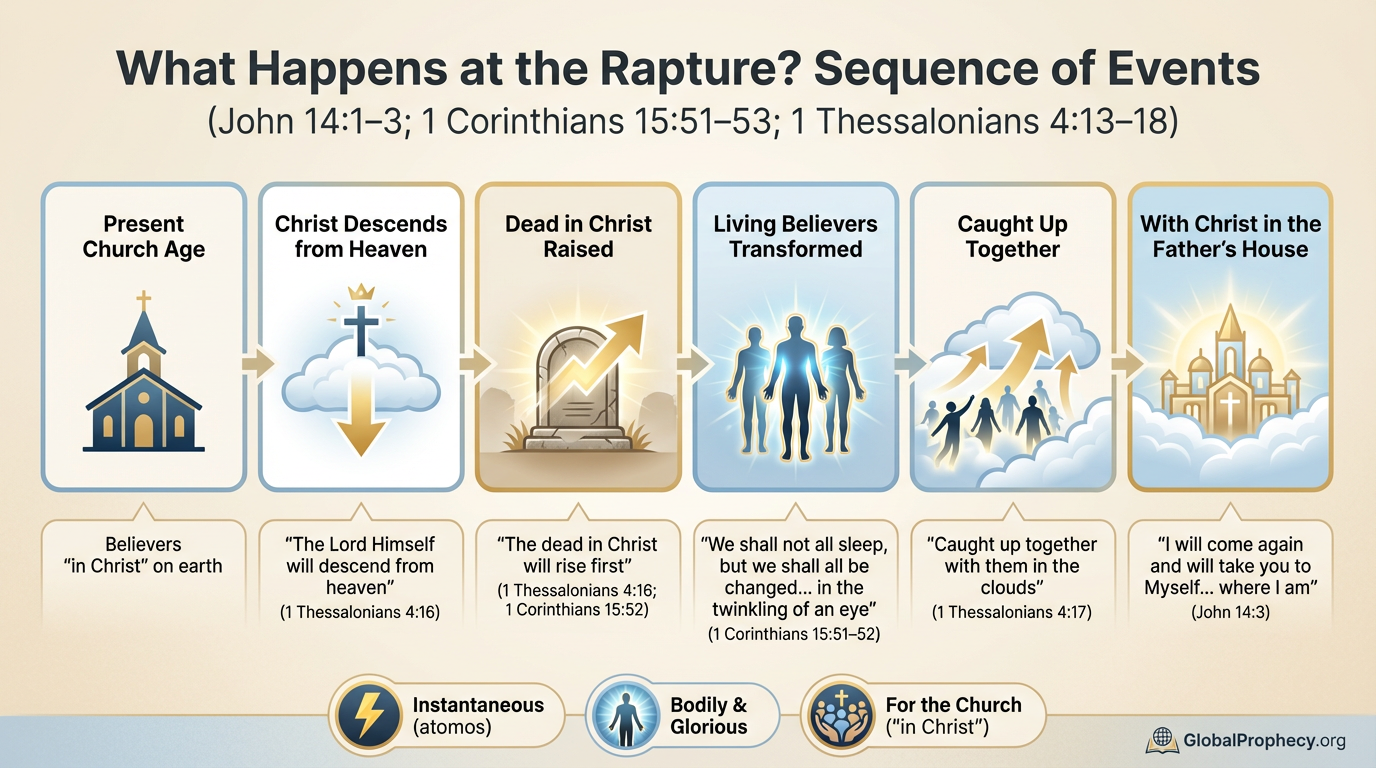
Several core elements make up this event:
- Personal descent of Christ from heaven.
- Resurrection of “the dead in Christ.”
- Translation / transformation of living believers.
- Catching up of both groups “in the clouds.”
- Meeting the Lord in the air.
- Everlasting union with Christ.
All of these elements are explicitly described in the New Testament, especially in John 14:1–3; 1 Corinthians 15:51–53; 1 Thessalonians 4:13–18.
3. The Meaning of the Term “Rapture”
3.1 The Biblical Verb harpazō
The English word rapture does not appear in most English Bibles, but the concept is clearly biblical. It comes from the Latin rapio / rapturo, used in the Latin Vulgate to translate the Greek verb harpazō in 1 Thessalonians 4:17:
“Then we who are alive, who are left, will be caught up together with them in the clouds to meet the Lord in the air…”
— 1 Thessalonians 4:17
The verb harpazō means:
- to seize, snatch, carry off by force
- to remove suddenly and decisively
Elsewhere in the New Testament it is used of:
- Philip being “carried away” by the Spirit (Acts 8:39),
- Paul being “caught up to the third heaven” (2 Corinthians 12:2–4),
- and Christ Himself being “caught up to God and to his throne” (Revelation 12:5).
The rapture, then, is the sudden, powerful removal of the church from earth to meet Christ.
3.2 A “Mystery” Now Revealed
Paul calls the rapture a “mystery” in 1 Corinthians 15:51:
“Behold! I tell you a mystery. We shall not all sleep, but we shall all be changed…”
In the New Testament, a mystery is not something spooky or insoluble, but a truth previously hidden and now revealed by God (cf. Ephesians 3:3–5; Colossians 1:26). The mystery of the rapture is this new information:
- Not all believers will experience physical death.
- Yet all believers—dead and living—will be changed into glorified, immortal bodies “in a moment, in the twinkling of an eye” (1 Corinthians 15:52).
This instantaneous transformation, apart from dying, is never revealed in the Old Testament. It is distinctive revelation for the church.
4. The Central Biblical Passages
4.1 John 14:1–3 — Jesus’ First Promise of the Rapture
On the night before His crucifixion, Jesus comforted His troubled disciples:
“Let not your hearts be troubled. Believe in God; believe also in me.
In my Father’s house are many rooms. If it were not so, would I have told you that I go to prepare a place for you?
And if I go and prepare a place for you, I will come again and will take you to myself, that where I am you may be also.”
— John 14:1–3
Key features:
- Christ’s departure: He goes to the Father’s house (heaven) to prepare a place.
- Christ’s return: “I will come again.”
- Personal reception: “and will receive you to myself” (He does not just appear; He takes us).
- Heavenly destination: that “where I am [the Father’s house], there you may be also.”
This is not Christ coming to earth to establish His kingdom; it is Christ coming from the Father’s house to gather His own and bring them there. This is the first clear reference to what is later called the rapture.
4.2 1 Corinthians 15:51–53 — Transformation in an Instant
Paul unfolds the mystery of how believers will obtain resurrection‑type bodies:
“We shall not all sleep, but we shall all be changed,
in a moment, in the twinkling of an eye, at the last trumpet.
For the trumpet will sound, and the dead will be raised imperishable, and we shall be changed.
For this perishable body must put on the imperishable, and this mortal body must put on immortality.”
— 1 Corinthians 15:51–53
Core truths:
- Not all believers will die (“we shall not all sleep”).
- All believers will be transformed (“we shall all be changed”).
- This happens instantaneously (“in a moment, in the twinkling of an eye”).
- Both dead and living believers receive imperishable, immortal bodies.
This is the transformation that occurs at the rapture.
4.3 1 Thessalonians 4:13–18 — The Classic Rapture Passage
To comfort believers grieving for those who had died in Christ, Paul gives the clearest chronological description of the rapture:
“For the Lord himself will descend from heaven with a cry of command, with the voice of an archangel, and with the sound of the trumpet of God.
And the dead in Christ will rise first.
Then we who are alive, who are left, will be caught up together with them in the clouds to meet the Lord in the air, and so we will always be with the Lord.
Therefore encourage one another with these words.”
— 1 Thessalonians 4:16–18
Key elements and sequence:
- The Lord Himself descends from heaven.
- His coming is announced:
- “a cry of command,”
- “the voice of an archangel,”
- “the trumpet of God.”
- “The dead in Christ” rise first—the bodily resurrection of church‑age believers who have died.
- Living believers are then caught up (“harpazō”) together with them.
- The meeting happens “in the clouds… in the air”, not on the earth.
- Permanent union: “so we will always be with the Lord.”
- Pastoral purpose: “Therefore encourage one another with these words.”
These verses define the rapture’s participants, location, and effect with great clarity.
5. Participants in the Rapture: Who Is “In Christ”?
5.1 “The Dead in Christ” and “We Who Are Alive”
Paul is very specific about who takes part:
- “the dead in Christ” (1 Thessalonians 4:16),
- “we who are alive, who are left” (4:17),
- those who “have fallen asleep in Jesus” (4:14).
Being “in Christ” is Paul’s distinctive term for those who belong to Christ in this present age, united to Him by the Spirit’s baptizing work (1 Corinthians 12:13). This is the church, the body of Christ.
Thus the rapture includes:
- All church‑age believers who have died (“the dead in Christ”).
- All church‑age believers still alive when Christ descends (“we who are alive”).
These together constitute the church, from Pentecost (Acts 2) to the moment of the rapture.
5.2 What About Old Testament Saints and Tribulation Saints?
Scripture indicates that other groups of believers have their own, distinct resurrection moments:
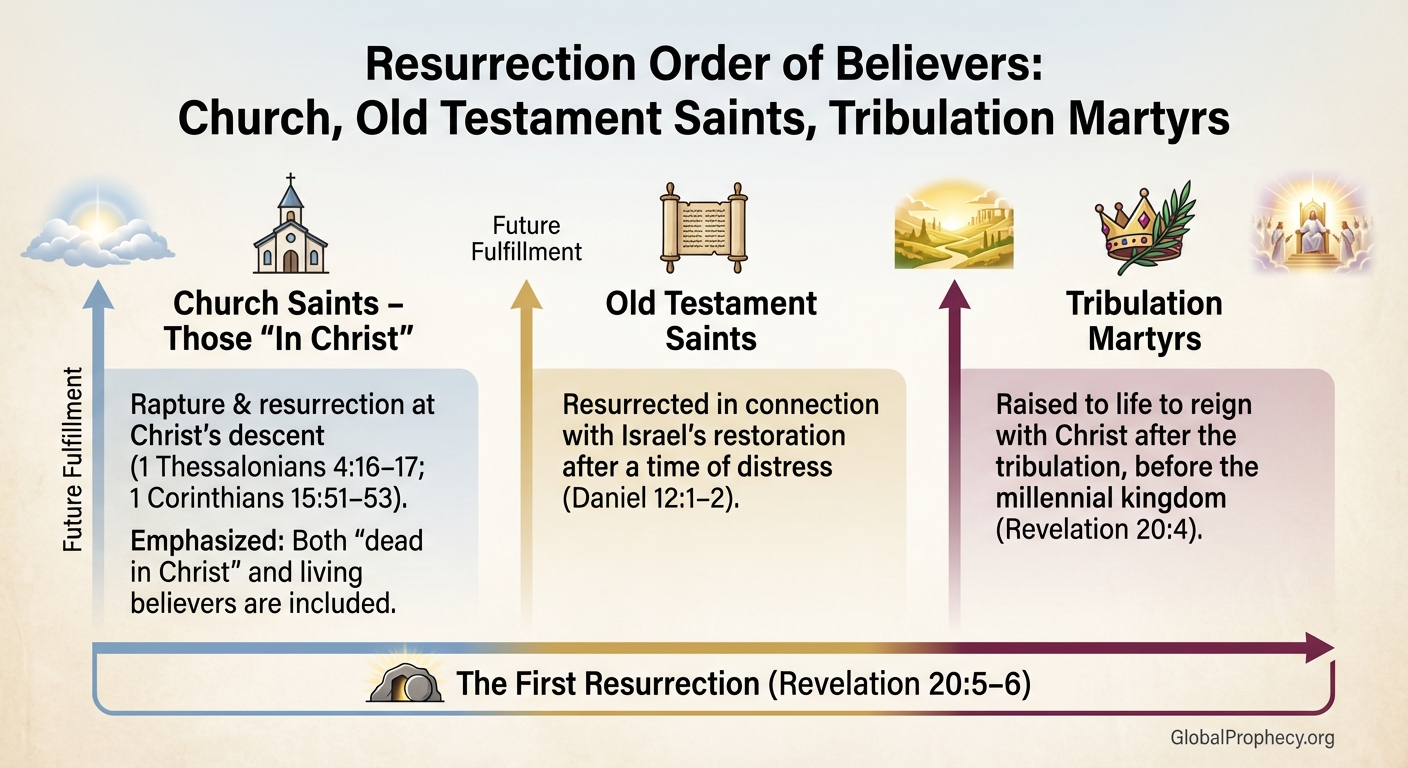
- Old Testament saints are resurrected “after the tribulation,” connected with Israel’s restoration (Daniel 12:1–2).
- Tribulation martyrs are raised at the end of the tribulation just prior to the millennial reign (Revelation 20:4).
They, too, share in “the first resurrection” in the broad sense (Revelation 20:5–6), but the rapture proper in 1 Thessalonians 4 concerns only those who are “in Christ”, that is, church saints.
6. The Nature and Character of the Rapture
6.1 Sudden and Instantaneous
The rapture happens “in a moment, in the twinkling of an eye” (1 Corinthians 15:52). The word translated “moment” (atomos) denotes an indivisible instant. The transformation of millions of believers worldwide will be virtually instantaneous—too fast for the human eye to dissect.
6.2 Bodily and Glorious
The rapture is not a mystical escape of the soul; it is an event involving real bodies:
- The dead in Christ are raised.
- Living believers are changed.
Both groups receive glorified bodies:
“He will transform our lowly body to be like his glorious body…”
— Philippians 3:21
These bodies are:
- Imperishable (no decay, 1 Corinthians 15:42),
- Immortal (no death, 15:53),
- Like Christ’s resurrection body (1 John 3:2).
6.3 Heavenly in Direction
At the rapture, Christ does not come to the earth to establish His throne; rather, He comes in the air to take His church to the Father’s house:
- In John 14:2–3, He promises to come and “take you to myself, that where I am [in the Father’s house] you may be also.”
- In 1 Thessalonians 4:17, the church meets Him “in the air.”
The direction is from heaven to the air, then from the air to heaven.
7. The Pastoral Purpose of the Rapture
7.1 Comfort in the Face of Death
The immediate context of 1 Thessalonians 4:13–18 is grief over deceased believers. Paul writes:
“that you may not grieve as others do who have no hope.”
— 1 Thessalonians 4:13
Christians do grieve, but not hopelessly. Because of the rapture:
- Deceased believers will not be left behind; they rise first.
- Living believers will not be separated from them; they are caught up together with them.
- All believers—dead and living—will “always be with the Lord” together.
Hence the command:
“Therefore encourage one another with these words.”
— 1 Thessalonians 4:18
7.2 Motivation to Holiness and Watchfulness
The doctrine of the rapture is not given for speculation, but for sanctification:
- “Everyone who thus hopes in him purifies himself as he is pure.”
— 1 John 3:3 - We are to be “waiting for our blessed hope, the appearing of the glory of our great God and Savior Jesus Christ,” which teaches us “to renounce ungodliness” (Titus 2:11–13).
- Paul connects the prospect of Christ’s coming with steadfast, holy living (1 Thessalonians 3:13; 5:23).
Knowing that Christ could descend at any time to gather His church should:
- Reshape our priorities,
- Strengthen our resolve against sin,
- Deepen our evangelistic urgency, and
- Produce joyful expectancy.
8. A Focused Summary
Putting the biblical data together, we can summarize:
- The rapture is the sudden, supernatural, bodily catching up of all church‑age believers, dead and living, to meet the Lord Jesus Christ in the air.
- It involves the resurrection of “the dead in Christ” and the instant transformation of living believers into glorified, immortal bodies.
- Christ personally descends from heaven, gathers His church to Himself, and escorts them to the Father’s house.
- It is a “mystery” revealed in the New Testament, grounded in Christ’s promise (John 14:1–3) and elaborated by Paul (1 Corinthians 15:51–53; 1 Thessalonians 4:13–18).
- The rapture is designed to comfort believers facing death and to motivate holy, hopeful living.
Whatever questions we may have about the exact timing of the rapture in relation to other end‑time events, the what of the rapture is clear and glorious:
“Then we who are alive, who are left, will be caught up together with them in the clouds to meet the Lord in the air,
and so we will always be with the Lord.”
— 1 Thessalonians 4:17
Frequently Asked Questions
What is the rapture of the church?
What does the word 'rapture' mean?
What Bible verses describe the rapture?
Who will be included in the rapture?
L. A. C.
Theologian specializing in eschatology, committed to helping believers understand God's prophetic Word.
Related Articles
Amillennialism Examined: Is the Church the Millennial Kingdom?
Amillennialism examined: is the church the millennial kingdom? Explore its claims, symbols, and a biblical critique of this end-times view.
The Betrothal of the Church, the Marriage of the Lamb, and the Banquet
Marriage of the Lamb explains Christ’s betrothal with the church, the heavenly marriage ceremony and the end-time wedding banquet in glory.
What are the Marriage of the Lamb?
Marriage of the Lamb reveals Christ’s union with His church in Revelation 19. Explore its meaning, timing, and eternal significance in God’s plan.
Mid-Tribulationalism Examined
Mid-tribulationalism examined in depth: understand its last trumpet argument, compare rapture texts, and see biblical reasons the church misses all tribulation.