
What is the Tribulation Period?
1. Introduction
The tribulation period is a central theme in biblical eschatology and end-times prophecy. Scripture presents it as a unique, future, seven‑year span of intense distress and divine judgment that immediately precedes the second coming of Christ and the establishment of His millennial kingdom. Understanding what the tribulation is, how long it lasts, and why God has ordained it is essential for grasping the Bible’s overall prophetic framework.
This article offers a focused definition and overview of the tribulation period in clear, academic, and biblically grounded terms.
2. Definition of the Tribulation Period
In the New Testament, the word translated “tribulation” (Greek thlipsis) generally means pressure, affliction, or distress. Jesus applied it in a technical, prophetic sense to an unparalleled future time:
“For then there will be great tribulation, such as has not been from the beginning of the world until now, no, and never will be.”
— Matthew 24:21
From a biblical‑prophetic perspective, the tribulation period may be defined as:
A future seven‑year period in which God pours out His wrath in worldwide judgments, brings Israel to repentance, judges unbelieving nations, and prepares the world for the visible return and kingdom of Jesus Christ.
Key features of this period include:
- It is future, not past or merely symbolic (cf. Matt 24:21–30; Rev 3:10).
- It is universal in scope—a “trial…coming on the whole world” (Rev 3:10).
- It is uniquely severe—no other time in history is comparable (Dan 12:1; Matt 24:21).
- It is explicitly linked to the day of the Lord, the wrath of God, and the wrath of the Lamb (Zeph 1:14–18; Rev 6:16–17).
The tribulation period is thus not merely “hard times” for believers in general, but a distinct eschatological era of climactic divine intervention in human history.
3. Duration and Chronology of the Tribulation
3.1 The Seven-Year “Seventieth Week” of Daniel
The primary biblical foundation for the duration of the tribulation is Daniel’s prophecy of the seventy weeks (Dan 9:24–27). Daniel speaks of “seventy weeks” (literally “seventy sevens”) decreed for Israel and Jerusalem. These “sevens” are best understood as weeks of years, so that 70 × 7 = 490 years.
- The first 69 “weeks” (483 years) run “from the going out of the word to restore and build Jerusalem to the coming of an anointed one” (Dan 9:25).
- After the 69 weeks the Messiah is “cut off” and Jerusalem is destroyed (Dan 9:26), events fulfilled in the first century.
- One final “week” (the seventieth week) remains unfulfilled in history.
This final “week” is described in Daniel 9:27:
“And he shall make a strong covenant with many for one week, and for half of the week he shall put an end to sacrifice and offering. And on the wing of abominations shall come one who makes desolate…”
— Daniel 9:27
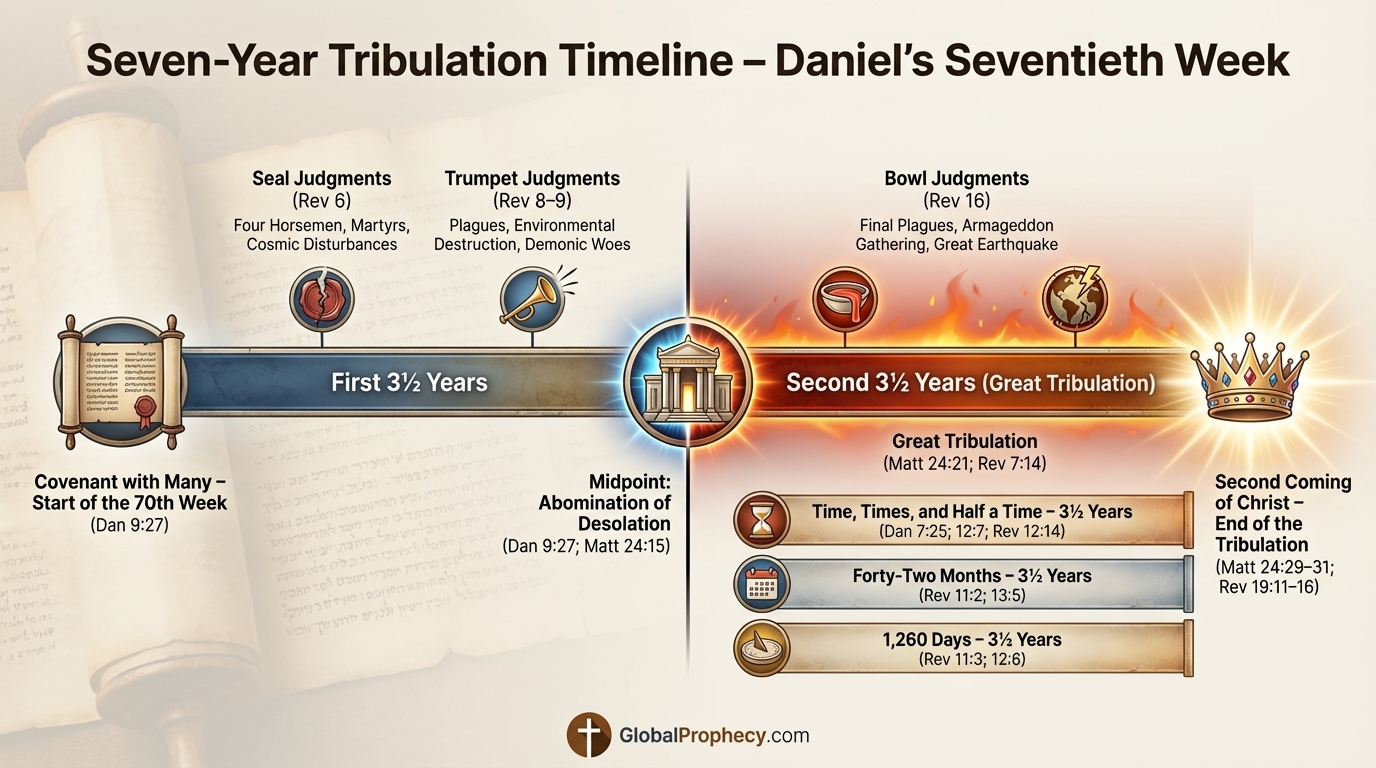
This “one week” is a seven‑year period, divided into two halves of three and a half years each. This seven‑year seventieth week of Daniel is what later Scripture calls the tribulation period.
3.2 Three and a Half Years, Forty-Two Months, 1,260 Days
Multiple prophetic texts further specify the internal structure of this period using equivalent time references:
| Expression | Duration | References (ESV) |
|---|---|---|
| “time, times, and half a time” | 3½ “times” | Dan 7:25; 12:7; Rev 12:14 |
| “forty-two months” | 3½ years | Rev 11:2; 13:5 |
| “1,260 days” | 3½ years (30‑day months) | Rev 11:3; 12:6 |
These repeated designations confirm that the tribulation’s seven years consist of two equal halves of three and a half years, portrayed in Revelation 6–19 through the seal, trumpet, and bowl judgments.
3.3 Beginning and End of the Tribulation Period
Biblically, the tribulation period begins and ends at clearly marked prophetic events:
- Beginning: The tribulation begins when a coming world ruler (the “prince who is to come,” commonly identified as Antichrist) “makes a strong covenant with many for one week” (Dan 9:27). This covenant with Israel marks the official start of the seventieth week.
- End: The tribulation ends with the second coming of Christ in glory, immediately “after the tribulation of those days” (Matt 24:29–31), when He returns to judge and to establish His kingdom.
From covenant to second coming, the tribulation period runs for a fixed seven years—no more and no less.
4. Names and Terminology for the Tribulation
Scripture uses numerous titles and images to describe this period, each highlighting a particular aspect of its character.
4.1 Old Testament Terms
Key Old Testament expressions that refer to this future tribulation include:
- “The day of the LORD” (Joel 1:15; 2:1; Zeph 1:14–15): A time of divine intervention in judgment.
- “The time of Jacob’s trouble” (Jer 30:7): Emphasizing Israel’s unique distress.
- “A time of trouble” (Dan 12:1): “Such as never has been since there was a nation till that time.”
- “Day of vengeance” (Isa 34:8; 61:2).
- “Day of wrath” / “day of the LORD’s wrath” (Zeph 1:15, 18).
- “Birth pangs” (Isa 26:17–18; Jer 30:6–7; Mic 4:10): Indicating increasing intensity that culminates in the “birth” of the kingdom.
These Old Testament terms collectively portray the tribulation as God’s climactic day of judgment and purging in preparation for messianic blessing.
4.2 New Testament Terms
The New Testament continues and sharpens this terminology:
- “The tribulation” (Matt 24:29; Mark 13:24).
- “Great tribulation” (Matt 24:21; Rev 7:14).
- “The day of the Lord” (1 Thess 5:2; 2 Thess 2:2).
- “The wrath to come” (1 Thess 1:10).
- “The wrath” (1 Thess 5:9; Rev 11:18).
- “The great day of their wrath” (Rev 6:17).
- “The hour of trial…on the whole world” (Rev 3:10).
- “The hour of judgment” (Rev 14:7).
- “Birth pains” (Matt 24:8; 1 Thess 5:3).
Each label underscores that the tribulation is both God’s wrath and a global testing of earth‑dwellers, not merely localized persecution.
5. Tribulation and Great Tribulation: Distinction Within the Seven Years
Within the seven‑year tribulation period, Jesus makes an explicit internal distinction. In Matthew 24, He outlines events that span the entire seventieth week and then marks a critical turning point:
-
First half (tribulation generally):
- Wars, famines, earthquakes (“the beginning of the birth pains,” Matt 24:4–8).
- Rising persecution and apostasy (Matt 24:9–12).
- Worldwide proclamation of “this gospel of the kingdom” (Matt 24:14).
-
Midpoint crisis:
- The “abomination of desolation” standing “in the holy place,” harmonizing with Dan 9:27 (Matt 24:15). This is the Antichrist’s self‑deifying intrusion into a rebuilt temple.
-
Second half (the Great Tribulation):
- “Then there will be great tribulation, such as has not been from the beginning of the world until now, no, and never will be” (Matt 24:21).
On this basis, many interpreters use the following terminology:
- “Tribulation” – the entire seven‑year period (Daniel’s seventieth week).
- “Great Tribulation” – the final three and a half years, beginning at the abomination of desolation, marked by the fiercest judgments and persecution.
The book of Revelation aligns with this structure by emphasizing the intensification of divine wrath and satanic activity in the latter half (e.g., Rev 12:12; 13:5–7; 16).
6. Biblical Purposes of the Tribulation
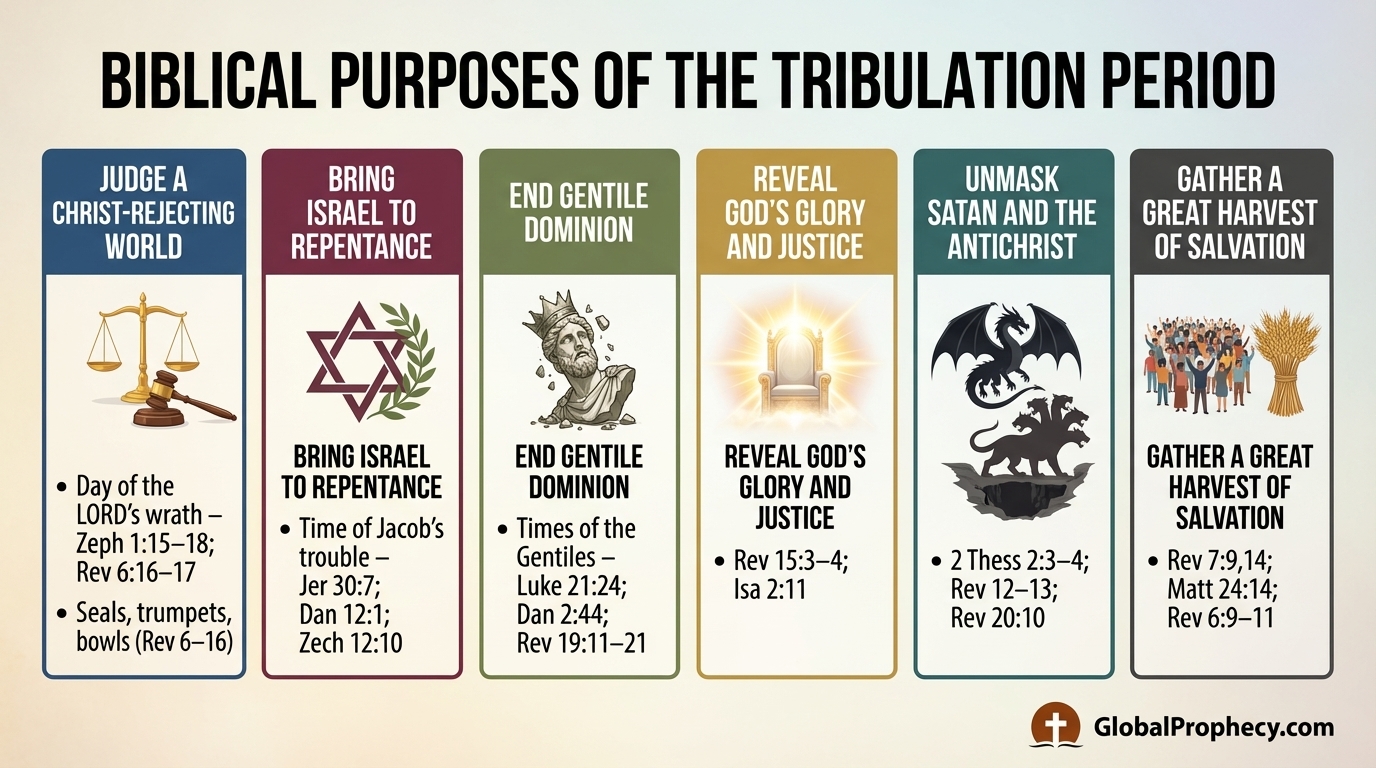
Beyond its chronology, Scripture reveals why God has ordained the tribulation period. Several interlocking divine purposes emerge.
6.1 To Judge a Christ-Rejecting World
The tribulation is fundamentally a period of divine judgment on persistent, global unbelief and wickedness. It is:
- “The day of the LORD’s wrath” (Zeph 1:18).
- “The wrath of the Lamb” (Rev 6:16).
- “The hour of trial…to try those who dwell on the earth” (Rev 3:10).
Revelation portrays this judgment through sequential seals, trumpets, and bowls (Rev 6–16), progressively devastating the earth’s environment, economy, and population. Even under such judgments, hardened humanity largely refuses to repent (Rev 9:20–21; 16:9–11), underscoring the moral necessity of God’s retribution.
6.2 To Bring Israel to Repentance and Restoration
A central purpose of the tribulation is God’s dealing with national Israel:
- It is “the time of Jacob’s trouble, but he shall be saved out of it” (Jer 30:7).
- Daniel speaks of a coming “time of trouble” for Israel, coupled with deliverance “for your people” (Dan 12:1).
- Zechariah foresees a future outpouring of grace on “the house of David and the inhabitants of Jerusalem” so that “they will look on me, on him whom they have pierced” and mourn in repentance (Zech 12:10).
Through the fires of tribulation, God will purge and refine Israel (cf. Zech 13:8–9), breaking centuries of national unbelief. By the end of this period, a believing remnant of Israel will acknowledge Jesus as Messiah, fulfilling Romans 11:26–27: “And in this way all Israel will be saved.”
6.3 To End Gentile Dominion and Prepare the Messianic Kingdom
The tribulation also concludes “the times of the Gentiles” (cf. Luke 21:24), the long era in which Jerusalem is trampled underfoot by Gentile powers. By the close of the tribulation:
- Gentile world empires will be judged and overthrown (Dan 2:44; Rev 19:11–21).
- The world’s political and religious systems will be dismantled to make way for Christ’s righteous rule from Jerusalem in the millennium (Isa 2:2–4; Zech 14:9, 16).
In this sense, the tribulation functions as a transition from the present age into the age of the millennial kingdom.
6.4 To Reveal God’s Glory and Vindicate His Justice
Throughout history, human rulers have challenged God’s authority. Pharaoh’s question, “Who is the LORD, that I should obey his voice…?” (Exod 5:2) foreshadows the end‑time arrogance of the Antichrist, who “proclaims himself to be God” (2 Thess 2:4).
God will use the tribulation to:
- Publicly vindicate His holiness and justice (cf. Rev 15:3–4).
- Demonstrate His absolute sovereignty over creation and history.
- Silence all blasphemous claims of rival deities and human pretenders.
As in the Exodus plagues, but on a global scale, the judgments of the tribulation will show that “the LORD alone will be exalted in that day” (Isa 2:11).
6.5 To Unmask Satan’s True Character
With the restraining hand of God’s providence partially removed (2 Thess 2:6–8), Satan will be allowed unprecedented influence during the tribulation:
- He empowers the beast (Antichrist) and false prophet (Rev 13:2, 11).
- He persecutes Israel and the saints with great fury, “because he knows that his time is short” (Rev 12:12–17).
This period will expose the devil’s hatred, cruelty, and deceit in full measure, vindicating God’s ultimate judgment upon him (Rev 20:10).
6.6 To Bring a Great Harvest of Salvation
Paradoxically, amid severe judgment, the tribulation will also be a time of massive evangelism and conversion:
- Revelation describes “a great multitude that no one could number, from every nation…These are the ones coming out of the great tribulation. They have washed their robes and made them white in the blood of the Lamb” (Rev 7:9, 14).
- The gospel of the kingdom will be preached “throughout the whole world as a testimony to all nations” (Matt 24:14).
Many—both Jews and Gentiles—will come to saving faith during this period, even though doing so often leads to martyrdom (Rev 6:9–11; 20:4). In this way, the tribulation serves not only as judgment but as a final, global call to repentance and faith in Christ.
7. Conclusion
In biblical eschatology, the tribulation period is a clearly defined, future seven‑year span—Daniel’s seventieth week—during which God brings history to its climactic crisis. It is:
- Uniquely severe: “Such as has not been from the beginning of the world until now, no, and never will be” (Matt 24:21).
- Precisely timed: A discrete seven years, split into two halves of 3½ years, culminating in the second coming of Christ (Dan 9:27; Rev 11:2–3; 13:5; Matt 24:29–31).
- Purposive: Designed to judge a rebellious world, refine and restore Israel, terminate Gentile domination, unveil Satan, display God’s glory, and gather a vast multitude of redeemed people.
Far from being an abstract or symbolic concept, the tribulation period is a structured, purposeful phase in God’s redemptive plan, preparing the way for the visible reign of Jesus Christ on earth.
FAQ
Q: What is the tribulation period in the Bible?
The tribulation period is a future, seven‑year span immediately before the second coming of Christ during which God will pour out unprecedented judgments on a rebellious world, bring Israel to repentance, and prepare the earth for Christ’s kingdom. It is based primarily on Daniel’s seventieth week (Dan 9:24–27) and is described in detail in Matthew 24–25 and Revelation 6–19.
Q: How long will the tribulation last?
According to Daniel 9:27 and related passages, the tribulation lasts seven years, often called Daniel’s seventieth week. This period is divided into two halves of three and a half years each, expressed in Scripture as “time, times, and half a time,” “forty‑two months,” or “1,260 days” (Dan 7:25; Rev 11:2–3; 13:5).
Q: What is the difference between the tribulation and the Great Tribulation?
The term tribulation can refer to the entire seven‑year period, while Great Tribulation usually designates the final three and a half years following the abomination of desolation in the temple. Jesus said, “Then there will be great tribulation” (Matt 24:21), marking an intensification of judgments and persecution in the latter half of the seven years.
Q: What is the main purpose of the tribulation period?
Biblically, the tribulation serves several interconnected purposes: to judge a Christ‑rejecting world, to bring Israel to national repentance and restoration, to end Gentile domination, to display God’s holiness and sovereignty, to unmask Satan’s true character, and to bring a vast multitude to salvation before Christ’s return.
Q: Is the tribulation the same as general suffering Christians experience today?
No. Scripture teaches that believers will face tribulation in a general sense in this age (John 16:33; Acts 14:22), but the tribulation period is a distinct, future, time‑bounded era of unparalleled, worldwide judgment and distress. Jesus and Daniel both stress that its severity and scope will be unlike anything before or after (Dan 12:1; Matt 24:21–22).
Frequently Asked Questions
What is the tribulation period in the Bible?
How long will the tribulation last?
What is the difference between the tribulation and the Great Tribulation?
What is the main purpose of the tribulation period?
Is the tribulation the same as general suffering Christians experience today?
L. A. C.
Theologian specializing in eschatology, committed to helping believers understand God's prophetic Word.
Related Articles
The 70 Weeks of Daniel: Understanding Bible's Prophetic Timeline
The 70 weeks of Daniel explain God's prophetic timeline for Israel, Christ's first coming, and a future 70th week leading to the end-time climax.
Babylon the Great
Babylon the Great in Revelation 17–18 reveals end-time religious and commercial rebellion against God and its sudden, final destruction in judgment.
What the Bible Says about Antichrist?
Antichrist in the Bible: discover what Scripture reveals about his identity, character, deceptive power, and end-time role in the Tribulation.
What the Bible Says about False Prophet?
False Prophet biblical identity and role in end times. Discover what Scripture reveals about this key figure in Revelation's tribulation prophecy.