
What the Bible Says about Antichrist?
1. Introduction
Among all end‑times figures in biblical eschatology, the Antichrist stands out as the central human opponent of Jesus Christ. Scripture presents him not as a vague symbol or mere system, but as a future personal world ruler, energized by Satan, who will dominate the final phase of human history before Christ’s return.
This article surveys what the Bible actually says about the Antichrist—his identity, titles, character, and actions—drawing chiefly from Daniel, the Gospels, 2 Thessalonians, 1–2 John, and Revelation.
2. The Biblical Term “Antichrist”
The specific word “antichrist” (antichristos) occurs only in the letters of John, but the figure himself appears throughout Scripture under many titles.
2.1 Two Uses of the Word
John uses antichrist in two related senses:
-
Present, general sense – any person, spirit, or teaching that denies the true Christ:
“Who is the liar but he who denies that Jesus is the Christ? This is the antichrist, he who denies the Father and the Son.”
— 1 John 2:22“Every spirit that does not confess Jesus is not from God. This is the spirit of the antichrist, which you heard was coming and now is in the world already.”
— 1 John 4:3 -
Future, specific sense – a single eschatological person:
“Children, it is the last hour, and as you have heard that antichrist is coming, so now many antichrists have come.”
— 1 John 2:18
John assumes his readers have already been taught that “the antichrist is coming”—a coming individual whose spirit is foreshadowed by many lesser antichrists in history.
2.2 Meaning of “Anti‑Christ”
The prefix anti‑ can mean:
- “against” – opposition and hostility (2 Thess 2:4)
- “instead of / in place of” – usurping Christ’s place (2 Thess 2:4; Matt 24:24)
Biblically, the Antichrist is both:
- Christ’s ultimate adversary, and
- a counterfeit messiah, a false Christ who imitates and replaces the true.
3. Biblical Names and Titles of the Antichrist
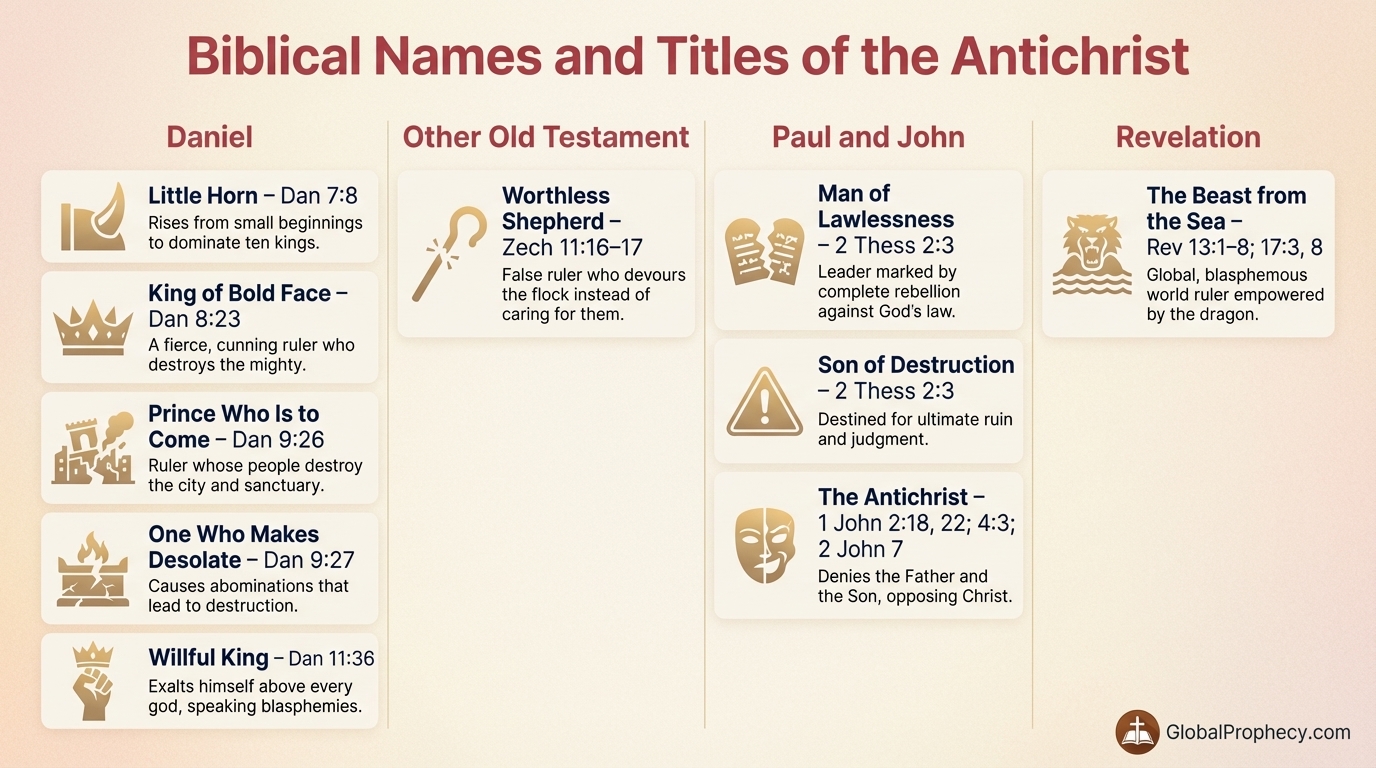
Though “Antichrist” is John’s term, Scripture gives this figure many titles, each highlighting a facet of his identity and work.
3.1 Key Titles
| Title | Reference | Emphasis |
|---|---|---|
| Little horn | Daniel 7:8 | Small start, rising to dominance among ten kings |
| King of bold face / fierce countenance | Daniel 8:23 | Harsh, intimidating ruler, master of intrigue |
| Prince who is to come | Daniel 9:26 | Future ruler from the people who destroyed Jerusalem (Rome) |
| One who makes desolate | Daniel 9:27 | Brings the “abomination of desolation” to the temple |
| Willful king | Daniel 11:36 | Self‑willed, exalting himself above every god |
| Worthless (foolish) shepherd | Zechariah 11:16–17 | False leader who exploits rather than cares for the flock |
| Man of lawlessness | 2 Thessalonians 2:3 | Characterized by rebellion and contempt for God’s law |
| Son of destruction | 2 Thessalonians 2:3 | Destined for ruin, and a destroyer of others |
| The antichrist | 1 John 2:18, 22; 4:3; 2 John 7 | Opponent and counterfeit of Christ |
| The beast (from the sea) | Revelation 13:1–8; 17:3, 8 | Ferocious, predatory world ruler over nations |
These diverse titles converge on one portrait: a coming world ruler, blasphemous, deceptive, violent, and utterly opposed to God and His people.
4. The Identity and Origin of the Antichrist
4.1 A Future Personal World Ruler
The Bible consistently portrays the Antichrist as an individual, not merely a system:
- Daniel describes a specific “king” and “little horn” who speaks great things, subdues kings, and persecutes the saints (Dan 7:8, 20–25; 11:36–45).
- Paul calls him “the man of lawlessness” and “the son of destruction,” who “takes his seat in the temple of God” and is destroyed personally by Christ’s coming (2 Thess 2:3–4, 8).
- John sees “a beast rising out of the sea” with authority over “every tribe and people and language and nation” (Rev 13:1, 7).
This person will be the final, climactic embodiment of the anti‑Christian spirit that has been active since the first century (1 John 2:18; 4:3).
4.2 Geographic and Political Origin: Revived Roman Empire
Daniel’s visions and Revelation link the Antichrist to the final phase of the Roman Empire:
- He arises as a “little horn” among ten horns on the fourth beast (Rome) in Daniel 7:7–8, 24.
- He is the “prince who is to come” from the people who destroyed Jerusalem and the temple (the Romans) in Daniel 9:26–27.
- John’s beast from the sea with ten horns echoes Daniel’s fourth beast and Daniel’s statue’s final stage (iron with clay toes) in Daniel 2; 7; Revelation 13; 17.
From this, many conclude he will emerge from a reunited / revived Roman sphere, likely centered in Europe, heading a confederation of ten kings (Rev 17:12–13).
4.3 Energized by Satan
The spiritual origin of the Antichrist is unmistakable:
“And to it the dragon gave his power and his throne and great authority.”
— Revelation 13:2
“The coming of the lawless one is by the activity of Satan with all power and false signs and wonders.”
— 2 Thessalonians 2:9
He is not the devil incarnate, but a fully human ruler under unprecedented satanic control, the apex of the “mystery of lawlessness” already at work (2 Thess 2:7).
4.4 The “Spirit of Antichrist” Already Active
While the man of sin has not yet been revealed, his spirit is already shaping culture and religion:
- Denying that Jesus is the Christ and the Son (1 John 2:22)
- Denying that Jesus came in the flesh (1 John 4:2–3; 2 John 7)
- Promoting false prophets and deceiving doctrines (1 John 4:1–3)
This spirit of antichrist prepares the world to receive the Antichrist himself when God removes His present restraint (2 Thess 2:6–7).
5. The Character and Spiritual Nature of the Antichrist
5.1 Both Opposed to Christ and a Counterfeit Christ
The Antichrist is simultaneously Christ’s opposite and His imitation.
As One Opposed to Christ
- “Man of lawlessness” (2 Thess 2:3) – literally “man of law‑breaking”: he rejects God’s moral law.
- “Son of destruction” (2 Thess 2:3) – he destroys and is destined for destruction.
- “Beast” (Rev 13:1) – wild, predatory, cruel; the antithesis of the gentle Lamb.
- He speaks blasphemies against God, His name, His dwelling, and those in heaven (Dan 7:25; Rev 13:5–6).
- He persecutes the saints and “wears them out” (Dan 7:21, 25; Rev 13:7).
As a Counterfeit Christ
He deliberately mimics key aspects of Christ’s person and work to deceive:
| Christ | Antichrist |
|---|---|
| Son of God (John 1:34) | Son of destruction (2 Thess 2:3) |
| The Truth (John 14:6) | Promotes “the lie” (2 Thess 2:11) |
| Humbled Himself (Phil 2:8) | Exalts himself above all gods (Dan 11:36–37; 2 Thess 2:4) |
| Cleansed the temple (John 2:14–16) | Desecrates the temple (Matt 24:15; 2 Thess 2:4) |
| The Lamb (Isa 53:7; Rev 5:6) | The Beast (Rev 13:1) |
| Sealed His servants (Rev 7:3–4) | Marks his followers (Rev 13:16–17) |
| Truly died and rose again (Matt 28:6) | Appears fatally wounded and restored (Rev 13:3, 14) |
| Receives worldwide worship as God the Son (Rev 5:8–14) | Demands worldwide worship as god (Rev 13:4, 8; 2 Thess 2:4) |
Satan’s goal is to present a plausible alternative Christ who will attract those who “did not receive the love of the truth” (2 Thess 2:10–11).
5.2 Moral and Spiritual Traits
Biblically, the Antichrist is:
- Lawless – “the mystery of lawlessness is already at work” (2 Thess 2:7). He disregards all divine and absolute moral standards.
- Blasphemous – he “speaks great things and blasphemies” (Dan 7:8; Rev 13:5).
- Deceptive – he “uses all wicked deception” (2 Thess 2:10); his empire is built on lies, false promises, and counterfeit miracles (Rev 13:13–14).
- Self‑deifying – he claims deity, sitting in the temple as God (2 Thess 2:4).
- Cruel and predatory – the “beast” imagery underscores his ruthlessness and bloodshed (Dan 7; Rev 13).
6. The Career and Actions of the Antichrist
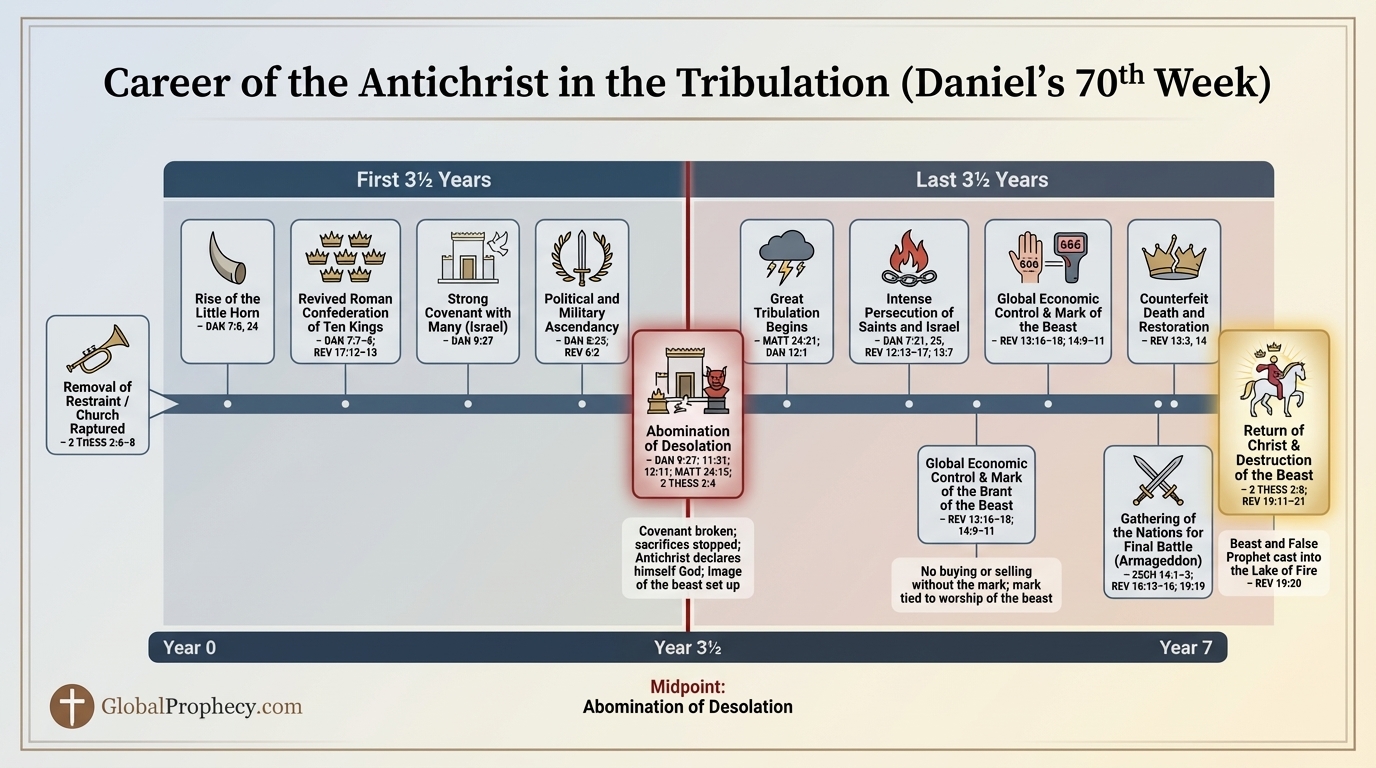
Scripture traces a recognizable career arc for the Antichrist—from his rise to power, through his tyrannical rule, to his final destruction.
6.1 Rise to Power and Covenant with Israel
After the church is removed and the present restraint is lifted (2 Thess 2:6–8), the Antichrist will:
- Emerge as a “little horn” among ten kings in the revived Roman sphere, subduing three (Dan 7:8, 24).
- Rise from obscurity to global prominence as a political genius and peacemaker (Dan 8:23; 9:26; Rev 6:2; 17:11–13).
- “Make a strong covenant with many for one week” (seven years) involving Israel (Dan 9:27), widely understood as a seven‑year peace agreement that allows Jewish temple worship to resume in Jerusalem.
This covenant marks the beginning of Daniel’s seventieth week—the final seven‑year period often called the Tribulation.
6.2 Self‑Deification and the Abomination of Desolation
At the midpoint of the seven years:
- He breaks the covenant with Israel (Dan 9:27).
- He stops sacrifices and offerings in the temple (Dan 9:27; 12:11).
- He commits the “abomination of desolation” spoken of by Daniel and cited by Jesus (Dan 9:27; 11:31; 12:11; Matt 24:15), which includes:
- Taking his seat in the temple of God, “proclaiming himself to be God” (2 Thess 2:4).
- Erecting an image of the beast in the sanctuary, which the false prophet animates and compels all to worship (Rev 13:14–15).
This triggers the period Jesus calls “great tribulation”—unparalleled distress for Israel and the world (Matt 24:21; Dan 12:1).
6.3 Persecution of Saints and Jews
Once unmasked as a tyrant, the Antichrist launches an intense persecution campaign:
- He “shall wear out the saints of the Most High” (Dan 7:25).
- He is given authority “to make war on the saints and to conquer them” (Rev 13:7).
- Satan, cast to earth, persecutes “the woman” (Israel) and “the rest of her offspring, those who keep the commandments of God and hold to the testimony of Jesus” (Rev 12:13–17).
This is especially a time of Jacob’s trouble (Jer 30:7), yet God preserves a remnant of Israel even amid severe suffering.
6.4 Global Economic Control and the Mark of the Beast
Under the Antichrist’s regime, economic life is fully controlled:
“Also it [the false prophet] causes all, both small and great, both rich and poor, both free and slave, to be marked on the right hand or the forehead, so that no one can buy or sell unless he has the mark, that is, the name of the beast or the number of its name.”
— Revelation 13:16–17
Key points:
- The mark is explicitly tied to the beast’s name or number (666) (Rev 13:18).
- It functions as a visible sign of allegiance and worship, not a casual economic device.
- Refusing the mark entails exclusion from commerce and often death (Rev 13:15, 17).
- Receiving the mark brings irrevocable judgment (Rev 14:9–11).
This system illustrates the Antichrist’s totalitarian control over economy, politics, and religion.
6.5 Counterfeit Death and Restoration
Revelation indicates that the beast experiences what appears to be a fatal wound followed by a recovery:
“One of its heads seemed to have a mortal wound, but its mortal wound was healed. And the whole earth marveled as they followed the beast.”
— Revelation 13:3
“…the beast who was wounded by the sword and yet lived.”
— Revelation 13:14
This counterfeit resurrection powerfully enhances his credibility and fuels worldwide worship: “Who is like the beast, and who can fight against it?” (Rev 13:4). Whether his death and revival are literal or heavily staged, the effect is to mimic Christ’s resurrection and deceive the unbelieving world.
6.6 Final Rebellion and Destruction
At the close of the Tribulation, the Antichrist:
- Gathers the kings of the earth and their armies for a final assault against Jerusalem and against the returning Christ (Zech 14:1–3; Rev 16:13–16; 19:19).
- Is confronted by Jesus Christ, who returns in glory with the armies of heaven (Rev 19:11–16).
His end is sudden and absolute:
“…the lawless one will be revealed, whom the Lord Jesus will kill with the breath of his mouth and bring to nothing by the appearance of his coming.”
— 2 Thessalonians 2:8
“And the beast was captured, and with it the false prophet… These two were thrown alive into the lake of fire that burns with sulfur.”
— Revelation 19:20
Thus the Antichrist’s brief, blasphemous kingdom is swept away, and Christ’s rightful reign is established.
7. Conclusion
Biblical eschatology presents the Antichrist as a real, future, satanically empowered world ruler who will:
- Arise from the sphere of a revived Roman Empire,
- Forge a deceptive covenant with Israel,
- Exalt himself as God in a rebuilt temple,
- Persecute Jews and believers with unprecedented fury,
- Control global worship and commerce through the mark of the beast, and
- Be personally destroyed by the appearing of Jesus Christ.
At the same time, Scripture warns that “many antichrists” and the spirit of antichrist are already at work—denying Christ’s person and work and preparing the world to receive the final Antichrist.
The Bible’s teaching about the Antichrist is not given to foster speculation or fear, but to clarify the trajectory of history, expose satanic deception, and exalt the supremacy of Christ, whose victory is certain and whose kingdom will never end.
FAQ
Q: Is the Antichrist a person or just a symbol of evil systems?
The Bible portrays the Antichrist as a definite individual person—“the man of lawlessness,” “the son of destruction,” “the king who does as he pleases,” and “the beast” who is captured and thrown into the lake of fire (2 Thess 2:3–4; Dan 11:36; Rev 19:20). While evil systems reflect the spirit of antichrist, Scripture anticipates a final, personal world ruler.
Q: Can we identify who the Antichrist is today?
According to 2 Thessalonians 2:6–8, the man of lawlessness cannot be revealed until the present divine restraint is removed, which is associated with the church age. Many figures have been wrongly labeled as Antichrist in history, but the Bible indicates his identity will only be clear once God’s restraint is lifted and he steps into his prophetic role.
Q: What does the Bible say the Antichrist will do?
Scripture teaches that the Antichrist will rise to global power, make and then break a seven‑year covenant with Israel (Dan 9:27), exalt himself as God in the temple (2 Thess 2:4), persecute Jews and believers (Dan 7:21; Rev 13:7), control world economy through the mark of the beast (Rev 13:16–17), and ultimately be destroyed by Christ’s second coming (2 Thess 2:8; Rev 19:19–20).
Q: What is the “spirit of antichrist,” and how is it different from the Antichrist himself?
The spirit of antichrist is the anti‑Christian influence already active in the world, expressed in false teaching that denies Jesus’ true person and work (1 John 2:22; 4:3). The Antichrist himself is the future climax of that spirit—a single man who will personify and lead the final rebellion against Christ.
Q: Is the mark of the beast the same as modern technologies like chips or digital IDs?
Revelation 13 ties the mark of the beast specifically to the name or number of the beast (666) and to conscious worship of him. Modern technologies may provide the infrastructure for such control, but biblically the mark is not merely technology; it is a deliberate sign of allegiance to the Antichrist, enforced during his rule in the Tribulation.
Frequently Asked Questions
Is the Antichrist a person or just a symbol of evil systems?
Can we identify who the Antichrist is today?
What does the Bible say the Antichrist will do?
What is the “spirit of antichrist,” and how is it different from the Antichrist himself?
Is the mark of the beast the same as modern technologies like chips or digital IDs?
L. A. C.
Theologian specializing in eschatology, committed to helping believers understand God's prophetic Word.
Related Articles
What the Bible Says about False Prophet?
False Prophet biblical identity and role in end times. Discover what Scripture reveals about this key figure in Revelation's tribulation prophecy.
Biblical Purposes of the Tribulation
Biblical purposes of the tribulation explained: why God sends this final period of judgment, purification, and restoration in His end-time plan.
Biblical Terms for the Tribulation
Discover the biblical terms for the Tribulation including Time of Jacob's Trouble, Day of the Lord, and Great Tribulation with their scriptural meanings.
Babylon the Great
Babylon the Great in Revelation 17–18 reveals end-time religious and commercial rebellion against God and its sudden, final destruction in judgment.