
What Will We Do in Heaven?
1. Introduction
“What will we do in heaven?” is one of the most common—and most important—questions about biblical eschatology. Scripture does not present heaven as an endless, passive existence on clouds, but as a vibrant, God‑centered life of worship, service, learning, fellowship, and joy on the new earth and in the New Jerusalem (Rev 21–22).
This article surveys the main activities and purposes of believers in heaven as the Bible describes them, especially in the eternal state. Our focus is not on how to get to heaven, or on the structure of prophetic timelines, but strictly on what redeemed people will actually do forever.
2. Seeing and Worshiping God
2.1 The central activity: beholding God
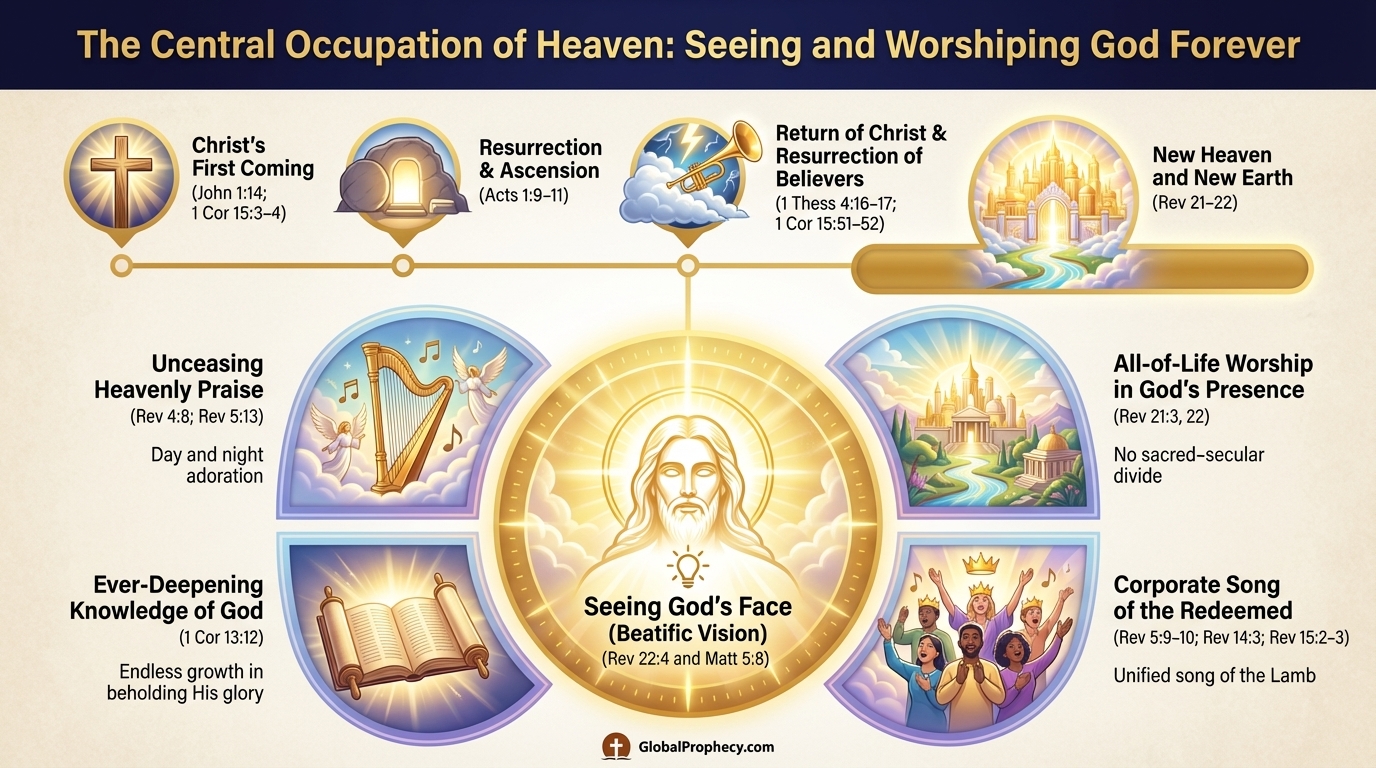
The primary “occupation” of believers in heaven is to see and enjoy God Himself. Scripture presents this as the heart of eternal life:
“They will see his face, and his name will be on their foreheads.”
— Revelation 22:4
“Blessed are the pure in heart, for they shall see God.”
— Matthew 5:8
This direct vision of God—often called the Beatific Vision—is not a brief event, but an ongoing, ever-deepening experience. Because God is infinite, finite creatures can spend eternity knowing Him more fully without ever exhausting His glory (1 Cor 13:12).
2.2 Worship as all‑of‑life
Heaven is often described in worship scenes:
“Day and night they never cease to say,
‘Holy, holy, holy, is the Lord God Almighty,
who was and is and is to come!’.”
— Revelation 4:8
“To him who sits on the throne and to the Lamb
be blessing and honor and glory and might forever and ever!”
— Revelation 5:13
But this worship is not limited to singing in a “service.” In the eternal state, all activity becomes worship, because God’s presence fills everything (Rev 21:3, 22). The distinction between “sacred” and “secular” disappears; everything believers do will be a conscious, joyful expression of love and adoration for the triune God.
2.3 Corporate praise and song
Scripture specifically mentions singing as an ongoing activity of heaven:
“They were holding harps of God. And they sing the song of Moses, the servant of God, and the song of the Lamb.”
— Revelation 15:2–3
“They were singing a new song before the throne.”
— Revelation 14:3
Heavenly worship includes:
- united praise of the Lamb for His redeeming work (Rev 5:9–10)
- responsive praise to God’s justice and truth (Rev 19:1–2)
- joyful celebration of fulfilled salvation purposes (Rev 7:9–12)
What we will do in heaven begins, and is sustained forever, by seeing and worshiping God Himself.
3. Serving and Reigning with Christ
3.1 Eternal service
Believers will not be idle in eternity. Revelation summarizes our activity this way:
“The throne of God and of the Lamb will be in it, and his servants will serve him.”
— Revelation 22:3
The verb “serve” here (Greek latreuō) normally refers to priestly or temple service—God‑centered ministry, not menial drudgery. In the eternal kingdom, all service will be:
- holy (fully devoted to God)
- joyful (no frustration, no fatigue)
- complete (no mixture of selfish motives)
Our service is our worship, and our work is our delight.
3.2 Reigning forever and ever
Eternal life also includes real rulership under Christ:
“They will reign forever and ever.”
— Revelation 22:5
Earlier, John is told of believers:
“You have made them a kingdom and priests to our God,
and they shall reign on the earth.”
— Revelation 5:10
In the millennium believers reign with Christ in His mediatorial kingdom (Rev 20:4–6). In the eternal state, this royal function continues on a perfected basis as part of the one eternal throne:
“The throne of God and of the Lamb will be in it.”
— Revelation 22:3
While Scripture does not give exhaustive detail, it implies:
- real governmental structures in the renewed creation (Rev 21:24–26)
- real responsibilities, fitting each believer’s Christ‑given capacities
- real diversity of roles, likely connected to faithfulness in this life (cf. Luke 19:17–19; 1 Cor 3:14)
Eternal destiny is not static; it is active participation in God’s righteous rule over a restored universe.
3.3 Priestly ministry
Believers in heaven are also described as priests:
“They are before the throne of God, and serve him day and night in his temple.”
— Revelation 7:15
“To him who loves us and has freed us from our sins by his blood and made us a kingdom, priests to his God and Father.”
— Revelation 1:5–6
Priestly activity in heaven includes:
- direct access to God’s presence
- mediation of His praise and glory throughout creation
- representing the creation before God in thankful worship
Thus, what we will do in heaven combines royal administration and priestly devotion in perfect harmony.
4. Fellowship and Community in Heaven
4.1 Perfected fellowship with all the redeemed
Heaven is not only God‑centered; it is deeply relational. Believers will enjoy perfect communion with all God’s people:
“You have come to Mount Zion and to the city of the living God, the heavenly Jerusalem… and to innumerable angels in festal gathering, and to the assembly of the firstborn who are enrolled in heaven… and to the spirits of the righteous made perfect.”
— Hebrews 12:22–23
Key elements of heavenly fellowship:
- recognition of other believers (cf. the disciples recognizing Moses and Elijah in Matt 17:1–4)
- no sin to disrupt relationships (Rev 21:27; 22:3)
- perfect love that never cools or breaks (1 Cor 13:8–13)
Every redeemed person from every age and nation will be part of “a great multitude that no one could number” (Rev 7:9), united in love for Christ and for one another.
4.2 Community life in the New Jerusalem
The New Jerusalem is described as a real, populated city (Rev 21:2–3, 10–27; 22:1–5). A city implies:
- interaction
- cooperation
- shared celebrations
- culture and community life
“The nations will walk by its light, and the kings of the earth will bring their glory into it.”
— Revelation 21:24
The bringing of “glory” into the city suggests that the best of human culture, purified from sin, will be welcomed into the eternal order—art, beauty, music, craftsmanship—in ways that honor the Lamb.
4.3 Restored and perfected relationships
In heaven there will be:
- no jealousy or envy (Rev 22:3–5)
- no broken relationships or misunderstandings
- no need to apologize or defend ourselves
Every relationship will be marked by:
- truth (no deceit)
- purity (no hidden sin)
- self‑giving love modeled after Christ
Fellowship itself—being with God’s people in God’s presence—is a central part of what believers will do in heaven.
5. Learning and Growth in the Knowledge of God
5.1 Eternal learning
Believers will be glorified, but not omniscient. We will always be finite creatures standing before an infinite God. That means eternity will involve ongoing growth in knowledge:
“Now I know in part; then I shall know fully, even as I have been fully known.”
— 1 Corinthians 13:12
“Knowing fully” here does not mean knowing everything God knows, but knowing Him truly and without distortion. Because His riches are “unsearchable” (Eph 3:8), learning in heaven never ends.
5.2 Christ‑centered instruction
The focal point of all heavenly learning is Jesus Christ:
“We know that when he appears we shall be like him, because we shall see him as he is.”
— 1 John 3:2
Seeing Christ “as he is” is transforming knowledge—not mere data, but relational acquaintance with the Lord. Throughout eternity, believers will:
- grow in understanding of God’s character and works
- explore the depths of His wisdom displayed in creation and redemption
- grasp more fully the riches of His grace (Eph 2:7)
5.3 Learning from God’s works and Word
Scripture hints that God’s people will continue to meditate on His Word and learn from His past acts:
- the tree of life and river of life point back to Genesis and forward to God’s completed plan (Rev 22:1–2)
- the very architecture of the New Jerusalem recalls Israel and the apostles (Rev 21:12–14), embedding God’s redemptive history in the eternal environment
Believers will study, remember, and rejoice over how God’s plan from creation to consummation glorified His Son. In heaven, theology will be adoring insight, not abstract debate.
6. Rest, Joy, and Everyday Life in Heaven
6.1 Real rest without passivity
Heaven is described as a place of rest:
“Blessed indeed… that they may rest from their labors, for their deeds follow them!”
— Revelation 14:13
“There remains a Sabbath rest for the people of God.”
— Hebrews 4:9
This rest is not inactivity but the end of toil, frustration, and resistance. Work itself is good (Adam worked before the Fall), but in the eternal state all work is:
- free from fatigue
- free from futility
- free from opposition
Believers will be constantly active in worship, service, exploration, and fellowship, yet never “burned out,” bored, or stressed.
6.2 Unbroken joy and satisfaction
Heaven is also the realm of complete and lasting joy:
“In your presence there is fullness of joy;
at your right hand are pleasures forevermore.”
— Psalm 16:11
“He will wipe away every tear from their eyes, and death shall be no more, neither shall there be mourning, nor crying, nor pain anymore.”
— Revelation 21:4
Every legitimate human longing— for beauty, meaning, belonging, security, and delight—will be fully and rightly satisfied in God and in His gifts. There will be:
- no guilt or shame
- no disappointment or loss
- no fear of the future
6.3 Embodied, cultural, and “ordinary” life
Scripture strongly indicates that believers will have glorified bodies like Christ’s (Phil 3:21; 1 Cor 15:42–54). His resurrection body could:
- be recognized (Luke 24:39–40)
- eat (Luke 24:41–43; John 21:12–13)
- interact physically, yet with new capacities (Luke 24:31; John 20:19)
On the new earth, this implies a truly embodied, physical life that may include:
- movement and travel (the city has a main street, Rev 22:2)
- perhaps eating and feasting as expressions of fellowship and joy (cf. Rev 19:9)
- exploration and enjoyment of a perfectly renewed creation
All of these “ordinary” activities will be expressions of worship, service, and communion, fully integrated into our God‑centered purpose.
7. Our Present Life in Light of Our Future Work
Understanding what we will do in heaven reshapes Christian living now. Scripture repeatedly ties our present faithfulness to our future responsibilities and joys.
| Future Activity in Heaven | Present Calling | Key Texts |
|---|---|---|
| Worshiping and seeing God | Pursue holiness and single‑hearted devotion | Matt 5:8; Heb 12:14 |
| Serving and reigning | Be faithful stewards now | Luke 19:11–27; 1 Cor 3:10–15 |
| Learning God forever | Grow in the knowledge of God today | 2 Pet 3:18; Col 1:9–10 |
| Loving in perfect fellowship | Practice love and unity in the church | John 13:34–35; Eph 4:1–3 |
| Enjoying rest and joy | Endure suffering with hope | Rom 8:18; 2 Cor 4:17–18 |
Because believers will spend eternity serving, learning, worshiping, and reigning, this life is not pointless; it is preparation. Our present obedience does not earn heaven, but it does shape our capacities and responsibilities in the coming kingdom (cf. 2 John 8; Rev 22:12).
8. Conclusion
According to Scripture, believers in heaven will not drift in vague spiritual bliss or sit in endless inactivity. On the new heaven and new earth, in the New Jerusalem, the redeemed will:
- See God’s face and worship Him with undivided hearts
- Serve Him in joyful, priestly work
- Reign with Christ in righteous administration forever
- Fellowship with all the redeemed in perfect love and unity
- Learn and grow eternally in the knowledge of God
- Rest and rejoice in a world where every trace of the curse is gone
This is the biblical answer to “What will we do in heaven?”: we will spend eternity as glorified sons and daughters of God, delighting to serve, worship, and reign with the Lamb in a renewed creation where “they will reign forever and ever” (Revelation 22:5).
Let this promised future direct our priorities now, as we “seek the things that are above, where Christ is” (Colossians 3:1–2).
FAQ
Q: Will we be bored in heaven if we worship God forever?
No. Biblical worship is not monotonous repetition but an ever‑fresh response to an endlessly glorious God. Because God is infinite, there will always be more of His beauty and wisdom to discover. Our worship includes singing, service, learning, ruling, and enjoying His gifts—activities that will engage all our renewed faculties without fatigue or boredom.
Q: What specific jobs or roles will we have in heaven?
Scripture does not list detailed job descriptions, but it clearly states that believers will serve God (Rev 22:3) and reign with Christ (Rev 22:5). This implies meaningful responsibilities suited to each believer’s capacities and faithfulness in this life. Roles will be varied, real, and joyful, all contributing to the ordered life of the new creation under Christ’s kingship.
Q: Will we recognize and interact with loved ones in heaven?
Yes. Scripture portrays conscious recognition and memory in the afterlife (for example Luke 16:19–31), and the transfiguration shows the disciples recognizing Moses and Elijah (Matt 17:1–4). In the New Jerusalem, believers from every age and nation share life together (Rev 7:9; Heb 12:22–23). Our fellowship will be deeper and purer than any relationship we have known on earth.
Q: Will we still learn and grow in knowledge in heaven?
Yes. Believers will be glorified but not omniscient. Passages like 1 Corinthians 13:12 and Ephesians 2:7 indicate ongoing growth in understanding of God’s character, works, and grace. Eternity provides the limitless “time” needed for finite creatures to explore the infinite riches of God without ever exhausting them.
Q: What does the Bible say about daily life or activities in heaven?
The Bible shows believers in heaven worshiping, serving, reigning, fellowshipping, and enjoying the blessings of the new creation (Rev 21–22). With glorified bodies like Christ’s, we will live an embodied life that likely includes movement, feasting, cultural activity, and exploration—all as acts of worship. Everyday life in heaven will be free from sin, sorrow, and curse, but rich in purposeful, joyful activity centered on God.
Frequently Asked Questions
Will we be bored in heaven if we worship God forever?
What specific jobs or roles will we have in heaven?
Will we recognize and interact with loved ones in heaven?
Will we still learn and grow in knowledge in heaven?
What does the Bible say about daily life or activities in heaven?
L. A. C.
Theologian specializing in eschatology, committed to helping believers understand God's prophetic Word.
Related Articles
Will We Eat and Drink in Heaven?
Will we eat and drink in heaven? Explore what Scripture reveals about dining in eternity, the marriage supper of the Lamb, and our resurrected bodies.
What Is Heaven?
Heaven in the Bible: explore what heaven is, the three heavens Scripture describes, and what eternal life with God means for believers.
Heaven vs Hell: The Great Contrast
Heaven vs hell: explore the great contrast between eternal life and eternal punishment, highlighting destiny, judgment, joy, and separation from God.
Will We Know Each Other in Heaven?
Will we know each other in heaven? Explore biblical evidence for personal recognition, enduring relationships, and perfected fellowship in eternity.