
When Will the Rapture Happen?
1. Introduction: Why the Timing of the Rapture Matters
Among evangelical Christians who believe in a future rapture of the church, the central debate is not if the rapture will occur, but when it will occur in relation to the coming tribulation. The pre‑tribulation rapture view (pretribulationism) teaches that Christ will catch away His church before the seven‑year tribulation (Daniel’s seventieth week) begins.
This article defends that the rapture is pre‑tribulational. It will show from Scripture that:
- The rapture and the second coming are distinct events.
- The rapture is imminent and signless.
- Church‑age believers are promised exemption from God’s eschatological wrath.
- The church is absent from tribulation texts.
- The tribulation’s primary focus is Israel and the nations, not the church.
Understanding these points is essential for a coherent, biblically grounded eschatology.
2. Distinguishing the Rapture from the Second Coming
A foundational question in biblical eschatology is whether the rapture (1 Thessalonians 4; 1 Corinthians 15) and the second coming (Matthew 24; Revelation 19) describe the same event or two phases of Christ’s return.
2.1 Key Rapture Texts
The classic passages on the rapture are:
“For the Lord himself will descend from heaven with a cry of command, with the voice of an archangel, and with the sound of the trumpet of God. And the dead in Christ will rise first. Then we who are alive, who are left, will be caught up together with them in the clouds to meet the Lord in the air, and so we will always be with the Lord.”
— 1 Thessalonians 4:16–17
“Behold! I tell you a mystery. We shall not all sleep, but we shall all be changed, in a moment, in the twinkling of an eye, at the last trumpet. For the trumpet will sound, and the dead will be raised imperishable, and we shall be changed.”
— 1 Corinthians 15:51–52
These passages emphasize translation and resurrection of church‑age believers, meeting Christ in the air, and being with Him forever.
2.2 Key Second Coming Texts
By contrast, second‑coming passages describe Christ’s visible return to the earth in judgment and glory:
“Then will appear in heaven the sign of the Son of Man, and then all the tribes of the earth will mourn, and they will see the Son of Man coming on the clouds of heaven with power and great glory.”
— Matthew 24:30
“Then I saw heaven opened, and behold, a white horse! The one sitting on it is called Faithful and True… From his mouth comes a sharp sword with which to strike down the nations…”
— Revelation 19:11, 15
Here the focus is on Christ’s descent to earth, judgment of the nations, and establishment of the millennial kingdom.
2.3 Contrasting Features
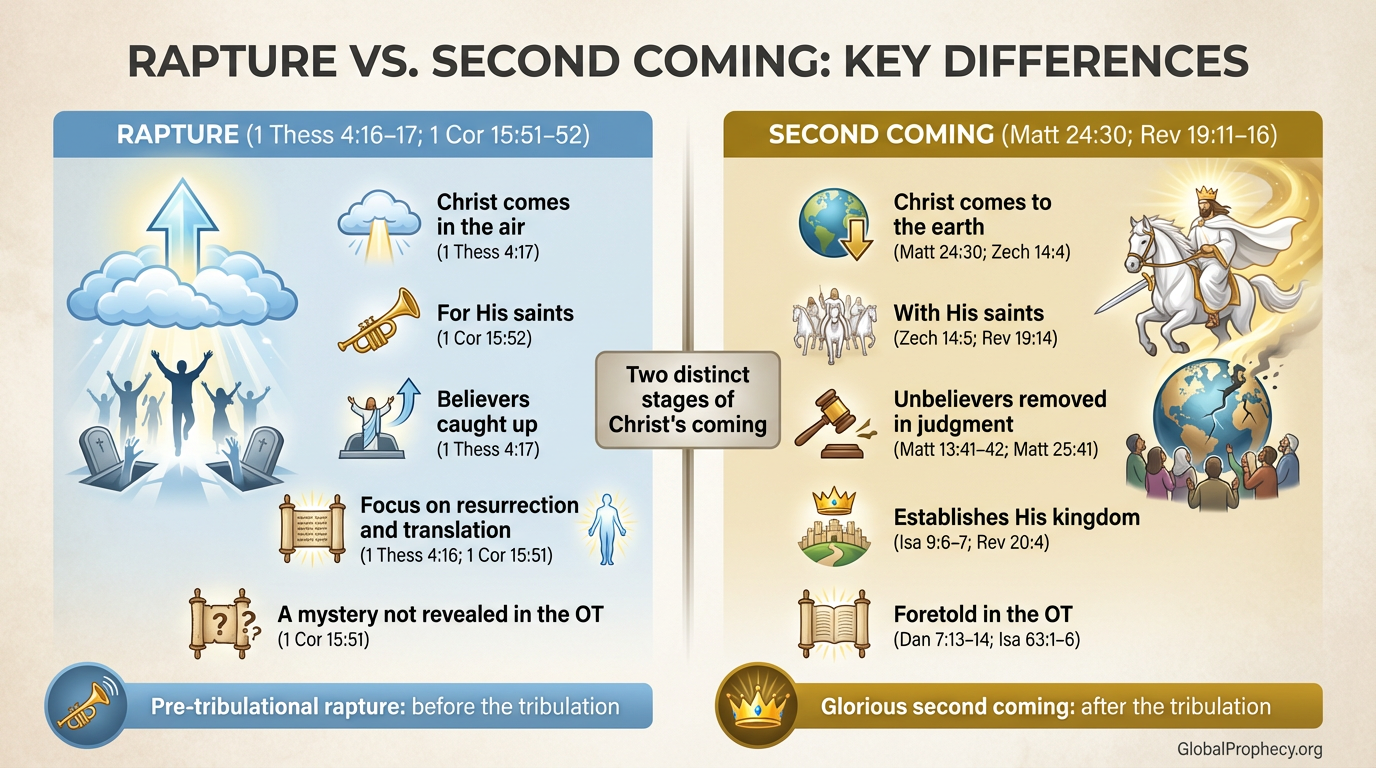
Placed side by side, the differences are striking and strongly support two distinct stages of Christ’s coming:
| Rapture (e.g., 1 Thess 4; 1 Cor 15) | Second Coming (e.g., Matt 24; Rev 19) |
|---|---|
| Christ comes in the air (1 Thess 4:17) | Christ comes to the earth (Zech 14:4) |
| Christ comes for His saints (1 Thess 4:16–17) | Christ comes with His saints (1 Thess 3:13; Rev 19:14) |
| Believers are caught up (1 Thess 4:17) | Unbelievers are removed in judgment (Matt 24:37–41) |
| No judgment on earth is described | Central focus is judgment on earth (Matt 25:31–46; Rev 19:15) |
| No mention of establishing the kingdom | Explicitly followed by the kingdom (Matt 25:34; Rev 20:1–6) |
| A “mystery” not revealed in the OT (1 Cor 15:51) | Prophesied repeatedly in the OT (Zech 12–14; Joel 3) |
The rapture is a translation/resurrection event for the church, while the second coming is a public descent in judgment and reign. These differences fit naturally if the rapture precedes the tribulation and the second coming concludes it.
3. The Imminency of the Rapture
A central plank of the pre‑tribulation view is that the rapture is imminent—it can occur at any moment, without any prophesied event that must precede it.
3.1 New Testament Expectation
The New Testament repeatedly exhorts believers to watch, wait, and look for Christ Himself, not for the Antichrist or specific tribulation signs:
- “…as you wait for the revealing of our Lord Jesus Christ” (1 Corinthians 1:7)
- “…from it we await a Savior, the Lord Jesus Christ” (Philippians 3:20)
- “…to wait for his Son from heaven… Jesus who delivers us from the wrath to come” (1 Thessalonians 1:10)
- “…waiting for our blessed hope, the appearing of the glory of our great God and Savior Jesus Christ” (Titus 2:13)
- “The Lord is at hand.” (Philippians 4:5)
- “Be patient… for the coming of the Lord is at hand… the Judge is standing at the door.”
— James 5:7–9
These texts make best sense if the rapture is signless and could occur at any time. If the church must first pass through identifiable portions of a seven‑year tribulation, believers would be commanded to watch for those signs, not for Christ Himself.
3.2 Imminency and Alternative Views
- Mid‑tribulation, pre‑wrath, and post‑tribulation schemes all require years of specific prophetic events (covenant with Israel, abomination of desolation, seal/trumpet judgments, etc.) before the rapture can occur.
- In such views, the rapture cannot be truly “at any moment”; it is at least 3½, 5½, or 7 years away once the tribulation begins.
Only pretribulationism maintains genuine imminency, in harmony with the New Testament’s pervasive expectation language and the church’s early watchword, Maranatha (“Our Lord, come,” 1 Corinthians 16:22).
4. “Not Destined for Wrath”: The Church and Divine Judgment
Scripture explicitly states that church‑age believers are not appointed to experience God’s eschatological wrath.
4.1 1 Thessalonians: Delivered from the Coming Wrath
Paul commends the Thessalonians for their conversion and expectation:
“…to wait for his Son from heaven, whom he raised from the dead, Jesus who delivers us from the wrath to come.”
— 1 Thessalonians 1:10
Later he explains:
“For God has not destined us for wrath, but to obtain salvation through our Lord Jesus Christ…”
— 1 Thessalonians 5:9
Within the immediate context (1 Thessalonians 5:1–3), this “wrath” is connected to the day of the Lord—a period of sudden destruction coming upon “them” (unbelievers), not upon “you” (believers).
The contrast between:
- they / them who say “peace and security” and are overtaken by destruction (5:3), and
- you / we who are “not in darkness” and thus will not be overtaken (5:4–5),
indicates that believers will not be present when the day of the Lord’s wrath falls.
4.2 Revelation 3:10 — Kept from the Hour
In the letter to Philadelphia Christ promises:
“Because you have kept my word about patient endurance, I will keep you from the hour of trial that is coming on the whole world, to try those who dwell on the earth.”
— Revelation 3:10
Key observations:
- The promise is not merely to be kept through the trial, but to be kept from the hour—the time period itself.
- The “hour of trial” is world‑wide (“on the whole world”), not a local persecution.
- In the context of Revelation, the only global “hour of trial” still future is the tribulation described in chapters 6–18.
The phrase “keep from” (Greek: tēreō ek) is highly significant. In John 17:15 the same construction appears:
“I do not ask that you take them out of the world, but that you keep them from the evil one.”
In neither place does tēreō ek mean to guard while remaining inside; rather it denotes protection by separation from the domain or period in view.
Revelation 3:10 therefore aligns perfectly with a pre‑tribulation rapture: Christ will remove His faithful from the very time‑frame of the coming world‑wide testing.
5. The Church’s Absence in Revelation 6–18 and the Restrainer Removed
5.1 Silence about the Church in Tribulation Chapters
The word ekklēsia (“church”) appears 19 times in Revelation 1–3 and once in 22:16. It is completely absent from chapters 4–18, which give the most detailed account of the tribulation.
- Revelation 1–3: church on earth, addressed directly.
- Revelation 4–5: the church appears symbolically as the twenty‑four elders in heaven—crowned, enthroned, and worshiping the Lamb.
- Revelation 6–18: intense judgments on “those who dwell on the earth”; no mention of the church.
- Revelation 19: the Lamb’s bride is in heaven, clothed in fine linen (her righteous deeds), ready to return with Christ in glory (19:7–14).
This pattern is best explained if the church is raptured to heaven before the seals are opened in Revelation 6. Saints are indeed present on earth during the tribulation, but they are tribulation saints, not the already‑completed, glorified body of Christ.
5.2 2 Thessalonians 2: The Restrainer
Paul writes of “the man of lawlessness” (Antichrist), whose revelation is currently restrained:
“And you know what is restraining him now so that he may be revealed in his time… Only he who now restrains it will do so until he is out of the way. And then the lawless one will be revealed…”
— 2 Thessalonians 2:6–8
Key facts about the restrainer:
- He/it restrains lawlessness and the revelation of Antichrist.
- He/it must be removed before Antichrist can be revealed.
- He/it is powerful enough to hold back Satan’s program.
The only adequate candidate is God the Holy Spirit, particularly in His present‑age ministry through the church:
- The Spirit is omnipotent and sovereign over Satan.
- He restrains sin in the world (cf. Genesis 6:3).
- Since Pentecost He indwells and works uniquely in the church (1 Corinthians 3:16; 6:19).
When the church is raptured, the Spirit’s present restraining ministry in and through the church will be removed, allowing the “mystery of lawlessness” to flood forth and the Antichrist to be revealed. The Spirit will, of course, still operate in salvation (as seen in multitudes saved during the tribulation), but the restraint that characterizes this age will be gone.
Again, this fits naturally with a pre‑tribulation rapture: first the church is removed, then the man of lawlessness is revealed, then the day of the Lord judgments fall.
6. The Purpose and Focus of the Tribulation
The tribulation (Daniel’s seventieth week) has clearly defined purposes in Scripture, none of which require the church’s presence.
6.1 A Time of Jacob’s Trouble
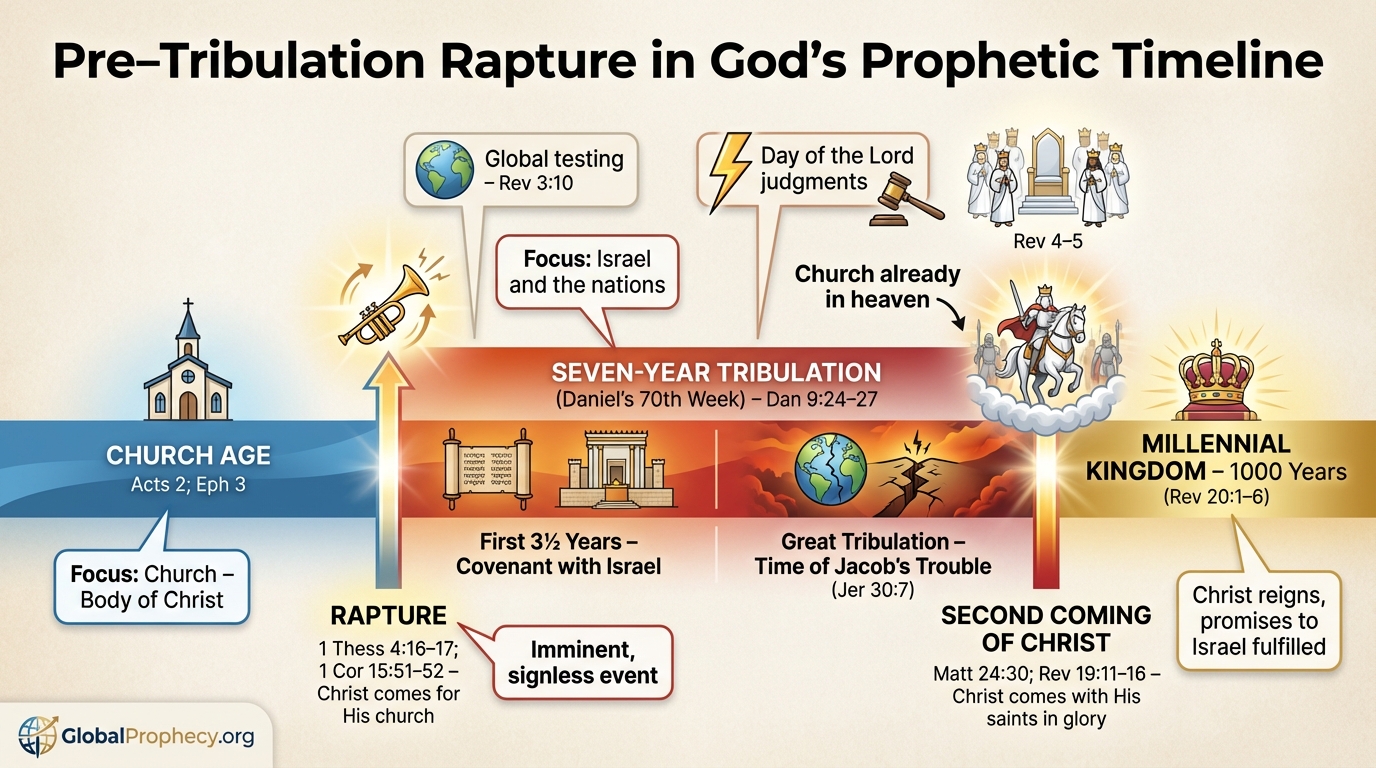
Jeremiah writes:
“Alas! That day is so great there is none like it; it is a time of distress for Jacob; yet he shall be saved out of it.”
— Jeremiah 30:7
Here the focus is explicitly Israel (“Jacob”), not the church. Daniel 9:24–27 likewise states that the seventy “weeks” are decreed:
“…about your people and your holy city [Jerusalem]…”
— Daniel 9:24
The tribulation is the period in which:
- God brings Israel to repentance and faith in Messiah (cf. Zechariah 12:10; Matthew 23:39; Romans 11:26–27).
- God judges the Gentile nations for their rebellion and treatment of Israel (cf. Joel 3:1–2; Zephaniah 3:8).
The church, a distinct body formed at Pentecost (Acts 2; 1 Corinthians 12:13), is not in view in these Old Testament prophecies. It is consistent that the church should be removed before God resumes His covenant dealings with national Israel in Daniel’s seventieth week.
6.2 A Time of Global Testing
Revelation 3:10 calls the coming crisis “the hour of trial that is coming on the whole world, to try those who dwell on the earth.” “Earth‑dwellers” in Revelation consistently refers to unbelieving humanity fixed in rebellion (e.g., Rev 6:10; 8:13; 11:10; 13:8, 12, 14).
The tribulation is thus an exposure and judgment of unregenerate mankind. The church’s purpose is not to be tested for salvation, but to be presented holy and without blemish to Christ (Ephesians 5:25–27) and to reign with Him.
7. Practical Implications of a Pre‑Tribulation Rapture
While the timing of the rapture is a doctrinal question, it also carries significant practical and pastoral implications.
7.1 Comfort and Encouragement
Paul concludes his rapture teaching with:
“Therefore encourage one another with these words.”
— 1 Thessalonians 4:18
The blessed hope (Titus 2:13) comforts believers because it assures:
- Our full salvation and transformation before the outpouring of divine wrath.
- The completion of Christ’s work in His church prior to God’s resumption of His program with Israel.
- The nearness of seeing Christ, not merely the nearness of catastrophe.
7.2 Motivation for Holiness and Service
Imminency produces a heightened sense of accountability:
“And now, little children, abide in him, so that when he appears we may have confidence and not shrink from him in shame at his coming.”
— 1 John 2:28
Knowing that Christ could come at any moment spurs believers to:
- Pursue holiness (1 John 3:2–3).
- Abound in the work of the Lord (1 Corinthians 15:58).
- Live in watchful readiness rather than complacency.
8. Conclusion: Why the Rapture Must Be Pre‑Tribulational
A careful, literal, contextual reading of Scripture strongly supports the conclusion that the rapture of the church occurs before the tribulation:
- The rapture and second coming have distinct features that are best harmonized by a two‑stage coming separated by Daniel’s seventieth week.
- The imminency of Christ’s return fits naturally only with a pre‑tribulation rapture.
- The church is explicitly said to be not destined for wrath and is promised protection from the very hour of the coming world‑wide trial.
- The church’s absence from Revelation’s tribulation chapters and the removal of the restrainer prior to Antichrist’s revelation align with the church’s prior translation.
- The purpose and focus of the tribulation concern Israel and the nations, not the already‑completed body of Christ.
For these reasons, the pre‑tribulation rapture view offers the most coherent and biblically faithful answer to the question, “When will the rapture happen?” It upholds the blessed hope of Christ’s any‑moment return for His bride and preserves the integrity of God’s distinct plans for the church and for Israel in the unfolding of end‑times prophecy.
Frequently Asked Questions
When will the rapture happen?
Will believers go through the tribulation?
What does 'imminent' mean regarding the rapture?
Why is the church absent from Revelation's tribulation chapters?
L. A. C.
Theologian specializing in eschatology, committed to helping believers understand God's prophetic Word.
Related Articles
Pre-Tribulationalism Examined
Pretribulationalism examined: a detailed defense of the pre-trib rapture, Israel–Church distinction, exemption from wrath, and the doctrine of imminence.
Mid-Tribulationalism Examined
Mid-tribulationalism examined in depth: understand its last trumpet argument, compare rapture texts, and see biblical reasons the church misses all tribulation.
Post-Tribulationalism Examined
Post-tribulationalism examined with a fair summary of the posttrib rapture view plus biblical critiques on imminence, the tribulation, and the millennium.
The Pre-Wrath Rapture View Examined
Pre-wrath rapture view examined: timing in the second half of the tribulation, its Satan vs. God's wrath distinction, and why wrath begins at the seals.