
Who is Gog in Ezekiel 38-39?
1. Introduction
The prophecy of Gog and Magog in Ezekiel 38–39 is one of the most debated texts in biblical eschatology. At its core stand three intertwined questions:
- Who is Gog?
- Which nations join him in the invasion of Israel?
- When will this prophecy be fulfilled in end‑times chronology?
This article focuses exclusively on those three issues, drawing on Ezekiel 38–39 and related prophetic passages, with careful attention to historical, linguistic, and geographical data.
2. Who Is Gog in Ezekiel 38–39?
2.1 Gog as a Future Political–Military Leader
Ezekiel introduces Gog in these words:
"Son of man, set your face toward Gog, of the land of Magog, the chief prince of Meshech and Tubal, and prophesy against him."
— Ezekiel 38:2 (cf. 38:3; 39:1)
Key observations:
- Gog is an individual, not a nation: he is directly addressed (38:14; 39:1) and called a prince (leader).
- The term “Gog” most likely functions as a title, like “pharaoh,” “czar,” or “president,” rather than a personal name.
- The underlying Hebrew root carries the idea of height / exaltation, suggesting a “supreme one” or “great ruler.”
From an eschatological standpoint, Gog is best understood as a future, powerful political–military leader, the head of a northern coalition that invades Israel in the last days.
2.2 Gog Is Not the Antichrist
It is crucial not to confuse Gog with the Antichrist:
- The Antichrist arises from a revived Roman Empire (the final form of the fourth kingdom in Daniel 2; 7).
- Gog leads a northern coalition rooted in Russia and allied Muslim-majority nations (Ezekiel 38:1–6).
- Gog’s invasion comes against Israel while she is under a covenant of security (or in a state of perceived safety), and his power is short‑lived, being annihilated directly by God (Ezekiel 39).
- The Antichrist’s rule stretches over a major portion of the Tribulation, culminating in Armageddon (Revelation 13; 16; 19).
Therefore, Gog is a distinct end‑times leader, heading a specific invasion, not a synonym for the Antichrist.
3. Who Are the Nations with Gog? Ancient Names and Modern Equivalents
Ezekiel lists a specific set of ancient peoples and regions that form Gog’s coalition (38:2–6). These can be correlated with modern geography by studying ancient Near Eastern and classical sources.
3.1 The Core Northern Bloc: Rosh, Magog, Meshech, Tubal
Rosh
The phrase “prince of Rosh, Meshech, and Tubal” (Ezekiel 38:2–3; 39:1, NASB) contains the debated term rosh. Grammatically, it can mean either:
- “chief” (an adjective), or
- a proper name, “Rosh.”
Several lines of evidence favor taking Rosh as a proper noun—a geographical name:
- Early Hebrew scholars (e.g., Gesenius, C. F. Keil) argued that Rosh in this context is best read as a place name, not merely “chief.”
- The Septuagint (Greek OT, c. 3rd–2nd century BC) renders it as a proper name (Ros), indicating that early translators understood it geographically.
- Ancient Near Eastern sources (Assyrian, Egyptian, and others) mention a northern people or land with similar names (Rashu / Reshu / Ros / Rus), located in the region of southern Russia / north of the Black Sea.
- Ezekiel repeatedly locates Gog and his allies in “the uttermost parts of the north” (Ezekiel 38:6, 15; 39:2). If one draws a line due north from Israel, it intersects the territory of modern Russia.
Conclusion: Rosh is best identified with the Russian heartland—the leading power of the far north in Ezekiel’s vision.
Magog
Magog is associated in ancient literature, especially Josephus, with the Scythians, a warlike people inhabiting the steppe region north of the Black and Caspian Seas.
Modern equivalents likely include:
- The Central Asian territories of the southern former Soviet Union:
- Kazakhstan
- Kyrgyzstan
- Uzbekistan
- Turkmenistan
- Tajikistan
- Possibly northern Afghanistan
These regions today are overwhelmingly Muslim and geopolitically linked to the Russian sphere of influence.
Meshech and Tubal
Meshech and Tubal appear together multiple times (Ezekiel 27:13; 32:26; 38:2–3; 39:1). Ancient Assyrian and Greek sources refer to them as the Mushki/Musku and Tabal/Tibareni, peoples inhabiting regions south of the Black and Caspian Seas.
Modern identification:
- Primarily modern Turkey, possibly with some overlap into adjacent areas of eastern Anatolia and nearby regions.
3.2 The Listed Allies: Persia, Cush, Put, Gomer, Beth‑Togarmah
Ezekiel then names specific allies, extending Gog’s reach east, south, and west.
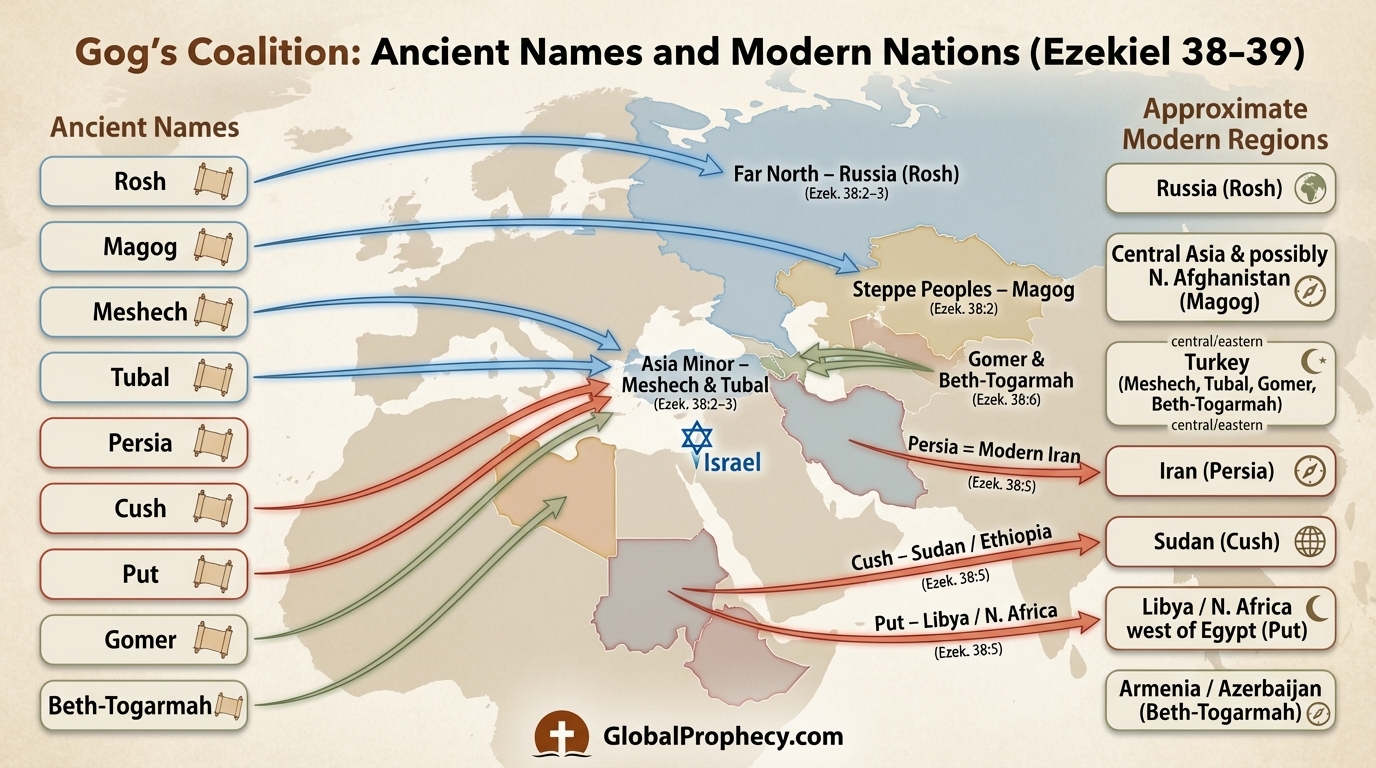
| Ancient Name | Key Biblical Texts | Approximate Modern Equivalent |
|---|---|---|
| Persia | Ezek. 38:5 | Iran |
| Cush (Ethiopia) | Ezek. 38:5 | Sudan (south of Egypt along the Nile) |
| Put (Libya) | Ezek. 38:5; 27:10; 30:5 | Libya, possibly including parts of Algeria and Tunisia |
| Gomer | Ezek. 38:6 | Likely central Turkey (Cimmerians / early Galatians) |
| Beth‑Togarmah | Ezek. 38:6 | Eastern Turkey / Armenia / possibly Azerbaijan, “from the far north” |
Persia (Modern Iran)
- In the OT, Persia is well-known; the territory corresponds directly to modern Iran.
- The official name changed from Persia to Iran in 1935, and later to the Islamic Republic of Iran in 1979.
- Ezekiel 38:5 explicitly places Persia in Gog’s coalition.
Cush (Ethiopia)
- The term Cush in Ezekiel’s context generally refers to the region south of Egypt.
- In modern terms, this fits Sudan, a nation with a long history of Islamist ideology and hostility toward Israel.
Put (Libya)
- Put is associated with North Africa, west of Egypt.
- The Septuagint translates Put as Libues (“Libyans”).
- This corresponds to modern Libya, potentially extending to parts of Algeria and Tunisia in a broader sense of ancient Libya.
Gomer
- Identified by Josephus and many historians with the Cimmerians, who migrated into Asia Minor (modern Turkey) around the 8th–7th centuries BC.
- Josephus also links Gomer with the people later known as Galatians, living in central Turkey in New Testament times.
Beth‑Togarmah
- “Beth‑” means “house,” so Beth‑togarmah is the “house of Togarmah.”
- Ancient references place Togarmah in eastern Anatolia / Armenia and regions near the Caucasus, north of Israel.
- Many scholars therefore identify Beth‑Togarmah with eastern Turkey, Armenia, and possibly part of Azerbaijan—again consistent with “the remote parts of the north” (Ezekiel 38:6).
3.3 Unlisted But Possible Participants
Notably absent from the explicit list are Israel’s nearer neighbors such as Egypt, Jordan, Syria, Lebanon, Saudi Arabia, and Iraq. Explanations include:
- They may be under different prophetic roles (e.g., Babylon in Iraq as end‑times religious/political center, Revelation 17–18).
- Some may be part of the Western / Antichrist bloc via peace agreements.
- Others may be included in the phrase “and many peoples with you” (Ezekiel 38:6, 9, 15), indicating that the enumerated nations represent the outer ring, while many more join the invasion.
What is clear is that Gog’s coalition is dominated by a Russian-led, largely Muslim confederacy encircling Israel from the far north, east, south, and west.
4. When Will the Gog Invasion Occur?
Ezekiel gives several chronological and situational markers:
“After many days you will be mustered. In the latter years you will go against the land that is restored from war, the land whose people were gathered from many peoples … They are living securely, all of them.”
— Ezekiel 38:8
“It shall come about in the latter days that I will bring you against my land…”
— Ezekiel 38:16
Key factors:
- It occurs in the “latter years” / “last days” of Israel’s prophetic history.
- It presupposes a worldwide regathering of Jews “from many peoples” to the land of Israel.
- At the time of invasion, Israel is dwelling securely and appears unwalled and at rest (38:8, 11, 14).
- The aftermath includes seven months of burying the dead and seven years of burning weapons (Ezekiel 39:9–12).
4.1 Not a Past Event
The invasion of Gog and Magog cannot be identified with any past historical incursion because:
- No invasion in history has involved all the specific nations listed in Ezekiel 38–39 attacking Israel together.
- Israel, until modern times, had never been regathered from “many nations” into a restored homeland as described in Ezekiel 36–37; 38:8, 12.
- Ezekiel explicitly situates the battle in the latter years / last days, pointing beyond the Old Testament era and the first century.
4.2 Relationship to Armageddon and Revelation 20
The Gog invasion must be distinguished from:
-
Armageddon (Revelation 16:12–16; 19:11–21)
- Involves all nations under the Antichrist, not a Russia‑led subset.
- Ends with Christ’s visible return and the destruction of the Beast and False Prophet.
- Occurs when Israel is under intense persecution, not at rest.
-
Gog and Magog in Revelation 20:7–9
- Takes place after the Millennium, when Satan is released and deceives the nations.
- Targets the “camp of the saints” and the beloved city (Jerusalem), and is ended by fire from heaven with no extended burial or cleanup period.
The reuse of the names “Gog and Magog” in Revelation 20 functions typologically—much as “Waterloo” can describe any decisive defeat. Ezekiel’s Gog invasion becomes the paradigm of final rebellion against God, but the two events are separated by over 1,000 years and differ in scope, timing, and outcome.
4.3 Likely Timing in Relation to the Tribulation
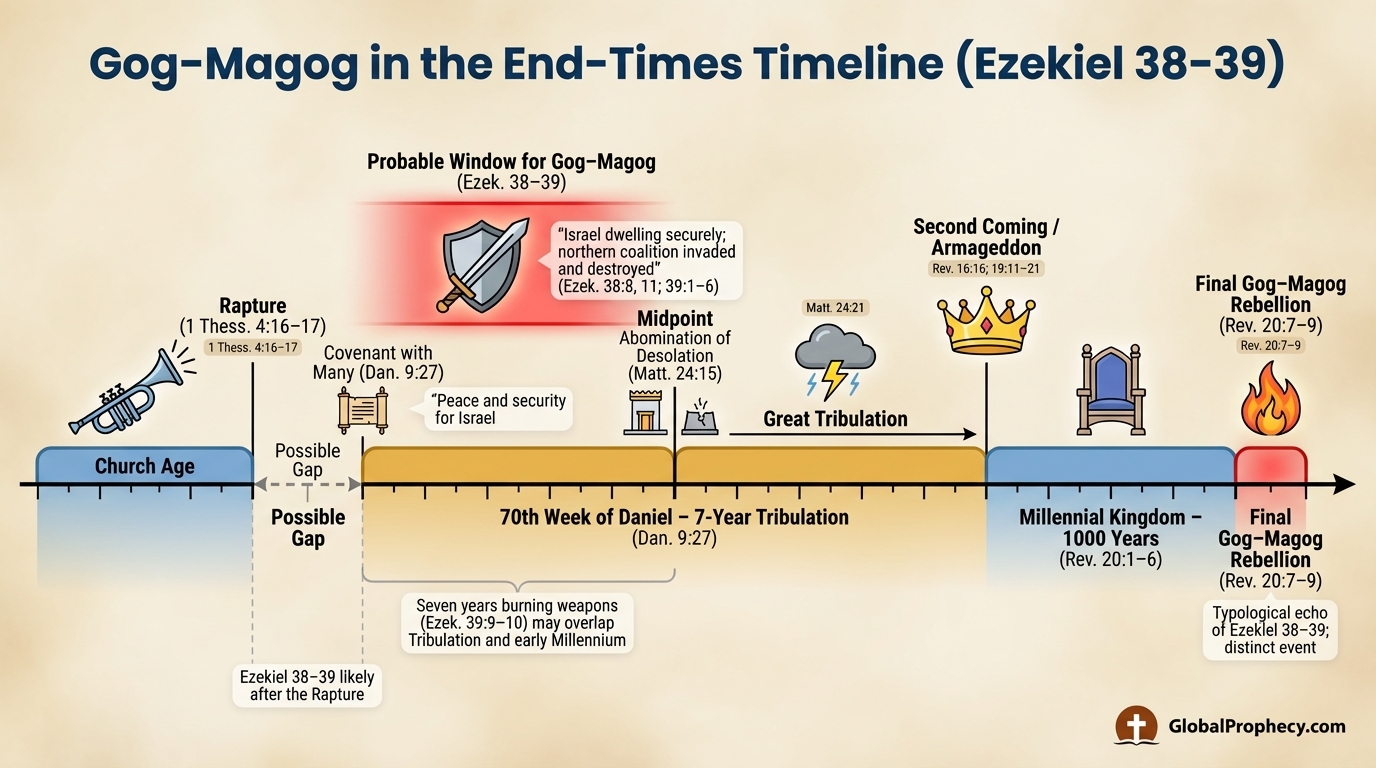
Within a premillennial dispensational framework, the best placement of Ezekiel 38–39 is:
- After the Rapture,
- During the early part of the 70th week of Daniel (the Tribulation), most plausibly in the first half, shortly after Israel enters a covenant of security with the coming Western ruler (Antichrist, Daniel 9:27), or
- In a short gap between the Rapture and the formal start of the Tribulation, with effects overlapping into the first half.
Key reasons:
-
Israel dwelling securely (Ezekiel 38:8, 11, 14):
- Today, Israel remains on high alert; it does not match the full picture of “unwalled villages” and relaxed confidence.
- A seven‑year peace covenant with a Western leader (Daniel 9:27) would create just such a climate of perceived safety.
-
The seven years of burning weapons (Ezekiel 39:9–10):
- If the invasion occurs in the first half of the Tribulation, the burning could continue through the last half and slightly into the Millennium.
- Alternatively, if the invasion occurs between the Rapture and the start of the Tribulation, there is enough time for the full seven years to elapse before Israel must flee at mid‑Tribulation (Matthew 24:15–21).
-
Political fallout that enables the Antichrist’s rise:
- The sudden divine destruction of Russia and key Muslim powers removes the primary eastern counterweight to a revived Roman (Western) empire.
- This creates a power vacuum easily exploited by the Antichrist, who can then consolidate global authority and “spin” the events to his advantage.
-
Prophetic sequence in Ezekiel:
- Ezekiel 36–37: Physical regathering of Israel.
- Ezekiel 38–39: Gog invasion and deliverance.
- Ezekiel 40–48: Millennial temple and spiritual restoration.
- The Gog war thus fits between Israel’s national restoration (1948+) and her final spiritual restoration in the Millennium, which harmonizes with an early‑Tribulation placement.
In summary, from a premillennial, dispensational perspective, Ezekiel’s Gog–Magog invasion is a yet-future event, most likely occurring after the Rapture and in connection with the first half of the Tribulation, at a time when Israel is living under a deceptive but real sense of peace and security.
5. Conclusion
In Ezekiel 38–39, Gog is portrayed as a future, exalted political–military leader from the uttermost parts of the north, best identified with a Russian ruler heading a massive coalition. His allies are carefully named using ancient geographical terms that correlate with modern Russia, Turkey, Iran, Sudan, Libya, Central Asia, Armenia/Azerbaijan, and other predominantly Muslim nations.
The invasion takes place when regathered Israel is dwelling securely in her land in the latter years, and God Himself destroys Gog’s armies by supernatural judgments. This not only vindicates God’s holiness before the nations but also dramatically reshapes the geopolitical landscape of the end times, clearing the way for the Western Antichrist to dominate the world stage.
Thus, the prophecy of Gog and the nations in Ezekiel 38–39 stands as a precise, future‑oriented revelation: it identifies who will come against Israel, which nations will join the attack, and when this climactic event will unfold in God’s eschatological program.
FAQ
Q: Who is Gog in Ezekiel 38–39?
Gog is a future political–military leader, a “prince” who rules “of the land of Magog” and over Rosh, Meshech, and Tubal (Ezekiel 38:2–3). From the geographical and historical data, he is best understood as a Russian leader heading a northern coalition against Israel in the last days, distinct from the Antichrist.
Q: Which modern nations are represented by Gog’s allies in Ezekiel 38–39?
Ezekiel’s ancient names correspond to modern regions as follows: Rosh (Russia), Magog (Central Asia and possibly northern Afghanistan), Meshech and Tubal (Turkey), Persia (Iran), Cush (Sudan), Put (Libya and possibly parts of Algeria/Tunisia), Gomer (central Turkey), and Beth‑Togarmah (eastern Turkey/Armenia/Azerbaijan). Together, they form a predominantly Russian‑led and Muslim‑majority coalition.
Q: When will the Gog and Magog invasion of Ezekiel 38–39 be fulfilled?
The invasion will occur in the “latter years” after Israel has been regathered from many nations and is dwelling securely (Ezekiel 38:8, 11, 16). From a premillennial, dispensational perspective, it will most likely take place after the Rapture and in connection with the first half of the Tribulation, either shortly before or soon after the Antichrist confirms a seven‑year covenant with Israel (Daniel 9:27).
Q: Is Gog the same as the Antichrist?
No. Gog leads a Russian‑dominated northern coalition and is destroyed directly by God in Ezekiel 38–39. The Antichrist arises from a revived Roman Empire, rules globally for much of the Tribulation, and is destroyed by Christ at His Second Coming (Revelation 19). They are distinct figures with different origins, roles, and endpoints.
Q: Is the Gog and Magog of Ezekiel the same as in Revelation 20?
They are related but not identical events. Ezekiel’s Gog–Magog war occurs before the Millennium, against a regathered but not yet fully converted Israel, and is followed by a long cleanup. Revelation 20’s Gog and Magog rebellion happens after the Millennium, involves all nations against Christ and His saints, and is ended instantly by fire from heaven. The same names are used in Revelation as a symbolic echo of the earlier, paradigmatic rebellion described by Ezekiel.
Frequently Asked Questions
Who is Gog in Ezekiel 38–39?
Which modern nations are represented by Gog’s allies in Ezekiel 38–39?
When will the Gog and Magog invasion of Ezekiel 38–39 be fulfilled?
Is Gog the same as the Antichrist?
Is the Gog and Magog of Ezekiel the same as in Revelation 20?
L. A. C.
Theologian specializing in eschatology, committed to helping believers understand God's prophetic Word.
Related Articles
Gog and Magog
Gog and Magog prophecy explained: explore Ezekiel 38–39, the northern invasion of Israel, key nations, timing, and end-times significance.
The Gog and Magog Invasion: When Will It Happen?
Gog and Magog timing explained: will Ezekiel 38–39 occur before, during, or after the Tribulation, and how does it align with other end-time events?
The 70 Weeks of Daniel: Understanding Bible's Prophetic Timeline
The 70 weeks of Daniel explain God's prophetic timeline for Israel, Christ's first coming, and a future 70th week leading to the end-time climax.
Babylon the Great
Babylon the Great in Revelation 17–18 reveals end-time religious and commercial rebellion against God and its sudden, final destruction in judgment.