
Who Will Be Judged at the Great White Throne?
1. Introduction
The Great White Throne judgment in Revelation 20:11–15 is the final and most solemn courtroom scene in Scripture. While this passage raises many questions about judgment, hell, and eternity, one foundational question must be answered clearly:
Who will be judged at the Great White Throne?
This article will focus exclusively on that question, drawing from key biblical texts to identify exactly who will stand before this throne and who will not.
"Then I saw a great white throne and him who was seated on it.… And I saw the dead, great and small, standing before the throne, and books were opened.… And if anyone’s name was not found written in the book of life, he was thrown into the lake of fire." — Revelation 20:11–12, 15 (ESV)
Understanding the identity of those judged here is essential for sound biblical eschatology and for avoiding common confusions about “judgment day.”
2. The Biblical Scene of the Great White Throne
The primary passage is Revelation 20:11–15. Several details in the text directly answer the question about who appears at this judgment.
2.1 “The Dead, Great and Small”
John writes:
"And I saw the dead, great and small, standing before the throne…" — Revelation 20:12
Three key observations:
- They are called “the dead” – This term is used in contrast to “the dead in Christ” (1 Thessalonians 4:16) and to those in the “first resurrection” (Revelation 20:4–6). It indicates spiritually dead, unsaved people.
- They are “great and small” – Every social rank and earthly status is represented: rulers and unknowns, the powerful and the obscure. No unsaved person is too important to escape, and no one is too insignificant to be overlooked.
- They are standing before God – This is a universal summoning of all who died in unbelief, regardless of time period, culture, religion, or moral reputation.
The repeated emphasis on “the dead” and the absence of any qualifying phrase like “in Christ” shows these are unbelievers only.
3. The Second Resurrection: The Wicked of All Ages
To identify who stands at the Great White Throne, Scripture links this judgment with what is often called “the second resurrection.”
3.1 Two Types of Resurrection
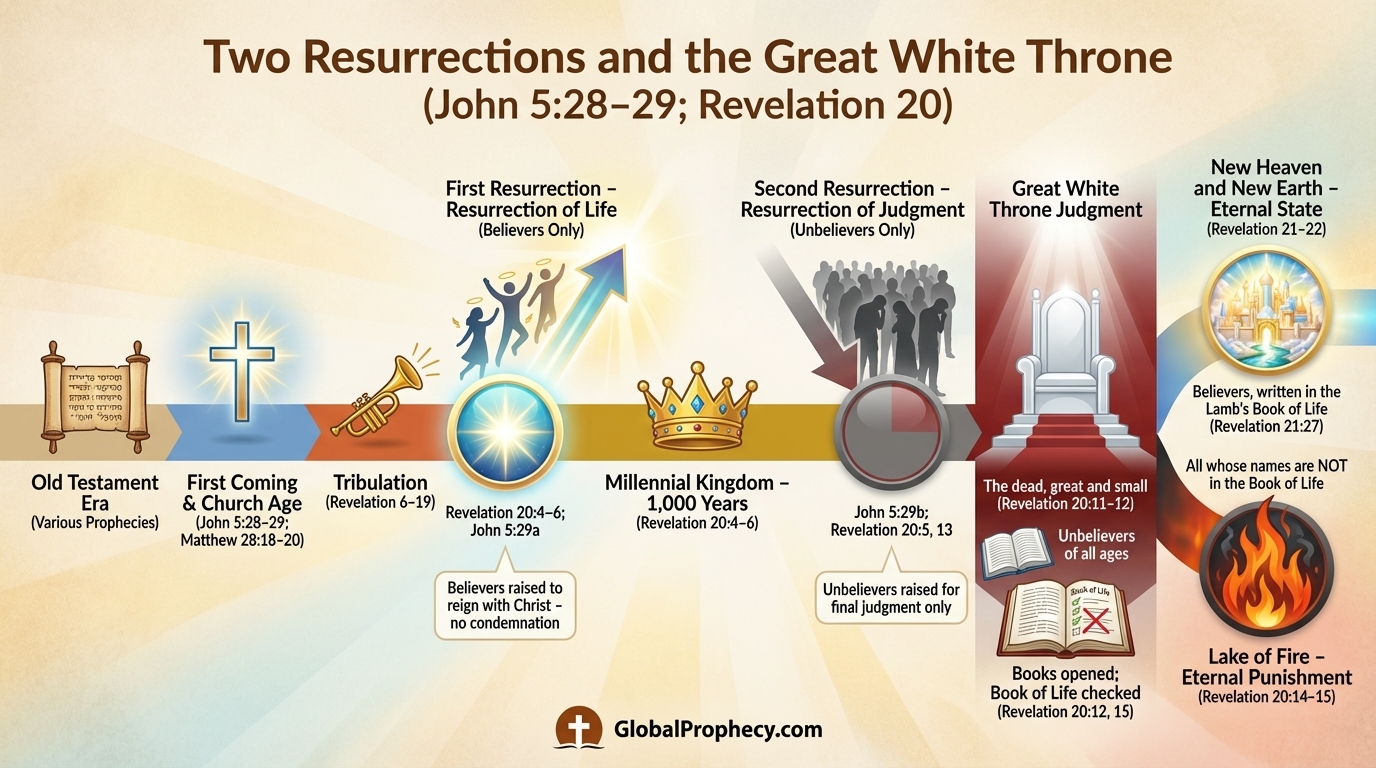
Jesus taught:
"…an hour is coming when all who are in the tombs will hear his voice and come out, those who have done good to the resurrection of life, and those who have done evil to the resurrection of judgment." — John 5:28–29
Revelation 20 clarifies that these two resurrections are distinct in kind:
- The first resurrection – the resurrection of the righteous (believers), called “blessed and holy” (Revelation 20:5–6).
- The second resurrection – the resurrection of the wicked, which occurs after the 1,000-year reign of Christ (Revelation 20:5, 11–15).
3.2 The Second Resurrection and the Great White Throne
Revelation 20:13 explains where the defendants come from:
"And the sea gave up the dead who were in it, Death and Hades gave up the dead who were in them, and they were judged, each one of them…"
Key points:
- “Death and Hades” give up “the dead” – This is the release of the unsaved dead from every holding place.
- This occurs after the millennium (Revelation 20:7–11), clearly distinguishing it from earlier resurrections of believers.
- All who arise here appear for judgment, not for reward.
Taken together, Scripture is explicit: the Great White Throne is the judgment of the second resurrection—the resurrection of the wicked dead.
3.3 Scope: Unbelievers of All Time
From the combined data:
- Revelation 20:12–13 – “the dead… great and small… the sea… Death and Hades gave up the dead…”
- John 5:29 – “those who have done evil to the resurrection of judgment.”
- Hebrews 9:27 – “it is appointed for man to die once, and after that comes judgment.”
We conclude:
All unbelievers from all of human history—from the first generation after Adam to the last rebel after the millennium—will stand before the Great White Throne.
This includes:
- Those who rejected God under the Old Testament.
- Those who rejected Christ in the Church Age.
- Those who rejected the gospel during the Tribulation.
- Those who rebelled against Christ’s rule in the Millennial Kingdom.
Every unsaved person of every era, from every nation and religion, is summoned here.
4. Who Exactly Are the Defendants?
Scripture and sound eschatology allow us to describe those judged at the Great White Throne with precision.
4.1 Their Spiritual Condition
They are:
- Unregenerate – never born again (John 3:3).
- Without saving faith in Christ – their names are not in the Book of Life (Revelation 20:15).
- Still in their sins – they lived and died without receiving the forgiveness provided through the cross (John 8:24).
"And if anyone's name was not found written in the book of life, he was thrown into the lake of fire." — Revelation 20:15
This verse is decisive: no one standing there has his or her name in the Book of Life.
4.2 Their Religious Backgrounds
The text does not limit the Great White Throne to any single group. The unsaved of all religions and philosophies are included:
- Pagans, atheists, agnostics.
- Nominal Christians who never truly believed.
- People of every non-Christian religion.
- Moral, decent, religious people who trusted in works, rituals, or their own goodness rather than in Christ alone.
What unites them is not their culture or creed, but their lack of saving relationship with Jesus Christ.
4.3 Their Earthly Status
The phrase “great and small” (Revelation 20:12) deliberately spans the entire spectrum of humanity:
| Earthly Category | Included at the Great White Throne? |
|---|---|
| Kings and rulers | Yes, if unsaved |
| Famous leaders and thinkers | Yes, if unsaved |
| Ordinary citizens | Yes, if unsaved |
| Poor and marginalized | Yes, if unsaved |
| Influential religious figures (without true faith in Christ) | Yes, if unsaved |
Earthly status, power, education, or reputation do not exempt anyone from this judgment if they die without Christ.
5. Who Will Not Be Judged at the Great White Throne?
Equally important for biblical clarity is identifying who will not stand at this judgment.
5.1 Believers Are Excluded
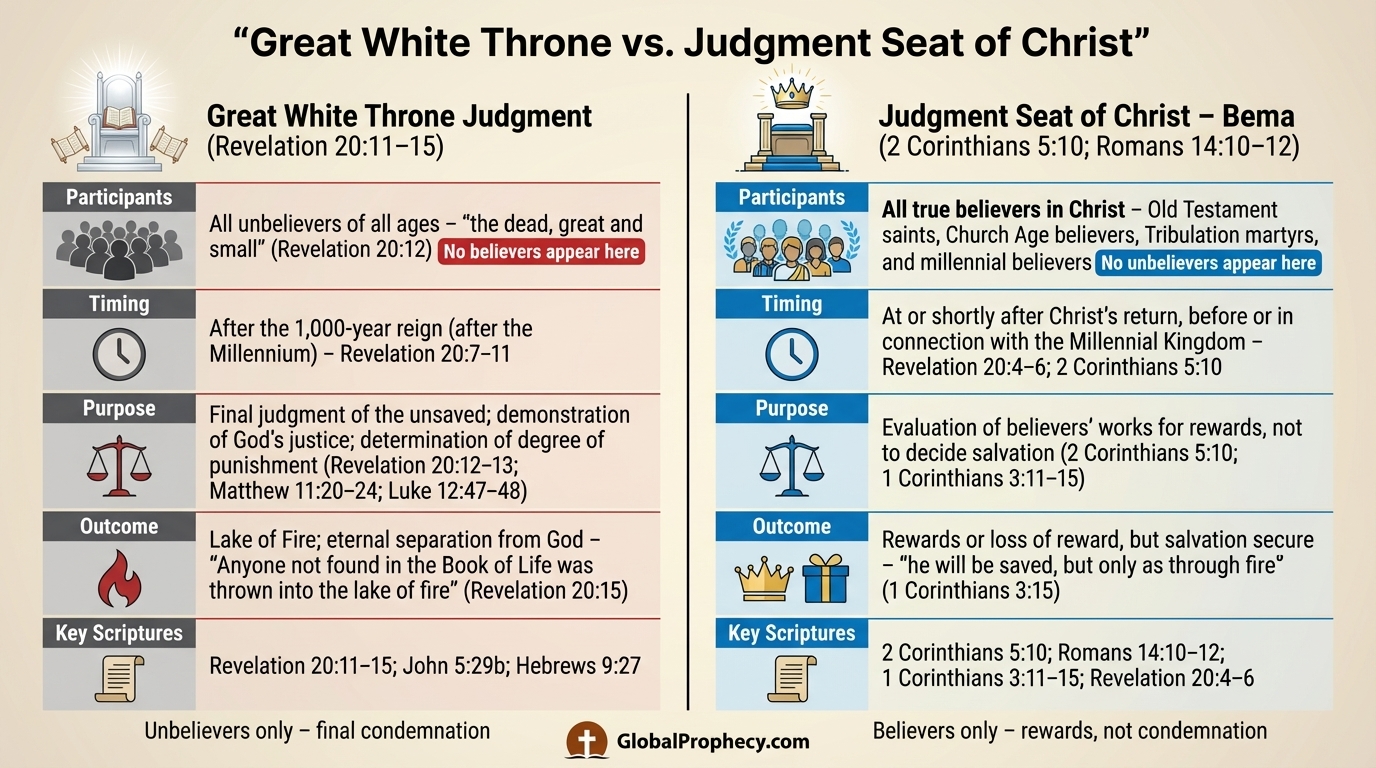
Those who have trusted in Christ for salvation—Old Testament saints, Church Age believers, Tribulation martyrs, and millennial believers—do not appear at the Great White Throne.
Reasons from Scripture:
-
Their resurrection is different
Believers participate in the first resurrection (Revelation 20:4–6), which is explicitly distinguished from the resurrection that precedes the Great White Throne. -
Their judgment is different in nature and timing
- Believers are evaluated at the judgment seat of Christ (also called the Bema), not for salvation but for rewards (2 Corinthians 5:10; Romans 14:10–12; 1 Corinthians 3:11–15).
- This judgment occurs before or in connection with Christ’s kingdom, not after the millennium as in Revelation 20:11–15.
-
Their names are written in the Book of Life
- Believers are repeatedly described as those whose names are in the Book of Life (Philippians 4:3; Revelation 3:5; 21:27).
- At the Great White Throne, no one present is found in that book (Revelation 20:15).
Therefore, the Great White Throne judgment does not mix believers and unbelievers. It is not a general sorting of “all humanity” into heaven or hell. It is a particular, final judgment of the unsaved dead only.
5.2 No Second Chance for the Lost
Those standing at the Great White Throne are not there to see if they might still be saved. Their presence there proves they are already lost. The opening of the books (their works) and the Book of Life serves to:
- Demonstrate the justice of their condemnation.
- Determine the degree of their punishment (Revelation 20:12–13; Matthew 11:20–24; Luke 12:47–48).
But their eternal destiny is already fixed by their rejection of God’s grace in this life (Hebrews 9:27).
6. Summary: Who Will Be Judged at the Great White Throne?
Bringing the biblical data together, we can answer very directly:
Those judged at the Great White Throne are all unbelievers of all ages—every person who has died without saving faith in Jesus Christ, from the beginning of history to the end of the millennium.
In other words:
- Only the unsaved are present.
- All the unsaved are present.
- No believer in Christ appears at this judgment.
Their common characteristic is not the amount of sin committed, the particular sins involved, or their religious system, but this single decisive reality: their name is not written in the Lamb’s Book of Life (Revelation 20:15; 21:27).
7. Conclusion
The Great White Throne judgment is not a vague or symbolic picture of “humanity in general” standing before God. Scripture is precise: it is the final, irreversible judgment of all unbelievers from all time, the culmination of what Jesus called “the resurrection of judgment” (John 5:29).
The righteous are raised in the first resurrection and appear before Christ at a different judgment for rewards. The wicked are raised in the second resurrection and stand alone before the Great White Throne.
Understanding who will be judged at the Great White Throne guards us from theological confusion and highlights the urgency of the gospel. Only those whose names are written in the Book of Life—that is, those who have trusted Christ alone for salvation—will be spared from this final assize and will enter the new heaven and new earth with the Lord forever.
FAQ
Q: Who will be judged at the Great White Throne?
All unbelievers from all ages will be judged at the Great White Throne. This includes every person who has died without saving faith in Jesus Christ, regardless of their religion, morality, or historical era. No true believer in Christ will stand at this judgment.
Q: Will Christians appear at the Great White Throne judgment?
No. Christians will not appear at the Great White Throne judgment. Believers are part of the first resurrection and are evaluated at the judgment seat of Christ for rewards, not for condemnation. At the Great White Throne, no one present has his or her name written in the Book of Life (Revelation 20:15).
Q: Are people at the Great White Throne judged to see if they can still be saved?
No. Those who appear at the Great White Throne are already lost; they are there precisely because they rejected God’s provision of salvation in Christ during their earthly lives. The judgment confirms their guilt and determines the degree of their punishment, but does not offer a second chance.
Q: Are Old Testament unbelievers included in the Great White Throne judgment?
Yes. The Great White Throne judgment includes all unbelievers of all time, both before and after the cross. Old Testament unbelievers, New Testament-era unbelievers, and those who reject Christ during the Tribulation and the Millennium will all stand there if they die without salvation.
Q: What is the difference between the Great White Throne judgment and the judgment seat of Christ?
The Great White Throne judgment is for unbelievers only and results in eternal condemnation in the lake of fire (Revelation 20:11–15). The judgment seat of Christ is for believers only and concerns the evaluation of their works for rewards, not their salvation (2 Corinthians 5:10; 1 Corinthians 3:11–15).
Frequently Asked Questions
Who will be judged at the Great White Throne?
Will Christians appear at the Great White Throne judgment?
Are people at the Great White Throne judged to see if they can still be saved?
Are Old Testament unbelievers included in the Great White Throne judgment?
What is the difference between the Great White Throne judgment and the judgment seat of Christ?
L. A. C.
Theologian specializing in eschatology, committed to helping believers understand God's prophetic Word.
Related Articles
What is the Great White Throne Judgment?
Great White Throne Judgment: final judgment of all unbelievers in Revelation 20:11-15, when the dead are raised, judged by works, and cast into the lake of fire.
The Books Opened at the Great White Throne Judgment
Great White Throne books opened: explore the book of life, books of works, and how these heavenly records determine final judgment in Revelation 20.
The Great White Throne vs. The Judgment Seat of Christ
Great White Throne vs. Judgment Seat of Christ: compare who is judged, when each occurs, and how their distinct purposes shape every believer’s eternal outlook.
The Nature of the Believer's Resurrection Body
Resurrection body of believers explained: explore 1 Corinthians 15 on the glorified, imperishable, Christlike nature of the believer’s future body.