
Will We Eat and Drink in Heaven?
1. Introduction
The question “Will we eat and drink in heaven?” touches both our curiosity and our hope. Scripture connects God’s future kingdom with banquets, feasts, and the “marriage supper of the Lamb,” yet it also promises that believers will “hunger no more, neither thirst anymore” (Rev 7:16). How do these themes fit together?
From a biblical-eschatology standpoint, answering whether we will eat and drink in heaven requires us to:
- Distinguish between the present heaven and the future resurrection life on the new earth,
- Examine what Scripture says about glorified bodies and food,
- Understand what it means that there will be no hunger or thirst,
- Clarify the purpose (not the necessity) of eating and drinking in the age to come.
This article focuses specifically on eating and drinking in heaven, drawing together the key biblical texts relevant to this question.
2. Heaven in Two Stages: Present Heaven and Future New Earth
When people ask, “Will we eat and drink in heaven?”, they often blend together two distinct biblical realities:
- The present heaven (intermediate state) – where the souls of believers go immediately after death (cf. Phil 1:23; 2 Cor 5:8).
- The eternal state – the new heaven and new earth with the New Jerusalem after the resurrection and final judgment (Rev 21–22; 2 Pet 3:13).
Scripture focuses most explicitly on eating and drinking in connection with:
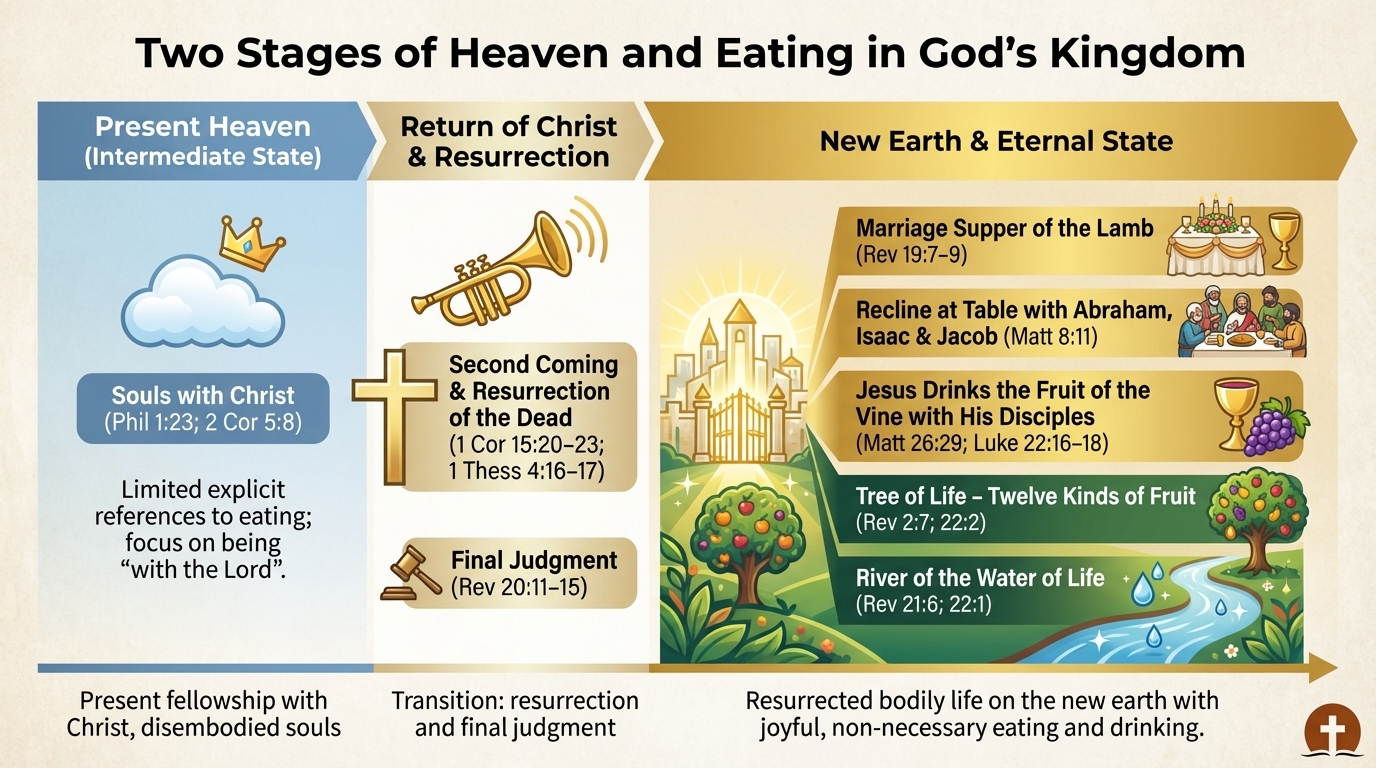
- Christ’s resurrection body, which is the pattern for our resurrection bodies (1 Cor 15:49; Phil 3:20–21; 1 John 3:2),
- The coming kingdom and marriage supper of the Lamb (Matt 8:11; 26:29; Luke 22:16–18; Rev 19:7–9),
- The tree of life and the river of the water of life in the New Jerusalem (Rev 22:1–2).
So, when we ask whether we will eat and drink in heaven, we are mainly asking about life in glorified bodies on the new earth—though some implications also touch the present heaven.
3. Glorified Bodies and the Ability to Eat and Drink
A crucial biblical foundation is the nature of Christ’s resurrection body, because believers will be “conformed to the image of his Son” (Rom 8:29) and will have bodies “like his glorious body” (Phil 3:21).
3.1 Jesus Ate and Drank after His Resurrection
After He rose from the dead, Jesus deliberately ate in the presence of His disciples:
“And while they still disbelieved for joy and were marveling, he said to them, ‘Have you anything here to eat?’ They gave him a piece of broiled fish, and he took it and ate before them.”
— Luke 24:41–43
On another occasion, by the Sea of Galilee:
“Jesus said to them, ‘Come and have breakfast.’ … Jesus came and took the bread and gave it to them, and so with the fish.”
— John 21:12–13
These passages are central for eschatology because:
- They show that a glorified, immortal body can take food and eat in a real, physical sense.
- Jesus’ eating was not for survival or to stave off weakness; it was demonstrative and communal—a sign of real bodily life and fellowship.
A concise summary of this theological point is:
| Fact about Resurrection Bodies | Scriptural Basis |
|---|---|
| Our bodies will be like Christ’s glorified body | Phil 3:20–21; 1 John 3:2 |
| Christ’s glorified body ate physical food | Luke 24:41–43; John 21:12–13 |
| Therefore glorified bodies permit eating | Derived implication |
This strongly supports the conclusion that resurrected believers will be able to eat and drink.
3.2 Resurrection Bodies Do Not Need Food to Sustain Life
At the same time, Scripture emphasizes that resurrection bodies are:
- Incorruptible and immortal (1 Cor 15:42–53),
- No longer subject to death (Luke 20:35–36),
- Free from the curse, pain, and decay (Rev 21:4; 22:3).
This implies that eating and drinking will not be necessary to preserve life, as it is now. Food in heaven will be for delight, fellowship, and worship, not for survival.
4. Feasting in the Kingdom: Biblical Pictures of Eating and Drinking in Heaven
Several key texts speak explicitly of future eating and drinking in God’s kingdom. These provide direct evidence that there will be meals in the age to come, especially in the fullness of the kingdom and on the new earth.
4.1 The Marriage Supper of the Lamb
Revelation 19:7–9 describes a climactic wedding feast:
“Blessed are those who are invited to the marriage supper of the Lamb.”
— Rev 19:9
The imagery clearly evokes a banquet—a shared meal marking the consummation of Christ’s union with His people. While some theologians stress symbolic aspects, the language of “supper,” “invited,” and “blessed are those who are invited” fits the consistent biblical pattern of real feasting in God’s kingdom (cf. Isa 25:6).
4.2 Jesus’ Promise to Eat and Drink Again with His Disciples
At the Last Supper, Jesus linked the Lord’s Supper to a future table fellowship in the kingdom:
“I tell you I will not drink again of this fruit of the vine until that day when I drink it new with you in my Father’s kingdom.”
— Matt 26:29
“For I tell you that from now on I will not drink of the fruit of the vine until the kingdom of God comes.”
— Luke 22:18
These are explicit statements that:
- Jesus Himself will drink the fruit of the vine (wine) again,
- He will do so “with you”—with His disciples—
- This will occur “in my Father’s kingdom” when it has come in fullness.
This points strongly to actual shared drinking in the future kingdom.
4.3 Sitting at Table with Abraham, Isaac, and Jacob
Jesus also says:
“I tell you, many will come from east and west and recline at table with Abraham, Isaac, and Jacob in the kingdom of heaven.”
— Matt 8:11
“Reclining at table” is the posture of a banquet. This anticipates a real, corporate meal of the redeemed with the patriarchs in the consummated kingdom.
4.4 The Tree of Life and the Fruits of the New Jerusalem
In the eternal state, after the new heaven and new earth are created, John sees:
“Through the middle of the street of the city; also, on either side of the river, the tree of life with its twelve kinds of fruit, yielding its fruit each month.”
— Rev 22:2
Believers are explicitly promised access to this fruit:
“To the one who conquers I will grant to eat of the tree of life, which is in the paradise of God.”
— Rev 2:7
Several observations follow:
- The tree of life bears fruit in the New Jerusalem,
- The fruit is explicitly to be eaten (“I will grant to eat”),
- This is part of paradise restored; what was lost in Eden is regained and surpassed (Gen 2–3; Rev 22:1–5).
Thus, eating in the eternal state on the new earth is not merely symbolic; it is part of the promised blessing.
4.5 The River of the Water of Life
John also sees:
“The river of the water of life, bright as crystal, flowing from the throne of God and of the Lamb.”
— Rev 22:1
Elsewhere the Lord says:
“To the thirsty I will give from the spring of the water of life without payment.”
— Rev 21:6
This water of life has a profoundly spiritual dimension (eternal life, satisfaction in God), yet the imagery of drinking is consistent. Just as with the tree of life, there appears to be a physical, life-enhancing enjoyment of what God provides, even though there is no threat of death or deprivation.
5. “They Shall Hunger No More”: How “No Hunger or Thirst” Fits
A central text sometimes raised against the idea of eating and drinking in heaven is:
“They shall hunger no more, neither thirst anymore.”
— Rev 7:16
How can Scripture promise no hunger or thirst and yet speak of banquets, wine, and fruit in God’s future kingdom?
5.1 The End of Need, Not the End of Enjoyment
The context of Revelation 7:16–17 clarifies the point:
“They shall hunger no more, neither thirst anymore; the sun shall not strike them, nor any scorching heat. For the Lamb in the midst of the throne will be their shepherd, and he will guide them to springs of living water.”
The emphasis is on the end of suffering, deprivation, and danger. To say “no more hunger” in this context means:
- No more lack of food,
- No more physical misery,
- No more threat of death through famine or thirst.
This is perfectly compatible with eating and drinking as celebration and fellowship. Just as we might say today that “I’ll never be hungry again” after escaping poverty—meaning not that we will never eat, but that we will never lack—so the promise in Revelation 7 means the end of all unsatisfied need, not the abolition of all eating.
5.2 Spiritual Fulness in Christ
The imagery also points to total spiritual satisfaction in Christ. Jesus is the bread of life (John 6:35) and the source of living water (John 4:14; 7:37–39). In heaven, there will be:
- No spiritual emptiness,
- No unsatisfied longing for God,
- No distance from His presence (Rev 21:3; 22:4).
Feasting imagery and the promise of no hunger or thirst work together: our deepest hunger and thirst—for God Himself—will be fully and eternally satisfied. Within that perfect satisfaction, bodily eating and drinking will express joy, fellowship, and worship, not need.
6. The Purpose of Eating and Drinking in Heaven
Putting the biblical data together, we can answer the question “Will we eat and drink in heaven?” along three crucial lines.
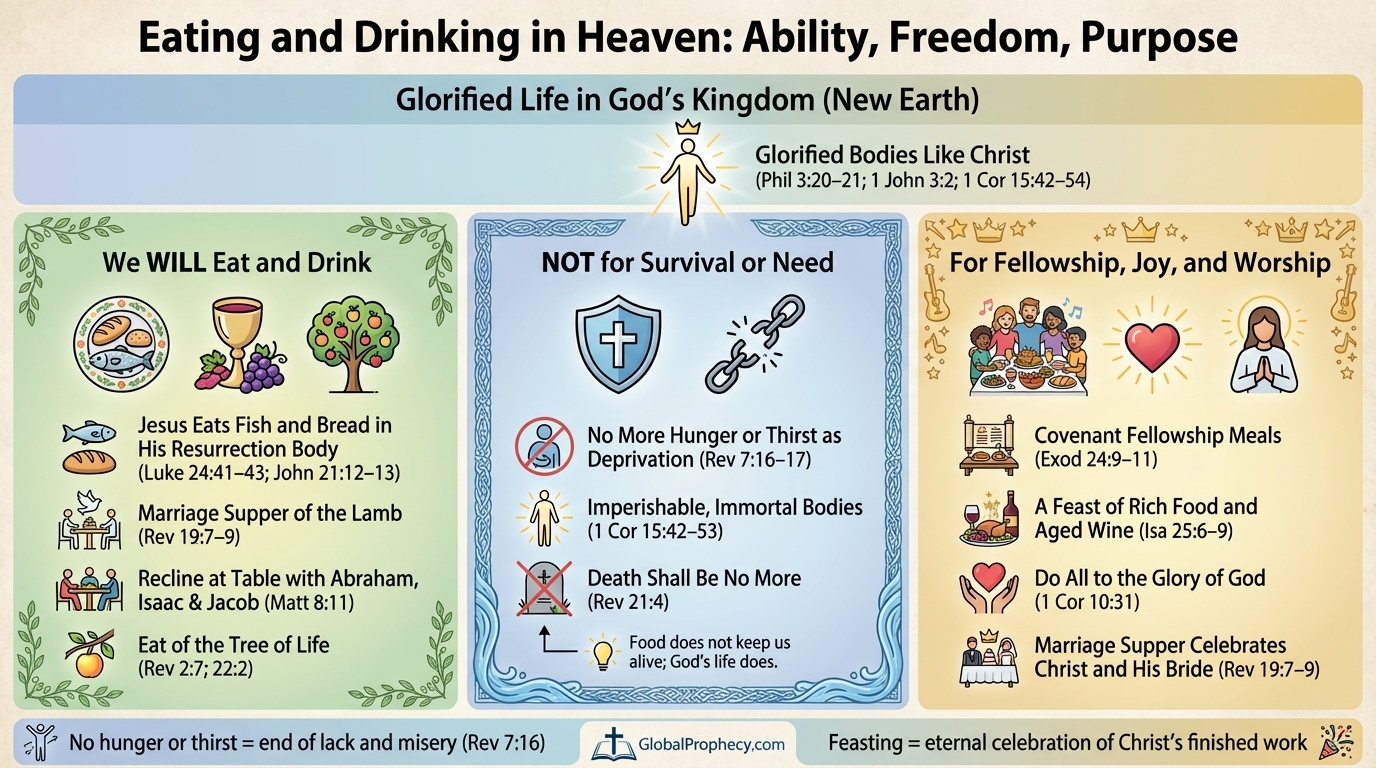
6.1 Yes, Scripture Indicates We Will Be Able to Eat and Drink
- Jesus’ resurrection meals show that glorified bodies can eat real food (Luke 24:41–43; John 21:12–13).
- Jesus promises to drink the fruit of the vine with His disciples in the kingdom (Matt 26:29; Luke 22:18).
- Believers will recline at table with Abraham, Isaac, and Jacob in the kingdom (Matt 8:11).
- The redeemed are invited to the marriage supper of the Lamb (Rev 19:7–9).
- Overcomers are explicitly granted to eat of the tree of life, whose fruit grows in the New Jerusalem (Rev 2:7; 22:2).
Taken together, these passages strongly support the conclusion that eating and drinking will be part of life in heaven, especially in the resurrection on the new earth.
6.2 We Will Not Eat and Drink Out of Necessity
However, the mode of eating and drinking will be transformed:
- No hunger from lack,
- No thirst from deprivation,
- No weakness, aging, or death that requires caloric maintenance.
Our glorified bodies will be indestructible, and “death shall be no more” (Rev 21:4; 1 Cor 15:54–55). Thus, while food and drink will be real, their function will be expressive rather than preservative.
6.3 Eating and Drinking Will Express Fellowship, Joy, and Worship
In Scripture, shared meals often signify:
- Covenant fellowship (e.g., Exod 24:9–11),
- Celebration and joy (Isa 25:6–9),
- Thanksgiving to God (Deut 12:7; 1 Cor 10:31).
In heaven and on the new earth, eating and drinking will:
- Celebrate the finished work of Christ,
- Manifest our unity as the people of God,
- Express delight in God’s goodness in a fully restored creation.
In this way, the marriage supper of the Lamb, the fruit of the tree of life, and the river of the water of life all testify that the future kingdom is deeply embodied and richly enjoyable—yet without sin, suffering, or lack.
7. Conclusion
Bringing the biblical testimony together, we can answer the question “Will we eat and drink in heaven?” as follows:
- Yes, believers in glorified bodies will be able to eat and drink in the future kingdom and on the new earth, following the pattern of the risen Christ and the promises of Scripture.
- No, we will not experience hunger or thirst in the sense of deprivation, danger, or unfulfilled need; those miseries belong to the old order that has passed away.
- Eating and drinking in heaven will be a gift of God’s goodness, expressing fellowship, joy, and worship in a renewed creation where God dwells with His people and where the curse is no more.
Thus, biblical eschatology presents not a vague, disembodied eternity, but a real, resurrected life in which food, drink, and feasting magnify Christ’s glory and our everlasting satisfaction in Him.
FAQ
Q: Will we literally eat food in heaven, or is it only symbolic language?
Scripture strongly points to literal eating in the age to come. Jesus ate fish and bread in His resurrection body (Luke 24:41–43; John 21:12–13), promises to drink the fruit of the vine with His disciples in the kingdom (Matt 26:29), and invites believers to the marriage supper of the Lamb (Rev 19:9). While these events also carry symbolic meaning, they are rooted in real, physical meals.
Q: If we will eat and drink in heaven, how can the Bible say we will “hunger no more” and “thirst no more”?
Revelation 7:16 promises the end of deprivation and suffering, not the end of all eating. “No more hunger” means there will be no lack of food, no misery, and no danger from hunger or thirst. Eating and drinking in heaven will be an overflow of joy and fellowship, not a necessity for survival.
Q: Will the tree of life in the New Jerusalem provide actual fruit for believers to eat?
Yes. Jesus says, “To the one who conquers I will grant to eat of the tree of life” (Rev 2:7), and John describes it as bearing “twelve kinds of fruit” (Rev 22:2). These statements indicate a real participation in what the tree provides, symbolizing and conveying the fullness of eternal life in the presence of God.
Q: Will eating and drinking in heaven involve animal sacrifice or meat, or only plant-based foods?
Scripture does not give a full menu of heavenly food. It does speak of fish in Christ’s resurrection meals (Luke 24; John 21) and of fruit from the tree of life (Rev 22:2). There is no explicit teaching on animal death in the eternal state; what is clear is that death itself is abolished (Rev 21:4; 1 Cor 15:26). Therefore, it is safest to affirm the reality of eating, while leaving the exact nature of heavenly foods to God’s wise design.
Q: Is food in heaven necessary to keep our resurrection bodies alive?
No. Resurrection bodies are described as imperishable, immortal, and powerful (1 Cor 15:42–54). They do not depend on food to avoid decay or death. Food and drink in heaven will be expressions of joy, communion, and worship, not means of biological survival.
Frequently Asked Questions
Will we literally eat food in heaven, or is it only symbolic language?
If we will eat and drink in heaven, how can the Bible say we will “hunger no more” and “thirst no more”?
Will the tree of life in the New Jerusalem provide actual fruit for believers to eat?
Will eating and drinking in heaven involve animal sacrifice or meat, or only plant-based foods?
Is food in heaven necessary to keep our resurrection bodies alive?
L. A. C.
Theologian specializing in eschatology, committed to helping believers understand God's prophetic Word.
Related Articles
What Is Heaven?
Heaven in the Bible: explore what heaven is, the three heavens Scripture describes, and what eternal life with God means for believers.
Heaven vs Hell: The Great Contrast
Heaven vs hell: explore the great contrast between eternal life and eternal punishment, highlighting destiny, judgment, joy, and separation from God.
Will We Know Each Other in Heaven?
Will we know each other in heaven? Explore biblical evidence for personal recognition, enduring relationships, and perfected fellowship in eternity.
The New Jerusalem
New Jerusalem, the eternal dwelling place of believers, revealed in Revelation 21–22: explore its glory, structure, and promise of life with God.