
Will We Know Each Other in Heaven?
1. Introduction
Few questions about biblical eschatology are as personal as this one: Will we know each other in heaven?
When believers think about the eternal state—the new heaven, new earth, and New Jerusalem—they naturally ask whether recognition and relationships will continue.
Scripture does not devote a chapter titled “Recognition in Heaven,” yet it gives consistent evidence that personal identity, memory, and relationships endure, though gloriously transformed. This article surveys the main biblical foundations for believing that we will recognize and know one another in heaven.
2. Biblical Foundations for Recognition in Heaven
2.1. The Rich Man and Lazarus (Luke 16:19–31)
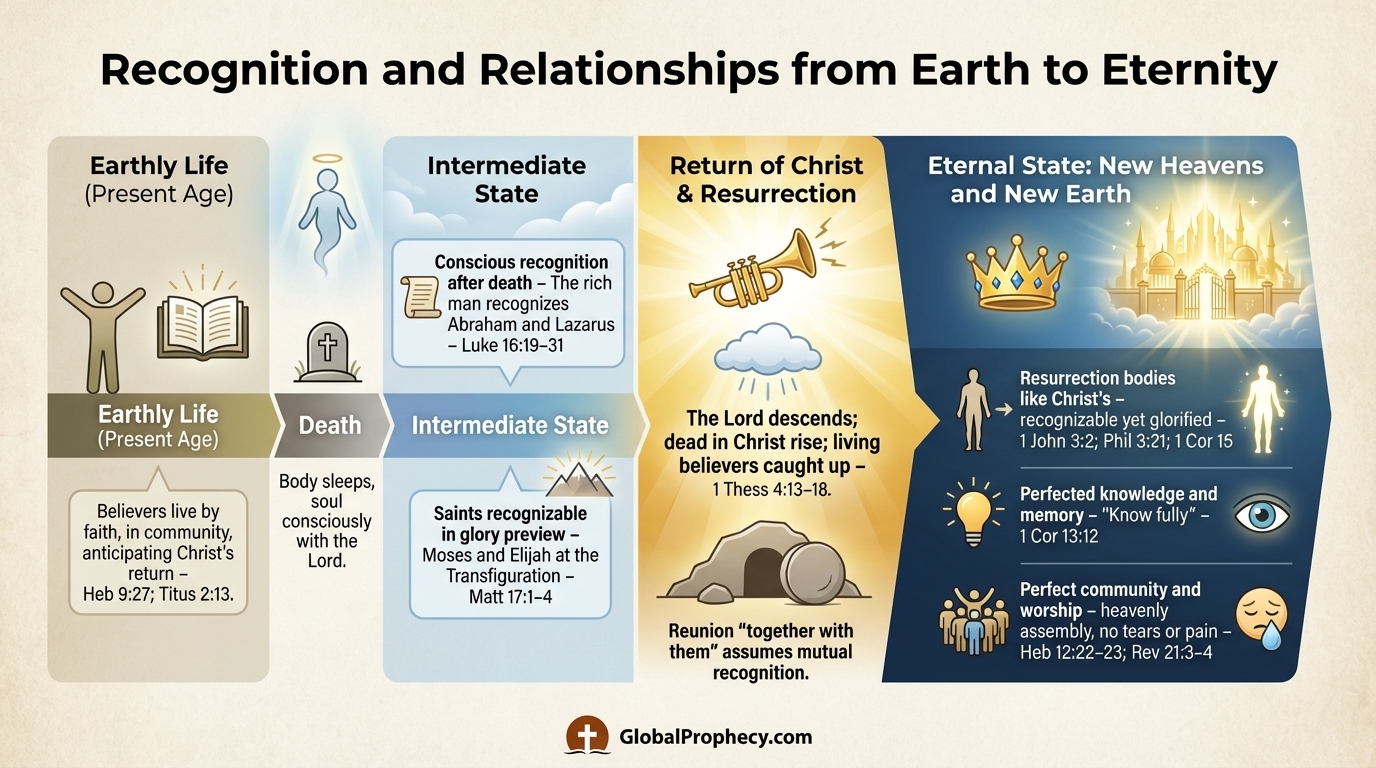
Jesus’ account of the rich man and Lazarus strongly supports conscious recognition after death.
"And in Hades, being in torment, he lifted up his eyes and saw Abraham far off and Lazarus at his side."
— Luke 16:23
Key observations:
- The rich man recognizes Lazarus by name.
- He recognizes Abraham, whom he had never met on earth.
- He remembers his five brothers still living (Luke 16:27–28).
- He retains specific memory of his earthly life.
This passage concerns the intermediate state prior to the final resurrection, yet it reveals a crucial principle: death does not erase identity, memory, or mutual recognition. If this is true before resurrection, it is certainly true in the glorified state.
2.2. The Transfiguration: Recognizing Moses and Elijah (Matthew 17:1–4)
At the Transfiguration:
"And behold, there appeared to them Moses and Elijah, talking with him."
— Matthew 17:3
Peter immediately responds:
"Lord, it is good that we are here. If you wish, I will make three tents here, one for you and one for Moses and one for Elijah."
— Matthew 17:4
Notable points:
- Peter recognizes Moses and Elijah though he had never seen them.
- No introductions are recorded; his knowledge appears intuitive and immediate.
This event previews the glory of Christ’s kingdom and shows that glorified saints retain recognizable identity and that God can grant direct knowledge of one another in the heavenly realm. It strongly implies that in heaven we will know the redeemed of all ages—not just those we knew on earth.
2.3. The Great Reunion: 1 Thessalonians 4:13–18
Paul comforts grieving believers by grounding their hope in a real reunion:
"For the Lord himself will descend from heaven… And the dead in Christ will rise first. Then we who are alive… will be caught up together with them in the clouds to meet the Lord in the air, and so we will always be with the Lord."
— 1 Thessalonians 4:16–17
The comfort rests on continued, conscious relationship:
- Believers are “together with them” (v. 17), not absorbed into an impersonal mass.
- Paul concludes:
"Therefore encourage one another with these words." (v. 18)
This encouragement presupposes that we will know those we are reunited with. A reunion without recognition would offer little comfort.
2.4. The Heavenly Assembly: Hebrews 12:22–23
The writer of Hebrews describes the present and future heavenly gathering:
"You have come to Mount Zion and to the city of the living God, the heavenly Jerusalem, and to innumerable angels in festal gathering, and to the assembly and church of the firstborn… and to the spirits of the righteous made perfect."
— Hebrews 12:22–23
Heaven is portrayed as:
- A real community (“assembly,” “church of the firstborn,” “spirits of the righteous made perfect”).
- A place of corporate worship and fellowship, not isolated, anonymous existence.
Such language makes sense only if personal distinctions and mutual knowledge remain.
3. Resurrection Bodies and Personal Identity
Biblical eschatology insists on continuity between our present selves and our resurrected selves. Recognition in heaven rests on this continuity.
3.1. A Recognizable Body
A summary of biblical teaching on our future bodies includes:
"It will be a recognizable body."
— based on John 21:7 and related texts
After His resurrection, Jesus’ body is the pattern for ours:
"We know that when he appears we shall be like him, because we shall see him as he is."
— 1 John 3:2
"[He] will transform our lowly body to be like his glorious body."
— Philippians 3:21
The Gospels show:
- The disciples recognized Jesus after the resurrection (Luke 24:36–43; John 20–21), though sometimes their recognition was delayed by spiritual factors (Luke 24:16, 31).
- His body bore marks of continuity—the wounds in His hands and side (John 20:27).
If our bodies will be “like His” and yet we will still be ourselves, then our loved ones will know us and we will know them.
3.2. Same Person, Glorified Condition
1 Corinthians 15 emphasizes both change and continuity:
- "It is sown… it is raised" (1 Cor 15:42–44). The same “it” (the person) that is buried is raised, though transformed.
- Our resurrection body is:
- Imperishable (no decay),
- Glorious,
- Powerful,
- Spiritual (Spirit-empowered, not non-physical).
Glorification does not erase identity; it perfects it. In heaven you will be fully you, without sin, weakness, or corruption. Recognition is therefore not only possible but natural.
4. Memory, Knowledge, and Emotion in Heaven
Some fear that if we remember our earthly lives, heaven could not be a place without sorrow. Scripture addresses both sides: enhanced knowledge and memory, yet no mourning or pain.
4.1. Deeper Knowing, Not Less
Paul contrasts present partial knowledge with future fullness:
"Now I know in part; then I shall know fully, even as I have been fully known."
— 1 Corinthians 13:12
This implies:
- Our capacity to know will increase, not diminish.
- We will not know less about God or each other; we will know more and better.
In heaven:
- We will remember God’s faithfulness throughout our lives.
- We will recognize fellow believers, including those we never met on earth, just as Peter recognized Moses and Elijah intuitively.
4.2. No Sorrow, Yet Real Relationships
Revelation emphasizes the complete removal of sorrow:
"He will wipe away every tear from their eyes, and death shall be no more, neither shall there be mourning, nor crying, nor pain anymore…"
— Revelation 21:4
How can this be, if we are aware of unsaved loved ones or past sins?
While Scripture does not answer every detail, several truths help:
-
Perfect understanding of God’s justice and mercy
In heaven we will see God’s ways as completely right and glorious. Our perspective will be fully aligned with His holiness and goodness. -
No guilt for forgiven sin
Our sins are fully atoned for in Christ. Glorification includes complete freedom from guilt, shame, and regret. -
Emotions perfected, not suppressed
The absence of mourning and pain does not mean emotional numbness. Rather, our emotions will be rightly ordered, responding perfectly to God and His purposes.
We therefore affirm both:
- Real memory and recognition, and
- Real freedom from sorrow and pain,
because our hearts, minds, and wills will be perfected.
5. Relationships in Heaven: Same People, Transformed Bonds
5.1. Will Earthly Relationships Still Matter?
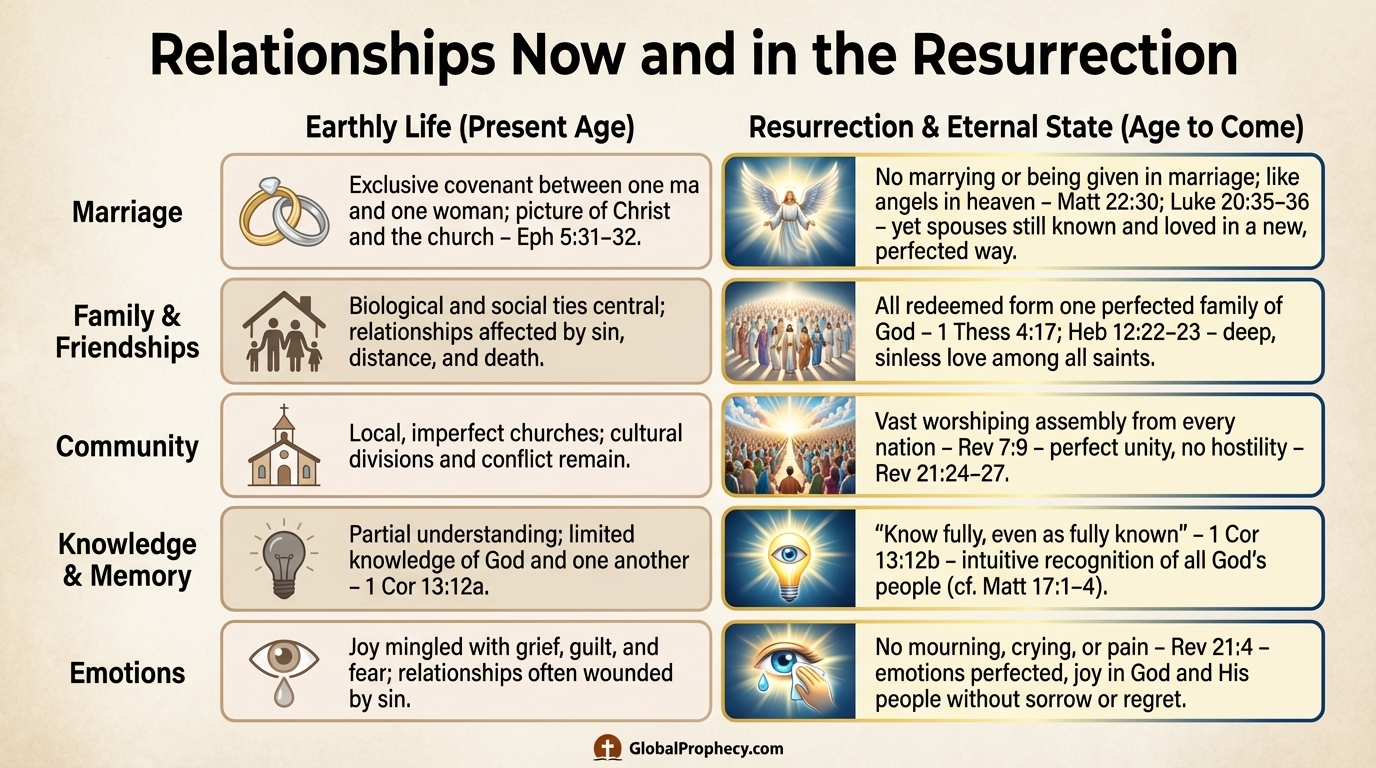
Jesus teaches that marriage as an institution does not continue in the resurrection:
"For in the resurrection they neither marry nor are given in marriage, but are like angels in heaven."
— Matthew 22:30
This does not mean:
- We will not know our spouses, parents, or children.
- Our earthly relationships are erased.
Instead it means:
- No more exclusive, covenantal marriage unions as now.
- No procreation (cf. Luke 20:35–36).
In heaven:
- You will certainly know your believing spouse, children, and friends.
- Your love for them will be purer and deeper than anything experienced on earth.
- Yet that love will be set in the context of a perfectly ordered love for Christ first, and for all the saints in unhindered fellowship.
5.2. The Communion of the Redeemed
Heaven is repeatedly pictured as a vast, conscious fellowship:
- "A great multitude that no one could number, from every nation" (Revelation 7:9).
- "The universal assembly… and to the spirits of the righteous made perfect" (Hebrews 12:22–23).
Distinctions of nation, tribe, and role remain (e.g., “nations,” “kings of the earth” in Revelation 21:24), but without sin or hostility.
Thus, our personal histories and identities are preserved, yet woven into a perfectly harmonious community. We will:
- Know those we knew,
- Meet those we never met,
- And live in eternal, joy-filled fellowship in the presence of God.
6. Why It Matters That We Will Know Each Other in Heaven
The doctrine that we will recognize and know each other in heaven is not a sentimental add-on; it is deeply biblical and pastoral.
-
Comfort in Bereavement
Paul explicitly says, “Therefore encourage one another” (1 Thess 4:18). The encouragement lies in a real reunion with recognizable believers in the presence of Christ. -
Affirmation of God’s Redemptive Purpose
God is not discarding His creation or our histories. He is redeeming them. The same God who will create a new heaven and new earth (not abolishing reality but renewing it) will also perfect, not erase, our identities and relationships. -
Motivation for Evangelism and Faithfulness
Knowing that we can share eternity with those we love should stir us to:- Proclaim the gospel clearly,
- Live faithfully before them,
- Pray earnestly for their salvation.
7. Conclusion
According to Scripture, we will indeed know each other in heaven.
- The rich man knew Lazarus and Abraham.
- Peter recognized Moses and Elijah.
- Believers are promised a reunion with “those who have fallen asleep in Christ.”
- Our resurrection bodies will be recognizable, patterned after Christ’s own.
- Our knowledge will be fuller, not diminished.
- Our relationships will be real and personal, yet purified and perfectly ordered under the supremacy of Christ.
Heaven will be a perfect community of redeemed, glorified persons—fully known, fully loved, and forever together in the presence of the triune God. This is not wishful thinking, but a hope grounded in the promises of God’s Word.
"And so we will always be with the Lord. Therefore encourage one another with these words."
— 1 Thessalonians 4:17–18
FAQ
Q: Will we recognize our loved ones in heaven?
Yes. Scripture consistently implies that believers will recognize and know one another in heaven. The rich man recognized Lazarus (Luke 16), Peter recognized Moses and Elijah (Matthew 17), and Paul comforted Christians with the promise of a real reunion with specific believers (1 Thessalonians 4:13–18). Our resurrection bodies will preserve our personal identity, making recognition natural.
Q: How can there be no sorrow in heaven if we remember people who are not there?
In heaven, our minds and emotions will be perfected. We will see God’s justice, mercy, and wisdom as completely right, and we will be fully conformed to His holiness. While Scripture affirms that we will “know fully” (1 Corinthians 13:12), it also promises that God will wipe away every tear (Revelation 21:4). Perfect understanding and perfect trust in God will remove all pain from our memories.
Q: Will our relationships be the same in heaven, especially marriage?
We will certainly know and love those who were close to us on earth, including spouses, family, and friends. However, Jesus taught that in the resurrection people “neither marry nor are given in marriage” (Matthew 22:30). Marriage as an institution will not continue, but the love between redeemed people will be deeper, purer, and more expansive, centered on Christ and shared with all of God’s family.
Q: Will we know people we never met on earth?
Yes. The Transfiguration shows Peter recognizing Moses and Elijah without prior acquaintance (Matthew 17:1–4). This suggests that in glory God can grant intuitive knowledge of other saints. In the heavenly assembly, we will know believers from “every nation, from all tribes and peoples and languages” (Revelation 7:9), sharing perfect fellowship across all ages.
Q: Does the Bible explicitly say, “We will know each other in heaven”?
The Bible does not use that exact sentence, but the combined testimony of passages like Luke 16:19–31; Matthew 17:1–4; 1 Thessalonians 4:13–18; 1 Corinthians 13:12; Hebrews 12:22–23; Revelation 7:9; 21:3–4 clearly implies continued personal identity, memory, and mutual recognition. On that basis, Christians throughout history have confidently affirmed: we will know each other in heaven.
Frequently Asked Questions
Will we recognize our loved ones in heaven?
How can there be no sorrow in heaven if we remember people who are not there?
Will our relationships be the same in heaven, especially marriage?
Will we know people we never met on earth?
Does the Bible explicitly say, “We will know each other in heaven”?
L. A. C.
Theologian specializing in eschatology, committed to helping believers understand God's prophetic Word.
Related Articles
Will We Eat and Drink in Heaven?
Will we eat and drink in heaven? Explore what Scripture reveals about dining in eternity, the marriage supper of the Lamb, and our resurrected bodies.
What Is Heaven?
Heaven in the Bible: explore what heaven is, the three heavens Scripture describes, and what eternal life with God means for believers.
Heaven vs Hell: The Great Contrast
Heaven vs hell: explore the great contrast between eternal life and eternal punishment, highlighting destiny, judgment, joy, and separation from God.
The New Jerusalem
New Jerusalem, the eternal dwelling place of believers, revealed in Revelation 21–22: explore its glory, structure, and promise of life with God.