
The Lake of Fire Explained
1. Introduction
The lake of fire stands as one of the most sobering realities presented in biblical prophecy. Described in the Book of Revelation as the final destination of the unsaved, Satan, and his demonic hosts, this eternal place of punishment represents God's ultimate justice against sin and rebellion. While many in contemporary culture prefer to ignore or reinterpret this doctrine, Scripture speaks clearly and consistently about this terrible reality.
Understanding what the Bible teaches about the lake of fire is essential for grasping the full scope of biblical eschatology and God's redemptive plan. The doctrine underscores both the seriousness of sin and the urgency of the gospel message. As we examine this difficult topic, we must approach it with reverence, recognizing that God's Word—not human sentiment—defines theological truth.
2. Biblical Terms and Definitions
The Lake of Fire Distinguished from Hades
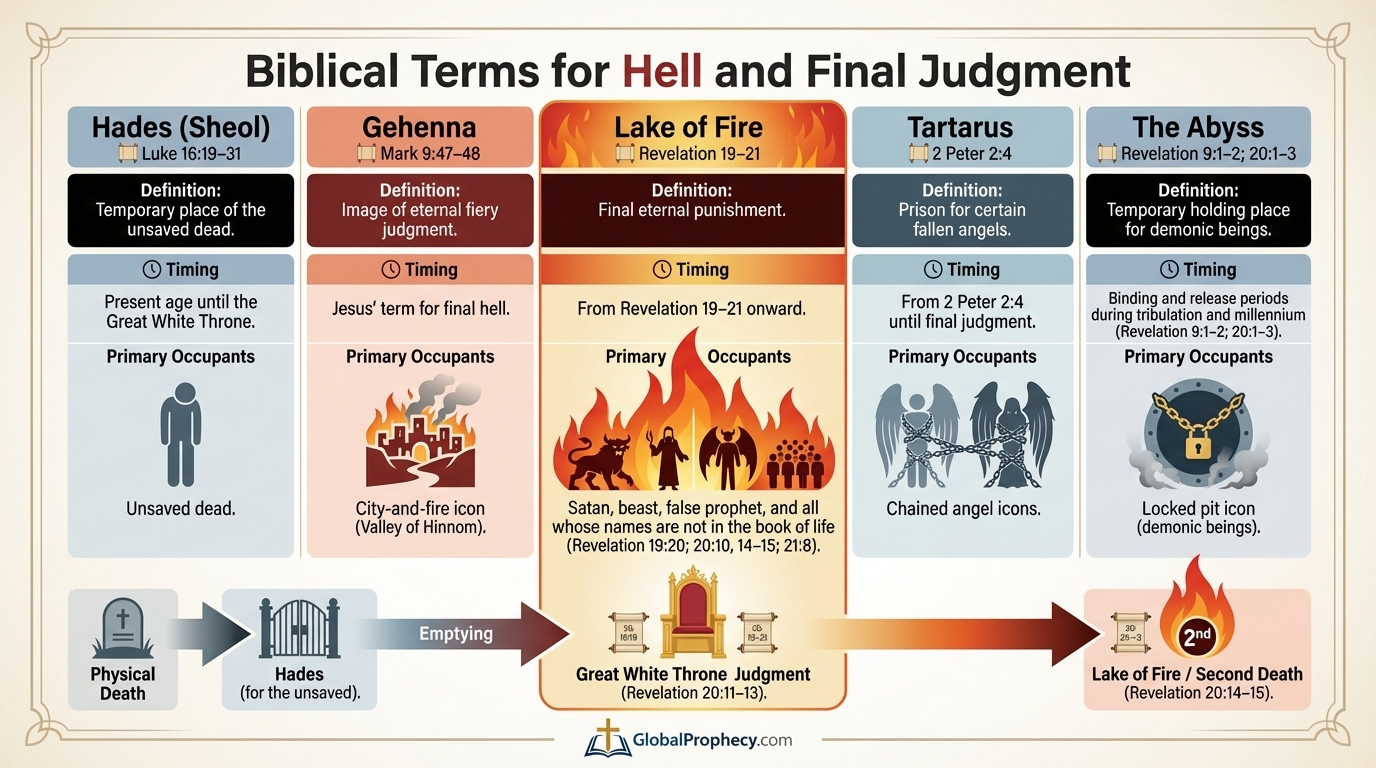
The lake of fire (Greek: limnē tou pyros) appears five times in the New Testament, exclusively in Revelation (19:20; 20:10, 14-15; 21:8). This place must be distinguished from Hades (Greek) or Sheol (Hebrew), which serves as a temporary holding place for the spirits of the unsaved dead. Luke 16:19-31 describes Hades as a place of conscious torment where the rich man experienced agony in flames while awaiting final judgment.
Currently, no one resides in the lake of fire. When unbelievers die today, they go immediately to Hades to await their final judgment at the Great White Throne (Revelation 20:11-15). Only after this judgment will they be cast into the lake of fire, their permanent place of suffering throughout eternity.
Gehenna: Jesus' Primary Term for Hell
Jesus frequently used the term Gehenna (occurring twelve times in the New Testament) to describe eternal punishment. This word derives from the Valley of Hinnom (Hebrew: Ge Hinnom), located southwest of Jerusalem. Historically, this valley served as a site of pagan child sacrifice to Molech (2 Kings 23:10; Jeremiah 32:35), causing Jeremiah to call it "the Valley of Slaughter" (Jeremiah 7:31-34).
By Jesus' time, Gehenna had become Jerusalem's garbage dump, where refuse, dead animals, and criminals' corpses burned continually. The perpetual fires and persistent worms made it an apt metaphor for eternal judgment. When Jesus warned, "It is better for you to enter the kingdom of God with one eye than to have two eyes and be thrown into hell [Gehenna], where 'their worm does not die, and the fire is not quenched'" (Mark 9:47-48), He was invoking imagery His audience clearly understood—a place of unending destruction.
Other Biblical Terms
Tartarus appears only once (2 Peter 2:4), referring to a prison where certain fallen angels are confined, awaiting final judgment. The Abyss (Greek: abyssos) functions as another holding place for demonic beings, from which they will be temporarily released during the tribulation (Revelation 9:1-2) and where Satan will be bound during the Millennium (Revelation 20:1-3).
3. The Occupants of the Lake of Fire
Satan, the Beast, and the False Prophet
Revelation 19:20 identifies the first two occupants of the lake of fire: "The beast was captured, and with him the false prophet who had performed the miraculous signs on his behalf... The two of them were thrown alive into the fiery lake of burning sulfur." These two figures, prominent during the tribulation period, will be cast into this place of torment before Christ's millennial kingdom begins.
One thousand years later, Satan himself will join them: "The devil, who deceived them, was thrown into the lake of burning sulfur, where the beast and the false prophet had been thrown. They will be tormented day and night for ever and ever" (Revelation 20:10). Significantly, the beast and false prophet will still be there after a millennium—demonstrating that the lake of fire does not annihilate its inhabitants.
Fallen Angels
Matthew 25:41 reveals that the lake of fire was "prepared for the devil and his angels." While hell was originally created for demonic beings who rebelled against God, human beings who reject Christ will share this same destiny. The fact that God prepared this place specifically for Satan's hosts underscores that it was never His intention for humanity to end up there.
Unbelieving Humanity
The most tragic occupants of the lake of fire will be unredeemed human beings. Revelation 20:15 states plainly: "If anyone's name was not found written in the book of life, he was thrown into the lake of fire." This follows the Great White Throne judgment, where the unsaved dead—from all of human history—will be resurrected, judged according to their works, and consigned to eternal punishment.
Revelation 21:8 provides a representative list of those who will suffer this fate: "The cowardly, the unbelieving, the vile, the murderers, the sexually immoral, those who practice magic arts, the idolaters and all liars—their place will be in the fiery lake of burning sulfur. This is the second death."
4. The Nature of Punishment in the Lake of Fire
Physical Torment
The rich man in Hades cried out, "Father Abraham, have mercy on me and send Lazarus to dip the tip of his finger in water and cool my tongue, because I am in agony in this flame" (Luke 16:24). This passage demonstrates that even before the final judgment, unbelievers experience conscious, physical suffering. The lake of fire will intensify this reality.
Scripture describes hell using terms like unquenchable fire (Mark 9:43-48), burning sulfur (Revelation 14:10), and eternal fire (Matthew 18:8; 25:41). Whether this fire is entirely literal or partially metaphorical, it represents real, physical torment. The resurrected bodies of the unsaved will be suited to endure eternal punishment, just as believers' resurrection bodies will be fitted for eternal glory.
Mental and Spiritual Anguish
Beyond physical suffering, hell involves profound mental torment. The rich man in Luke 16 was told to "remember" his earthly life (v. 25), suggesting that memory persists and intensifies suffering. Inhabitants of hell will recall specific occasions when they heard the gospel and rejected it, when loved ones pleaded with them, when conviction touched their hearts—yet they hardened themselves against God.
Jesus described hell as a place of "weeping and gnashing of teeth" (Matthew 13:42, 50; 22:13; 24:51; 25:30). Weeping indicates overwhelming grief and despair. Gnashing of teeth suggests rage—anger at the sin that brought them there, at what they've become, at Satan's deceptions, and at their own rejection of salvation.
Separation from God
Second Thessalonians 1:9 describes the punishment of unbelievers as "everlasting destruction and shut out from the presence of the Lord and from the majesty of his power." The essence of hell is eternal exile from God's presence, grace, and mercy. Everything good in this present life—love, beauty, joy, relationships, pleasure—ultimately derives from God's common grace. In hell, that grace is entirely removed.
Isaiah 48:22 declares, "There is no peace for the wicked." Hell offers no fulfillment, no comfort, no rest, no peace. It is a place of complete spiritual emptiness, where sinners remain "locked in" to their rebellion against God forever.
The Horrifying Reality of Outer Darkness
Jesus described hell as "outer darkness" (Matthew 8:12; 22:13; 25:30). This phrase suggests exclusion from the light and glory of God's presence. Second Peter 2:17 and Jude 13 speak of "blackest darkness" reserved for the ungodly. While hell involves fire, it is also characterized by darkness—perhaps indicating a literal absence of light, intensifying the horror and isolation.
5. The Eternal Duration of Hell
The Meaning of "Eternal"
The Greek word aiōnios (eternal, everlasting) is used throughout the New Testament to describe both the duration of heavenly bliss and hellish punishment. Matthew 25:46 creates an explicit parallel: "Then they will go away to eternal punishment, but the righteous to eternal life." The same word describes both destinies. If heaven is endless, so is hell.
Romans 16:26 uses aiōnios to describe God Himself as "the eternal God." Hebrews 9:14 speaks of "the eternal Spirit." If this word means "everlasting" when applied to God, it must mean the same when applied to punishment. The biblical concept of aiōnios is consistently used of entities and conditions that are unmistakably eternal.
"Forever and Ever"
Revelation uses an even stronger phrase: eis tous aiōnas tōn aiōnōn ("forever and ever" or "unto the ages of ages"). This intensified expression appears in descriptions of both God's eternal nature and hell's duration. Revelation 14:11 states of those who worship the beast: "The smoke of their torment rises for ever and ever. There is no rest day or night."
Revelation 20:10 applies this same phrase to Satan, the beast, and the false prophet: "They will be tormented day and night for ever and ever." The language could hardly be more explicit. The punishment is unending, with no possibility of reprieve, annihilation, or eventual salvation.
Biblical Warnings Assume Eternality
Jesus repeatedly warned of eternal consequences, emphasizing that hell must be avoided at all costs—even if it meant cutting off a hand or plucking out an eye (Matthew 5:29-30; 18:8-9). Such extreme language makes sense only if hell is truly eternal. If punishment eventually ended or led to annihilation, these warnings would be dramatically overstated.
Hebrews 9:27 teaches, "Man is destined to die once, and after that to face judgment." There is no second chance after death, no opportunity for postmortem repentance, no purgatorial purging that leads to heaven. The judgment is final, and its consequences are eternal.
6. Degrees of Punishment
Different Levels of Accountability
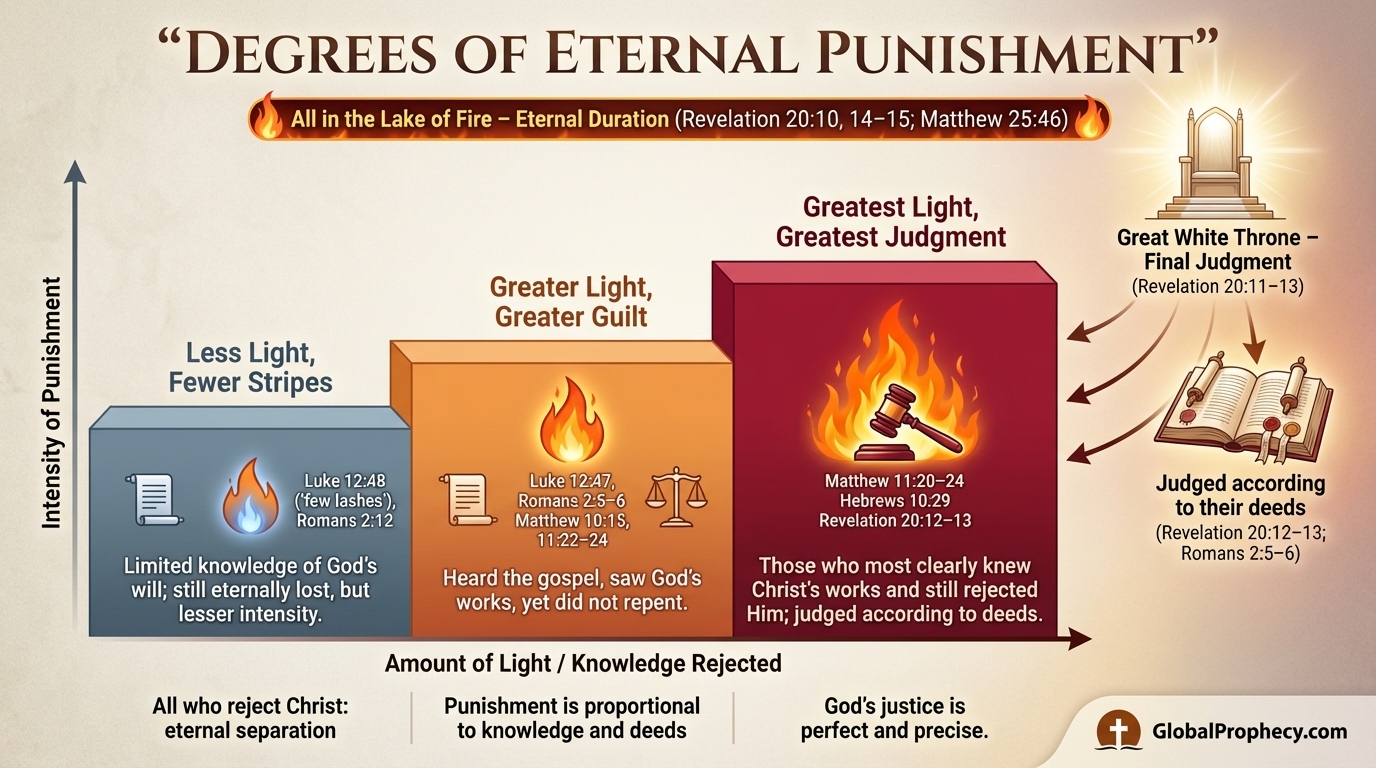
While all who reject Christ will suffer eternally in hell, Scripture indicates varying degrees or intensities of punishment based on knowledge received and sins committed. Jesus declared: "That servant who knew his master's will and did not get ready or act in accord with his will, will receive many lashes, but the one who did not know it, and committed deeds worthy of a flogging, will receive but few" (Luke 12:47-48).
This principle of proportional judgment appears throughout Scripture. Jesus pronounced severe woe upon Chorazin, Bethsaida, and Capernaum because they witnessed His miracles yet refused to repent: "It will be more tolerable for Tyre and Sidon in the day of judgment than for you" (Matthew 11:22). Similarly, He stated it would be "more tolerable" for Sodom and Gomorrah than for cities that rejected His disciples (Matthew 10:15).
Judgment According to Works
Revelation 20:12-13 describes the Great White Throne judgment: "The dead were judged according to what they had done as recorded in the books." Romans 2:5-6 warns that those with unrepentant hearts are "storing up wrath for yourself in the day of wrath and revelation of the righteous judgment of God, who will render to each person according to his deeds."
These passages suggest that while all unsaved people will experience eternal separation from God, the intensity of their suffering will vary based on their earthly deeds. The unbeliever who lived a relatively moral life will still be lost forever, but may suffer less intensely than a Hitler or Stalin. God's justice is both perfect and precise.
7. Objections and Biblical Responses
"How Can a Loving God Send People to Hell?"
This common objection misunderstands both God's nature and human responsibility. God is indeed love (1 John 4:8), but He is also holy (Isaiah 6:3), righteous (Psalm 119:137), and just (Deuteronomy 32:4). His love does not negate His justice; both are essential to His character.
Furthermore, God does not "send" people to hell against their will. C.S. Lewis observed that sin is humanity saying to God throughout life, "Leave me alone." Hell is God finally honoring that choice, saying, "Your will be done." God has provided salvation through Christ (John 3:16), sent His Spirit to convict of sin (John 16:8), and desires all to be saved (1 Timothy 2:4; 2 Peter 3:9). Those who end up in hell do so by persistently rejecting God's gracious offer of salvation.
"Isn't Eternal Punishment for Finite Sins Unjust?"
The severity of any crime depends partly on the dignity of the person against whom it is committed. A child striking another child is one matter; that same child striking a parent is more serious; striking a police officer is a felony. Sin against an infinite God deserves infinite punishment.
Moreover, those in hell continue in their rebellion. They do not repent or change their nature. Hell confirms and "locks in" the sinner's choice to live in opposition to God. Jonathan Edwards argued that hell's eternality reflects the eternal nature of the God against whom sin is committed and the perpetual state of the sinner's rebellion.
"What About Annihilationism?"
Some evangelicals have advocated annihilationism (or conditional immortality), suggesting that the wicked will eventually cease to exist rather than suffer eternally. However, this view fails to account for several biblical realities:
First, the same word (aiōnios) describes both eternal life and eternal punishment (Matthew 25:46). If punishment is not truly eternal, neither is life. Second, passages speak of conscious, ongoing torment "day and night forever and ever" (Revelation 20:10), not extinction. Third, the language of "destruction" in Scripture (2 Thessalonians 1:9) means ruin and loss, not annihilation. A destroyed building still exists; it is simply in ruins.
Finally, the parable in Luke 16 shows the rich man in Hades conscious and suffering long after death, able to remember, reason, and feel pain. If death meant extinction, there would be no one in Hades and no future to be judged.
8. Conclusion
The doctrine of the lake of fire is undeniably difficult, yet it is firmly established in Scripture. This eternal place of punishment was prepared for Satan and fallen angels but will also be the destiny of all who reject God's gracious offer of salvation through Jesus Christ. The lake of fire is characterized by conscious, physical, and spiritual torment that continues forever without end or relief.
Rather than causing us to question God's character, the reality of hell should drive us to several responses. First, it should deepen our gratitude for Christ's sacrifice on the cross, where He bore the wrath we deserved. Second, it should create urgency in evangelism—the time to respond to God's grace is now, for after death comes judgment (Hebrews 9:27). Third, it should motivate holiness, as we recognize the seriousness with which God views sin.
The existence of the lake of fire also vindicates God's justice. A holy God cannot allow sin to go unpunished. The eternal separation of evil from good in hell makes possible the eternal preservation of good in the new heaven and new earth. Without hell, there could be no heaven where righteousness dwells.
Ultimately, the doctrine of eternal punishment highlights the glory of God's grace. That the Creator of the universe would provide a way of escape through His own Son, Jesus Christ, demonstrates love beyond comprehension. "For God so loved the world that he gave his one and only Son, that whoever believes in him shall not perish but have eternal life" (John 3:16). The door to heaven remains open—but it closes at death. Today is the day of salvation (2 Corinthians 6:2).
Pertanyaan yang Sering Diajukan
Is the lake of fire the same as hell?
Will people suffer in the lake of fire forever, or will they eventually be destroyed?
Who will be thrown into the lake of fire?
Why did God create the lake of fire if He is loving?
How can believers be happy in heaven knowing loved ones are in the lake of fire?
L. A. C.
Teolog yang mengkhususkan diri dalam eskatologi, berkomitmen untuk membantu orang percaya memahami Firman nubuatan Allah.
Artikel Terkait
Apa Itu Neraka?
Neraka adalah tempat hukuman kekal bagi orang fasik. Pelajari natur, tujuan, api kekal, dan siapa yang masuk ke dalam neraka menurut Alkitab.
Apakah Hukuman Neraka Bersifat Kekal?
Hukuman neraka kekal atau sementara? Teliti ayat-ayat Alkitab kunci, nilai pandangan alternatif, dan lihat mengapa Alkitab mengajarkan hukuman sadar yang kekal.
Annihilationisme Diuji dan Disanggah
Annihilationisme diselidiki dan disanggah dari Alkitab, membuktikan mengapa imortalitas kondisional salah dan neraka adalah hukuman sadar kekal.
Kitab-Kitab yang Dibuka pada Penghakiman Takhta Putih yang Besar
Kitab-kitab yang dibuka pada Penghakiman Takhta Putih yang Besar: kitab kehidupan, kitab perbuatan, dan catatan surgawi yang menentukan hukuman akhir.